 SOUNDTRACK: ROBIN OLSON-Tiny Desk Concert #724 (April 1, 2018).

Because the blurb is perfect, I am including it in it’s entirety.
“Not all pianists are created in equal temperament,” Robin Olson told a small but enthusiastic audience behind NPR Music’s storied Tiny Desk. The pianist, hailed as an “avant-garde gewandhaus” by Berlin’s Staubzeitung, is as celebrated for his cryptic maxims as he is for his inscrutable music.
Olson’s trademark style — shooting clusters of shimmering chords and solitary, pearlescent pitches into reverberant space — has led him to exalted concert halls and to work with a broad array of stars such as Yuja Wang, Aretha Franklin, Chick Corea and Emanuel Ax.
Drawing from the seminal Plink technique, cultivated among the Schlammstadt School of composers in the 1950s, Olson is regarded as a leading technician of the more expansive Neo-Plink style. “Intervals have coincident partials,” Olson explains. “They create a form of dissonance, called ‘beats,’ by which pitches are set for optimum harmonicity.”
From a bulging briefcase, Olson pulls out any number tools to alter specific pitches, as in his opening piece, “A 440.” He threads ribbons of felt between piano strings to mimic the muted cries of the Asian dung beetle in “The Temperament,” from his 2014 collection Infinite Chasms.
Olson surprised everyone at the Tiny Desk by debuting a new piece, “Tuning the Bass,” wherein his inventive command of the instrument’s lower register highlighted spaces between keening dark octaves.
He may be considered a challenging artist, but Olson, through the essential humanity of his performance, reveals the efforts of almost any other living pianist to be little more than a joke.
Set List
- “A 440”
- “The Temperament”
- “Tuning the Bass”
I only wish I had seen this before the Editor’s Note revealed that it was an (excellent) April Fool’s joke.
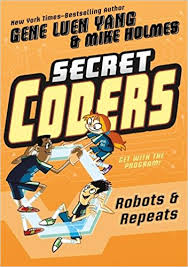
[READ: December 27, 2017] Secret Coders: Robots & Repeats
Secret Coders 3 ended with a puzzle. And I guessed wrong! How embarrassing. I see what I did wrong, but I still would have failed. I have a hard time with binary, too.
Anyhow, this book reveals some pretty amazing details about the ongoing story.
After selecting the correct door, the gang finds a floating triangle thing. We learn that Professor Bee is not actually from this planet (okay now things are getting pretty weird, I must admit). But he dismisses that (what??) so the kids can code some more using a construct made of “solidified light” which is pretty cool, although perhaps not as cool as an alien.
The kids use the repeat function to save Dr Bee, but despite all of their good deeds, Eni’s mother does not want him hanging out with the other two, specifically that Hopper girl (turns out his nasty sisters have ratted on him).
Of course he doesn’t stop hanging out at school–even though his sisters spy on him.
But during the assembly where they are sitting together, Dr One-Zero comes in and announces that all classes will be shortened by half and they will all do advanced chemistry the rest of the time (which basically just means making that green pop that we saw in the last book.
The gang finds out how useful a repeat command is, especially if you nest them.
And their code opens yet another secret room. This one is One-Zero’s conference room and they see a map with a binary code on it. But before they can do any more, the triplets drag professor One-Zero in he literally tells them they can’t hang out with each other anymore. So they don;t…in school
But they can still work after school. They do a big binary puzzle and then Eni shows them the ASCII Table that converts numbers into letters
Their path leads them to an old school arcade where they are set upon by adorable little green ducks–with rows and rows of teeth!
Gasp!
I was sure this series would end with four books, but now I have no idea how many books there will be. But the story is getting so crazy that I’m really looking forward to the rest.

 I Just Read About That...
Leave a comment