
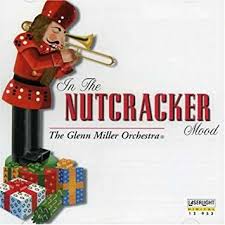
 SOUNDTRACK: THE GLENN MILLER ORCHESTRA-In The Nutcracker Mood (2012).
Glenn Miller disappeared just before Christmas on December 15, 1944. His Orchestra, in the too-short run under his personal leadership, had officially recorded only one Christmas song (“Jingle Bells”, October 20, 1941).
Year later, the orchestra has recorded three Christmas albums.
A list of desirable players was compiled. There were a few requisites — musicians had to be working currently; only alumni of the Glenn Miller Orchestra would be recruited; each individual had to have recognized and outstanding talent; each veteran had to be able to take a leave-of-absence from his current “gig”; and, of course, be available to come to New York City to record. The average age of this band is about 50. The length of time each player performed with the Glenn Miller Orchestra ranges from as little as 6 months to well over 10 years. The cumulative experience of this band recreating the authentic Miller “sound” is well over 100 years!
The first recording, “In The Christmas Mood”, was released in 1991. It was so successful that a second recording, “In The Christmas Mood II,” was produced and later released in 1993.
Almost all of the musicians performing on all three of these recordings, are the same. The only differences are the pianist for the first recording, and trombonist, Larry O’Brien, the then leader of the Glenn Miller Orchestra, was unable to make the second recording due to being on tour. Larry is noticeably back on this recording as evidenced by his beautiful trombone solo on Toyland.
My parents loved Glenn Miller and I grew up listening to him. So when I saw this, I knew I had to get it–combining Glenn and the Nutcracker!
“Miniature Overture” a fun overture that puts the swing in things.
“March” I don’t know if Brian Setzer put the swing into this song before they did, but it has Glenn all over it.
“Dance of the Fairy Dragee” doesn’t differ too much for the original at least until the middle when the jazzy drums kick in. The end totally swings.
“Russian Dance” fast and peppy and wonderful with a big band flourish at the end.
“Arabian Dance” I love that the more Arabian sound comes from a muted trumpet.
“Chinese Dance” There’s some extra big band solos thrown into this one–cheating a bit I think.
“Dance of the Mirlitons” Some nice swinging in this dance too of course.
“Waltz of the Flowers” This song is usually pretty sedate, but they big up the band. The main part is still a pretty waltz, though.
“Jolly Old St. Nicholas” The band’s singers enter on this song. I have to admit I never really liked the Miller songs with words. But this sounds pretty accurate to me.
“Toyland” A slow romantic ballad that I don;t recognize from elsewhere. I could see Lawrence Welk and his bubbles doing this song.
“Ode to Joy” You don’t hear jazzy versions of this too often, but they have the Glenn Miller sound perfectly for this swinging Classic.
“A String of Carols; Here We Come a-Caroling, Up On the House Top, a Child Is Born in Bethlehem, Deck the Halls” The swingers are back with this nice medley of carols.
“Parade of the Wooden Soldiers” I love that they threw in a few bars of In the Mood into this song.
“Old Fashioned Christmas Tree” and “March of the Toys” I’m not sure if they are from something or just goo old swinging fun.
“What Are You Doing New Year’s Eve?” returns the vocals to the end of the disc. I fitting end for the Christmas holiday.
The Glenn Miller Orchestra:
Saxes: Ralph Olson Lead Clarinet, Alto Saxophone & Flute; Lee Lachman Clarinet, Alto Saxophone & Piccolo; Mark Vinci Clarinet & Tenor Saxophone; Frank Perowsky Clarinet & Tenor Saxophone; Richy Barz Bass Clarinet, Alto Saxophone, Baritone Saxophone
Trumpets: Tom Snelson; Ken Brader; John Hoffman; Dale Thompson
Trombones: Larry O’Brien; Eric Culver; Randy Purcell; Dennis Good
Piano: Tony Monte
Bass: Lanny Fields
Guitar: Jay Patten
Drums: Danny D’Imperio
The Moonlight Serenaders: Annette Sanders, Arlene Martell, Al Dana, Paul Evans, Kevin DiSimone
[READ: April 25, 2017] The Art of Wordless Storytelling
This book is a companion to an exhibition of Wiesner’s art at the Santa Barbara Museum of Art.
Wiesner has created some of the most beautiful children’s pictures books ever. And most of them have no words at all. His books include Free Fall (1988), Hurricane (1992), Tuesday (1991), June 29, 1999 (1992), Sector 7 (1999), The Three Pigs (2001), Flotsam (2006), Art & Max (2010), Mr Wuffles! (2013) and Fish Girl (2016).
This book taught me that all of his art is done in watercolor and done in such a way that he adds layer upon layer of color to create intense depth of color and shade–I’d always known his art was great but had no idea why. But then I read that when most books are created they print all of the colors at the same time, effectively muting his work. So all of the subtlety in his work is lost when it comes out in book form. His original drawings and paintings sound breathtaking.
In addition to seventy some plates of paintings, this book contains a few essays and Q&A with Wiesner.
The introduction is by Eik Kahng and while informative, it is pretty dry. And, lest we forget, it was written for the art exhibition, not necessarily for this book. But it does give some insight into Wiesner’s influences: Salvador Dali, Charles Sheeler, Joseph Stella.
Far more interesting is the Q&A with Kahng, Ellen Keitner and Wiesner. It’s amusing just how long-winded Wiesner seems, given that he doesn’t include words in his books.
They ask him why he chose books as opposed to other media and he says that when he was young he was inspired by comic books and he always wanted to create something that he could hold in hid hands like that. Some other inspirations: Moebius, Max Ernst and Lynn Ward.
He talks about his process–pencil drawings (he likes to be able to see the pencil when he is done). And lately he has been making 3-D models of his characters to better realize them–a photograph is no substitute. He also talks about the thrill of watercolor–how it is so spontaneous and how it doesn’t allow for massaging the work. He says he enjoys looking at watercolor sketches of oil painting because of their beauty and spontaneity
They ask if he had ever wanted to make films instead of books. He talks about his app Spot, which sounds kind of fun. He says he never felt that he could have made a dent in his own storytelling if he went to traditional film route–studio productions and whatnot. He also says how much he loves Hayao Miyazaki. But he does like to use film techniques in his layout–jump cuts and close-ups and even the way the Three Pigs break the boundaries of books.
Katherine Roeder’s essay is also pretty academic, but it also works a useful guide to his books.
We learn that he did many collaborations before creating his first book. Free Fall was his first solo book and his first Caldecott win. It features a boy in bed who goes on a long dream journey only to return to bed with the dream possibly being real.
Hurricane is the only book I don’t know (and there is actually text in it).
Tuesday and June 29,1999 are similar in their surrealist nature. In Tuesday an army of frogs flies across the landscape–an invasion or a prank? And in June 29, 1999 a girl believes that her joke of sending fruits and vegetables floating in the sky might be responsible for the subsequent arrival of overly large food in the sky.
Sector 7 is another great story about cities and clouds–and the clouds within cities being assigned the shapes they will make.
The Three Pigs was Wiesner’s second Caldecott award. It is not exactly a telling of the Three Little Pigs, but rather an inversion of sorts. The pigs break from the story and enter different stories, with Wiesner having them take on the appearance of the stories they enter.
Flotsam won his third Caldecott and it is my favorite. A boy finds a camera on the beach. It looks ancient and is covered in barnacles. He gets the film developed and find incredible undersea scenery–wonderful and fantastical. He realizes that it is his turn to continue the saga. It’s really breathtaking.
In Art & Max he plays with the conventions of storytelling and art, enjoying dissembling and deconstructing the way art is done. It’s fun and clever and quite different from his other books.
Mr Wuffles is an amusing story. A cat (the same cat that we’ve seen in previous books I believe) is investigating a new toy. But the toy proves to be an alien spaceship. The aliens flee but they are welcomed by the other creatures that the cat tortures–and they make a plan to work together. It’s fun and clever.
Fish Girl was his first full-scale comic book and I have posted about it. It is a very clever story–quite different from his other stories because of the size and the full use of words. But the art is unmistakably his.
And then come the plates of his work.
They date back to 1978 with his earliest works are mostly cityscapes with fish images intertwined. After some magazine covers and a few other prints from the early 80s we jump all the way to 1988’s Free Fall. And this is where you can see that this book really lets us see the beauty of his work in a way that his children’s books simply don’t. The subtlety and gradients are present here . I also love seeing how his people look more or less he same as they always do.
There’s scenes from Hurricane (which contain more fish and a black and white cat).
There’s several pages from Tuesday–the astonished frogs and floating pigs. As well as scenes from June 29,1099 and the girl letting her experiments float out the window. The revelation of the giants foods is similar to Magritte’s men floating in the sky .
It’s amazing that Sector 7 was a full 7 years later and a the color are just amazing.
The Three Pigs shows some great examples of the pigs busting through the walls of the pages, and becoming “real.”
And then there’s the beauty of Flotsam a full five years later.
The book also includes some posters and designs from flyers as well as scenes from Art & Max and Mr Wuffles.
For those of us without the Spot app, this book offers several scenes from it–primarily ladybugs and other designs with spots on them.
And then we end with Fish Girl which was where I first noticed how much of a better production this book was than the original. The subtleties present in these paining has all been lost in the book version. (even though the book still looks great). I imagine that they’re even more amazing in person.
Since Wiesner’s books are all readily available, they might be easier to find than this one, but if you like his art, this a is great way to see them with more clarity (even if the pictures are technically smaller).

 I Just Read About That...
👵🏽👵🏽
Just gifted this to my Mom from the Eric Carle 🐛museum