Feeds:
Posts
Comments

Archive for August, 2017

[ATTENDED: August 3, 2017] Andrew Bird

My experience with Andrew Bird has been frustrating.  I often hear a song or story about him and I think, “I love this guy!”  Whether it’s a feature on his amazing whistling or his adventurous violin playing, I love the songs that they play.

But when I try to listen to more of his songs, I find them…okay.  Never bad, just okay.  Perhaps if I really devoted time to the songs I would learn to appreciate them more, but as it is I find them pleasant.

And this concert was much the same.  I really enjoyed a number of the songs he played (I don’t know the names of most of them), but by the end of the set, I was sort of drifting off a bit.

Before the show we met some friends who were also there.  One of them told me that he often plays solo, looping his violin and such.  He did loop the violin a number of times, but he played every song with his four piece.  And while I can’t compare something I haven’t seen, I feel like the band worked very well and made the show a bit more upbeat. (more…)

Read Full Post »

[ATTENDED: August 3, 2017] Porches

I’ve complained several times already about the trip to the Mann and while this one moved a little more smoothly, we were still pretty late.  We caught all of two songs from Porches.

I had heard of Porches when I saw that they were the opening slot for Belle & Sebastian and Andrew Bird, but I didn’t know much about them (I think I had them confused with about four other bands with similar names).

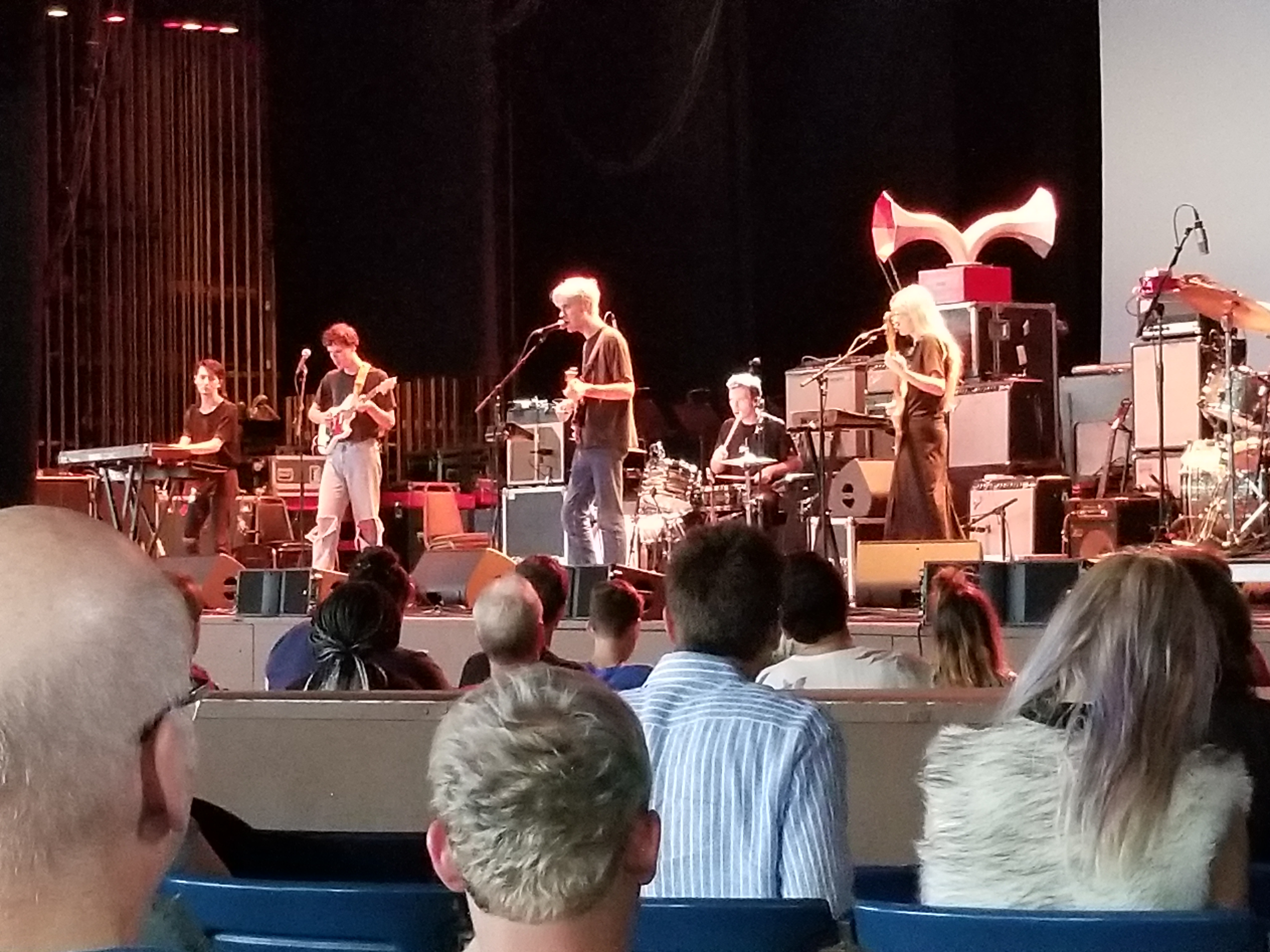
They are described as a synthpop band on Wikipedia, but as you can see from the photo, there’s more than synths. Lead Porch Aaron Maine was an amusing and engaged front man.  I enjoyed that when he introduced the final song he said, “I suppose this will be our last song,” or something else noncommittal.

(more…)

Read Full Post »

SOUNDTRACK: DIET CIG-Tiny Desk Concert #641 (August 2, 2017).

The guys at NPR have raved about Diet Cig for quite some time.  Especially their live show.  They played at a small club near me and I thought about going but I couldn’t make it.  So I was happy to hear they played a Tiny Desk so I could see what all the fuss was about.

Diet Cig is yet another duo:

with drummer Noah Bowman propelling the high kicks and constant pogo bounce of guitarist and singer Alex Luciano. With a candied voice, she sings of being on the cusp of adolescence — but underneath that bright veneer Alex sings truth to power, and about what it means to be a punk in a skirt, dealing with disrespectful souls. “I think you’re the kind of guy / who would meet me at a party / and forget my name / and try to take me home all the same,” she sings on “Sixteen.”

And while the songs do have some angst, it’s the incredibly happy infectious nature of Luciano that made me instantly fall in love with them and berate myself for not going to see them in a small club when I had the chance–I see they’re selling out shows in London now.

They play 3 songs in 9 minutes (and the last one is pretty extended because Luciano is dancing all over the place: on desks, on the drums, everywhere.  None of the songs are terribly complex, but that’s fine.  They’re charming pop punk nuggets

“Sixteen” is what gets the parental warning. Its starts off slowly:

when I was sixteen I dated a boy with my own name / it was weird in the back of his truck / moaning my own name while trying to fuck

then it picks up and Alex starts bouncing around.  And although the song is kind of sad, “I’ll never barbecue again, and you can keep all of your shitty friends” she can’t stop smiling all the way through.

“Tummy Ache” is when she really starts dancing–doing high kicks and bouncing around all while playing nonstop guitar.  The lyrics are simple but great: “I don’t need a man to hold my hand / and that’s just something you’ll never understand.”

“Harvard” is the first song they wrote.  It has the amusing chorus of  “fuck your ivy league sweater.” She bounces all over the place, climbs on the desk, steps over to the drums and plays the last chords from the bass drum.  As the final chord rings out she reaches into her fanny pack and throws confetti all over herself as she jumps down.

The set is delightful and adorable and boy, I hope when they come back to the area it’s to another small club.

[READ: August 2, 2017] “New World”

This story centers around a global event that I know nothing about.  That combined with some confusing lineage angles made this story less satisfying for me than it should have been.

The story is about the independence of Ceylon (currently Sri Lanka) from Britain.  The story presumes we will know a few details about this event (I knew none: Independence from Britain occurred in 1948, but had a convoluted history trying to attain full independence).  I assume knowing that is useful to the story.

But for our story the impact is more local.  When the new prime minister Don Senanayake spoke first in English and then in Sinhala–no one knew what he was saying–but they all heard the word Ceylon.  Sir William (no last name given) left the country on the eve of independence and he left all of his property to Mr Balakumar, the Tamil manager.

The story is written from a “we” narrator: “We didn’t see Selvakumar approach.”  The “we” are married ladies (who mustn’t be too old, although they do mention husbands at one point).  They are mostly interested in Selvakumar’s story.

This character was fascinating but slightly confusing–at one point he says of himself:  “How can an Indian bastard be prime minister?”  Selvakumar worked for Mr Balakumar, and the man often whipped the boy for doing a poor job (I loved the grotesque detail that he was beaten so hard with the sugar cane that he “smelled like brunt molasses.”

But the real conflict for Selvakumar is with a boy named Muthu.  Muthu, they said, would grow up to be like his father Mr Padmanathan who thought of himself as a big boss.  Muthu was 10 and that was the only reason his father allowed his son to have a friendship an “Indian coolie.”  Muthu would teach Selvakumar whatsoever he learned in school.  The thing that stuck with Selvakumar the most was Marco Polo and his travels.

While the village was celebrating its independence, a storm came through the village.  The rain came hard and fast and began to knock down the poorly made houses.   It flooded the ground, which turned into raging torrents.  When the rain subsided, the people slept “by the ruins of our homes.”  And yet despite the destruction, they knew that Independence would be a more lasting and powerful event for them.

As they assessed the damage, it became clear that Selvakumar was missing.  Had he been killed?  Everyone scoured he area for him.

But I found this part really confusing.  The main part of the story was full of so much detail that I was really surprised by how unstraightforward the end was.  .

This sentence, once unpacked, makes sense but reading it in context created so many visuals that I couldn’t parse it right away.

By the time we discovered the yellow-tipped butterfly on the fat corpse, Muthu’s father had rounded the hillside, dragging his son by the ear with one hand and comforting the wailing Mrs. Balakumar with the other.”

So much is going on there.

Suffice it to say that someone has died.  But something else largely unexpected has happened as well.

The end of the story sees the women imagining their future and the future of the boys in the village as well.

There was a lot going on in this story and I felt like some things came just out of the blue. It was strange how the story begin speaking of the future as one thing but then things changed dramatically after the storm.  Although apparently not because of the storm.

Read Full Post »

SOUNDTRACK: FRAGILE ROCK-Tiny Desk Concert #635 (July 14, 2017).

Fragile Rock are an emo band.  But they are not your typical emo band because they are a band of puppets.

And for just 15 minutes on a glorious spring day in Washington, D.C., National Public Radio became National Puppet Radio.

It was the real-life breakup of band leader Brently Heilborn that led to the formation of the woefully woven band Fragile Rock. But these aren’t just any puppets — no. They are emo puppets, armed with drums and guitars and glum tales to tell, with songs like “Wake Up to the Breakup” and “I Am Sad (And So Am I)” that which draw from the spastic boogie of The B-52s and the laments of The Smiths. At one point, you’ll see Fragile Rock empty a bag of “bloodied” socks, tossing them into the crowd, before breaking into the song “Socks Are Murder,” a playful take on The Smiths’ thoughtful “Meat Is Murder.”

The band consists of seven puppets (handled by 8 performers) and three actual musicians (see below for the details).  They play three punky songs.  And I wish I liked the songs a little more.  There’s something that doesn’t quite live up to the visual fun of the band.

“Wakeup To The Breakup” is a fast punk song, but the song isn’t quite as catchy as I’d like.  But I do like the spirit of the song and the amusing “crowd surfing” of Milo S.  I also enjoyed the amusing commentary afterward: “There’s so many sad breakup songs… but sometimes it’s a wonderful thing.  So if anyone came here today with someone you don’t want to leave with… that song legally counts as your conversation.”

The second song is a lot more catchy (and a bit funnier).  As an introduction, Milo says, “A lot of you don’t want us to get political on National Puppet Radio.”  But they need to speak out that “Socks are Murder.”  The lyrics are largely clever: “argyle is a lie / with every step a puppet dies.”  I rather like the way the chorus starts with him dead panning “Socks Are….”  “socks are murder!”  When the song ends, he glowers: “We don’t appreciate your laughter.”

Before the final song, Milo says “We’re very happy to be here at the legendary Tiny Desk Concert.  We’re assuming we set the bar so high this will be the last one.  So we’d like to close out the series….”  The backing puppets all look aghast: “It’s not funny!”  The song is dedicated to everyone’s dark muse, “Fairuza Balk.” It’s the catchiest of the three with great backing vocals.  I like at the end when the final line is “She was in The Craft” and the guitarist chimes in.  “And The Waterboy.  She was in The Waterboy, etc.”

And in the spirit of the day Fragile Rock managed to crowd surf a puppet bringing giggles to a crowd of reporters, editors and friends, while puppets depicting NPR hosts Susan Stamberg, Michel Martin and Robert Siegel (the latter actually received a playful kiss from none other than Nina Totenberg) — all created by NPR’s own puppet master Barry Gordemer — objectively observed.

As the video ends, you can see the puppets getting of the elevator and then sitting behind the NPR microphone.

It’s a very fun, make no mistake.  I just don’t think I’d enjoy the songs without the visuals.

  • Musicians

    Milo S. (lead vocals, handled by Brently Heilbron); Nic Hole (bass, handled by Megan Thornton); Kyle Danko (guitar, handled by Chadwick Smith); CoCo Bangs (drums; handled by Taylor Love and Luke Wallens); The Cocteau Triplets (back up vocals; handled by Emily Cawood, Kim Stacy, and Bryan Curry); Cindy Ward (bass); Ryan Hill (guitar); Jayme Ramsay (drums)

[READ: August 1, 2017] “Le Réveillon”

This excerpt comes from a 1977 untranslated novel called Livret de famille.  It was translated by .

The piece begins as we learn of the death of Fats.

The narrator was 18 when he met Fats.  He was introduced to the large man (the nickname was not ironic) by a cabaret girl, Claude.  At midnight she would appear on stage wearing a mink coat and evening gown.  She would perform a striptease while two white toy poodles capered around her and snatched her underthings as she removed them.

Fats was a regular presence at her shows and would leave notes for her afterwards.  When she introduced Fats to the narrator, Fats laughed that the narrator had the same name as brand of cards in Italy, so he began calling him Poker. (more…)

Read Full Post »

SOUNDTRACK: ALDOUS HARDING-Tiny Desk Concert #640 (July 28, 2017).

Aldous Harding is a singer from New Zealand.  Her second album, Party, is full of deeply personal songs with memorable melodies and spare instrumentation.  Aldous Harding’s musical partner for the Tiny Desk is Jared Samuel Elioseff .

I was mesmerized by her performance right from the start.  Her voice is deep and sultry like Nico’s, and I imagined that she was French the way she enunciated.  There’s something about her face–she seems to be filled with what…? disdain? emotion?  as she sings these song.  She grits her teeth, protrudes her lower jaw, makes fascinating expressions all to convey her meanings.

The first song she performs,”Imagining My Man,” is about what she calls the “tender and frightening thoughts that come with being in love,” and what you witness while watching her are often painful, pensive expressions that are as important to the song as the notes being played.

I really like this song a lot–the simple melody, the fascinating delivery and the wonderful touch of a strange little zip sound after each singing of “all my life….”  The way she sings “if you get down” introduces yet another strange expression and an even stranger vocal delivery.  It all borders on comical, but she is not funny she is baring emotion.

In introducing “Blend” she gives Jared the guitar and says “I’m really sorry for what you’re about to see me do, but it’s all for the good of the song.”  And I genuinely can’t tell what she’s talking about.  She doesn’t do anything expect change the drum sound on the keyboard.  This song is whispered and the guitar plays gentle picked notes.

For the final song, “Horizon,” she takes away the guitar, stands up and says “thanks for watching” with a smile.  She stands singing the final song which I think is my favorite.  The expressions she uses as she delivers the first few lines is really intense–almost like a verbal threat:

I broke my neck dancing to the edge of the world, babe
my mouth is wet, don’t you forget it, don’t you lose me

The fact that she stands straight, dressed all in white–unmoving except for some hand gestures–just adds to the subtle intensity of her performance.

[READ: August 1, 2017] “Eric Duncan”

Philip Roth retired from writing in 2012, but that doesn’t mean that we can’t get more new material from him (although this isn’t exactly new, since it is from 2008).  This excerpt comes from remarks he gave at his 75th birthday celebration and will be collected in a forthcoming volume.

This is his recollection of the first things he ever wrote on his mothers Underwood typewriter.  In 1943, Philip’s mother was teaching him to type–white keys with black letters and number which “constituted all the apparatus necessary to write in English.”

He says that as soon as he mastered touch typing, he wrote his first title: “Storm Off Hatteras.”  But he says that instead of writing his own name, he wrote by Eric Duncan: “There’s little that can bestow more confidence and lend more authority than a name with two hard c’s in it.” (more…)

Read Full Post »

« Newer Posts