 SOUNDTRACK: PATTY GRIFFIN-Tiny Desk Concert #282 (June 24, 2013).
 I have Patty Griffin’s first two albums—I like her folkie sensibilities and her voice which I tend to think of as a little unusual. And yet it’s not unusual here at all. She sings powerfully and beautifully.
For this Tiny Desk Concert she’s playing some from her then new release:
she takes care to balance the exquisite mourning of “Faithful Son” — and the sweetly somber “That Kind of Lonely,” which Griffin describes as “a song about finally letting go of your delayed adolescence” — by closing her set with the playfully bawdy, kindly celebratory “Get Ready Marie.” Inspired by a favorite photo of her grandparents, the song finds Griffin viewing two complicated lives with the generous, hopeful eye she’s been casting on her subjects for three fruitful decades now.
She opens with “Faithful Son.” I love how the middle of this has a cool section where the two acoustic guitars (played by Griffin and Dave Pulkingham) face each other and strum hard for a bit. The problem for me with this song is that the baritone guitar (played by Craig Ross) is either out of tune or the Ross hits a few wrong notes. Since it resonates a bit louder than anything else, it’s really noticeable. The accordion (played by John Deaderick) isn’t loud enough either.
“That Kind Of Lonely” is, as noted, a song about finally letting go of your delayed adolescence. It’s a pretty, quiet number. A good contrast to “Get Ready Marie.” She says she is always picking on her family for stories. She says she got this idea from a photograph of her grandparents taken just after they wed in the 1920s. Her grandmother is looking at the camera like maybe she made the biggest mistake of her life and her grandfather (who looks really handsome) looks like he can’t wait to get his hands on her. They had a wild relationship—plates were lying. This is a comic bawdy song that sounds like a traditional drinking song with some great lyrics:
No this isn’t the end of our story
No our marriage stuck like a habit
But I had a good hunch, when she kissed me a bunch
She could do other things like a rabbit
It’s in ¾ time and the accordion is louder here and it all sounds terrific. It’s hard to believe that she’s been playing for 30 years, but she sure sounds like a pro.
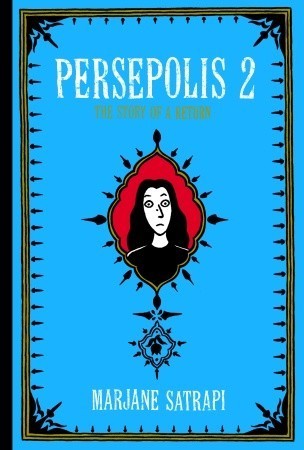
[READ: March 26, 2016] Persepolis 2
I found Persepolis to be an amazing book. A peek inside a regime that was sort of mythically wicked during my childhood. Marjane’s personal story was interesting of course, but I enjoyed seeing just what was happening in this world that seemed so mysterious when I was growing up.
This sequel is a little less exciting because it is more or less about a lonely teenager in Europe. I think if the first book wasn’t so groundbreaking, this one wouldn’t feel as disappointing. Her story is interesting and her experiences are story-worthy, but compared to the first book this one is the awkward teenage years.
We see that Marjane’s being sent to Europe didn’t go quite as planned. She stayed with her mom’s friend. But the friend fought with her husband all the time and their house was not a happy one. They felt that they couldn’t look after Marjane so they sent her to boarding school in Vienna–Marjane didn’t speak German.
She didn’t make friends for while, but soon started hanging out with some eccentrics and punks. They were anarchists (in name only) and into death (so her life in war-torn Iran fascinated them). She was eventually thrown out of that school too–Christian extremists were as bad as Islamic ones as far as she was concerned.
When she went to her first coed party there–and people were having sex–she was shocked. And it seemed to make her change a lot–she cut her hair and put on goth make up. Over the next few months, she grew several inches and changed even more–when her parents saw her they didn’t recognize her. She also met several homosexuals–they were forbidden in Iran. Indeed she moved into a house with gay men and then one of her boyfriends proved to be gay, as well.
But Germany was terrible for her. She was lonely. She didn’t have nay real friends, and life threw her one bad thing after another. She eventually wound up sleeping outside for several nights (this is a little dramatic since she had an apartment at the time) and getting sick.
So she decided it was time to return to Iran. Of course Iran was still a repressive regime, and the culture shock after so much decadence was really harsh. She felt like an outsider at home. For me, this was where the story grew interesting again.
She starts hanging around with her old friends but things aren’t and can’t be the same. They judge her and she gets even more depressed.
So she tried to change once again–she styled her hair and became an aerobics instructor. And then she met a man, Reza. They were complete opposites but they complemented each other well. They both went to art school together where they pushed back again t the rules in a slightly more sanctioned way (as artists).
But since the regime was still so oppressive, they couldn’t be seen together if they were unmarried. Which more or less made them get married very young–exactly what she swore she would never do–be a married woman at 21.
Seeing the wedding ceremony was very cool–her parents didn’t really approve of him, but hey wanted the ceremony to be special. But their marriage was on shaking ground from the start.
Technology brought about some freedoms. Once people started getting satellite dishes, they were exposed to more Western ideas. They spend hours watching anything that they can, since for so many years the Islamic regime had complete control over what Iranians could watch.
Meanwhile, the war between Iraq and Kuwait had begun. For many Iranians, this caused panic, but Marjane and her father Ebi, found the whole thing amusing–they didn’t really care about the war between Iraq and Kuwait as long as they didn’t have to be a part of war anymore.
She and Reza put differences aside and made an art project together that received high accolades. Although when it was proposed for construction (it was a theme park), they were told that it was too contemporary and the government would never allow it. This sent her into sense of despair which culminated in her wanting a divorce. She is given advice from both sides about being a divorced woman in Iran.
This freedom proves to be both metaphorical and physical as the end of the book sees her setting out for a new life.
So if you are reading this book as a continuation of Marjane’s life, it’s quite interesting–seeing how a woman who didn’t really fit in anywhere managed to make it through some tough times. Although, again there were times when she was in Germany when I just wanted to shake her and say snap out of it, lady. But if you’re reading this for more insight into how the Iranian regime affected individuals, this books comes up short somewhat. And that makes sense because she wasn’t there for much of the book. But once again, it felt like all of the sections about Iran were always more powerful.
And of course, books like this are always useful for seeing what fascism looks like and how people who claim to have good intentions might just be lying. (Sound familiar yet, America?) #ITMFA #RESIST

 I Just Read About That...
Leave a comment