Yacht is a synthy band with a dramatic and charismatic lead singer–Claire Evans.
There are tons of synth and funky synth sounds on “Dystopia (The Earth is On Fire)”. But what really sound great are the excellent harmony vocals. There is some guitar but it’s pretty overshadowed by the synth (and synth drums). I don’t love the line “The earth is on fire. We don’t have no daughter. Let the mother father burn.” But I’m willing to accept it because the synth solo is pretty cool.
The keyboardist and programmer switch places for “Psychic City (Voodoo City).” The guitar is more prominent in this song primarily because the song is practically a capella–the chorus is principally Aye Yi Yah Yah HOOH, Aye Yi Yah Yah HO HO, which would probably be a lot of fun to sing along to live, but feels a little tedious here.
After this song it is revealed–horrors–that there was gum under Bob’s desk and Jona Bechtolt gets some on his nice pants. There is talking of sending them the dry cleaning bill, but Claire grimaces and says “too soon.”
“Shangri-La” opens with an interesting synth riff (and the guys in back switch places). The chorus “If I can’t get to heaven let me go to L.A.” is pretty funny.
I’m not sure what the band sounds like when it is not stripped down (the blurb talks about how long it took them to get settled), but I feel like their lyrics don’t support the stripped down sound.
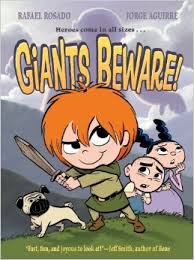
[READ: February 17, 2015] Giants Beware
This is a First Second children’s graphic novel. It is quite long for a children’s book (200 pages) but it’s a lot of fun and the design is fantastic.
The story opens with an old storyteller telling a story to a bunch of kids. It’s the story of the Baby Feet Eating Giant. The giant liked to eat the feet of all the babies in the village. No one was safe until the brave leadership of the great Marquis Pierre the XXXII. He chased the giant into the mountains and built a wall around the village to keep it secure.
The end.
Except, as the young girl on the cover of the book says… Well? How did he kill the giant? Did they “tell the evil giant a pointless story and he died of boredom?” This is Claudette; she wants to hear action. She wants to hear about giant slaying. She thinks that leaving the giant outside and simply building a wall around the city is irresponsible.
As the story teller walks away he mumbles that she is just like her father and look where that got him. (more…)
It was two years ago that I saw Gogol Bordello and I put them on my list of bands to see again–their live show was that much fun. So they played two nights at Union Transfer. I chose the first night (Thursday rather than Friday) although I’m not exactly sure why. I think it turned out to be the right choice because Friday night’s show sold out and if my show was intense, I can’t imagine what a sold out show is like.
This show was part of their tenth anniversary tour. Not ten years since the band formed, but ten years since their first big album, Gypsy Punks (which was recorded by Steve Albini!). And their plan was to play that entire album, and some other songs. I only found out about this entire album thing a few days ago. It turns out that it’s the GB album I don’t own (I don’t own their earlier ones either), so I had to quickly scramble to see what songs were on it. Well, it turns out that most of those songs have been played live or appeared elsewhere, so I knew a pretty good amount of them. Phew.
They came out to roars from the crowd and they launched right into the lead off track from the album. “Sally” features some intense screaming from one of the women in the band, and one of the women came out and supplied it for the song. And I knew that this set was going to be a lot of fun. (more…)
I saw Gogol Bordello a few years ago and the show was fantastic. For many bands, seeing them once is enough, but for GB, I had to see them again. So I was pretty psyched that they were going to play at Union Transfer an excellent club in Philly.
When I looked on their site, they said that the opening act was going to be Jessica Hernandez & The Deltas. I checked out their stuff and it was good. But that must have been for a previous tour, because when I got there, the listed opening act was Xylouris White. I couldn’t even imagine what that meant, much less how to say it.
So imagine my surprise when the band came out and it was a guy (with crazy hair) on drums and then a guy with crazier hair and a big beard on what turned out to be a Cretan lute. And that was it. (more…)
As I write this, there is no band I am more tired of than Tedeschi Trucks Band. It seems like they are everywhere. Coming home from somewhere the other night, there was a whole hour of a radio show devoted to them. Gah.
When I first heard about them I was interested. Their story was fairly compelling–husband and wife join forces to make some music. And then I heard the song they played and I though, huh, Bonnie Raitt and a blues bar band. That’s fine.
I’ve grown sick of th eone song they’ve been playing a lot, but I enjoyed this Tiny Desk.
Their music is certainly fun–a lot more so in this live setting than on record. And it’s very cool in “Just as Strange” to watch Derek Trucks play solos while using that slide on his finger.
“Don’t Know What It Is” fares better–the horns add a nice touch and the song gets treated more like a jam than a song. I love watching Tedeschi play the bitchin wah wah solo. There’s a lot of toe tapping in this song. And after the hand clapping section, the song really takes off–the sax solo is tremendous.
The song segues into the one I’ve been hearing on the radio a lot–the one I assumed was Bonnie Raitt. The problem for me with this song is that the verses are the exact same melody as Radiohead’s “High and Dry” and I keep waiting for the song to turn into that–which it doesn’t. I don’t love the chorus so much but I really like the horn riffs at the end of the song and the guitar solo is wicked (I don’t think the end is as good on the studio version).
So after watching this I have grown to like them better. Their musicianship is pretty stellar.
[READ: January 21, 2016] “The Trusted Traveler”
This was a fascinating story in that I loved some parts of it, didn’t like other parts of it and was amazed at how the main crisis developed and then was basically abandoned.
As the story begins we learn that the narrator and his wife Chris have received an annual visit–right after tax season–from Jack Bail, a CPA who is a former student of the narrator. The narrator loathes this annual visit. And I loved the reason why: “For some reason, almost anything that has to do with Jack Bail is beyond my grasp, I can’t even remember having taught anybody named Jack Bail.”
He feels worse for his wife Chris, because Chris actually remembers things about Jack and his life. (more…)
SOUNDTRACK: GRAHAM NASH-Tiny Desk Concert #515 (March 14, 2016).
I only realized after reading this blurb that he was in The Hollies. I’ve really only known him from CSN&Y. And that makes sense now why “Bus Stop” (a song I’ve known forever but never knew the name of) sounds so familiar.
Nash plays guitar (and harmonica) and sings and he’s accompanied by Shane Fontayne on guitar and harmony vocals. The duo sound great. Nash’s voice is clear and sounds amazing (because he’s 74 but even if he weren’t). Obviously I missed the mega harmonies of CSN&Y, but as a solo performer he really shines.
The first song he plays is “Bus Stop” and it sounds wonderful. I miss some of the inflections that are in the original–but this is clearly a solo rendition (and it has been 50 years after all).
The other two songs are from his new album. “Myself at Last” he says was the first song the recorded and that it was done in one take (and that musicians love that). It’s a lovely song with a very Graham Nash feel (imagine that). I love the chord progression in the bridge and the slight delay in vocals for the chorus.
For the final song, “This Path Tonight,” he asks us to imagine “an incredible rock and roll band playing with us.” Even though the song isn’t fast, it has a real sense of urgency in it. The chord progression is intense, and I imagine that with a band this song would be even more exciting.
[READ: January 20, 2016] “My Diagnosis”
This is the kind of story that reads more like an exercise that was later developed into a full story.
The opening of the story is that the narrator’s mother has made the narrator’s diagnosis public.
And the rest of the story is the narrator’s way of obfuscating what that diagnosis is–possibly from herself but definitely from her mother’s friends. (more…)
I have enjoyed David Cross since the old days of Mr. Show, and the as Tobias on Arrested Development and even in Alvin and the, well, actually I’m just happy for him that he got a lot of money for it.
When he released his previous stand up album, Bigger and Blackerer, Sarah and I listened to it in the car on a long trip and we had tears in our eyes from laughing so hard.
So when I heard he was touring I thought it would be fun to see him live. And, yes, it was.
But we ran into a few bumps along the way. We had to leave very late because our babysitter had car trouble. She arrived just late enough that we weren’t sure if it was worth still driving the hour to Philly. We decided if traffic was terrible we would just stop somewhere and have dinner instead. I even called the Theatre to see if there was an opening act (nope) and if the show really started at 7:30 and not 8 (yup, he would start at exactly 7:30). Traffic was light and the GPS said we’d get to the garage at 7:35. I missed the turn for the alley that our garage was on, and then we got slightly lost on the walk from garage to theater and as we got there at 7:40… there were still a whole bunch of people milling about in the lobby. And then they flashed the lights telling us to get to our seats. We missed nothing!
And we even got to tsk at people who arrived later than us. Cross even joked that he would wait to start his joke because “it’s not fucking distracting or anything” when people are being seated. I was frankly shocked that people seemed to still be arriving around 8PM! (more…)
SOUNDTRACK: Y LA BAMBA-Tiny Desk Concert #143 (July 21, 2011).
With a name like Y La Bamba, I expected, a band, possibly from Mexico, singing in Spanish. So imagine my surprise that the band is from Oregon and sings (almost) entirely in English.
The band’s musical make up is really interesting–accordion, percussion, guitar and lot of singers. Lead singer Luz Elena Mendoza’s (who is Mexican..I was sort of right) voice is cool and unusual, passionate and anguished and perhaps a little intimidating.
For the first song “Crocodile Eyes,” Mendoza’s voice is right up front as she sings and plays guitars. And her voice is a little surprising. But it’s even more surprising when the (rather loud) drums come rumbling in after the first few seconds (it’s especially disconcerting because you can’t see the drummer).
But perhaps the most impressive thing about Y La Bamba is the backing singers. Two bearded men sing wonderful “whoah ho hos” to accompany her as she sings.
For “Fasting In San Francisco” the guitar switches to one of the (unbearded) men. And instead of percussion there is a wonderfully clear xylophone that adds a beautiful counterpoint to the plucked guitar. On this song the backing vocals sound amazing. I especially loved the middle section “I’m a fragile dandelion” where that line is repeated in many different ways (including spoken) and then all the singers break in to a series of fugue-like “doh” notes at different pitches–it is mesmerizing,.
“Hughson Boys” opens with fast acoustic guitar picking. And the vocals are a duet with the guitarist and Luz Elena. This song is not quite as anguished, but the harmonies are once again wonderful–and his falsetto vocals at the end are a great touch.
There’s a story about Luz Elena Mendoza on NPR (from a few months earlier) where they have some of their studio songs available to stream).
This was such an unexpected treat–totally not what I anticipated and a band I definitely want to hear more from.
[READ: January 11, 2016] “Too Good to Be True”
I didn’t know Huneven before reading this story. And I was a little dismayed that the story was going to be about A.A.
However, it was about A.A. in a very unexpected way.
The protagonist is a woman named Harriet. Harriet had bottomed out not too long ago and lost the job that she really liked. She was recently hired by a woman name Lois. Harriet and Lois met at an Al-anon meeting and now Harriet is their housekeeper. Well, Lois and her family are very wealthy and they have a maid and a babysitter. So, technically, Harriet is more if a personal chef–making far more money than she ever would as a chef somewhere else.
As the story opens Harriet has agreed to take Gayle to A.A. Gayle is Lois’ daughter. Gayle is the middle child between a successful older sister in college and an adorable younger brother (he was a happy accident). Gayle was an A student until she left one day at age 15 and didn’t come back for several months.
As they are driving to the meeting, Gayle tells Harriet the details of all the things she did (and people she did) to score drugs on the streets. Gayle was dragged home once but left again twelve hours later. She had been in forced rehab but it never took. And now, this time, Gayle is getting clean on her own accord. She saw a vision of her future as a successful international business woman and she intends to see that through.
So, in addition to A.A., she is studying Mandarin and being an exemplary daughter.
But then one night, as has happens so many times before, Gayle doesn’t return. Gayle’s dad assumes that something bad happened to her–an assailant or the like. But Lois assumes she hopped in the back of car and is getting high again.
Harriet has been told so many details of Gayle’s past. She knows that yes Gayle wants to get clean but also, yes, she spoke so fondly of the highs she had. She doesn’t know what to think. The police, aware of Gayle’s past, assume she has left as well.
Every phone call brings a charge of fear. And while Lois says that she would rather Gayle were dead than missing–it would be so much better to know-of course, she also obviously hopes she isn’t.
This is an unhappy story and no real ending is going to shine a bright happy light on it. But the route that Huneven went was unexpected.
I don’t really like stories like this in general, but it was well told and very engaging and the details (like the phrases that Gayle learned in mandarin) were great.
SOUNDTRACK: STEVE EARLE-Tiny Desk Concert #123 (April 25, 2011).
Steve Earle is pretty cool. He’s a country outlaw who is a socialist and an outspoken Bernie Sanders supporter. He is a vocal opponent of capital punishment. He’s also written a song “directed towards the state of Mississippi and their refusal to abandon the Confederate Flag and remove it from their state flag.”
For this Tiny Desk it’s just him and his guitar as he sings songs from his then new album.
He opens with “Waitin’ On The Sky” and says it’s the first time he’s played it in front of people. He has to restart the song because “debris from a Cobb salad shifted in his throat.” He also forgets some of the words, but it still sounds great.
He is very chatty with lots of stories about the recording of the record and how a song that he mentions isn’t on the record, but it is on a download or vinyl. “We used to make records for girls and now we make them for nerds.”
“Every Part Of Me” is a slow ballad, it’s quite pretty. His voice sounds good and hard-worn as he sings. He says it is “the song you’re most likely to hear on the handful of radio stations that actually play me.”
While tuning before his third song he says that he is involved with a show called Treme “that’s ‘treme,’ just like it sounds… if you’re French.” In the show he’s a street performer in New Orleans. He says that there are non-traditional buskers–professional musicians who sing on the streets for tips (hundreds of dollars a day). And he tells about the turf wars that began in the 80s. Eventually an agreement was reached between the players. That’s all a lead in to a song that is on the Treme soundtrack called “This City.” It’s a touching song about New Orleans.
I’d always thought that he was much more “country” sounding, and maybe he is on record, but at least here, he is simply singing well writing and well-though out songs.
[READ: February 23, 2016] “To Laugh That We May Not Weep”
This is a brief essay about cartoonist Art Young. Young would be 150 years old this year and Spiegelman says that Bernie Sanders would have been the best birthday present we could have given him. Because Art Young was a radical! Political !! Cartoonist!!! (the oblivion trifecta). The only concept less inviting is a political radical.
Spiegelman says that once upon a time political cartoonists were very powerful (although in some respect they still are, as you can see by the the murdered Charlie Hebdo artists).
Young was a talented cartoonist who drew for all kinds of publications. He was never convicted for his drawings, but he was put on trial for libel. He was found not guilty; he drew a picture of himself sleeping with a caption “Art Young on trial for his life.”
Spiegelman contends that political cartoons are usually short-lived and timely but that Young’ are more timeless–and perhaps sadly still relevant. And that he was never shrill or humorless. (more…)
SOUNDTRACK: CHRIS THILE & MICHAEL DAVES-Tiny Desk Concert #133 (June 13, 2011).
After seeing Avi Avital play an amazing show last week, it seemed only fitting to mention a show with an other amazing mandolin player. Chris Thile does some incredible work on that tiny instrument. I’d love to see a duel between the two of them—it would be mind blowing.
Thile has played with many many different musicians, both in bands (Punch Brothers, Nickel Creek) and as duos and trios. And this duet with guitarist Michael Daves is fantastic.
Daves plays a folkie electric guitar and sings. They share lead and harmony vocal duties (with Thile usually going higher). And while Thile’s mandolin solos are incredible, Daves is no slouch on the guitar either–his fingering may be just as fast as Thile’s.
The two have a great rapport (and play a super long set!). The duo met and were going to record one song, but it turned into more than a dozen. And they play 6 of them during this show.
“Sleep With One Eye Open” feature Daves on lead vocal. It’s upbeat and bouncy folk with a country twang attached. (I love that Thile’s mandolin is just as loud as Dave’s guitar). And I love watching Thile bounce around while playing.
They duet on vocals for “Rabbit in the Log” which is about the inherent cuteness and tastiness of rabbits. Thile’s fingerwork is mind blowing until you hear the solo that Daves does. And how does a song that’s so fast end so sweetly?
“Bury Me Beneath The Willow” is slower song with Thile on lead vocals. it shows that their whole act isn’t about speed.
“Billy In The Lowground” Thile says that Billy, “through no fault of his own ended up in the lowground.” It’s an instrumental so we just have to imagine what Billy did. It’s another place for them to show off their skills.
“It Takes One to Know One” is a more bluesy than bluegrass song with Daves on lead vocals. It’s alike a slow blues song with Daves’ country twang vocals. Thile’s slide solo is amazing—never seen anything quite like that on the mandolin (well, until Avi did something similar).
When their set should be over, Thile says they’ll do “one more for good measure.” “Roll In My Sweet Baby’s Arms” is an incredibly fast song. They duet on vocals but Daves really shines on the super fast guitar solos.
The more I see Chris Thile the more I’m impressed by him. I can’t wait to see who he teams up with next.
[READ: February 23, 2016] “There are Other Forces at Work”
John Darnielle, singer and guitarist for the Mountain Goats is also a fiction writer. And here is a great essay about John Cage.
Darnielle opens the essay by saying that on the day that Nixon resigned, Darnielle was 7, but he cheered anyone since he was taught that Nixon was the bad guy. And on that day, John Cage gave the first public reading of “Empty Word” a piece of unaccompanied voice in which he read from Thoreau’s journals and reduced the journals first to single words then to syllables and eventually to letters–drawing them out slower and slower.
This piece caused riots.
Then Darnielle gets to the meat of the matter. He has gone to Halberstadt because The John Cage Project has been performing Cages’ “ORGAN2/ASLSP” there since 2000. And it plans to run until 2640. Perhaps you have heard of this piece and its preposterous length.
There is a piano version of ASLSP (which stands for As Slow as Possible). Darnielle tries to imagine playing each note on a piano until it rang its length out (about 30 seconds). But an organ can play for as long a performer can hold the note. The only instruction Cage gave for the piece: “all eight pieces are to be played. However, any one of them may be repeated, though not necessarily, and as in ASLSP, the repetition may be placed anywhere in the series.” In other words you can play it for as long as you like
Here’s a 4 minute version
It is being performed in Halberstadt because the modern twelve note keyboard was in vented in Halberstadt in 1361. That was 639 years before 2000 and thus the entire piece will last until 2640 which is 639 years from 2000 (there’s nice symmetry for an asymmetrical piece). As such, since they were mathematical about it, they determined that one of the 8 parts would last 71 years. That’s 71 years of an organ playing a single note.
When Darnielle arrives it is for one of the changing of the chords. This discordant chord had been playing since 2012. Before he arrived, he tried to imagine what it would be like, and he is both underwhelmed but also moved by the simplicity of it. He says its not pretty or unpretty, it’s just sort of there–a kind of background drone. It’s also much quieter than he imagined. The chord is being played by sandbags–there is no keyboard.
The note change (and Darnielle’s visit) was on October 5, 2013. The next change is in 7 years. Here’s a list of planned chord changes (note they do not go until 2640)
The piece started with a 17-month rest on September 5, 2001, Cage’s 89th birthday. The first sound appeared on February 5, 2003. Subsequent dates for note changes include:
July 5, 2004
July 5, 2005
January 5, 2006
May 5, 2006
July 5, 2008
November 5, 2008
February 5, 2009
July 5, 2010
February 5, 2011
August 5, 2011
July 5, 2012
October 5, 2013
September 5, 2020
Beyond the sound of the chord there are things to see. An engraved metal panel attached to an iron rail at eye level–these were paid for by people as a funding for this project and they were allowed to write what they liked.
Darnielle was quite moved by the thing although he is concerned because they play the notes of the new chord one at a time–one note builds on the others. He says the piece is supposed to be just the one chord and that’s it. (Realistically it allowed the three people who were invited to begin the chord to each have a moment in the spotlight). Then he realizes that in the course of 639 years (if you were to compress it to a reasonable length) that will seem like a blip or a grave note.
Darnielle notes that Cage can still cause people’s ire to rise, just if you look at all of the YouTube comments on his piece “4’33′”(the silence piece). People are outraged by it, still.
I really enjoyed Darnielle’s look at this fascinating event. I really like Cage for his daring.
SOUNDTRACK: BEN SOLLEE-Tiny Desk Concert #141 (July 11, 2011).
I’d never heard of Ben Sollee before this Tiny Desk and I’m a little surprised by that–he seems like the kind of musician I’d have run into somewhere. For this set (I have no idea what his sets are usually like), they are a trio.
Sollee plays cello and sings (!), Phoebe Hunt plays violin and sings backing vocals and Jordan Ellis plays drums (in this case one of cool those snare drum boxes).
But despite the strings-dominated sound, the songs feel very rock-oriented. Although as the blurb says, they are kind of genre defying. Each song has a very different feel.
On “Hurting” Sollee opens with some great big plucked bass notes from the cello. Then Sollee switches between plucking and bowing the cello. And that transition really impacts the overall sound, making it sound like more than a trio. The violin plays some accented notes and then some big long notes (like the cello). But it’s the drums (brushes on the box) that add a lot of character to this song. Sollee has a good strong voice and it fits the song well.
“Captivity” is about being in prison (he wrote it after watching a documentary about a maximum security prison) both physical and metaphorical. For this song he strums (in an interesting, folky way) the cello. He plays some bass notes while strumming the rest of the instrument–it’s a great sound. And I love how different this sounds from the first song. Once again the percussive sounds add so much.
“The Globe” about the Globe Theatre and how it was burnt down twice. So he wrote a story about a frustrated loverboy burning it down. The song names checks some of Shakespeare’s characters and while not comical is kind of funny too. Musically the song is great with builds and sudden stops. It’s also quite funky at times, with all kinds of different rhythms from the cello and violin as well as the percussion (which in this case is hand claps). He says that they’ve been having fun playing it live and that really comes through. I really like the sounds that Sollee makes from the cello at the end of the song.
“Inclusions” is an a capella song. He says they’d been working on it in the van on the way down. I expected a simple song, but they have wonderful harmonies as well. For percussion, Phoebe is rattling a can of cacao nibs. (There was recently a very funny cacao nibs joke on Brooklyn Nine-Nine, otherwise I’d never have heard of them–I like that Sollee beat Brooklyn by five years though).
This was a wonderful find and I definitely want to hear more from Sollee–I’m curious to see what he gets up to in the studio.
[READ: January 10, 2016] “The Hanged Man”
November was a dark month for stories in Harper’s. This story along with the one I posted a while back from John Edgar Wideman both deal with suicide. This is an excerpt from War, So Much, War, and it opens with a man cutting down a sack which was hanging in a tree.
The sack contains a body–“his face was white, his tongue black, his lips purple.” When he cuts down the sack, the body’s head hits a rock and the protagonist is worried because the body is actually alive and he’s afraid it is now damaged.
The body doesn’t speak for a long time. But when it does it is angry that the man has cut him down. (more…)
 SOUNDTRACK: YACHT-Tiny Desk Concert #136 (June 22, 2011).
 Yacht is a synthy band with a dramatic and charismatic lead singer–Claire Evans.
















 I Just Read About That...