 SOUNDTRACK: SUFJAN STEVENS Christmas Unicorn: Songs for Christmas, Vol. X (2010).
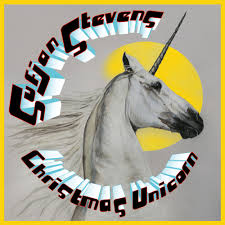 This is the final disc in the second Sufjan Steven Christmas box set. It is comprised of mostly shorter songs except for the final one which is 13 minutes long.
Interspersed in the disc are three short instrumentals (under a minute each). “It Came Upon A Midnight Clear” “Angels We Have Heard On High” and “We Three Kings” are all pretty with flutes and minimal electronics.
The more traditional songs are “Have Yourself A Merry Little Christmas” which sounds very much like a Sufjan song with some fun electronic sounds and orchestration and some unusual vocals. “Up on the Housetop” features lots of drums and layered vocals. It is the standard version but tinkered with with in fun ways. “We Need a Little Christmas” is a fun and traditional version with choral vocals.
The other three tracks are originals from Sufjan. “Happy Karma Christmas” a slow track of mostly drums and echoed vocals. It reminds me of Beck’s discoey electronic moments. “Justice Delivers Its Death” is based on the lyrics of “Silver and Gold” (from Rudolph) but it is a much darker song (obviously, given the title) and sounds nothing like it.
The final track is “Christmas Unicorn.” It’s a sweet song with funny/thoughtful lyrics. After three minutes it turns into a nice instrumental. At the four minute mark a new refrain begins. It sounds like the song is going to fade to end, but it doesn’t. At 6:30, drums come back in and the song takes off with more singers and a fugue style of interweaving vocals. At 7:36 a new melody is introduced which is, Joy Divisions’ “Love will Tear Us Apart.” They incorporate that into the fugue vocals and it works very well. It’s a strange song and very unChristmassey, but it’s very cool and quite catchy by the end.
I don’t enjoy this second box set as much as the first, since it is so unChristmassey, but it has some really interesting songs on it.
[READ: December 13, 2014] Bolaño: A Biography in Conversations
I don’t often read biographies about authors I like, but once in a while one will catch my eye. I knew Maristain’s name from Bolaño’s last published interview, so I was curious what she would do with this collection. It was translated by Kit Maude, and I am also curious about some of the words that Maude chose to use (the word savage/savages comes up an awful lot when not referring to The Savage Detectives). But overall it was an easy, quick read.
As the subtitle suggests, Maristain has compiled a loose biography of Bolaño based on interviews with others. Some are interviews that she has conducted and others are previously existing interviews that she has cobbled together. The people interviewed are primarily his family and his fellow poets/novelists/friends.
Bolaño was born April 28 1953 in Santiago de Chile. Soon after, they moved to Valparaiso, and then other smaller towns in Chile. In 1968 they moved to the Mexico City because of his mother’s asthma (although he never set foot in Sonora, the scene of the crimes in 2666). They lived close to the Olympic park and were within walking distance of the Olympic torch during the 1968 Olympics.
He had a difficult upbringing, with his parents splitting up and his mother moving out and taking his sister with her. Roberto, meanwhile, stayed with his father. They eventually had a falling out and Roberto went twenty years without seeing him. His father was a boxer and an opinionated man, and there are lots of quotes from him in the book.
In 1977 Bolaño left Mexico for Spain (and never went back) and that’s when we start getting into his publishing history.
There is a much made of the formation of the Infrarealists–the literary movement created by Bolaño and several others, including Bruno Montané. Although Bolaño never really spoke of the movement much, it was clearly an essential part of his writing. There are quotes from interviews with many of the people who were involved with the Infrarealists–either directly or because they were influenced by them. And they all have interesting things to say about Roberto (most of them make an appearance in his writing, especially in The Savage Detectives.
The next chapter talks about the people whom Bolaño didn’t like–Isabel Allende, in particular. He disdained her style of writing (which he called scribbling). But he did like the anti-poetry of Nicanor Parra.
The book talks about the very close friends that Bolaño had for various parts of his life. He seemed to make friends very easily and would keep them for about as long as they seemed to be able to keep up with him. Bolaño was a voracious letter writer and it seems that most people fell out of friendship with him because he was just too much for them. But everyone who was friends with him describes his charming and open personality–both before and after he became famous.
It’s interesting to hear fans of his (who are also writers) talk about his work. The general consensus seems to be that his best poetry is actually in his prose–that his poetry (which Roberto himself regarded very highly) was maybe not quite as good as his prose (especially the two big novels).
Bolaño was an avid reader and often said that reading was the most important thing a writer could do. He read everything he could and apparently watched a lot of films as well (he loved Repo Man). Interestingly, he also spend most of his time writing (sometimes 10 or more hours a day). So how did he have tome to do all this? (That is not explained, although it sounds like he barely slept).
She lists Bolaño’s top favorite books: Don Quixote by Cervantes, Moby Dick by Melville. The complete works of Borges, Hopscotch by Cortázar, A Confederacy of Dunces by Toole. I should also cite Nadja by Breton, the letters of Jacques Vaché. Anything Ubu by Jarry, Life: A User’s Manual by Perec. The Castle and The Trial by Kafka. Aphorisms by Lichtenberg. The Tractatus by Wittgenstein. The Invention of Morel by Bioy Casares. The Satyricon by Petronius. The History of Rome by Tito Livio. Pensées by Pascal.
There is of course talk of the biographical stories about Bolaño–most of which are not true, and most of which he made up himself. Many people go to great pains to say he never even tried heroin much less became an addict. There’s even one story that Bolaño made up to a friend–in which he claimed to have killed a man–just to see the friend’s reaction.
There is much talk of Bolaño’s legacy. How there is now a street named after him (and that people will kill for house number 2666) and while he would have hated the adulation, he would have laughed to know that the street had no houses on it. But also how so many people now come out of the woodwork to say they loved him and were his friend.
There is a section on his relationships with women. As far as I can tell (I found this section confusing), he was married to his wife and he loved her very deeply until he died. But they lived apart. And he seems to have loved many other women in the meantime (“loved” is never defined).
The book ends with some interviews with people who have been influenced by him and for whom Bolaño’s opening up of Latin American literature to the world was a boon.
Bolaño died in 2003 of liver failure (which was hereditary and not due to alcohol). It’s hard to believe it has been so long since he died, because his star has been rising since 2004 and they are still translating posthumous works. 2666 came out just after he died.
Bolaño’s life was basically all hearsay (mostly from stories he made up). So this biography which is entirely comprised of hearsay makes an interesting sketch. I found it very entertaining. It is also, as expected, contradictory and frustrating. But it presents sides of Bolaño that one may not know. What I think was most interesting is how many people said that they were tired of people (Americans particularly) being introduced to Bolaño because of his supposed biographical details rather than his works. So this biography simultaneously adds to the noise about him but also deflates it at the same time.
Maristain has done a great job in building this picture of a man almost in relief from his actual life.
I would have appreciated a chronological list of his works though (sure they are available, but it would have been nice to have handy). I have read them all in translation in various order, and seeing them listed out (since everyone talks about which of his books they started with) would have been very helpful. I’m also surprised that there are no interviews with his children. I couldn’t want to hear from them in any kind of prurient way, but I am curious what they would have to say about the man.
For ease of searching, I include: Roberto Bolano, Monica Maristain

 I Just Read About That...
Leave a comment