 SOUNDTRACK: THE BLOW-“Make It Up” (2013).
 This song from The Blow is what Bob Boilen played the other day on NPR. He had just seen them live and liked the show so much that he listened to the whole album three times in a row on the way home. He said the live show was amazing—Khaela Maricich is on stage singing and talking to the audience all by herself. He thought that the music was all backing tapes, but then he realized that her partner was back at the soundboard—creating the music and doing the lights at the same time.
Yesterday I said that The Blow’s “Parentheses” was the perfect pop confection. “Make It Up” is far more complicated anc more challenging. It has many elements of pop perfection but it is nowhere near as immediate as “Parentheses.”
The song, despite its simplicity, has many complicated elements—the opening drum sequence is elaborate with all kinds of rhythms and sounds. But when the verse starts, the vocals are delicate and simple and the keyboards are single notes. Until the chorus when the complexity jumps in again—in addition to the drums, we get several versions of Maricich‘s voice doing background vocals, singing leads, making sound effects and then they disappearing again. The third part introduces a new, simple, very pretty melody with beautiful voices playing counterpoint to each other.
The song feels so busy but it is really just a few simple elements piled on top of each other. It’s simultaneously pretty and mind-boggling. More pop songs should do that.
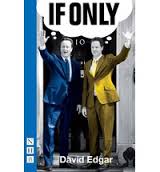
[READ: September 25, 2013] If Only
You shouldn’t judge a book by its cover, but sometimes a cover grabs you. I have no idea what it was about this cover that made me look at this book twice, but I did. And when I investigated the author, I discovered that Edgar is a prolific playwright and that this play is a contemporary political story set in current and future England.
What struck me immediately was this disclaimer at the bottom of the character page: “The second half of the play concerns the future of the coalition government. This text went to press before the end of rehearsals and so may differ considerably from the play as performed.” How interesting is that? First that they would do that and second that it might actually be a different play that I have read.
The opening of the play takes place in the spring of 2010, right after the eruption of the Icelandic volcano which grounded European air traffic to a halt. In the airport are three politicos: Peter, who works for the Conservatives, Jo, who works for the Liberal Democrats and Sam, who works for Labour. They are all fairly high up in the party (but not name recognized). They are stuck because of the volcano and are seeking any way to get back home as the general election is but a few weeks away. I really enjoyed the continual jokes about charges for their phones and devices.
Most of the first act concerns their attempts to get back home and their discussions about the upcoming election. Thy can’t get back home despite their various clever ideas, until they learn that they can by a car for a few hundred pounds and can all drive together back home.
The political discussion is far more complicated—and it certainly helps if you know more about British politics than I did [I had no idea what UKID was or who Clegg was, for instance].
So, a summary for those who forgot and those who didn’t know, because it is a summary of the play as well. The three politicians figure that there are four possible scenarios for the upcoming election. Gordon Brown’s Labour party is in disfavor, but David Cameron’s not popular enough to bring a majority Conservative victory. Since it is presumed that no one will win an outright majority (for only the second time in some 60 years), there will have to be a coalition of some sort.
- Conservatives win without a majority but with less than enough to ally with their ideological partners The Democratic Unionists, so they would have to pair with the Liberal Democrats.
- Labour wins but doesn’t have a majority. But they win enough to partner with the Lib Dems (which has happened in the past)
- Both parties win enough that they could pair with the Lib Dems (very unlikely).
- Conservatives win without a majority, Labour tries to put together a coalition with Lib Dems and a bunch of smaller parties (the nightmare scenario)
And so the car ride has the politicos talking about their platforms and manifestos and finding out just how much the supposedly diverse platforms have in common.
He also throws in to this mix a 17-year-old girl named Hannah. Hannah is a university student looking to get home for a concert festival. She hears that they are planning to get home and she offers to help them get on the ferry that her mom has purchased tickets for. Of course, that all goes to pot which is why they have the car. But because Hannah tried to help them they take her along. She is a seemingly naïve girl, but is nowhere near as naïve as it seems–asking tough political question and really getting into the discussion. She says that she is going to vote for the first time this year and that they should all be trying to persuade her what to do.
Before Act Two, the election happens. The first scenario plays out with the Lib Dems forming a coalition with the Conservatives (what many consider an unholy alliance).
Act Two is set in 2014, just before the referendum to give Scotland independence. And Act Two, which is all set in one room sees the three politicos meeting again, because Peter has called them to tell them something.
He has news that the coalition is in trouble, that the nut job Conservatives are really trying to change the country for the worst (even he can see that) by bashing immigrants, the poor and students. Peter explains what the Prime Minister is proposing and wants the help of the other two to see that his radical plans don’t come to fruition.
By the end of the act Hannah returns, fresh out of school and with her sights set on a future in politics… as a Conservative. And her attitude seems to conform to exactly the attitude that Peter is worried about. The question is, will Sam and Jo sacrifice their careers for the good of the country? For their beliefs?
This is a very thought-provoking play. Obviously knowing more about British politics will help in the overall enjoyment of it. But even being vaguely interested in politics would be a decent foundation for this story (you can always look up the things you don’t know).
For a story that is largely talk and speculation, I found it very exciting, especially the last three dozen or so pages which really showed the dangers coming to a head.
I’ve not read any of Edgar’s works before but I really enjoyed this one. And I’m curious to see if he had any real insights into politics in a year from now.
My only real complaints about the play: the title sucks. It tells you nothing and in a dozen years no one will remember what it was a bout. But worse yet: The character of Hannah says “like” waaaay too much. I understand it is a generational thing and he is trying to make her sound young but she speaks too confidently and knowingly to use “like” quite so often (especially at the end after she had returned from school). Hopefully that was tampered down in the stage version.


Leave a comment