 SOUNDTRACK: THE STATLER BROTHERS-“Flowers on the Wall” (1965).
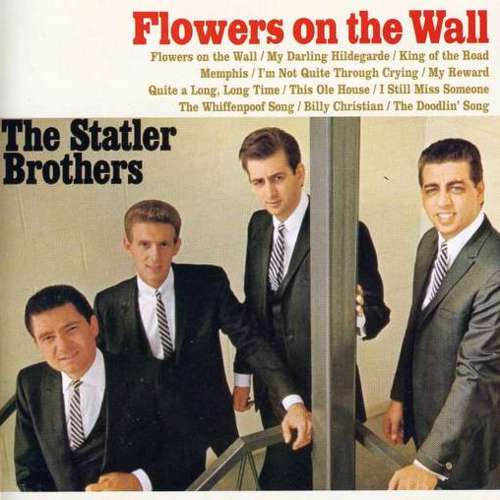 Vonnegut mentions this Statler Brothers song in Palm Sunday as well. I know this from Pulp Fiction–a song that I found very amusing and never would have guessed was a classic country song. Country music was very different in 1965 than it is now. I don’t even know if there was a folk or bluegrass category back then, and this song, with its banjo and bouncey acoustic guitar is a great example of the kind of country music I like. And those harmonies!
This song certainly seems to be about insanity–about a man counting flowers on the wall, playing solitaire with a deck of 51 cards, smoking cigarettes and watching Captain KAN Kangaroo. Don’t tell him he’s nothing to do. What a weird little song. And man is it catchy. No wonder it was a #1 hit.
[READ: May 31, 2013] Fates Worse Than Death
After reading Palm Sunday I learned that Fates Worse Than Death was a kind of autobiographical sequel to that non fiction book. I also learned that the two essays that make up Nothing is Lost Save Honor which is impossible to find (and for which I can’t even find a cover) are available in FwtD. However, since there is no real contents or index, you do have to read the whole thing to find out which chapters contain the essays. Or you can just look here and see that “The Worst Addiction of Them All” (which was published in The Nation) is in Chapter XIV and “Fates Worse Than Death” appears in Chapter XV.
The last time I read a bunch of Vonnegut together I got a bit burnt out on him and the same thing happened here. The problem with Vonnegut’s nonfiction is that he tends to repeat himself. A lot. And while this book is ostensibly about the 1980s, he talks an awful lot about his family and his friends from the war and his other literary acquaintances., like he did in Palm Sunday. In a number of places, he says that he doesn’t like to read himself in English, and it would seem that he doesn’t proofread to see if he said something already either.
This is not to say that the book is not worth reading. Indeed, if you read Palm Sunday in the 80s and then this one in the 90s, you might not remember all of the details that pop up again, but when you read them days apart…well.
Having said that, there is a lot of new stuff in this book. He is especially critical of the Reagan administration and has a lot of nasty things to say about neo-conservatives ( I had no idea they were around back then). But he also has some nice things to say about William F. Buckley (not his ideas, but about the an himself, who is always dignified and presents a rational. logical argument for the frothers at the mouth).
As with Palm Sunday he includes essays and speeches and his gives context to them. This is certainly a nice idea as having just the speech is fine, but knowing a bit more about it is better (like a clip show). This i especially true when you read these books twenty or thirty years after they were compiled.
There’s a speech he gave at the American Psychiatric Association (given at the time of the “disgraceful” Bush vs. Dukakis campaign “(at which time the eventual winner was promising to protect rich light people everywhere from poor dark people everywhere).” (29).
This book also talks a lot about the craziness in his family. We know that his mother committed suicide and that his son was institutionalized for Schizophrenia. Mark Vonnegut wrote a book about the experience and it was a bestseller. However, as of this writing, Mark has since changed his mind about his treatment–saying that the vitamins they gave him were not the only thing that cured him as he once believed. He feels that the relabeling of schizophrenia in different ways is beneficial to all those who suffer as he did. We also learn by the end that Kurt Vonnegut himself tried to kill himself, apparently at a much older age (his wife must have been quite upset). He had always talked about wanting the cigarette to kill him off but then he finally tried to do it more proactively.
His religion comes up a lot in this book as well (he even wrote a requiem mass for non Christians). Interestingly he seems to waver between being an atheist/agnostic and a Unitarian (which is about as close to agnosticism as yo can get and still be considered a Christian). But as with many atheists that I know his belief squares up nicely with the tenets of Christianity–be nice to each other, try to help each other out–or as we call it humanism.
He talks about the first and second amendment and makes the somewhat ignored argument these days that no one with gun defending his house is a well-regulated militia.
I only wish the NRA and its jellyfish, well-paid supporters in legislatures both State and Federal would be careful to recite the whole if [the 2nd Amendment], and the tell us how a heavily armed man, woman or child, recruited by no official, led by no official, given no goal by any official, motivated and restrained only by his or her personality and perception of what is going on, can be considered a member of a well-regulated militia.
Amen to that.
I also liked this. Vonnegut was in the war and grew up with guns ans was a pretty good shot. But,
I consider the discharge of firearms to be a low form of sport. Modern weapons are as easy to operate as cigarette lighters. Whenever I hear of someone that he is a good shot, I think to myself, “‘That is like saying he is a good man with a Zippo or Bic.” Some athlete.
The above mentioned chapter XIV has a wonderful speech about compulsive prepares for war (that is the worst addiction). Not people who love war, but those who feel compelled to always be preparing for it–spending more and more money at the expense of our children, education, the future. He says that these people should be pitied and forced to join a self-help group. And should in no way be in charge of the country.
The final chapters see Vonnegut in Mozambique trying to help those in the civil war to stay alive. By the end of this section, after he has reported the disaster, he says that he didn’t really feel anything there–that he had become numb to the tragedy and this itself was a tragedy.
By the end of the book, Vonnegut has gotten quite angry and it’s a little hard to read, as he usually couches his anger in humor. But you can tell that he has had it with the Reagan/Bush era, warmongers, neo-cons and the like.
He has an Appendix in the back of the book which includes his son’s forward t the new version of his book The Eden Express (in which he says that modern medicine has influenced his opinion about his earlier treatment); it also includes the full text of the mass he wrote (in English and Latin) and a few other pieces of ephemera.
I probably would have enjoyed this book a lot more had I read it in 1991, when I was just as angry about politics as usual. But having read this right after Palm Sunday, I was hoping for maybe a short story or some more humor.
Incidentally, this book includes what Vonnegut’s claims is the filthiest limerick ever. It is so bad that the speaker has replaced the really offensive words with the syllable “da” and it goes:
da da da da da da da da
da da da da da da da da
da da da da da
da da da da da
da da da da da fucking cunt.
Do not repeat at home.

 I Just Read About That...
Leave a comment