 SOUNDTRACK: DEAD CAN DANCE-“Children of the Sun” (Live at KCRW, April 24, 2013).
 Dead Can Dance are timeless. Their music sounds ancient and modern at the same time. And Brendan Perry’s voice has an unearthly majesty to it that never seems to age.
I’ve known the band for decades (during which time they have broken up and reunited and broken up and reunited). And in all that time, while their sound has changed in subtle ways, the band is instantly recognizable. I’ve never really thought of them as a live entity–they just seem like such a creation of the studio that it would be impossible to do justice to their wash of music live. Of course that was truer three decades ago before it was easy to fit an entire orchestra on an iPod.
You can watch this song on NPR. It’s fun to watch a band with two keyboardists (and Lisa Gerrard on…autoharp?) and see all of them making very different sounds. The only disappointing thing about watching this is that they have so many cool instruments strewn about which do not get used on this song (you can see the whole show here and watch him bust out that bouzouki).
This song is a new one and it doesn’t have quite the ponderous nature as their older material. Which is a bit of a shame, as they were so over the top it was fabulous, but maybe they’re just settling into New Old Age.
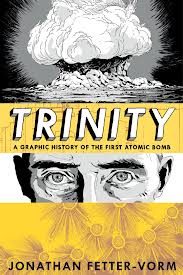
[READ: April 20, 2013] Trinity
Sarah brought this book home because it was on YALSA Hub Reading Challenge for 2013. I’m unlikely to do the challenge as I have so many other books to read, but I have already read 5 of the required 25. Not too bad, although since the challenge is from Feb to June and I read a couple last year, I don’t even qualify for some of the ones I DID read. Anyhow, she told me I’d like this and she was right (as usual).
Trinity is the story of the development of the atomic bomb done as a graphic novel.
It outlines how we came to develop and test the bomb and of course, the aftermath of its use. What I liked about the story is that leading up to the detonation of the bomb, the quest for its discovery is presented in a fairly neutral way. Essentially, once it was discovered that we could split the atom, it was deemed inevitable that someone would make a bomb out of it. It stood to reason that if Hitler or the Japanese figured it out before us they would use it on us (since we were at war with them). The intention was that America would be decent and not use it with impunity (which is not to say we wouldn’t use it at all). The book presents that American can do spirit that the forties seem to be all about–a sort of gee whiz, let’s figure this out mentality.
I knew some of the history of the bomb, but there was a lot here that I didn’t know: that thousands of people moved to New Mexico to work on the bomb—housing was put up and families moved in, some 80,000 people in all. And most of the people had no idea what they were working on. It’s hard to fathom that there were thousands of people whose work helped to create a nuclear bomb and yet they can feel neither pride nor shame because they had no idea that’s what they were doing. Weird.
The scientists who made the bomb seem to be the most culpable and yet they were mostly researching for science’s sake–to see if they could actually do it (seeming to come out of their fog long enough to wonder what it could be used for). It was an awesome power and a very impressive one to conquer. Until finally they were actually able to stand back and realize what they had done.
The first test—at Trinity site—was successful, but it really gave them no idea exactly what they had created. They only performed this one test before deploying the bomb. So when they dropped the bomb of Hiroshima, they had no real idea of the force with which it would impact the city. And when the second bomb fell on Nagasaki, well, that was just horrific.
There were some fascinating details about Japan right after the bomb. Because of 1940s era communication, the generals in Tokyo had no idea what the impact of the bomb on Hiroshima was right away. They also believed that the US couldn’t possible have two bombs of that power, so Nagasaki came as a complete surprise.
This book implies that the Japanese were not ready to surrender until after the second bomb was dropped—I have heard criticism of the deployment of two bombs because the Japanese were ready to surrender. I guess sources can vary, but this one certainly suggests that the second bomb was “necessary.” And yet Fetter-Vorm is not an apologist for the war or the bomb. He is clearly unhappy with the state of the world immediately after the bomb when the arms race that was simply out of control.
This was a very interesting and informative book (including lots of details about how the bombs worked, which I didn’t understand at all). It’s hard to believe that something so powerful could come from something so small. And that a bunch of pictures can have such a big impact on a reader.

 I Just Read About That...
Leave a comment