 SOUNDTRACK: SISKIYOU-“Bad Days” (2012).
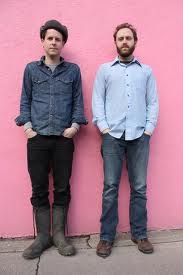 Siskiyou has had some medical problems and have canceled their recent tour. They are also going on a brief haitus. This is a shame as after their second album, they really had momentum and they sounded better than ever.
As a kind of peace offering to fans who would not be able to see the band, they recorded a cover of The Flaming Lip’s “Bad Days.” The cover souds remarkably like the original, with one big difference: rather than squalls of feedback, Siskiyou uses only piano. And it works very well, getting down to the basics of the song and sounding a bit like Wayne Coyne singing.
It’s a nice tribute and a nice “until later”
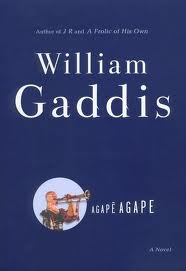
[READ: August 27, 2012] Agapē Agape
I have a long history with this book.
I was working at Baker and Taylor, a book supplier, when this book was released. Some of the higher ups were able to get free books from the publishers they dealt with. The guy who dealt Viking was not the friendliest guy, but since B&T paid absoluet crap wages, I was going try to get any books I could for free. So, I asked for this book. It was embarrassing enough to walk in and say this title with confidence, since I knew how it was pronounced (yes I took Greek in college), but knew he didn’t. After some groveling, his reaction led me to think I wouldn’t be getting it.
But lo and behold a few weeks later it was sitting on my desk.
And now, ten years later, I’ve finally read it.
In JR, Jack Gibbs is writing a book with the name Agapē Agape, it is a jumbled history of the mechanization of the arts, starting with the player piano. JR was finished in 1975–who knows for how long he had been working on it until then. According to the Afterword of this book by Joseph Tabbi, Gaddis was pretty all-consumed by the idea of the player piano. (It’s really quite an obsession).
This book is the culmination of all of Gaddis’ work on the player piano and how it removed all of the artistry from music (this theme of art and mechanization is in JR as well). But rather than write this as an essay, which he didn’t think would be very effective, Gaddis decided to make this a novel. I admit to not really knowing if he finished it–Gaddis died in 1998. While it doesn’t feel unfinihsed, I’m just not sure if he was “done” with it.
Agapē Agape is 96 pages of rather large type. It seems like it should be the kind of book you polish off pretty quickly. And yet…there are no paragraph breaks, and there are precious few periods. This is a stream of consciousness meanderings of an old and dying man. The Afterword is helpful in solidifying some detials–like that the narrator is on prednisone (which Gaddis himself was on for emphysema), a drug whose effects are “consistent with the peculiar pacing of the narrative he left us–its meandering, hallucinatory quality that suddenly comes to focus on one particular object” (104).
I use that quote as something of a descriptove of the novel–which is indeed meandering. The whole book is a straeam of consciousness rant from a dying man. The man is intelligent and has done a lot of reasearch–he name drops constantly. I haven’t read most of the authors he refernces–and many of those he refernces casually assuming you would already know the conetnt. The narrator is agitated and impateint, so you get this sense of an absolute rant.
As with JR, there are no strctural niceties to the book–the book starts in the mans’ thoughts and never leaves. So we get what he is thinking about in terms of authors, pianos, his breathing, taking the drug, his own mortality–it’s all crammed in there.
All of this leads to me saying that it is not an easy 96 page read.
And while it is nowhere near as obtuse as Gibbs’ Agape Agape in JR, it is not always easy to follow. The basic premise is well done and easy to follow–the mechanization of the arts and that damned player piano. And most of what he quotes from different authors who support his rant. (He even repeats the joke from JR about Plato rhyming with tomato).
I can’t say as I enjoyed the book very much. It was hard to follow and frankly I just can’t get that worked up about a player piano. I loved JR, so it wasn’t the style that I didn’t enjoy (although the fun of JR is figuring out who is speaking which isn’t necessary here. But the content was a little less than exciting. It’s nice to have read it (and I’m glad I did), but unlike JR which I would encourage pople to read if they could get past the style, I can’t really recommend this one to anyone.

 I Just Read About That...
Leave a comment