 SOUNDTRACK: PINK FLOYD-the final cut: a requiem for the post war dream (1983).
 My college experience seems very unlike many people’s (especially the stories I hear from you young kids today). And I’m just talking musically. I went to college in the late 80 and early 90s. And my freshman year, the most popular albums on campus were Steve Miller’s Greatest Hits, Squeeze’s 45s and Under and Pink Floyd’s The Wall. My friend John also loved this album. And I think we listened to it hundreds of times, blasting out of dorm room windows.
It’s kind of strange that college freshmen would embrace an album about (more or less) Roger Waters’ father dying in WWII, especially since none of our fathers had died at all, much less in WWII. But angst finds its home I suppose.
This album is not a sequel to The Wall, but it has echoes (see what I did there) from that album. There were touches of WWII in The Wall. And sonically a lot of this album sounds similar. The big difference is that Roger Waters wrote pretty much the whole thing, long time keyboardist Richard Wright left the band and David Gilmour, sings on only one song. So, it’s practically a solo project (and it fees a lot like Waters’ solo album The Pros and Cons of Hitch Hiking).
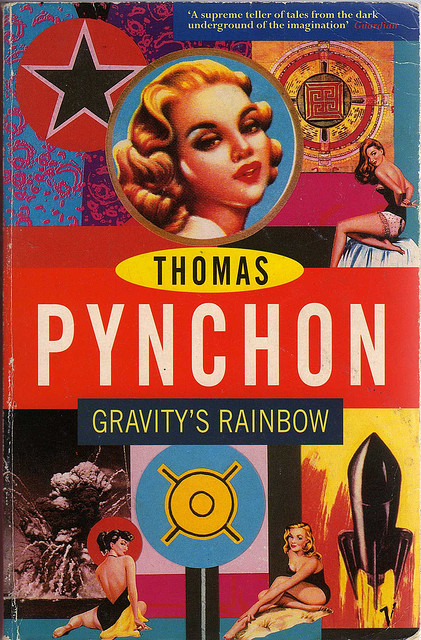
This album seems to have alienated fans of Floyd. But I happen to like it quite a lot. And, I it a lot while reading Gravity’s Rainbow.
“The Post War Dream” opens with military sounding horns and funereal organs, as befits an album about the war. It also has an intriguing assortment of sound effects (I wonder where he gets most of this stuff). It sounds very Pink Floyd–Roger Waters’ voice is pretty unmistakable). But “Your Possible Pasts” sounds even more Pink Floyd. Evidently this album has a number of songs that were cast offs from The Wall. If that’s true, this is probably one of them, as it sounds like it could easily fit on that album–especially when the keyboards kick in during the second chorus (even if Richard Wright wasn’t on the album). And the guitar solo is so David Gilmour–that’s what you call a signature sound.
“One of the Few” has something I love from Floyd–whispered vocals (“teach”) and creepy laughing; it works as a nice transition to the louder “The Hero’s Return.” This track is very complex–all kinds of tonal shifts, echoed vocals and bitter lyrics. It explodes into “The Gunner’s Dream,” a gentle piano ballad about a soldier being shot down. It’s a surprisingly tender song (although not really given the topic of the album) and lyrically it is really impressive. I don’t really care for the saxophone solo–it’s not my thing, but I think it actually works well for the song. And, again the end sounds like it came from The Wall (Waters is amazing at angsty screams).
“Paranoid Eyes” is a delicate song that works, for me, as lead in to the wonderful “Get Your Filthy Hands Off My Desert” a short, string-filled somewhat goofy song that is very bitter under its seeming jocularity. It’s followed by “The Fletcher Memorial Home,” a really dark track about old age with a lot of current political commentary thrown in (although the “group of anonymous Latin American meat-packing glitterati” always confused (and amused) me. So even though it is “about” WWII, there’s plenty of anger at current political climate, right Maggie?. Boom boom, bang bang, lie down, you’re dead–take it away David…
“Southampton Dock” is another gentle song, more of a story with musical accompaniment. It segues into “The Final Cut” a fitting piano end to a sad album about death and loss, that also happens to reprise song elements from The Wall.
But that’s actually not the last song. We get the incongruous “Not Now John.” It really doesn’t fit with the album at all (I happen to love it, even if it doesn’t). It’s way over the top, including the how-in-the-hell-did-they-think-this-would-be-a-single? opening lyrics: “fuck all that we gotta get on with this. (fuck all that).” And yet, single it was, reaching #7 in the US. Man it rocks. Oi, where’s the fucking bar, John?
The album ends properly with “two suns in the sunset” a mostly acoustic track that returns the mood to more sombre feelings (except for the rocking section where you drive into an oncoming truck). Never has futility felt so upbeat. For an album as personal as this is, it really draws the listener in. Of course, if you don’t want to be drawn in, it’s easy to resist, as many have.
The reissue (which I don’t have), includes the cool song from The Wall movie, “When the Tigers Broke Free.” Which I imagine would work quite well contextually.
[READ: Week of April 30] Gravity’s Rainbow 4.7-end
And the book ends with a bang and a lot of leftover questions. My first reaction is that I can’t get over Pynchon spent so much time in the last 60 pages talking about things that had nothing to do with the “plot” per se. I never really felt like the story was all that hard to follow until the end, when Pynchon let loose the dogs of war on his writing. There are several pages of stream of consciousness reverie where I was completely at a loss. Of course, this has been true for much of the book–Pynchon would talk about something and then cycle back into it, filling in the gaps that he left open. The whole book seemed to have this kind of coiled effect (perhaps a slinky). He would set up a scene as if you had been there all along. And while you were puzzling over just who the hell he was talking about, he would flashback to whatever you needed to fill in the missing pieces. And he is still doing that as the story comes to a close.
And although it starts out with a familiar figure, he quickly takes something and has a massive hallucination. Is this even true?
As Section 4.7 opens, Tchitcherine has abandoned the stakeout on the Argentinian anarchists. Tchitcherine’s “supervisor?” is in town. His name is Nikolai Ripov and he is the Commissariat for Intelligence Activities. Even Džabajev has taken off on a wine-drinking binge posing as Frank Sinatra (and fooling everyone!). Tchitcherine is alone. He thinks back to Wimpe and their discussion of Marxist politics (Wimpe believing that Marxist dialectics were as much an opiate as anything else).
Wimpe also believed that the basic problem has always been getting people to die for you—trying to find out what it’s worth for them to give up their life. He says that religion was perfect at getting people to die for a set of beliefs. Their discussion is assisted by syringes full of Jamf’s Oneirine theophospate “(Tchitcherine: “You mean thio-phosphate, don’t you?” Thinks indicating the presence of sulfur… Wimpe: “I mean theo-phosphate, Vaslav,” indicating the Presence of God) (702). In fifteen minutes they are wild, embraced by Jamf’s so-called “Pökler singularity,” a hallucination that overtakes all five senses and is often known as a haunting. The hauntings offer a narrative continuity, and as far as hallucinations go, they are pretty minor—Jaach calls them “the dullest hallucinations known to psychopharmacology” (702) They’re nothing big, just the realization that everything in Creation is connected.
The subsection headed Tchitcherine’s Haunting discusses Ripov’s arrival: heavy and inescapable. He says they know that Tchicherine is in trouble. But all Tchitcherine wants to know is if he was supposed to die during the war. Ripov says no one want wants him to die. “You’re not much use dead” (704). He also says there is no life after death.
Tchitcherine suddenly leaps at Ripov, but other agents stop him. Then there is a girl at the other side of the room. He doesn’t recognize her but it is Galina, come back to the cities.
Finally Ripov asks why he is hunting his black brother. Tchitcherine says he thought he was being “punished. Passed over. I blamed him” (705). Ripov wants to know if he will ever rise above old barbarisms like blood lines, personal revenge. He says that Enzian is not his target, that others want him. He says that Tchitcherine is free to go. And he is free to go on survivor’s leave before returning to Moscow.
 Section 4.8 returns us to Roger Mexico and friends with the very real question, “what searcher has ever been directed north?”
Ensign Morituri, Carroll Eventyr, Thomas Gwenhidwy and Roger are sitting at a table in Der Grob Säugling (The Gross Suckling) at the edge of a beautiful sparkling lake. They are discussing the rocket and how it was fired everywhere but north. It was fired southward (Antwerp), westward (London), eastward (Peenemünde) but not northward. Taking the measurements of all the others, the 00000 should be fired at True North–0 degrees.
The Gross Suckling has a sign with a fat baby reaching out for a nipple while eating a ham. Roger imagines that this is Jeremy as a child. Ah yes, Jeremy. Jeremy now knows everything that happened between Roger and Jessica. He has forgiven Jessica (Jeremy was no saint, the War takes its toll, all kinds of reasonable bullshit like that). Even worse, he seems to be trying to impress Roger! He also has most tasteless pipe that Roger has ever seen: Churchill’s head for a bowl, with a cigar in his mouth which smoke comes out of too!
They are enjoying a presumably awkward evening together with Roger getting very drunk. There’s also a “calibration test” in which Roger has planned for two men to leap out at Jeremy while he walks in the park. They will proceed to beat each other with seven-foot long foam penises (fully detailed and realistic!). Roger and Bodine stage these fights often (and make a nice bit of change from it). It ain’t a pie in the face, but at least it’s pure.
Jessica tells the table that she and Jeremy are to be married and are trying to have a baby. Roger states that he doesn’t care, he’ll take care of anyone’s baby if she’ll come with him. She calls security on him, but Jeremy waves off the cops. Then, awkwardly, Jessica gets “sick” and the men talk a about Operation Backfire, which is designed to reassemble A4s and fire them into the sea. Roger can’t imagine why they would reassemble them just to fire them into the sea. Jeremy says, “to see, obviously.” Upon being asked if Roger is a math chap, there’s this wonderful exchange:
“Little sigma, times P of s-over-little-sigma, equals one over the square root of two pi, times e to the minus s squared over two little-sigma squared.”
“Good Lord.” Laughing, hastily checking out the room.
“It is an old saying among my people.” (709).
[I don’t have the energy to figure out of that math means anything].
 Jeremy invites Roger and a guest to a dinner party at the Krupp works in Cuxhaven. [This is not Krups the coffee maker makers. The Krupp they are talking about is a military industrial conglomerate].
Roger believes it’s a setup: a) Operation Backfire b) Krupp executives c) at least one ear who heard of the Urinating Incident. But as the narrator tells us: “If Roger only knew what Beaver and his friends really have in mind” (710).
Roger’s chooses as his guest Seaman Bodine. And Bodine has a fantastic zoot suit—lapels reinforced with coat hangers, quintuple pleated pants belted under his armpits. It’s paint-blue. “At gatherings it haunts the peripheral vision, making small talk impossible” (710). [There’s a lot of things in this book that I would really love to see, this is not number one on that list].
But Bodine seems reluctant to go and Roger whines that Bodines’s lost his sense of adventure. Then he drags him off to the Krupp shindig. At the Krupp affair, the string quartet features piano dweller, Gustav Schlabone (Captain Horror). They are playing Haydn Op. 76, the so-called “Kazoo” Quartet in G-Flat Minor [I now wish I had been paying attention to all of the kazoos in this book–there are dozens of entries for the word]. The Inner Voices play kazoos instead of their usual instruments.
Slothrop’s here too. And this is the first mention of the eventual disintegration of Slothrop as an individual, “because by now–early Virgo–he has become one plucked albatross. Plucked, hell-stripped. Scattered all over the Zone. It’s doubtful if he can ever be ‘found’ again, in the conventional sense of ‘positively identified and detained'” (712).
Then we get reminded of Section 4s titular Counterforce, which if they knew better would be able to deal with the Man, but they are as schizoid as the rest of us. The Man has an office in each of our brains and the symbol is an albatross (the local rep’s cover is the Ego). Their mission: Bad Shit. They will use us to achieve their ends. And Roger has to wonder what is worse: living on as Their pet or death?
After a musical interlude…the dinner continues and “the plot against Roger has been formulated with shivering and giddy glee” (713). Seaman Bodine is just a bonus.
 The meal opens with Überraschungbraten (which is a nice call back to earlier in the book because it means Surprise Roast). When Bodine looks down the table, Roger’s mouth is being held open and he is being given a vigorous tooth brushing by several maids. Looking further he notes that on the spit is turning a person, “whose face is about to come rotating around, why it’s—“ (714). [Who? What? Drugs? Reality? WTF?] Immediately scenes from The Cook The Thief His Wife and Her Lover pop into my head.
Someone starts shouting for ketchup (which the narrator tells us is a code word).
At the same time, Brigadier Pudding is floating above the room—he is part of the Counterforce thanks to Carroll Eventyr. Sadly he talks more now that he’s dead than he did when he was alive.
 Then Bodine and Roger work on grossing out everyone at the table (and now the scene from The Meaning of Life pops in to my head). The list of offensive foods is amusing and staggering: snot soup, pus pudding, menstrual marmalade, clot casserole, vomit vichyssoise (coming from Commando Connie—dinner companion Constance Flamp, loose-khakied newshound, who also comes up with Hemorrhoid Hash and Bowel Burgers).
Jessica has to be escorted from the premises by Jeremy who hauls off and gives Roger a dirty looks. And just in case we though that Pynchon had lost his knack for names: Mnemosyne Gloobe is having a seizure of some kind. [So, was there a person on the spit or what?]
As the puking continues, Roger, Bodine, Gustav and the quartet sneak out. And the scene ends in disgusting merriment.
Section 4.9 opens with Geli Tripping (jeez I even forgot who that was–she’s Tchitcherine’s lover who helped Slothrop escape via balloon) carrying a bunch of personal effects from Tchitcherine and some herbs. She is off to find her man. Of course there are hundreds of women smitten with Tchitcherine all over the Zone, but none, except Geli, are witches.
The Blacks have left Nordhausen and Geli knows they are on a collision course with Tchitcherine (who is known by some as The Red Doper). She hears various things about her man: that Ripov is meant to intercept him, or that he is already dead, or that there’s an impersonator, but she carries on.
The story shifts abruptly to Gottfried! Many many posts ago I wondered if we’d ever find out what happened to him. And by golly, do we ever! Indeed, he is essential to the end of the book. We are at the point where things are going bad for Blicero. [And frankly, at this point I find the whole timeline of this book to be very very confusing. When does this happen with Gottfried and Blicero. Isn’t Blicero dead by the time the 00001 is assembled? Is this all flashback?]. Gottfried cannot imagine being separated from Blicero, but the war will be over any day now. Blicero is even feeling somewhat emotional about things—actually talking seriously to Gottfried (and neither one is dressed as a woman either).
There are several paragraphs in quotations that I take to be Blicero’s dialogue. Mostly he talked about the next edge of the World. It was once America. Will the moon be next? He remembers Gottfried talking about living on the moon with Blicero someday [a nice call back to Pökler and his daughter]. After some serious soul searching, in which Gottfried sees Blicero really look at him for the first time, he realizes he has a decision to make….
Section 4.10 zooms back towards Enzian and his men ramrodding their brand new rocket through the night: “It is 00001, the second in its series” (724).
Despite my best efforts, the narrator finally lost me now—There is talk of the Rocket and loving the Rocket and Rocket state-cosmology. Someone is creating what looks like a daguerreotype of the early Raketen-Stadt (in 1856). This picture killed the photographer—mercury poisoning which may have had something to do with the look of the picture. I assume this is all in Enzian’s head? He thinks about the parabolic arc and how what we see above the earth is only the tip–the rest is inside the earth. Talk of Kabbalists studying the Rocket as Torah, Manichaeans who see two Rockets, good and evil (some say their names are Enzian and Blicero). A good Rocket to take us to the stars and an evil Rocket for the World’s suicide. [Really, at this point, I just want some more plot].
Back to practical matters, the Schwarzkommando (and the children who tagged along and are now sick) are taking the rocket across the countryside in pieces—hiding it under carts, under hay bales–for its eventual reassembly. This is Destiny.
Enzian and Christian debate while they walk. Enzian says that They have never done anything for everyone else—They can’t even keep us from catching cold. But the Rocket will penetrate Them. The Schwarzkommandos stop when they reach a German weapon that failed–the sonic death mirror (how can there not be a band with this name?). The mirror didn’t work, but it might have worked in a desert—fewer obstructions. Katje asks who would fight for a desert. Not for, Christian emphasizes, in a desert. A great observation from the narrator; “Saves trouble later if you can get the Texts straight soon as soon as they’re spoken” (729).
A hundred meters away, watching them is…Ludwig! And he found Ursula! He’s been trailing the convoy (did they really not see a chubby white kid trailing them?) looking for evidence. All he’s seen so far is a chewing gum and foreign cock.
Enzian and his men travel on. They get to a checkpoint but Enzian realizes it’s a man in black face (rain beading on him unnaturally). They back up to avoid the fight, but see that several of their men are dead. So they call for all personnel to halt while they deliberate. There is tension between Enzian and Andreas about who is going to “make it” (are the decoys sitting ducks?). Enzian manages to smooth things out and then Josef Ombindi, leader of The Empty Ones offers his own questions. And after a few minutes of Enzian chewing gum at him, he relieves all of Ombindi’s men of their duties.
Section 4.11, the penultimate chapter in the book…is two pages long [!]. And the first half of it is about a graffiti. It speaks of an idyll, the location where Geli finds Tchitcherine. She casts her spell and they reunite, lying naked on a cold grassy bank. Tchitcherine wakes and hears a convoy approaching. He sneaks up and asks for some food and a smoke. Enzian stops his motorcycle to talk to the white man. He gives him half a pack of smokes and three potatoes and then drives off.
This section, and this whole plot line concludes: “This is magic. Sure—but not necessarily fantasy. Certainly not the first time a man has passed his brother by, at the edge of the evening, often forever, without knowing it” (735).
Section 4.12 is the final section of the book. We’ve made it!
And the final section, the one that is going to clarify everything we’ve seen, begins:
By now the City is grown so tall that elevators are long-haul affairs, with lounges inside: padded seats and benches, snack bars, newsstands where you can browse through a whole issue of Life between stops. For those faint hearts who first thing on entering seek out the Certificate of Inspection on the elevator wall, there are young women in green overseas caps, green velvet basques, and tapered yellowstripe trousers–a feminine zootsuit effect–who’ve been well-tutored in all kinds of elevator lore, and whose job it is to set you at ease (735).
Oh for fuck’s sake.
Shake it off, man, keep pushing on. But even more confusingly, the nice lady, Mindy Bloth of Carbon City, Illinois, tells us that “before the Vertical Solution, all transport was, in effect two-dimesnional” (735). She interrupts a heckler by saying he was going to ask about airplanes, when in fact he was going to ask about rockets. The topic jumps to the changing shape of an orifice as we pass it. Which Mindy assures us is what happens, despite the heckler. [So, this is in the future right–post explosion by rocket?].
Then we shift to a gentleman in an office asking Marie, “where you ladies hiding the drawings on the SG-1… what do you means Field Service has them…again?” (736). This transpires while the Lübeck Hitler Youth Glee Club (although their road name is The Lederhoseners) sings a song. Everyone in the room, when looking at the leather-encased buttocks of the Glee Club, has an erotic fantasy about them, evidently. Thanatz asks if all fantasies were learned when we were children: “That somewhere tucked in the brain’s plush album is always a child in Fauntleroy clothes, a pretty French maid begging to be whipped?” (736). Turns out that Ludwig is with Thanatz (with his ass on his hand). Thanatz is extolling the virtues of S&M in a disapproving society. They frown on S&M because They want us to submit to Them, not each other: “if S and M could be established universally, at the family level, the State would wither away” (737). Call it “Sado-anarchism”.
 The Schwarzkommandos have made it to the Lüneberg heath at last. And just as we start to talk about the 00001, the narrator starts telling us about a kid who hates kreplach. He breaks out in hives in the mere presence of it. The psychiatrist tells his mother to make it with him watching, have him help, even, so he can see it coming together. He’s fine all the way through until she folds it over into a tri—“GAAHHHH!-kreplach” (737).
There is also the story about Tyrone Slothrop:
who was sent into the Zone to be present at his own assembly–perhaps, heavily paranoid voices have whispered, his time’s assembly–and there ought to be a punch line to it, but there isn’t. The plan went wrong. He is being broken down instead, and scattered. His cards have been laid down, Celtic style, in the order suggested by Mr. A. E. Waite, laid out and read, but they are the cards of a tanker and feeb: they point only to a long and scuffling future, to mediocrity (not only in his life but also, heh, heh, in his chroniclers too, yes yes nothing like getting the 3 of Pentacles upside down covering the significator on the second try to send you to the tube to watch a seventh rerun of the Takeshi and Ichizo Show, light a cigarette and try to forget the whole thing)–to no clear happiness or redeeming cataclysm. (738)
Wait what? The tarot theme runs through this last section and I am simply waaaay to unversed in Tarot to make heads or tails. I understand in general, but as to the specifics, no. There is a nice parallel here with Weismann’s Tarot reading a little later, but again, I missed the details.
And then analyst Mickey Wuxtry-Wuxtry said “There never was a Dr. Jamf,” Slothrop created him to help explain the feelings in his genitals when the rockets exploded. This helped him disguise the truth that he might be in love with his race’s death.
A spokesperson for The Counterforce says they were never interested in Slothrop qua Slothrop he was more of a pretext. And then in a bracketed aside, he explains that he was a traitor—he caught some people in the Underground. “Between two station-marks, yellow crayon through the years of grease and passage, 1966 and 1971, I tasted my first blood” (739). Wait what? Is this story being told in past tense from post 1971 (when it was written), is this some kind of clue for who the narrator is?
Then there’s something listed as Item S-1706.31, a fragment of undershirt with blood stain. This cloth was given to Slothrop by Seaman Bodine. The evening it happened reprised their first meeting. Bodine is singing. He currently has a siren ring lodged in his asshole to punctuate his music with farted WHEEEEeee’s” (740) that is pretty funny, but we have only 20 pages left, why is talking about farted Wheees? Because it is an introduction to more about Slothrop, with again something important in parentheses: Bodine looks straight at Slothrop:
(being one of the few who can still see Slothrop as any sort of integral creature any more. Most of the others gave up long ago trying to hold him together, even as a concept–“It’s just got too remote” ‘s what they usually say). Does Bodine now feel his own strength may someday soon not be enough either: that soon, like all the others, he’ll have to let go? But somebody’s got to hold on, it can’t happen to all of us–no, that’d be too much… Rocketman, Rocketman. You poor fucker (740).
The blood on the cloth is John Dillinger’s (Bodine was there when he was shot and killed).
[It slowly starts to dawn on me that this must be the future. Things that seem odd are signs of the future. Bodine is letting Slothrop go…. They have won…. Bodine is spending more time with Trudi, because her friend Magda was “picked up on first-degree mopery and taken back to Leverkusen” (742). This little subsection ends with “the object of life is to make sure you die a weird death” (742).
Next is Item S-1729.06 a bottle with May wine. Slothrop had run into the AWOL Džabajev, which is where he presumably got the wine. Whatever town they are currently in (would this be von Göll’s fake town?), they are planning to ask Great Britain for Commonwealth status and to apply for membership in the UNO. And at this festive gathering tonight they will inject Wine! A wine rush is defying gravity. You separate in two and each part is aware of the other.

Not Slothrop’s band
Another parenthetical suggests that Slothrop’s fragments are scattered all over the Zone and that all of the current population are offspring of this somehow. There’s even a joke about his last photograph being on an album by The Fool, an English rock group. Seven men posed in the arrogant style of the early Stones (ie. circa mid 60s) where he is credited as “a friend” playing harmonica and kazoo.
Now, until the end, the section is split into small sections. Each one has a heading in all caps.
The first: The Occupation of Mingeborough.
This is a flashback (real?) to Marjorie and Pete Dufay who will have a daughter named Kim. Kim’s braids are dipped into ink by Hogan Jr (this would be Tyrone’s nephew). This will happen whether Slothrop is there or not. Slothrop wants to get home through his shortcuts but the occupation may have blocked them off already.
The second heading: Back at Der Platz
Gustav and Andre, back from Cuxhaven, have made a nice water pipe from a kazoo—which turns out to be the optimum hashpipe design. It also has the exact same thread design as a lightbulb socket. (Which Gustav says is a sign of Phoebus). Gustav proves it by inserting a bulb into the kazoo (which is of course, Byron the Bulb–I’m not sure if that payoff was worth the long story last week).
Under the rug in Der Platz is a movie on a 24 hour loop. It’s an offensive and repulsive film by von Göll called New Dope. It’s about a brand new kind of dope that no one heard of—once you take it you are incapable of telling anybody what it’s like or where you get it. I enjoyed the line: “All you can hope is that you’ll come across somebody in the act of taking (shooting? smoking? swallowing?) some” (745). [Surely I’m not the only one who thought of Infinite Jest’s Entertainment here.] In the film it’s a backward world where bullets go into guns and corpses rise back to life. Imagine editing this. A title pops up “Gerhardt Von Göll becomes sodium amytal freak! And then there’s some gibberish from Der Springer.

I ching
Then a funny thing from friends of Magda, [I really chucked at this lame joke]: “devotees of the I Ching who have a favorite hexagram tattooed on each toe, who can never stay in one place for long, can you guess why? Because they always have I Ching feet!” (746).
Then we see Weismann’s tarot. Weismann is “covered” by The Tower. He appears on a black horse, charging out of control. He’s the father you can never manage to kill. The Tower is also The Rocket. He is crossed by the Ace of Spades. And there’s a whole bunch of stuff about The Qlippoth (which is the representations of evil forces in the mystical teachings of Judaism, such as in the Kabbalah). [Who ever would have guessed this book would have started talking about the Kabbalah?]
Then a series of short sections, each as puzzling as the next: The Last Green and Magenta; The Horse; Isaac. They are all precursors to Pre-Launch which returns us to Gottfried.
Weismann has Gottfried dressed symbolically, complete with candle, as he gets him ready to climb into the womb that is 00000. ” Get ready, Liebchen.” He has a speaker in his ear through which he hears the words of Weismann—but there’s no return channel to the ground. The exact moment of his death will never be known.
The section headed Chase Music tells us that finally, after a career of saying he was too late, but not actually being too late, “Sir Denis Nayland-Smith will arrive, my God, too late.” (751). This is followed by examples of various superheroes being too late—something that never happens–and what impact it has on them.
Quick shift to Pointsman. He actually misses all those dogs because everything he experiences now is odorless, touchless. At first he liked the sensory deprivation, but even that grew tiresome. He has basically given up on everything.
Jump to Countdown. Which tells us that the countdown we know: 10-9-8-u.s.w. was invented by Fritz Lang in 1929 in the film Doe Frau im Mond (true, apparently). Kabbalists says the earth was Created in 10 sections (Spehiroth) and we must travel through all of them (10-1) to return to God. Sephiroth is called the Tree of Life which is rooted at the Bodenplatte. Steve Edelman has been telling this Kabbalistic story. He also pops a ton of Thorazine. His children had been spiking his jar with water capacitors from transistor radios. He nearly died, but his wife discovered the prank in time.
Wait, someone has actually found the Bodenplatte? The Pole? Yes, The Kaiserbart Expedition found it, which is obviously a pseudonym, the Kaiser has no beard. [There really was a Operation Bodenplatte, although I’m not sure if this is what he’s talking about]. There’s even a video about it:
Back to Gottfried (Strung Into the Apollonian Dream…) where he has found the Imipolex shroud. And it calms him. All is well.
Orpheus Puts Down Harp switches gears entirely, taking us, via newswire to Los Angeles. Where Richard Zhlubb, night manager of the Orpheus Theatre on Melrose has come out against “irresponsible use of the harmonica” (754). Joking to the last, Pynchon gives Zhlubb an adenoidal condition and he calls it a harbodica. Zhlubb decries Steve Edelman as a ringleader of this group. Edelman was accused of Attempted Mopery with a Subversive Instrument–he attempted to play a chord progression on the DOJ list. And now they’re all doing it. Zhlubb brings us out to the Santa Monica Freeway, a highway for freaks—playing harmonicas and even kazoos, despite the Prohibition. Zhubb’s car is rigged with sound effects and audience reactions. He explains that you need to talk in code. [I love this little bit]: “We always have. But none of the codes is that hard to break. Opponents have accused us, for just that reason, of contempt for the people. But really we do it all in the spirit of fair play. We’re not monsters. We know we have to give them some chance. We can’t take hope away from them, can we?” (756). Zhlubb says he has a fantasy of dying while driving on this very freeway and a dry cleaning bag slips over his head and he barely notices. And then there’s a siren:
But the sound is greater than police. It wraps the concrete and the smog, it fills the basin and mountains further than any mortal could ever move… could move in time…
“I don’t think that’s a police siren.” Your guts in a spasm, you reach for the knob of the AM radio. “I don’t think–” (757).
The first of the final three sections: The Clearing.
Blicero shouts “Räumen” (clear). And then through a series of German checks and clearances, they ignite the rocket with Gottfried inside.
Ascent
Gottfried refuses to cry out and he thinks of his love for Blicero. He thinks of this rocket as a Bleaching, as a whitening, an abolition of pigment. Now—
Descent
The scene opens with a group of people sitting in a theatre. The film has stopped, they are chanting to start the show. And it is above this theater that the Rocket reaches its delta-t. If you’re freaked, there is time to sing a song which They never taught you. It was by William Slothrop, and is now out of print:
There is a Hand to turn the rime,
Though thy Glass today be run,
Till the Light that hath brought the Towers low
Find the last poor Pret’rite one…
Till the Riders sleep by ev’ry road,
All through our crippl’d Zone,
With a face on ev’ry mountainside,
And a Soul in ev’ry stone…
And the story ends, dragging us into the tragedy with everyone else:
Now everybody—(760).
—–
I finished this a few days ago and I’m still mulling it over. I’m thinking maybe by the end of the week or next week I’ll write a more thoughtful bit about the book. But for now my initial reaction to the end is kind of negative but mostly puzzlement. As I’ve mentioned I wasn’t expecting everything to tie up with a neat bow. The story was clearly not going to do that. But I’m disappointed that so much of it was left so…confusing.
I’m confused as to exactly what was happening in the end. Why was a rocket landing on a movie theater…possibly in L.A.? Was that the 00001? Did it abruptly shift from Gottfried in the 00000? And was all that Raketen-Stadt meant to be real? Were we seeing a post-bomb world (which was set in the 70s?)
On a more practical level, what happened to everybody? If I accept that Slothrop more or less disintegrated into the Zone, which I can, what about everybody else? Katje was with the Schwarzkommando, presumably they set off their bomb…now what? What about the men? Roger Mexico, when last seen, was leaving a puking contest. What happened to him? Is there some kind of Infinite Jest the-end-is-in-the-beginning business that I missed completely? And what about the narrator, is there one? or five?
I suspect I will read some kind of commentary on this book in the near future, but I’m very curious about what other people have to say about it.
The strange thing is though, up until Section 4, I really enjoyed the book quite a lot. I even enjoyed parts of Section 4. I didn’t stop enjoying it because of the denouement, I just stopped enjoying the craziness by the end. Maybe it was one hallucinatory episode too many for me. I enjoyed be along for the crazy ride, but I would have liked the ride to end properly, not mid spin.
Anyone else?
For ease of searching, I include: Dzabajev, Saugling, Uberraschungbraten, Peenmunde, Saure, Pokler, Luneberg,

 I Just Read About That...
I think what I said about the first part of Part 4 also applies here: the book simply becomes too hallucinatory for my tastes.
This is also something that I found confusing on my first read. This time I knew about Gottfried’s fate in advance, so it was clear to me from various references in the book (and, of course, Weisenburger didn’t hurt) that the 00000 launch happens on Easter Weekend, before the end of the war. 00001 doesn’t get launched — I don’t think — within the timeframe of the novel, and one mystery I was hoping would get cleared up but didn’t is of who would play the role of Gottfried in Enzian’s launching.
I don’t see how the movie theater rocket could be 00001, based on geography, yes, but also because 00001 is launched in 1945 and there’s much evidence that the movie theater scene takes place in Pynchon’s present day at the time of writing. (With Richard M. Zhlubb being a Nixon stand-in.) I can only imagine that it’s meant to connect the issue of rocketry with the cold war era threat of nukes, and of the general theme of death and uncertainty with the reader’s death itself. But I sadly don’t have much more insight into this.
One last point: Weisenburger has been very helpful in this read with explaining many of the allusions to Kabbalah and Tarot, and they are legion throughout the book. (According to W. the coprophilia is an inversion of a Kabbalistic ascent of a Merkabah throne.) In the end I can’t say that any of that helped elucidate the book for me in any significant way. But it is helpful to see how much of what seems almost like nonsense in the novel is actually carefully rooted in cult practices.
Marco, thanks so much for your help with the book. I’m always torn about secondary resources when reading books like this. I know they are immensely helpful, but I also don’t want to know too much ahead of the game either. And Lordy, if I had time to read a companion book with it, I’d be a lucky man. I think the Weisenberger is probably an essential read for me, maybe in the not too distant future. I did look at a few online resources and they did help with some of the confusion.
I’m with you on the Blicero/Gottfried launch at the end being in the past (I wouldn’t have guessed Easter weekend, but I’ll take that insight). I was putting it in my head that Katje would be the stand in for Gottfried for the 00001, but that seems almost too easy/obvious/synchronous. And I hope that’s not what happened.
I like the idea of Zhlubb being Nixon. It doesn’t strike me as biting political commentary, but it is still funny. I don’t really know much about the mood of the country in 1972/3, but I can certainly see a tie in with nukes, and the end of the world from rockets. I think it’s Wikipedia that suggests that the theater is in England, but that doesn’t really sit well with how I read it.
“According to W. the coprophilia is an inversion of a Kabbalistic ascent of a Merkabah throne” That is an insight I would never have imagined. Ever 🙂
Also, knowing about the cult connections makes a lot of sense. There’s certainly enough of them in the book–all kinds of searching for meaning in something. That seems like an interesting thing to look for in a future read (along with the narrators).
I totally accept that Pynchon is doing way more than I could see, and he has certainly earned all of the craziness. I guess at this point I have to wonder if I’m willing to do the work to read this again.
Hmmm, wonder if there’s an audio book.
Argh, I just left a lengthy comment on this and WordPress seems to have eaten it.
Suffice it to say, I was still confused in the second part of part 4. I also pointed out that the 00000 launching does indeed take place in the past, on Easter Weekend before the end of the way. (And that I was unsure who played Gottfried’s role in the 00001 launching that doesn’t occur in the timeframe of the book.) And that the movie theater scene does seem to take place in Pynchon’s present time when writing the book, with Zhlubb being a stand-in for Nixon, and the bomb being a cold war era nuke. (The book’s general theme dealing with death truly makes an impression with the reader.)
Lastly, I wanted to say that Weisenburger really helped me with the legion Kabbalah and Tarot references, but that even with that knowledge they didn’t elucidate much of the book for me, except to emphasize Pynchon’s fascination with cult practices.
And, of course, thanks again, Paul, for these helpful summaries.
Looks like it didn’t eat your original comment. I find WP to be maddening about losing connections sometimes. Many is the time I have clicked Send only to have a blank page returned to me and me muttering “Schwarzgerat” under my breath.