 SOUNDTRACK: FRANK ZAPPA-Civilization Phaze III (1994).
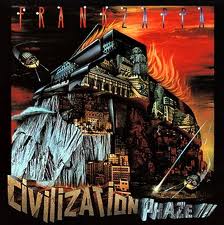 There were a number of choices for soundtracks for this week’s read. I could have chosen the Andrew Sisters (and their wonderful “Don’t Sit Under the Apple Tree”) who get a mention in the book. And, of course, I could have chosen Elton John’s “Rocket Man.” But, when I read Trudi tell Magda about her boyfriend Gustav who wants to live inside a piano, well, it was hard not to think of this, Frank Zappa’s final work.
Civilization Phaze III is an opera-pantomime. According to the libretto, “The speaking characters all wear oversized masks, gloves and shoes. They live in an abstracted grand piano….” And musically opens with this introductory spoken passage:
FZ: The audience sits inside of a big piano and they listen to it grow.
Spider: People are going to sit inside of a piano. They’re going to listen to this piano grow.
John: They’re going to listen to the piano grow?
Civilization Phaze III was released posthumously in 1994. But here’s the weird thing. Most of the sessions of “piano people” dialogue were recorded in 1967. Zappa had a bunch of people come into the studio, sit under a piano that was miked and improvise dialogue (sounds like the 60s to me). He released some of this dialogue on his late 60s albums, but as far as I can tell, the parts about the piano were never included (in Lumpy Gravy someone talks about wanting to live in a drum). I’m also not sure how well-known the “piano sessions” were at the time.
So, here’s the question…did Zappa influence Pynchon or did these two people come up with the same idea at roughly the same time. The reason Zappa put off using the material recorded in 1966 was because technologies were simply not advanced enough to let him manipulate the dialogue so it would sound decent, much less coherent. So Civilization Phaze III became his exploration of the past with contemporary technology.
He also recorded new spoken dialogue in 1991 and merged the two. It’s an interesting idea, but I fear that the new dialogue absolutely misses the vibe of the earlier dialogue. In the early dialogue, they all sounds like they’re stoned and are talking crazy nonsense about horses, smoke and music. The later dialogue is much more abrasive (especially Michael Rappaport, the only person who has since gone on to renown). At the time, Rappaport had been on one TV show as a guest, but by now he is too famous for this. I find him a distraction (not Zappa’s fault obviously), even more so because he talks as if he is black (he says “Nobody said nothin’ when y’all bought my people, right?”) while he is demonstrably not. And then ruins it contextually by mentioning Yo MTV Raps, the only thing that places the story in time. It’s weird that Frank wouldn’t have a black person say these lines, especially since he has so many other races and nationalities represented in his music. But maybe that’s me intellectualizing that I just don’t like Rappaport.
So, what’s this monstrosity about? I have no idea. Improvised stoner dialogue from the 60s is pieced together into a kind of story. Occasionally Frank’s voice chimes in and prompts them to talk about certain things (which is quite disorienting). And the whole “plot” well, I’m not even sure if it can be called a plot, but Frank tries to cobble something together–again, the 1991 dialogue seems to be more pointed, more about conflict, possibly something about overcrowding and racism, and there’s certainly some social criticism at work, but as for a story, well, not so much.
The music, on the other hand, is the culmination of Zappa’s more experimental, atonal “classical” music. Most of the first disc is performed on the synclavier while most of the second disc contains more actual musicians. The music is difficult and not to everyone’s tastes, for sure.
Atonal music is far more intellectual than visceral, so it’s hard to “enjoy” this music. Zappa obviously knew how to write catchy poppy friendly music, so this is a deliberate attempt to write something more challenging. I like Zappa’s crazy music in small dozes, so listening to this entire thing (over 2 hours) can be a tough in one sitting. But each piece (especially the two really long pieces “N-Lite” (18 minutes) and “Beat the Reaper” (15 minutes) ) showcases something interesting or satisfying.
The libretto that Zappa includes with the discs explains the story in far more detail and shape than one would ever get from listening to the music. Without the book, you would know that this is a dark and moody piece, but with the book, you can actually see what the music is showing. That may be a flaw, or that may be the way of a staged performance. I have no idea if it was ever staged.
There are certainly easier introductions to Zappa’s music.
[READ: Week of March 26] Gravity’s Rainbow 3.6-3.10
Last week was a bear of a read for me, but this week was so fast (and short) that I just kept going because I was so into the Slothrop story (I won’t go past the spoiler line, I promise). And yes, it’s (almost) all Slothrop this week.
Section 3.6 begins with Slothrop violently ill. [I admit I don’t think of novel characters as getting ill very much–unless it’s a plot point–but surely characters get colds and tummy aches just like everyone else, right?]. He drank out of an ornamental pond in the Tiergarten–but, duh, everyone knows to boil water before drinking these days. This also introduces Slothrop as Rocketman, something we won’t get more details on until later.
He’s having hallucinations and isn’t sure what’s real. When he thinks he hears a U.S. Army detail marching past he consides asking them to bring him back home.
After gaining enough strength, he stumbles upon the Schwarzkommando digging for pieces of rocket. The Schwarzkommando uniforms are a hodge-podge of Wermacht and SS, mixed with civilian clothes. But they all have one thing in common: a painted device in red white and blue [which I can’t believe I can’t find online].
It contains the letters K E Z V H in a circle. The insignia is adapted from German troopers in Africa, but the letters stand for “Klar, Entlüftung, Zündung, Vorstufe, Hauptstufe, the five positions of the launching switch in the A4 control car” (361).
While the Schwarzkommando dig things up, the town gathers to watch–with beer and a band and the air of a party. As they close in on the rocket, people start throwing mud, even at Enzian himself (Germans on shore are “politely aghast” at the lack of discipline). But the rocket proves a disappointment for Enzian; “outase” (shit); it is not Rocket 00000 (Fünffachnullpunkt). Enzian asks if Slothrop’s people are after it too. Slothrop says he doesn’t have any people.
They find a rocket whose warhead is unexploded. Slothrop says that Marvy was right–they didn’t disarm the Schwarzkommando. The answer Enzian is, “They didn’t know where to find us” (361). The follow up is wonderful, “There are now powerful factions in Paris who don’t believe we exist. And most of the time I’m not so sure myself” (361).
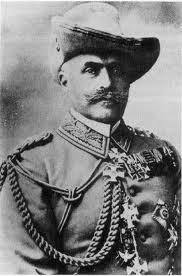
von Throtha
Slothrop doesn’t understand this reasoning, but Enzian explains that nearly forty years ago they were all wiped out…for no reason that they could ever determine. Not even the Will of God; only the will of Lothor von Trotha. Enzian continues that they have a mantra that they repeat when times are bad: Mba-kayere (“I am passed over”). They are also able to be unmoved by their own past. Enzian says that the reason they are attached to the rocket, the Aggregat 4, is because it is so powerful and yet it can easily it can be ruined by small things (dust, grease even rain).
Enzian’s speech ends with this no doubt prophetic line: “Stay in the Zone long enough and you’ll start getting ideas about Destiny yourself” (362).
Enzian wonders how Marvy’s people got along with the Russian at the Mittlewerk. Slothrop says they were like ace buddies. Enzian believes that there is a coordinated effort to shut them down from all fronts (Brits and Russian). Slothrop says he wants to help, but Enzian says the most succinct line about Slothrop yet: “All anyone knows about you is that you keep showing up” (364).
 Later that night Slothrop has a revelation. The Schwarzgerät is no Grail. That’s not what the G in Imipolex G stands for. And he is not a hero, he is more like Tannhäuser, the Singing Nincompoop. And he is about to meet his Lisaura (Tannhäuser’s beloved) whom he will be with for a while and then leave. Her name is Greta Erdmann (she shows up in a few pages). The story of how they meet is a long one because it also involves the story of how he meets Emil “Säure” Bummer (Säure means acid). Säure got the nickname from carrying around a bottle of schnapps but tricking people into believing it was nitric acid.
Most nights Slothrop raids people’s garden for food–often getting pelted with things from the owners. One night while scrounging he smells, “no it can’t be yes it is it’s a REEFER!” (365). Säure, the Weimar Republic’s notorious burglar and doper is smoking in an upended trunk with two beautiful girls at his side (Trudi and Magda). They pass some around (oboy). Slothrop notices a Wagnerian opera costume: pointed helmet with horns, a full cape of green velvet, buckskin trousers. And Slothrop imagines putting on the helmet (sans horns), putting some fins on his boots and a big capital R on the cape…Säure shouts Raketemensch! and outfits Slothrop accordingly and then moments later says: “Good. Now listen Rocketman, I’m in a bit of trouble” (366).
Trudi tells Magda about her boyfriend Gustav who wants to live inside the piano. “All you could see was his feet sticking out, he kept saying, ‘You all hate me, you hate this piano'” They’re giggling now. “Plucking on the strings,” sez Magda, “right? He’s so paranoid.”
Säure says that he is supposed to meet an American at The Chicago Bar, (a doper paradise in Berlin) like last night or something. They go marching towards their destination, hallucinating about everything they see (some funny examples, too). They walk in on a guy singing “The Doper’s Dream.” The guy is Seaman Bodine of the U.S destroyer John E. Badass. He’s the guy that Säure is there to see.
Bodine complains that Potsdam used to be cool but is now covered with Russian security. They’re having a meeting about how to carve up Germany. There’s no way they can get in. Then Säure suggest that Rocketman could do it. And I love at this point how they talk of Rocketman as if he’s been there forever and not for just a couple of hours: “Aw come on, Rocketman, jeepers. You don’t want to do nothing no more” (371). They say that there are six kilos of Nepalese hash in Potsdam (which is only 15 miles away). Oh ,and they’ll print off a million marks (from their printer in their basement) to give to Rocketman when he gets back. So with a mission, a lots of marks and a bed with Magda, he prepares for the night.
 Section 3.7 details the caper. The hash is stashed under a juniper bush outside of 2 Kaiserstrasse in Neubabelsberg. They tell him to stay off the autobahn and take the canal. And that there’s soldiers everywhere. Slothrop suggests that maybe Emil should do it but Säure responds, “Buccaneering is for Rocketmen.” (372).
Then there’s a brief discussion of historical context,
“Emil, who’s that guy in the glasses?”
“The American president. Mister Truman.”
Quit fooling. Truman is vice president. Roosevelt is president.”
Säure raised an eyebrow. “Roosevelt died back in the spring. Just before the surrender.”
…
“Why didn’t anybody tell me?” (373).
 There’s a rather touching sequence in which Slothrop thinks of Roosevelt as his president, the only presidente he’s ever known (Roosevelt was elected while Slothrop was in high school) and has been president ever since.
Later Säure and Sothrop discuss the rocket. Säure was never interested in it, especially because it brought disaster down on the cocaine market: “something in that rocket needed potassium permanganate.” (376). The drought was so bad you could sell sodium bicarbonate with a bit of Novocaine. So Emil doesn’t care about the Rocket; he asks why Slothrop’s country wants it. Slothrop says he doesn’t have a country. Emil says that the Russians are looking for it and that Tchitcherine is in Potsdam now too. “Oboy. Him again?” (376). When Slothrop brings up the Schwarzgerät, Emil says to talk to der Springer (but leave his name out of it).
Who is der Springer? “He is the knight who leaps perpetually across the chessboard of the Zone, is who he is . Just as Rocketman flies over obstacles today.”
Emil gives him some reefer and sends him on his way to get the hash and meet back at Emil’s house. The name on the pass that Emil has given him is Max Schlepzig and Slothrop decides that he is an illusionist on an important gig in Potsdam. The sentries stop him, take his card and his boots (Slothrop gets nervous–A SNAFU for Rocketman?) but it’s just an inspection and he is on his way. He steals a boat and rides up the canal. Then sprints across the autobahn. The map is perfect except that some 150 houses have been commandeered for this Postdam conference.
The joint is sealed off like a Hollywood Premiere (with limos and tuxedos and everything). Max has his international pass and so goes about his business. He’s in his Rocketman costume and newspapermen wonder who he is–this gives Slothrop a chance to be Errol Flynn. #2 is more heavily guarded than any other house on the street because the sign stencilled on it is The White House. But he makes it through and digs up the hash, all neat and clean (damn, why did he forget a pipe?). As he stand ups he realizes that he is eye to boots with Mickey Rooney. He can’t think of anything to say other than, “You’re Mickey Rooney.”
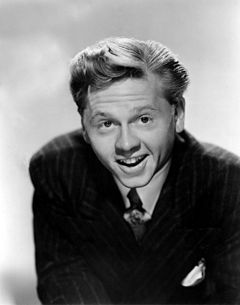
Rooney in 1945
So instead, he sneaks away. Just before the section ends, he feels a pinch in his arm and is informed, as he drifts off, “Yes…you were followed all the way” (383).
Section 3.8 reintroduces Squalidozzi and his friends in the stolen U-boat.
The sailors on the U-boat are Argentinian poets and anarchists: El Ñato, Beláustegui, Luz, Felipe, Graciela Imago Portales. El Ñato talks gaucho slang, Felipe (a difficult young poet) often has to translate El Ñato’s speech. Beláustegui is the engineer and is good with a knife (the latter is why El Ñato won’t make a play for Beláustegui’s girl). Luz is with Felipe, although she is really Squalidozzi’s girl.
Squalidozzi shows up again though, after being chased through Germany by British Military Intelligence with no idea why [because he traded clothes with Slothrop, right?]. Squalidozzi tells them all he sent some guy whose name he never got [Slothrop] to Geneva to do his work.
Squalidozzi happened upon a group of gangsters in Bavaria. The gangsters invited him in to watch the film they were all watching. They knew Squalidozzi was in the neighborhood–though he himself was invisible to them, “they could infer his path…by the movements of the police, which were not” (385). The leader of the gang is Blodgett Waxwing who says that all the hepcats are going goofy over something called “nuclear physics” (385).
After the movie Squalidozzi is introduced to Gerhardt von Göll, who made the phony Schwarzkommando film earlier in the book and turns out to be a (more or less) real filmmaker. He wants to sow reality into the Zone with his films (he is in a “controlled ecstasy of megalomania” (388) because the Schwarzkommando turned out to be real).
Oh, and he is Der Springer!
 He and Squalidozzi hit it off right away and von Göll asks Squalidozzi if he’d like to make a film out of Martin Fierro, the Argentinian folk hero. His story can be summed up as central government vs gaucho anarchism. von Göll is thinking of making two movies, in the first he fights the system and in the second (Return of Martin Fierro) he assimilates back in to society. von Göll thinks he’ll get more profits from two parts, although the idealists reject the Part II of the story–even though all gouchos “sell out” eventually.
There’s a brief look at von Göll’s career–his use of Emulsion J (created by Lazlo Jamf) which could render human skin transparent to a depth of half a millimenter (this sounds like what happened with Igor Blobadjian in last week’s read). von Göll is especiallly interested in the singing duel between the white gauchos and the dark El Moreno, and he’d like to play with the details beneath the skin. The film stock was used in von Göll’s immortal Alpdrücken.
Graciela wants to know if going along with von Göll is a comprpmise they can afford. But her reverie is cut short by shouts of “Der Aal!” (the eel) which is what they are calling the torpedo. Because the U-boat has appeared on the radar of the U.S.S. John E. Badass. But the U-boat has fired its torpedo directly at the midship of the Badass. And there is much mayhem on board, especially since Seaman Bodine has spiked the coffee with Oneririne (Lazlo Jamf’s celebrated intoxicant) which Bodine scored.
And the effects of the drug have shifted things in time so that what Beláustegui fired upon was an old derelict and what the Badass thought was a torpedo was actually a corpse floating in the water which the Badass proceeded to blow into small pieces.
The section ends with a series of questions. Although at whom they are directed is not easily understood. By me at least.
Section 3.9 is barely 2 pages long! Tchitcherine and his driver (well, really his buddy) Džabajev, a teenage Kazakh dope fiend, are frowning at the size of the hash that Tchitcherine took from Slothrop (they are the ones who captured him). Tchitcherine says that Slothrop should be locked up but he is more useful running around free. And really Tchitcherine likes Slothrop and feels they could have been friends if things were different.
 But down to business: they gave Slothrop sodium amytal and black runs through the transcript: although he never mentioned Enzian or the Schwarzkommando by name, he mentioned Schwarzgerät and several other schwarz-prefixed words.
Geli had ratted out Slothrop to Tchitcherine, who was only casually interested; but he found it strange that Slothrop seemed to be alone. He followed all the standarad rocket-finding routes, but her reports back to no one. And for that Tchitcherine will always keep track of him. He’s clearly not as easy to exploit as Major Marvy was.
The section ends with Džabajev saying that the next time they run into Slothrop they must ask were he got the hash.
Section 3.10 closes out this week’s read with Slothrop waking up and knowing he’s been hit with the sodium amytal (he recognizes the feeling). He sees that some hash is taken but he just lays back and flashes back to his father in Berkshire.
When he wakes again he realizes that he is on a movie set. He starts to leave but is stopped by a woman in a black Prussian frock. She is the fabled Lisaura–Margherita Erdmann. She’s passing through looking for her daughter Bianca and stopped in the studio for old time’s sake–she had been filmed here by Gerhardt von Göll. She was in several of his pornographic horror films, including Alpdrücken (which means incubus). Von Göll had made films that questioned Hitler but then in deference he also made one that Goebbels saw three times (once with Hitler next to him in the theater).

Thank goodness for that!
Greta (for that is her nickname) thinks that the transvestite who whipped her in Alpdrücken is the father of Bianca. And his name was Max Schlepzig (well, that was his stage name). Slothrop shows Greta his fake ID with Max’s name and she says it was definitely his, although Slothrop thinks it’s a coincidence. Greta says no, They want him here…for her. And so, with her shackled down in the prop, they recreate the scene from the movie (a new kind of S&M for the book). They each come thinking about another…she about Max (and Bianca) and he about his Katje.
—-
This was a fun week–sex and drugs and boogie woogie. I’m a little surprised about the explicitness of some of the sex scenes here, too. I had no idea it was that kind of book.
Slothrop’s story grows more and more confusing (which is understandable, but I’m not even sure what he’s after–it’s almost like a porn version of Don Quixote at this point.
We’re only in the middle of Section 3, which seems to be all about Slothrop (more or less). I’m still pondering what will happen in Section 4. And getting back to Ulysses, is Slothrop’s wanderings in any way like the wanderings that Stephen does–seemingly with purpose but more for drink and sex (are we in the Nighttown section?). Although Stephen is sex-less if I recall correctly. Parallels area difficult thing.
For ease of searching, I include: Entluftung, Zundung, Funffachnullpunkt, Schwarzgerat, Tannhäuser, Saure, El Nato, Belaustegui, Gerhardt von Goll, Alpdrucken, Dzabajev

 I Just Read About That...
Leave a comment