 SOUNDTRACK: ROCKWELL KNUCKLES-You’re Fucking Out I’m Fucking In (2011).
 I downloaded this disc a while ago because I really liked “Silly Human“
I listened to it again recently and realized just how much I like the whole disc. Rockwell Knuckles has a great delivery style—a basso profundo voice—and a great sense of melody both in his delivery and his backing music. He captures the best of Chuck D and Ice T. “Bullet Train Army” has such a cool melody line—and the fact that he raps along with it is fantastic. Apparently the Bullet Train Army is his posse or something, because it appears a lot on the disc.
“Silly Human” is a fantastic song—a wispy futuristic keyboard riff fizzes away behind Rockwell’s super fast delivery and funny (but not really) lyrics. The chorus is delivered super quickly in a cool descending melody line. And I love that someone in the background is shouting Yes Yes! YES! as he deliveries his lines. It reminds me in strange way of The Flaming Lips. “Play Catch” shows off his diversity of styles with this more gentle song. I like the way the verses end with a repeated word which seems like it’s going faster because the beasts speed up, It’s a cool trick.
“Baking Soda” has a guest rapper (I really don’t like guest rappers, I’m here for Rockwell not Tef Poe, who immediately lost my respect by having his first rhyme end with bitch—lazy!). I don’t really care for the music behind this one either—cheesy sax and horns. It’s made up for with “Point of No Return.” This song has a sung chorus with a weird sci-fi-sounding melody and some great lyrics. I haven’t really mentioned the lyrics yet but they stand out here “the early bird catches the worm, but the first sponge catches the germs) and a reference to Sojourner Truth.
The lyrics are even better on “Unstoppable” (which has a cool synthy sound over the chorus): “My competition ‘s delayed I’m rocking digital/
Ive been around the world in a day not in the physical/Artistic freedom in what I say y’all are to literal.”
The simple riff behind “Intergalactic” is also cool. At first I wasn’t sold on Theresa Payne’s backing vocals but I think it works quite well. I particularly love the chorus of “Supercalifragilisticexpiala-futuristic”
There’s another great delivery melody on “Motto of Today” with more cool sci-fi backing music. “You Got It” has the great fast beats and delivery that I love out of Atlanta, even though Rockwell is from St. Louis. There’s even a cool binary joke in the lyrics (1001001). Guest rapper Vandalyzm fares better, although there’s more curses than actual lyrics in his verse, I think.
“Nomanisan Island” also features Tef Poe, but I like him better on this track. But maybe that’s because the chorus is great: “No man is an island and we are never stranded” I’m not sure though that Tef Poe should be singing the line “black tea party, we’re coming to impeach” with Obama in the white house.
“Controlled” I assume has a sample for a chorus, it slows things down nicely and the sound of the drums is fantastic. I’m partial to the lines “Stone cold like Medusa” and “Shows about to start, I don’t know when it will end, son/ Puppet on a string controlled by Jim Henson” (whatever that means, I like it).
“Every Angle” has a groovy chorus that I like despite itself. Rockwell makes it flow wonderfully. And the final track, “Natural Born Leader” opens with a simple rocking guitar riff. When the lyrics kick in, the song soars with 70s keyboards and big guitars.
This album is really fantastic. And while there are plenty of deserving artists out there, Rockwell Knuckles is amazing and should be huge. Don’t be put off by the album title or the cover, this album is more about melody than a cursing.
You can download the whole album here for free.
Oh, and the reason I chose this is because of a note I had written in the margins of GR, which I thought had read No Man is an Island, but which didn’t. Oops.
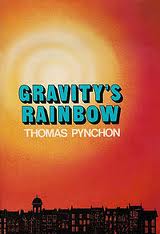
[READ: Week of February 27] Gravity’s Rainbow 1.13-1.18
I found a few of this week’s sections to be more challenging to get through. There are a lot of long passages that are meandering–often with an unclear narrator (although the narrator usually becomes apparent by the end). During these section, it feels like the book is just drifting of into a reverie for a while before snapping out of it and getting back to the business at hand. And that seem apt given all of the crazy stuff that happens in the book (all of the mental/psychological ideas).
After reading a few of the posts at Infinite Zombies this week, I have new eyes for the book. When I first read all of the sex in the book, I thought again about Joyce’s Ulysses and all of the sex that he described (shockingly for the time) and how modern writers seem to revel in writing about sex–not pornographically, just “real.” But now, after reading Christine’s post, I had to rethink this attitude on sex. I’ve been surprised by Pynchon’s frequent use of the words “cock” and “cunt” as anatomical names. “Cock” in particular is a word I don’t hear used all that often in fiction and it has (to my ear) a kind of crass/vulgar connotation. And what more needs to be said about “cunt.” I wondered if this was a Pynchon thing or a 70s thing or an I’m-too-uptight thing, but in Christine’s post she writes: “One of the things I most loathe about the other Pynchon books I’ve read is the latent, creepy, old-man sex fetish” and “the constant phallic status updates (noted in my paperback as I.P.R.s [infantile penis reference]” (which is hilarious, by the way). This has made me even more aware of all the sex in the book–although to what end I’m not sure yet.
Jeff’s post at Infinite Zombies focuses on Roger and Jessica (I know that wasn’t the point of the post, but the mind takes what it will) and makes me think of Roger as more of a protagonist of the story. Even more than Pirate (who, coming first, I assumed was the focus). And this week’s reading reveals more importance for Roger.
So on to the read:
Section 1.13 opens with an epigram of sorts–a quote from Neil Nosepicker’s Book of 50,000 Insults which references Dr Jamf three times. Jamf created Kryptosam (in 1.11) but we haven’t heard much else about him until this section.
And then there’s a dialogue (with actual, clear speakers designated!) between Pointsman and Brigadier Pudding. Pudding is questioning Pointsman about the “shabbiness” of messing with someone’s mind. Pointsman says that the Americans already did it to Slothrop (because that is who they are talking about), which Pudding hardly feels is a reason for them to do it.
Then we find out exactly what happened to Tyrone Slothrop. Lazlo Jamf conditioned his “Infant Albert” to react with horror to anything in fur (even his mother in a boa). And with “Infant Tyrone” Jamf tried to condition his sexual response. With no budget at all, Jamf decided the cheapest, easiest thing to measure was the hardon (Christine, I await your analysis)–it’s binary: it’s either there or not. And so he applied a Mystery Stimulant. The question remains, then, was he fully extinguished of the conditioning?

V-2
Everyone has an opinion about Slothrop at “The White Visitation.”
- Rollo Groast thinks he has precognition–he acts on advance information and is never where the bombs go off even though he had been there earlier. Groast doesn’t know if sex has anything to do with it.
- Edwin Treacle thinks it is psychokinesis. He is causing the bombs to drop where they do (maybe fiddling with the electrical signals in the rocket?) But sex definitely comes into it (Treacle is a Freudian). Slothrop is trying to erase that sexual Other.
- Pointsman wonders if the stimulus was a loud noise–like the sound of an impending V-1 rocket? But no, Slothrop gets the reverse–explosion first then the sound of the approaching V-2.
Oh and that map of Slothrops’ conquests? It is a Poisson distribution, identical to Mexico’s map of the Robot Blitz. The bomb comes between two and ten days after Slothrop has visited the girl.
Then Pointsman and Mexico go for a walk on a cold day. Against his better judgment Mexico asks, what if it is PK, that he is unconsciously making them fall. Pointsman wonders why he would do that, but what Mexico really wants to know is what Pointsman and his team are looking for with their experiments. Pointsman explains about Pavlov’s desire to reduce everything to pure cause and effect. Mexico (I love this line “honestly wishing not to offend the man, but really” (89)) feels that cause and effect has gone too far, that science must explore less narrow options. Pointsman smiles and Mexico will even years later remember it “as the most evil look he has ever had from a human face” (89). [This certainly gives Mexico a degree of humanity.]
Pointsman is looking forward to working on Slothrop’s brain, not for fame, but for success in the name of Pavlov (and he notes that no one has considered telepathy as an option, yet). Pavlov believed in an ultra paradoxical state of the brain. The example is of a dog who used to drool for the metronome but now not only turns away when it clicks, but licks it after it has been turned off.
Then, perhaps in conjunction with that evil smile, Pointsman admits that mostly he wants help from Mexico. Although he doesn’t know why exactly yet. Mexico feels that he is out of his depth.
The scene quickly shifts to Dr Bleagh (really?) and his nurse Ivy–who have just finished a lobotomy–snapping garters in bed (and that’s all from them at the moment). And then we see Myron Grunton and Edwin Treacle watching their “Magic Negro” skating on the ice. [Surely this is Gavin Trefoil from 1.18].
[As a side note, does this edition have typos? I feel like I’m seeing a lot, but, you never can tell. A very minor one here: “Until he smile [sic] they dare not…” (92)].
We flash back to Pointsman and the Book. The Book was translated by Dr. Horsley Gantt. Most copies of the Book were destroyed. Pointsman scribbles notes in the margins (particularly the chapter called “An Attempt at a Physiological Interpretation of Obsessions and of Paranoia” even though the 7 original owners agreed not to mark it up.
Section 1.14 opens on a new character: Katje and it is written in a very peculiar way: “the camera follows as she moves deliberately nowhere” (92). At first I though this was a metaphorical camera (just a writing style) then I thought that maybe Pirate was in the room with her and Osbie Feel–who is spending a lot of time preparing mushrooms for smoking ) filming her, but now I’m guessing it is a hidden camera or something. True it says “secret cameraman” but who knows what exactly that means. [We sort of find out later.]

Kinderofen--not as sinister as the one in the book.
Anyway, Katje is long-legged and beautiful, her hair “not bluntly Dutch at all” (92) (this comes up again later…watch for it!). She is distracted by Osbie using the oven to dry his mushrooms. This leads to a long phantasmagorical sequence that is a real life Hansel and Gretl/S&M scene. For Katje belongs to Der Kinderofen–the nightmare created by Captain Blicero in Schuβstelle 3.
I’m skipping details here, but she and a boy named Gottfried were involved in extreme scene of bondage (Gottfried was kept in a cage) and sodomy. And in addition to the the rape, there are also on a secret launch site (Schuβstelle 3) with rockets that misfire daily which makes the house as much a target as a launch site.
But Captain Blicero fears that Katje may be a spy–Holland knows many of their plans after all. And, even worse, she is not emotionally invested in her work with him (his military work, that is). And Blicero’s twisted reverie continues for several pages. It concludes with him anticipating getting pushed into the oven (by an English bomb perhaps). He genuinely believes and is emotionally invested in the Nazi message and he worries that the kids don’t seem to be.
He flashes back further to his trip to the Südwest where he met the African natives. This one boy wants to have sex with him and we learn that he (the boy) is now in Germany. And he imagines Gottfried to be the color negative of the African boy. Blicero anticipates and prepares for every move or feeling of Gottfried and Katje but he is totally unprepared for her to “leave the game” when she escapes (oddly enough, by simply walking out the door) which he likens to “knocking over the chessboard, shooting the referee” (102).
Gottfried sees Katje escape, but he will not try the same. Gottfried does not seem troubled by all of this rape [am I misreading that?]. He knows that the (military) expertise he is gaining in the house will lead him places, like studying to be an engineer. And in a weird parallel to Slothrop–for Gottfried, “the word bitch, spoken now in a certain tone of voice, will give him an erection he cannot will down” (103). He will not tell on Katje, but when she leaves, Blicero is convinced that they will be bombed so Schuβstelle 3 is moved and the requisitioned house is abandoned.
Katje has fled to England, dressed like a boy. Her only debt is to Captain Prentice (because he met her at a windmill called the Angel and then ultimately sent her to “The White Visitation”). But while the study her, she reveals nothing of the location of Schuβstelle 3 or the rockets. Prentice knows that Katje never talks about the house in the woods anymore. He doesn’t even know why she left Schuβstelle 3. Katje says she is not Pirate’s responsibility although Pirate feels she is. Katje does not like feeling indebted.
 Then there’s a lengthy flashback to her ancestor–17th century’s Frans Van der Froov who went to Mauritius and made it his mission to wipe out every dodo on the island–essentially extincting the species because they were so ugly and useless (and tasteless) they were an abomination to God. And yet the settlement on Mauritius was also doomed, so were they an abomination too? If only the dodos could communicate–and then Frans has a fantasy of communicating with them–which is pretty bizarre and which I’m sure I didn’t digest wholly.
There’s also this wonderful quote
Don’t forget the real business of war is buying and selling. The murdering and violence are self-policing, and can be entrusted to non-professionals. The mass nature of wartime death is useful in many ways. It serves as spectacle, as diversion from the real movements of the War. It provides raw material to be recorded into History, so that children may be taught History as sequences of violences, battle after battle, and be more prepared for the adult world. The true war is a celebration of markets (105).
Then we return back to Osbie who is an idiot savant snorting nutmeg like snuff.

Mendoza

Sten
Prentice starts talking about a crotchet [this is a word I did not know before, and I thought it was a mis-use] like carrying a Mendoza instead of a Sten like everyone else in the firm. The Mendoza is three times as heavy as the Sten that everyone else uses, but he’s indifferent to the weight now, its his crotchet.
Back to Pirate and Osbie on the roof of the flat. They look at the light fading and the throngs of starlings that are called “Angels.” Their discussion revolves around a giant octopus (ha!) and how no one knows what is happening “The White Visitation.” Myron Grunton is angry with Roger Mexico and The Zouave has gone back to his unit in North Africa.
The section ends with Gerhardt von Göll, who is making a faux documentary of men (including the Zouave), and the whole Psi Section crew in blackface (including Pointsman, Mexico, Treacle, Rollo Groast, and Thowster all playing black soldiers in the fictional Schwarzkmmando. It is 3 minutes 25 seconds of footage aged and ready for “discovering” in a site in Holland as part of a counterfeit rocket firing site in the Rijkswijksche Bosch. Von Göll loves the film, saying it is his finest work. A critic sort of agrees. Mitchell Prettyplace says one “cannot argue much with his estimate though for vastly different reasons than von Göll might have given, or even from his particular vantage, foreseen” (113).
At “The White Visitation” each day around noon the Operation Black Wing people gather to watch their film; Webley Silvernail brings the projector past Griogri the octopus (I love the way these details keep popping up). Then Webley brings the projector back so that Grigori can watch a film of a girl (wait for it) whose hair is “not bluntly Dutch at all” (113).
Section 1.15 opens with a different voice, more casual: “They’ve cut Slothrop loose again, he’s back on the street, shit, last chance for a Section 8 ‘n’ he blew it.” (114). [Which by the end of the chapter I can’t help wonder if it is his own voice speaking of himself in third person.] The voice wonders why they didn’t keep him on at “that nut ward.” And now Slothrop feels that he’s being followed—eyes following him, his desk moved around, something’s not right. And then one day he sees a hot woman who calls his name and—oh, he knows her, it’s Darlene from St Veronica’s. Darlene lives nearby with Mrs Quaod a widow suffering from all kinds of sicknesses, including scurvy! So Darlene went in search of limes for her. Darlene brings him up to Mrs Quaod’s house and the talk of wormwood tea brings back a memory of being there before.
 This section made me laugh a lot. It begins with wine jellies (“they’re prewar”). I’ve had wine gums, which I assume these are a take-off on and I like them better than, say Jujubies. But this one is menthol flavored. And I love Slothrop’s description to his mom: “The English are kind of weird when it comes to the way things taste, Mom… The other day I had one of those things they call ‘wine jellies.’ That’s their idea of candy, Mom! Figure out a way to feed some to that Hitler ‘n’ I betcha the war’d be over tomorrow” (116).
The candy scene goes on for a while and it’s all hilariously disgusting. Mrs Quoad asks for some of his “slimy elm things” but Slothrop is out of slippery elm. Then he is given bitter tea with lime in it. Next is a black licorice-looking item with a liquid center of mayonnaise and orange peels called (nice callback this–Marmalade Surprise). I also love this little descriptor/digression, “we got rid of all of those—‘ a blithe, Gilbert & Sullivan ingenue Thewse—“ years ago” (116).
Mrs Quoad is happy to have her rhubarb cream instead. He has a sip of tea to get rid of the taste but of course, the tea is gross too. So Darlene gives him a raspberry-looking and, amazingly, -tasting candy. However, “he bites into it, and in the act knows, fucking idiot, he’s been had once more” (117) it must be pure nitric acid. He’s so puckered he can’t speak—it’s a shabby trick but especially from an old lady who is supposed to be one of our Allies.
There is so much to laugh at here. More candy jars are brought and “he goes plunging, like a journey to the center of some small hostile planet” (117). There’s a eucalyptus flavored fondant and a camphor gum-centered chocolate even a clove-flavored tapioca-centered confection. It finally ends with a gin marshmallow: “It is enormous and soft, like a marshmallow, but somehow—unless something is now going seriously wrong with his brain—it tastes like gin” (118). He is finally sent packing with a Meggezone, which is really more of a menthol cough drop and it lingers all day in his head. And thus endeth the Disgusting English Candy Drill. The scene naturally ends with him in bed with Darlene, with possibly someone watching them.
Section 1.16 starts with a return to Mexico and Jessica. Jessica remembers the first time he touched her and made her come twice before entering her [lucky girl, eh ladies?. With Christine’s post in my mind I now wonder if Pynchon imagined women would read this at all].
Of course, in the back of Roger’s mind is always Beaver, or Jeremy as he is known to his mother. Roger can’t handle the idea that Jessica does any of the things that she does to Roger to Jeremy (it sounds like she doesn’t). [It’s a fairly surprising list of bedroom activities—now I’m wondering if Pynchon is trying to disabuse us of the myth of the prudish forties and fifties: of course women stuck their fingers in mens’ asses during the war, it wasn’t just invented during the 60s, you know].
Despite the kink, Mexico and Jessica together look innocent; people want to protect them. And then they fade in to a reverie….
Of a time when, on a dare, she took off her shirt (she wore no brassiere) while they were driving. Roger is aghast, and worried about getting arrested when (and for all of the craziness of this scene, I love the description)
Meantime, the most gigantic lorry Roger has ever seen in his life has manoeuvred steel-shuddering nearby, and now not only the driver, but also several—well, what appear to be horrid . . . midgets, in strange operetta uniforms actually, some sort of Central European government-in-exile, all of them crammed somehow into the high-set cab, all are staring down, scuffling like piglets on a sow for position, eyes popping, swarthy, mouths leaking spit, to take in the spectacle of his Jessica Swanlake scandalously bare-breasted and himself desperately looking to slow down and drop behind the lorry—except that now, behind Roger, pressing him on, in fact, at a speed identical with the lorry’s, has appeared, oh shit it is, a military police car. He can’t slow down, and if he speeds up, they’ll really get suspicious.
A fun moment for Jessica clearly. When she snaps out of her reverie back into their room she looks at Roger and kisses the back of his neck in his sleep.
Then we jump to Roger in his office. He hasn’t seen Jessica in a fortnight and he wakes up with a long hair in his mouth. This leads to some paranoid concern for himself (and for her) and leads him to seriously wonder about mind control, hypnotism, or what about other occult hings. He realized that everyone he works with is a freak, like Gavin Trefoil and Ronald Cherrycoke–are they tuning in on everything he does? Even when he’s having sex with Jessica?
All he can think is I want a transfer. It was so bad, he feels he’d be more at home in Germany with the Enemy than at the Psi Section.

No idea what kind of car they'd drive, but this looked cool.
Shift to Jessica who will be with Jeremy tonight, although she’d rather be with Roger. Or would she? Up close, Roger is full of love, but from a distance he frightens her—he’s so negative and hates England so (as seen above). Jeremy is so much safer—they’ve been together for three years. Should she destroy that for this “erratic self-centered–boy really” (127). But the worst is that she has no one to talk to: “six years of slander, ambition and hysteria make confiding anything to anyone around here and act of pure masochism” (127).
There’s another flashback to Roger and Jessica driving, this time it ends more chastely at a church. And Roger actually volunteers to go inside. Inside they hear a black man with an honest to God tenor voice singing Latin hymns with German lyrics in an English church. Jessica is moved and imagines that Roger is too.
This leads to a description of a man at “The White Visitation” who believes that he is WWII—on the day of the Normandy invasion his temperature spiked at 104. Tears come to his eyes when rockets land; he will die on V-E Day.
Then there’s a long reverie about Christmas and Italians singing songs that the Post Office may just have to ban (complete with ukelele chords for easy identification). And there are lots more stream of consciousness here which I admit lost me (even after a second read) but which seems to convey a general distaste for humanity).
Section 1.17 returns to Pointsman thinking about the paradoxical phase. He is dreaming of home. There is a light as there always is but this time it is different. And tonight instead of turning right as he always does in his dreams, he turns left. He’s walking with a girl he’s never met who is his “wife” and he feels that it is the most sinister time of the evening (6PM). Then a tapping wakes him up for real—it’s Thomas Gwenhidwy coming to tell him that Dr Spectro is dead. He was killed by a bomb blast that took out half of St Vincent’s.
[I’ve got another possible typo here, the name Spectro has a subscript E at the end of it. Unless that is some kind of weird designation] (138).
We take a look at ghosts floating above England. Spectro is one of them and he calls out “Foxes” as a clue for the living. It’s meant for Pointsman but he doesn’t hear it and the rest of the team ignore it–it just gets added to Milton Gloaming’s database of words.
Then back to Pointsman who looks at the Book and realizes that only two of the original seven are left: he and Gwenhidwy. The five ghosts are Pumm (jeep accident), Easterling (raid by the Luftwaffe), Drommond (German artillery), Lamplighter (flying bomb) and Kevin Spectro (auto, bomb, gun V-1 and now V-2),. He thinks it is a curse of The Book [although really, they are in a war, don’t forget]. Poinstmasn says he is now ready for D Wing.
D Wing is “The White Visitation’s” cover, which still houses a few patients. Because Pointsman can’t bring himself to go the Psi Section and ask them to help (maybe Eventyr can do a séance) he can’t even admit to Mexico that he misses the others, especially Lamplighter who would bet on anything. Pointsman is filled with regret for all of the should haves but then acknowledges that he is a creepy guy which is why women won’t stick with him. {Does this have anything to do with the evil look he displayed earlier?] It ends on a really creepy note: “Oh but how he’d like someday to give them something really to scream about” (which leads to an erection (141).
He thinks about Spectro; how Spectro wasn’t as binary about Outside and Inside; the cortex was an interface organ. Pointsman used to dream of a Minotaur (that was alluded to earlier, too). He had a sword an would attack the beast. And now that Slothrop is in it (he is an angel too) might he actually have the chance to fight the beast?
 He once stalked Reichssieger von Thanatz Alpdrucken, a champion Nazi Weimaraner, but he may be giving up dogs after all—for the elusive human subject. He says that Vicar de la Nuit can worry about whether it is “right.”
But more to the point—Spectro is dead and Slothrop was with Darlene only a few blocks from St Veronica’s two days before [is Pointsman the camera man of that earlier scene: point+man]. He owes it to Spectro to investigate this further. At the very least Slothrop is sick. For Spectro’s memory, Pointsmans could look for the answer on Slothrop’s cortex. Slothrop may suffer, but how many thousands are suffering because of him? Indeed, Pointsmasn writes in his journal, “The thought of [Slothrop] lost in the world of men, after the war, fills me with a deep dread I cannot extuinguish…” (144).
He thinks of Pavlov and symmetry how a mirror image can be confused Inside. But what sickness Outside can create symmetrical opposites like the V-1 and V-2.
Section 1.18 ens this week’s readings with a look at Carroll Eventyr. Nora Dodson-Truck called Eventyr’s “gift” a “splendid weakness.” This gift came upon him when he was 35. All at once someone was speaking through him. The thing about this gift though is that Eventyr completely surrenders to it—afterward he can remember nothing of what happened and must rely on the notes of others.
Rollo Groast put him under the EEG and just about everyone in Psi Section has a theory about what Eventyr’s deal is. Aaron Throwster (he keeps popping up but we haven’t really seen anything about him yet) suspects it is a tumor; Edwin Treacle thinks petit-mal. Allen Lamplighter died shortly after the EEG and was therefore given his own chance to communicate with Eventyr but even with 5 to 2 odds he’s still been silent.
Then we see Ronald Cherrycoke the psychometrist. He’s holding a pince-nez that belonged to Group Captain “Basher” St. Blaise. And he can recite an intimate resume of the group captain including that “Basher” once reported an incident that only he and his wing man saw. More on that in a moment.
Or Margaret Quartertone, who can produce voices on discs miles away without touching the equipment. Nora Dodson-Truck is having dreams of falling at the same time as Edwin Treacle is having dreams of flying. Why? It’s freaking people out.
Even Peter Sachsa, Eventyr’s control who is normally cool and sarcastic. Sachsa was a fan of the old peace, the Weimar decadence, until he was taken over in 1930 by a blow from a police truncheon. But he remembers the good old days, too..
Why are so many new freaks coming to “The White Visitation”?
Walter Asch “Taurus” was visited by something so unusual he needed massive drugs to calm down and even then, he wouldn’t go back to sleep.
Like Gavin Trefoil (remember him?) who is only 17. He has what Groat calls autochromatism, the ability to change his skin color at will. He was very useful in Göll’s film (for obvious reasons). Rollo believes that this ability is an elaborate revenge on childhood bully Jenny Greenteeth who was always waiting in the fens to drown him.
We resurface in a (flashback) conversation between Nora and Eventyr. She explains to him that the Outer Level is the epidermis, a place where everyone goes, eventually. He reflects on their relationship–he is passive to her, he has loved her over a decade, even though she is an erotic nihilist, a frightening person. Nora has turned to the Outer Radiance and seen nothing…taken that Zero with her. Eventyr feels he himself is too passive, unlike Cherrycoke who laughs at everything. Although really he is laughing at something that he thinks others can see.
 Then we get to “Basher’s” secret—he and his wingman saw an angel. Although no one on the ground saw or heard anything on any channels. They saw the red ember eyes clearly and they dropped their bombs immediately. They did not include the details of the Angel in their report (for obvious reasons). Cherrycoke was able to get the information by probing some items that were on the flight. That’s how the story got around. Eventyr tried to reach out to Terence Overbaby (love the name) Basher’s wingman to get more details (to outdo Cherrycoke) but turned up empty. But Peter Sachsa said that there were many version of the Angel.
As this section ends, Roger Mexico returns. Edwin Treacle is trying to light a disgusting pipe (filled leaves, string and bits of cigarette) while talking about sociologists that they have not studied–like those of “us” in Psi Section. Roger quickly excludes himself from the group, “Careful with that ‘we’” he says.
Treacle continues that they all form a single subculture a “psychical community, if you will.” “I won’t,” Mexico says drily. Although he concedes that someone should look into it (153).
Treacle explains that there are peoples who communicate with the dead every day–the Hereos communicate with their ancestors as a matter of course. But as we saw, this communication is one-way for the likes of Eventyr who can’t remember anything. Even his control Sachsa, Eventyr knows about him but can’t remember him. He knows that Sachsa loved Leni Okler who was married to Franz. Franz had a connection with Army Ordnance and … This section ends on a ellipses as action is about to take place, although speculation is probably futile.
—-
This week’s reading was a little harder for me, but the rewards were wonderful. I even had Sarah (who has no interest in reading this book) read the Disgusting English Candy Drill and she loved it (of course, she loves domestic comedy/drama from post war England, but still).
Mayonnaise and orange!
For ease of searching I include: Schusstelle 3, SchuBtelle 3, Gerhardt von Goll

 I Just Read About That...
I don’t have the book in front of me for context, but “until he smile” is probably just the subjunctive here.
Weisenburger glosses the magic negro, though I forget the specifics. I don’t think it’s Trefoil, but I’m also not sure it matters a lot.
The “E” subscript stands for Eventyr (since he channels Spectro). It’s a weird little notation for sure.
For more on Jenny Greenteeth, see this.
As always, a great run-down of what happened in the book, loads more perceptive about even the basic events than I managed on my first reading a few years ago.
Thanks Daryl, especially about the typos–as with IJ, it could go either way! That subscript makes sense (it would have been a really weird typo!), I’ll keep an eye out for it in future,
I’m unsure how much secondary reading i want to do this time through (and a lot of that is for time reasons, sad to say), so I’m relying on what you guys tell me!
I never would have guessed that Jenny Greenteeth was a folkloric character (is that common knowledge?), especially since the name is just as peculiar as any other Pynchon comes up with.
I feel like this first reading is a first and second reading because I tend to skim when I post. And it’s amazing how much you get the second time!
I hadn’t known about Jenny Greenteeth. I have Weisenburger to thank for that reference (and many others, including the E subscript).
[…] Section 2.5 opens with a ponderous sentence that I still don’t understand: “The great cusp–green equinox and turning, dreaming fishes to young ram, watersleep to firewalking, bears down on us” (236). Perhaps it is a floral way of saying that Spring is nigh. March is here (like a lamb) and women are dressing seasonally appropriately at “The White Visitation.” But over at the Casino Hermann Goering, Slothrop is still there and the only familiar face is General Wivern. And Slothrop is falling into a state of consciousness “perhaps what used to be called a reverie” (hey I picked the right word!). […]
I’m finding this all so wonderful – long after you posted it – as I struggle my way through GR. Fortunately my edition has very different pagination, but it’s working out. It’s not unlike the era years ago when I read Finnegans Wake with a commentary – yours is the equivalent commentary and I think I’m beginning to comprendez something as a result.
Thanks darwinkiwi. I really enjoyed reading this with some help from others. Definitely click on some of the links in my posts because every one else who was involved had some great insights! I’m not sure I knew what was going on all the time (as someone pointed out after week one), but different insights certainly open up new avenues of seeing. Keep it up, it’s a rewarding read!
Er ,,, that should have read: Unfortunately …
🙂