Feeds:
Posts
Comments

Archive for August, 2011

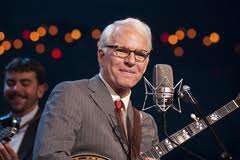
SOUNDTRACK: STEVE MARTIN & THE STEEP CANYON RANGERS-“Athiests Don’t Have No Songs” (2010).

We watched this Steve Martin performance on Austin City Limits last night.  Who knew that Steve Martin (yes, that Steve Martin) won a Grammy in the bluegrass category!  I’m not a huge fan of bluegrass–basically I like it enough for a few songs, but a half an hour is a bit much.

Nevertheless, Steve Martin is an amazing banjo player.  Anyone who has his comedy albums from the 70s knows that.  He used to play banjo between jokes (“Oh…death and grief and sorry and murder).  Now he tells jokes between banjo songs (the joke about the Grammy is very funny).

This song does not feature his amazing banjo playing but it is very funny indeed.

I just love the crazy notes that Martin hits near the end, which sounds so out of tune and yet fit very well together.

[READ: July 27, 2011] Five Dials 18b

The bulk of this short special issue is the five poems by Michael Robbins, a poet with whom I am unfamiliar.  The only other items included here are Craig Taylor’s Letter and Laurence Scott’s Currentish Events about Galliano and Gaddafi.  Since Five Dials issues are of varying sizes to begin with, it was unclear why this issue was a “b” and not the next issue, but Taylor sets us all straight.

CRAIG TAYLOR-A Letter from the Editor: On Spring and Robbins
They got into the publishing gig to be able to comment on things as they occur.  So this special issue is designed to usher in Spring and to introduce the world to the new poet whose title “Aliens v Predator” so impressed them that they asked him for five more. (more…)

Read Full Post »

SOUNDTRACK: STARS-Live at the 9:30 Club, Washington DC, October 20, 2007 (2007).

Thanks NPR for this unexpected concert.  Unexpected because Stars is a wonderful band but I think they’re largely unknown (I could be wrong about that, but it’s not like you hear them on the radio or anything). 

This show was during a tour for In Our Bedrooms After the War, which was one of the best albums of the year as far as I’m concerned.  

It’s an intimate album, with all kinds of styles in it: whispered confessions, dancey pop songs, synthy tracks and also some solid alternative rock.  The unifying theme for Stars is beautiful, often super catchy songs that are filled with melancholy and sadness (and occasionally, hope: “at least…the war is over”).  But the key to their beauty is the wonderful harmonies that the singers give us.

Musically the things that surprised me most during this show were the singers’ speaking voices.  Torquil Campbell’s speaking voice is quite a high register and yet his singing voice is low and soothing.  The opposite is true for the other singer, Amy Millan who has a kind of gruff peaking voice but whose singing voice soars to the heavens.  It’s fascinating.  Torquil is also a gushing frontman, thanking the audience so much for coming and even asking “Don’t your friends have bands that are playing whose shows you should be at right now?”  He also thanks Ben and the rest of Death Cab for Cutie for being so very nice to them.  A very nice chap it seems.

The bands sounds quite good live, but my only problem with the show is that as i mentioned, Stars’ music is very intimate, sometime whisper-quiet, and it doesn’t always translate very well in a live setting (even a relatively small club like the 9:30 Club).  Sometimes it feels like they’re singing too loudly to match the music.  Now, it’s entirely possibly that this doesn’t come across when you see them live, that this soundboard recording picks up every flaw. 

Despite that, there’s undeniable energy here and some really great moments where the bands switches direction at the drop of a hat.  And, overall, this is an excellent introduction to the wonder that is Stars’ music (or a big treat for established fans).

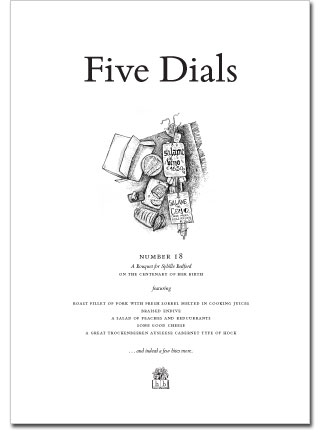
[READ: July 25, 2011] Five Dials 18

Five Dials 18 is unique in the history of the journal.  This entire issue is given over to the memory of SYBILLE BEDFORD.  It is written by ALIETTE MARTIN (there’s not even a Letter for the Editor).

Martin writes about Bedford’s love of wine and fine food.  It was pretty funny to read about her detailed love of meat after reading all of the vegetarianism promoted in the Five Dials news pages (Jonathan Safran Foer’s Eating Animals was just published by Hamish Hamilton). (more…)

Read Full Post »

SOUNDTRACK: RA RA RIOT-Live at the Black Cat, Washington DC,  October 12, 2008 (2008).

I really like Ra Ra Riot’s album The Rhumb Line, and this concert is basically a showcase for that album.  There’ s an interview at the end of the show (all downloadable from NPR), in which the  band says that critics raved about their live show as much as their album.

I don’t really hear that the show is more energetic than the album (maybe visually they are wild), but it did sound fantastic.  It’s amazing to hear a rock band that is dominated by strings–the cello and violin are often louder than the guitar (but not in a competing/drown you out kind of way,  more of a strings do the melodies and the guitar adds bulk to the sound).

I always enjoy hearing a band that is grateful to their audience for showing up (this is most evident in young bands, who seem so much more genuine about their love of the audience) and Ra Ra Riot are certainly that .  They seem genuinely surprised at the turn out, and they play a great set accordingly.

There are two songs that aren’t on the album here “A Manner to Act” and the encore “Everest.”  They both feel like they came off the album, which bodes well for their second album, Orchard, which just came out in May.  Ra Ra Riot also do a great cover of the obscure Kate Bush song “Suspended in Gaffa.”  At the end of the show they tack on a cover of “Hounds of Love.”  Lead singer Wesley Miles has a wonderfully strong voice and he can reach some pretty high notes–not soprano or anything like that, just strong enough to be able to pull off a Kate Bush cover.

This is a great show.  And when you read about the tragedy they suffered just as they were starting to take off, their obsession with death may not be so surprising.  I’m looking forward to Orchard.

[READ: 1995 and August 18, 2011] Microserfs

After reading Life After God and thinking about Microserfs, I looked up Coupland’s bibliography and saw that indeed Microserfs came next.  And I was really excited to read it.  I have recently watched the JPod TV show and I knew that JPod was a kind of follow-up to Microserfs, so I wanted to see how much of it rang true.  And I’ve got to say that I really rather enjoyed this book.

While I was reading this, I started taking notes about what was happening in the book.  Not the plot, which is fairly straightforward, but about the zeitgeisty elements in the book.  And, since I’m a big fan of David Foster Wallace, I was also noting how many zeitgeisty things this book had in common with Infinite Jest.  I’m thinking of tying it all together in a separate post, maybe next week.  But I’ll mention a few things here.

My son also loved the cover of this book because it has a Lego dude on it and he has been really getting into Lego lately.

So Microserfs is the story of a bunch of underpaid, overworked coders who work for Microsoft.  The book is written as the journal of Daniel Underwood (Coupland still hadn’t really branched out of the first person narrative style, but the journal does allow for some interesting insights).  The story begins in Fall 1993.  I felt compelled to look up some ancient history to see what was happening in the computer world circa 1993 just for context.  In 1991, Apple released System 7.   In 1993, Windows introduced Windows NT, Intel released the first Pentium chip, Myst was released and Wired magazine launched.  In 1994, Al Gore coined the term Information Superhighway.  Yahoo is created.  The Netscape browser is introduced.  So we’re still in computer infancy here.  It’s pretty far-seeing of DC to write about this.

Daniel works at Microsoft with several friends.  Daniel is a bug tester, Michael (who has an office, not a cube) is a coder, Todd (a bodybuilder) is a bug tester.  There’s also Susan (smart and independent), Abe (secret millionaire) and Bug Barbecue (an old man–he’s like 35).  The five of them live in a house on “campus.”  There’s also Karla (a type A bossyboots who doesn’t like seeing time wasted) who works with them but lives up the street.

As the story opens, Michael has just received a flame email from Bill Gates himself and has locked himself in his office.  This leads to a very funny scene and ongoing joke in which the office mates feed slide two-dimensional food under his door and he vows to eat only things that are flat. (more…)

Read Full Post »

SOUNDTRACK: TINDERSTICKS: Falling Down a Mountain [CST065] (2010).

Another Tindersticks album comes out from Constellation!  This one features a bit more dissonance than I’m used to hearing from them.  Not crazy noisy dissonance, just sprinkles of it that make the album feel slightly askew: horns that are abrasive, strings that are foreboding and even Stuart Staples usually mellow singing is filled with vibrato (!) at times.

The opening song is an unusual track: a six and a half minute mostly instrumental which ends with some repeated chanting/singing of the title.   Given that this is the Tindertsicks, a band which at this point is possibly known more for its soundtrack work than anything else, it’s not all that surprising to hear an instrumental from them, but there’s something about the structure of the song that sounds different for them–it’s a slow builder with lots of horns. It’s really cool.

“Keep You Beautiful” is a slow, quiet number.  A beautiful showcase of that side of Tindersticks–harmonies and melodies aplenty.  “Harmony Around My Table” is a beautiful shuffling song which sounds like classic Tindersticks.  The twist is that Stuart kind of vamps around the end of the song.  It’s a catchy number with lovely backing vocals and some cool lyrics ( “I found a penny, I picked it up / The other day I had some luck / That was two weeks last Tuesday / Since then there’s been a sliding feeling.” ).

“Peanuts” is a sweet duet with the elusive Mary Margaret O’Hara it has some very sweet lyrics: “You say you love peanuts / I don’t care that much / I know you love peanuts / And I love you / So I love peanuts too.”

“She Rode Me Down” is the best song on the album and one of their best songs in a long time. It features some great mariachi style rhythms (handclaps, castanets, a flute) and wonderful brass section.  There’s also a nifty bass string (viola?) that adds an unexpected melody line.   There’s also the fun to sing bridge: “she rode me, she rode me, she rode me.”

“Hubbards Hill” is an actual instrumental.  It reminds me a bit of an acoustic Air song, all moody and tense.  “Black Smoke” has some creepy violins and Staples’ slightly askew vocals–he seems to be really straining, and it ends up with a wavery vibrato.  “Factory Girls” is a slow, delicate piano song.  It’s similar to some of their older songs, but it seems even more quiet than usual.  The final track, “Piano Music” is a great instrumental.  It’s slow and melancholy with some wonderful piano sprinklings throughout.

Again it’s hard to be surprised by anything Tindersticks do, their output is so varied, but this disc has some real surprises to it.  It’s not unusual for Tindersticks to create instrumentals (they do all those films scores after all, but I kind of associate the band with Staples’ voice.  That there are almost three instrumentals here is unexpected.  It feels like a transitional record, as if perhaps their next one will totally kick ass.   But at the same time, this one is really good too.

[READ: August 1, 2011] “Above and Below”

This story was surprisingly long.  It just seemed to keep going and going.  And that was fine, except that the story was basically about a girl who seemed to fall hard on her luck and then find some kind of circumstance that picked her back up again. And then up and down and then up and down.  Dumb luck seemed to keep her from hitting rock bottom.

So anyway, the main character (unnamed as far as I recall) was until recently a TA in Florida.  When she lost her job, and her funding, she decided to say “the hell with it all.”  She took the last few items she had, piled into her station wagon and took off.  She called her mom and told her not to worry, that she’d call again when she got settled.  Of course, her mom is kind of spacey and unresponsive and the narrator hates her stepdad, so the actually calling part may not really have been that high a priority.

First, she stays in her car until she eventually shoved off by the police.  She finds a new beach and a hotel with a gym where she can shower.  She basically has no intention of doing anything.  She should hit rock bottom but then the first of the unreasonable coincidences occurs: “She was baking on the beach when a leaf slid up over her stomach.  She caught idly at it, and found that it wasn’t a leaf at all but a five-dollar bill.”  Really?  A five dollar bill?  We should all that happen to us.  My suspicions were immediately raised by that detail, although I let it pass. (more…)

Read Full Post »

SOUNDTRACK: RUSH-“Garden Road” (1974).

So the bootleg that I mentioned yesterday was in fact incomplete.  On the Up the Downstair site, the track list includes “What You’re Doing” and “Garden Road.”  When I wrote to the cool host of Up the Downstair, he said that these two songs were available on You Tube and that he’d try to find them and add them to the site.

So in the meantime, I got to listen to the song on YouTube.  This is a song that the band wrote but which they never recorded (same is true for “Fancy Dancer”).  I have to imagine that they wrote these songs for their second album (along with “In the End” which they kept) around the time that Neil Peart joined the band.  Once they realized that Neil could write better lyrics, they scrapped these two heavy rockers.  Both songs have great riffs, even if lyrically they’re pretty poor.

The song rocks pretty well, although the solo seems to have been put to better use in “Working Man.”  I enjoy how the song breaks for the shouts of the Garden Road chorus (kind of like “Bad Boy”–perhaps it was a “thing” for them).  I rather like this song, and I think I like it better than a couple of the songs on Rush.

Check it out.

Maybe it’s time to release these old chestnuts for the fans?

[READ: August 10, 2011] Life After God

After the success of Shampoo Planet, Douglas Coupland wrote several short books (which were really short stories).  They were compiled in Life After God.  To me this book also stands out as another odd one from DC, because it is very tiny.  Not in length, but in height.  It’s a small book, about the size of a mass market paperback.  But it makes sense that it was made this short because it is written with lots of short paragraphs that lead to page breaks (kind of like Vonnegut).

For instance, the first story contains at most two paragraphs per “chapter” about–16 lines of text and then a page break.  At the top of each page is a drawing from DC himself which illustrates to a small degree the information on the page.  It leads to incredibly fast reading and even though the book is 360 pages, you can polish it off pretty quickly.

But what’s it about?  Well, mostly the stories seem autobiographical (even though they are classified as fiction.  And actually, I don’t know anything about DC’s personal life so I don’t know if they are based on anything real, although I do know he doesn’t have any kids, so those can’t be true at any rate).  There are eight stories.  They are all told from the first person and are more or less directed at “you.”  They all seem to deal with existential crises of some sort.  They are honest and emotional.  To my ear, sometimes they seem a little forced, maybe it’s contextual, but it’s hard to write this kind of massively introspective piece and have it sound “real.”  (But maybe I’m not very introspective about things like this myself). (more…)

Read Full Post »

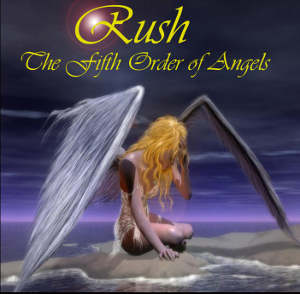
SOUNDTRACK: RUSH-The Fifth Order of Angels (bootleg from the Agora Ballroom,Cleveland, 26 August 1974) (1974).

I have mentioned this concert before, but I played it again today, and was struck by a couple of things.

1) According to the liner notes, Neil Peart had been in the band about two weeks.  How did they decide that their new drummer was going to be doing a drum solo during the show?  I mean, by now, everyone knows that the solo is its own song.  But, he’s been in the band two weeks.  It’s obvious he’s a good drummer, better than their original drummer, but a drum solo?  Is that just what rock bands did back then?

2) I’m struck by how much this show sounds like early Kiss.  I never really thought that  their first album sounded like Kiss, but in this live setting, a number of the songs, or perhaps just  the way they are recorded make me think of early Kiss.  In particular, during the crazy “one, two, three, FOUR!” of “In the End,” when the guitars kick back in, it sounds like a Kiss show from circa Alive!.

3) It’s amazing how guitar-centric the band was back then.  The mix is a little rough so it’s not entirely clear how insane Geddy is on the bass (when he gets a few solo notes, the bass sounds really tinny).  But the concert is like a showcase for Alex’s solos.  True, the whole first album really demonstrates what a great soloist he is, but it’s really evident here that Alex was the star.

4) Their earlier songs are really not very good.   I mean, every Rush fan knows that the first album is almost not even a real Rush album, but it’s shocking how pedestrian these songs are compared to even what would show up on Fly By Night.  Still, circa 1974 I’ll bet this show kicked ass.

It’s available here.

UPDATE: The missing content has been added!

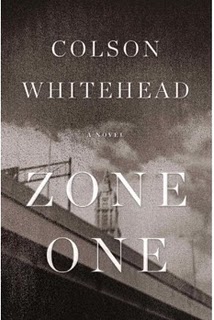
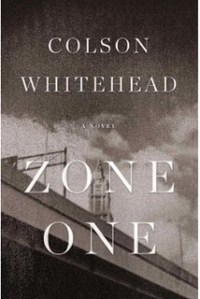
[READ: August 9, 2011] Zone One

After reading the excerpt from Zone One in Harper’s I decided it was time to read the book (which is due to be published in October).

I admit I haven’t read Whitehead’s other works, but I have read excerpts, and I thought I knew the kind of things he wrote.  So it came as a huge surprise when the excerpt ended the way it did. I didn’t want to spoil anything when I wrote the review of the excerpt, but since the entire book is set in the dystopian future and since it explain what has happened right on the back, I can say that Zone One is set in the aftermath of a kind of zombie apocalyptic plague.  And I can’t help but wonder if the rousing success of McCarthy’s The Road has more or less opened up the field of literature to more post apocalyptic, dare I say, zombie fiction.  [I haven’t read The Road, so there will be no comparisons here].

Actually there will be one.  Sarah read The Road and complained that you never learned just what the hell started the end of the world.  Indeed, in this book you don’t either.  There is an event called Last Night, and after that, there’s simply the current state of affairs.  I suppose you don’t really need to know, and since the story is all about dealing with the zombies, I guess it doesn’t really matter how it all started, but I think we’d all like to know.

Now what makes this story different from the typical zombie story is that for the most part there aren’t all that many zombies (or whatever these undead people are called) in the story.  There are some of course, and they are inconvenient to the main characters, but unlike a story like Zombieland, (which was awesome) or the more obvious Night of the Living Dead, the story isn’t really about fighting zombies, it’s more about the rebuilding of the country in a post-zombie world. (more…)

Read Full Post »

SOUNDTRACK: BILLY BRAGG-Live at the Newport Folk Festival (2009).

Billy Bragg is one of the great holdouts of aggressive political liberalism in music.  For every “American Idiot” that young bands play, Billy can whip out “There is Power in a Union” or the more prescient, “No Power without Accountability.”  Lyrics:

IMF, WTO,
I hear these words just every place I go
Who are these people? Who elected them?
And how do I replace them with some of my friends?

He’s an old school American folkie, despite the fact that he is so outrageously British that his singing accent is stronger than most British folks’ speaking voices.

But he’s not all politics (well, yes he is, but sometimes he disguises it).  Like on his minor hit “Sexuality.”  With some of the first gay positive lyrics I can remember hearing on the radio: “I’ve had relations with girls from many nations/I’ve made passes at women of all classes/And just because you’re gay I won’t turn you away/If you stick around I’m sure that we can find some common ground.”

Billy’s set is pretty great.  He plays the electric guitar for most of it (with an amusing moment where he switches to the acoustic guitar and references Dylan), and really, he needs no accompaniment.  He plays several of his own songs as well as a number of Woody Guthrie songs (both ones that Guthrie recorded and ones that Bragg and friends recorded for the Mermaid Avenue project).

Bragg also talks.  A lot.  His stage banter is as funny as it is impassioned.  And he urges people not to give in to cynicism about their newly elected President (the task is too great for him to please everyone).   Sometimes he comes across as really inspirational and other times as simply idealistic.

The only part of the show that I don’t really like is the “cover” of “One Love.”  I don’t particularly like the song to begin with and this version is 6 minutes long.  True, he modifies the lyric, but the basics are  the same.  Aside from that it’s a pretty rousing set (even if the DJs interrupt him about 40 minutes in, apparently thinking he was going to be end).

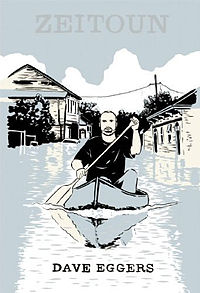
[READ: August 1, 2011] Zeitoun

I loved A Heartbreaking Work of Staggering Genius.  And I liked You Shall Know Our Velocity quite a bit too (and I just found out that YSKOV was rereleased as Sacrament with an extra 45 page section from Hand’s point of view–and that apparently there is only one copy available anywhere in the world and it costs $250!).

Anyhow, It was through Eggers that I found McSweeney’s (and its vast empire).  And yet during that time, I sort of gave up on reading Eggers’ published works.  When Zeitoun came out, I wasn’t all that interested to read it.  Mostly because I knew the book was about Hurricane Katrina, and I didn’t think I could handle a book about such a tragedy.

But recently, several people in book clubs had mentioned how good (and quick) of a read it was.  So I decided to give it a read.  And I’m really glad I did.

The book is about Abdulrahman Zeitoun, a Syrian born American.  He was living in New Orleans and was the owner of a very successful remodelling business (as well as the landlord of several properties around New Orleans).  Zeitoun is a hard-working, exceptionally conscientious man (the flashback to him running to work, carrying his broken bicycle on his back is as inspirational as it is amusing).  He rarely takes a vacation (much to his family’s chagrin) and oftentimes his wife has taken their kids on a vacation without him.  (One time they dragged into the car with his bags already in it without telling him they were going away for a weeklong vacation). (more…)

Read Full Post »

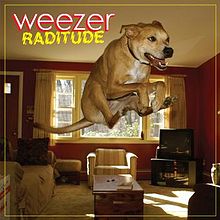
SOUNDTRACK: WEEZER-Raditude (2009).

I didn’t buy this Weezer album when it came out because I had heard really bad things about it (like the “guests”), but when I saw it cheap I decided to check it out.  This has to be the most polarizing Weezer album of them all.  I listened to it twice yesterday.  The first time I thought I had been too harsh on it.  The second time I thought it was godawful.  It’s amazing what a couple of hours can do.

It opens with a wonderful bit of poppy wordplay ala Cheap Trick: “(If You’re Wondering If I Want You To) I Want You To.”  It’s catchy as anything and is a wonderful start to the album, even if it is probably their poppiest song ever.  From there though, the album really degenerates.  And mostly it’s because it’s so dumb.  I mean the album title should tell you what you’re in for, but who would have expected the moronic sub-pop-metal of “The Girl Got Hot” or even the reprehensible lyrics of “I’m Your Daddy” “You are my baby tonight And I’m your daddy.”  It’s just creepy.  Or gah, a song about the mall?  “In the Mall.”  It’s not even worth mocking.  And really, try to picture Rivers Cuomo in a mall.  Any mall.

But nothing could prepare anyone for “Can’t Stop Partying.”  Unlike Andrew WK’s ouvre, which is so sincere about partying that you can’t take it seriously, this song really seems to be about the guys partying.  It’s laughable.  The anemic rap but Li’l Wayne certainly doesn’t help.

Even the collaboration with Indian musicians on “Love is the Answer” (yes, seriously) doesn’t really work.  It feels like they wrote the song and then said, “Hey let’s throw some sitar on it.”  It’s not enough to be exciting but too much to ignore.

This is not to say that these songs aren’t catchy.  I mean, geez, I still have “Can’t Stop Partying” in my head while I’m listening to something else.   Rivers knows how to write a pop trifle.  And the more he writes songs like this, it makes me thing that Pinkerton was the fluke.  Which is fine. The music world needs poppy songs, right?

[READ: early August 2011] various nonfictions

I thought about doing individual posts for all of Arthur Bradford’s non-fiction that’s available on his website (that’s right,  yet another author that I have read short uncollected pieces by without having read any of his bigger works–I’m looking at you Wells Tower).  Bradford has links to all of his nonfiction ( I assume) on his website.  There are 12 links in total.  One is to his blog (which I’m not reviewing).  The rest are for articles covering a pretty broad array of topics from a pretty broad variety of sources.  (more…)

Read Full Post »

SOUNDTRACK: TORI AMOS-Live from the Artist’s Den (2010).

I think my relationship with Tori Amos has come to an end.  I haven’t enjoyed her more recent albums all that much lately, but I was excited to see that this live and intimate set was on PBS.  After all, it was just her with a piano and what turned out to be a really cheesy organ.

I was pretty thrilled by the setlist, which goes all the way back to her debut album (with “Girl” and “China”).  I was even more excited to hear “Bells for Her” one of my favorite songs by her and even “Concertina” one of her more mellow tracks that worked well for this show which was primarily mellow songs.

There were a lot of newer songs which I don’t know that well, and a few newer songs which I know okay.   I don’t love her newer stuff, but I was even disappointed with the presentation of her older songs.  She has definitely taken on a new technique where she reeeeeaaaaaalllllllllyyyyy streeeeeeeeeeeetches the songs out. And, as I’ve complained on other recent posts, she mis-pronounces or mis-enunciates words that she used to say perfectly fine.  I find it maddening.

It took me two days to watch this 50 minute show because I kept falling asleep.  Gadzooks.

Now I totally respect an artist’s desire to change her songs.  Indeed, there are some live versions of her songs that I have enjoyed more than the originals.  But there’s something about the way these are drawn out that it feels like the life has been sucked from them.  The melody of “Ruby Through the Looking Glass” loses its impact when it is slowed down so much.

I’m also really disappointed with the synth that she chose.  Synthesizers can make any sound in the world, so why did they program this keyboard to play utterly anemic strings?  The conclusion of “Girl” which is so dramatic on record actually sounds worse with the thin washes than it would if it were played on just piano.

And as for the way she sings words now…  “Bells for Her” to give just one example, has her mangling the word “you” so that when she sings “not even you” we get something like “not even yaow” which I don’t understand.  I mean, listen to the awesome live version on To Venus and Back–she didn’t used to do that.  So wha happa?

I used to think that I liked her solo better.  I always enjoyed the little quiet time section of the concerts when she would play a song or two by herself.  But I feel like now, when she’s by herself, she loses any sense of editing.  The band seemed to keep her on pace.  And it’s a shame to see her drift so much.

Because Tori was an important part of my music youth, I’ll give her one more chance–she has a new album due out reasonably soon, but I’m not holding out much hope for it.   I think we may just be on very different planes of existence anymore.

[READ: July 19, 2011] Five Dials Number 17

The brevity of the Christmas issue is followed up by the somewhat longer Five Dials Number 17.  (This issue also has 7 pages of photos at the end of the issue).  I admit I didn’t know where Jaipur was (it’s sort of north west-ish in India, not terribly far from New Delhi).

This is also the first issue of 2011 (I’m nearly caught up!).  So the issue opens with New Year’s Resolutions.  The letter is also from editors, plural, for a change.

CRAIG TAYLOR & SIMON PROSSER-Letter from the Editors
The letter opens with some enjoyably self-deprecating comments about resolutions (and how they made theirs now, instead of at the end of the year).  But what I enjoyed most was the collective list of resolutions that the entire staff made.  They are listed as one person, which makes for wonderfully contradictory resolutions.  I was particularly pleased by: “stop making that face when my brother makes a suggestion.” (more…)

Read Full Post »

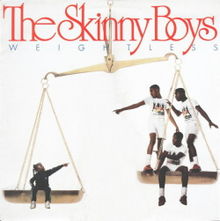
SOUNDTRACK: THE SKINNY BOYS-“Jockbox” (1986).

I didn’t realize that the theme song from Workaholics was from a real song.  I loved the “I’m fresh” bit in the show, but I thought it sounded like it might actually be from something.  Sure enough, the internet led me to this.  The Skinny Boys (evidently a response to The Fat Boys) from the hip hop mecca of Bridgeport, CT put out this beatbox song (with that cool sci-fi keybaord) as a shocase for their member: The Human Jock Box.

This is a pretty bizarre track.  And I’m not even sure what they’re talking about.  But I love the hiccups around the three minute mark.  Note also how by the end of the song, the keyboard plays the riff from Herbie Hancock’s “Rockit” and then a little later “America the Beautiful” (with accompanying beatbox).  Wha??

The Workaholics bit is from 1:13 to 1:23.  You gotta be fresh!

[READ: July 25, 2011] “Matinée

I’m not going to say how I just don’t get Coover.  Every time I read one of his stories I think the same thing: it’s clever but, well, so wha?  I know that Coover is an experimental fiction writer, but I just feel that there’s no emotional resonance to his stories.  Perhaps I like experiemntal art and music but not fiction.

There were some really cool tricks with this story.  All of the (unnamed–don’t get attached to them) characters are watching movies or are in the movies.  And so, in a series of what, infinite regresses? chance encounters? something, new characters are introduced, they watch a film (possibly of the people who were watching them?) they may or may not have sex and then the “camera” shifts to a new couple. (more…)

Read Full Post »

« Newer Posts - Older Posts »