Feeds:
Posts
Comments

Archive for April, 2011

[WATCHED: March 19, 2011] Until the Light Takes Us

Soon after finishing Lords of Chaos, I heard a radio interview on the Sound of Young America with the directors of this movie (which is about the same black metal scene in Norway).  I finally got around to watching the film, and I’m really glad I did.

It covers much of the same terrain as Lords of Chaos (although the book covers much more stuff), but what’s cooler about the movie is actually seeing these guys talk to you.  And seeing how “normal these guys are.”  The two “stars” of the movie are Fenriz from Darkthrone and the main man in the scene, Varg Vikerens.

In the radio interview, the directors talked about the way they structured the film. And, I’ll reveal a bit of that.  So if you don’t know this particular fact, I’ll give the next line as a spoiler alert:

SPOILER ALERT: (Highlight the blank space to read it) Varg is in jail for murder and for the burning of several churches and was sentenced to 21 years in prison.

They don’t reveal this information until very late in the film.  So when we first meet Varg, he is a clean cut, handsome man in his late 30s.  He is in jail (although not explicitly stated, it is clear he is in jail).  And he is talking about the Norwegian black metal scene.  Vikerens formed the band Burzum in 1991.  He later joined the band Mayhem.

Mayhem is at the center of the black metal controversy.  The singer of Mayhem, Dead, killed himself with a shotgun.  The guitarist Euronymous found him and took pictures of him (one of which was used as a bootleg album cover–ewww) before calling the police (and it is believed he took some “souvenirs” from the scene).

Vikerens talks about growing up in idyllic Norway, which is peaceful and beautiful–but he undermines all of that by talking about the fairly typical suburban ennui that kids face.  Of course, in Norway it surfaced in violence and death.   Later, he talks about Christianity and how when it came into Norway there was no respect for the Norwegian culture.  Christians built churches on top of ceremonial grounds.  And it seems that he and his mates became very interested in Norwegian folklore and avenging the wrongs done to it. (more…)

Read Full Post »

SOUNDTRACK: RHEOSTATICS-Night of the Shooting Stars (2001).

This was the first CD by The Rheostatics that I bought as it was released.  I had gotten into them in 1999 or so, and I remember being very excited that this disc was coming out.  I ordered mine from Maple Music (and it was even autographed!) and I recall the evening it came in the mail and I sat in my kitchen rocking out to it.  Night is probably their most accessible disc. There’s a bunch of tracks from Tim Vesely, (who writes the sweet melodies) and although Martin Tielli’s wonderful weirdness is present, it’s more weirdness within conventional songs rather than unconventional song structures.

The disc also features a lot of heavy guitar work.  The disc opens with a heavy guitar riff which morphs into an upbeat poppy number.  Of course, how many pop numbers are titled “These Days Are Good for the Canadian Conservative Youth Party Alliance,”  (Tielli, of course).  There’s a catchy repeated bridge “these days are good for us now” even if the chorus (chorus?) features the bizarre line: “I chipped my eyetooth on the back of a urinal.”

It’s followed by two of the catchiest, poppiest, most wonderful songs the Rheos have done “Mumbletypeg” a delightful ditty sung by Dave Bidini with (again) a wonderful chorus.  And, “P.I.N.”, (Tielli) too catchy by half, and featuring the wonderfully weird lyrics, (in a great descending melody): “You’ve got the key to my heart; you’ve got the P.I.N. to my guts”

“Superdifficult” is sung by Tim Vesely, and sounds a lot like the kind of songs he would later writer for The Violet Archers (he has the most delicate pop sensibility in the band).  Tim also sings “We Went West.”  It kind of slows the pace of the record down, but it is a beautiful song (done with different guitars in each headphone).

“The Fire” is a charming ditty sung by Tielli.  It continues the mellowness of “We Went West” and runs with it until Bidini takes over vocals and adds some heavy guitars.  They end the song with some beautiful harmonies and some screaming guitars.

The next two songs, Vesely’s “In It Now” and Bidinis’ “Here to There to You” are slight songs which are more charming than catchy.  They’re followed by the last three tracks which end the disc with a bang.

“The Reward” has a cool slinky riff and great vocals for Tielli. It’s also sprinkled with some heavy guitar pyrotechnics late in the song.  “Remain Calm” is a calming song from Vesely.  It seems perfectly located between the craziness of “The Reward and the wonderful rocking nonsense of “Satan is the Whistler.”

I always think that “Satan is the Whistler” is a much longer song (it’s six minutes) because there are two official parts to it.  The first 3 minutes are slow and moody, then half way through it bursts into a tremendously heavy riff (complete with whistles!).  It’s a great ending to the disc.

There are also two previously recorded tracks here in new form: “Song of the Garden” is from The Story of Harmelodia, done in a slightly more rocking version here.  And “Junction Foil Ball” (Tielli) was on their odd Nightlines Sessions release.  It opens with some odd effects and guitars and evolves into an incredibly, incredibly catchy riff.  The version here is not vastly different, but it’s a bit cleaner.

I’ve really loved this disc.  And even if the middle is a bit slow, it still rocks.

[READ: March 11, 2011] “Barnyard Desires”

This was a surprisingly odd and twisted story.  And for The Walrus, it was quite long, as well.

It opens with Leona hearing noises in her ceiling.  She suspects that the noises are from rats.  She has called the landlord out several times, but he hasn’t seen any rats.  In fact, he has stopped coming out because he thinks she’s crazy.  She imagines what the rats are up to up there: procreating mostly.  Eventually, she notices a kind of brown stain on the ceiling, which she is convinced is the rats mating and urinating.  The stain grows larger and larger, and it is right above her bed.  She also believes it is taking vaguely human shape.

Meanwhile, we learn about her upstairs neighbor.   The first time they met was in their building’s elevator.  He proudly (and very closely) admittedly that he was recently born again.  She made a quiet comment, turned away and hadn’t really spoken to him since. (more…)

Read Full Post »

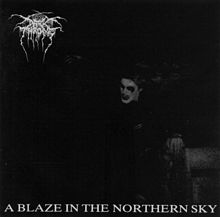
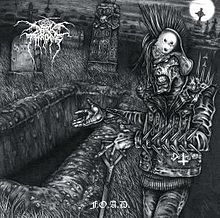
SOUNDTRACK: DARKTHRONE-“Kathaarian Life Code,” (1992), “Sacrificing to the God of Doubt” (2004), “Canadian Metal” (2007).

After watching Until the Light Takes Us, I wanted to check out some of Darkthrone’s music.  According to their Wikipedia page, over the years the band who pioneered black metal has morphed away from the sound.  They’ve added elements of punk and speed metal to their bludgeoning sound.  In the movie Fenriz says that he listens to all kinds of music and is very open-minded.

Kathaarian Life Code” is a ten minute dirge of black metal.  It opens the band’s second album (considered to be a black metal classic) with chanting and guttural spoken words.  Then it blasts forth with the jackhammer style of drums that is now standard in black metal.

It slows down from time to time, allowing for the really heavy parts to blast through the chaos of the fast parts.  It’s pretty intense and not for the faint of heart.  You can hear occasional guitars screaming through the din, but the production is intentionally murky, dark and noisy.  As they say in the movie, the bands intentionally recorded on the shittiest equipment they could find.

Sacrificing to the God of Doubt” is a later song, taken from what is considered their final album in the black metal style.  The band was turning away from the traditional black metal sound, and there are elements of punk (guitar riffs that are audible, and a sound that is less bass heavy) present.  And the production, while still mired by noise is relatively cleaner.

Canadian Metal” is from their third most recent album, after the shift from black metal was more or less official.  It sounds more like an early death metal song.  There’s low tuned notes, audible vocals (growled, but you can actually hear words) and a kind of headbanging aspect to it.  The album is called F.O.A.D. which was a song by Venom (and others, obviously), and this track reminds me of Venom somewhat.  I wouldn’t say that the band has sold out because there’s no way anyone is playing this on the radio, but it’s interesting to see how a band has managed to change things up and add new elements to its sound even though they were the forerunner and grandfather of a scene.

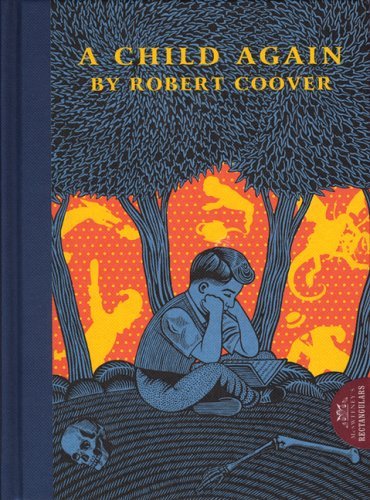
[READ: February and March 2011] A Child Again

This is a collection of short stories from Robert Coover.  There is a kind of theme throughout (most of) the stories about returning to childhood.  But the overall sense is one of despair, sadness, pointlessness and sex.  Lots and lots of sex.  And the sex is usually as vulgar and nasty as the tone of the book suggests it would be.  It’s a little off-putting, actually.

I was planning to say that I didn’t like this collection at all because I really didn’t enjoy the first half-dozen or so stories.  I continued because Coover has a great reputation that I didn’t want to give up after a few misfires.

The real disappointment came because the stories seem so promising: many of them are a kind of retelling of classic fairy tales that looks at “what happened afterward.”  However, and this was true for almost all of them, Coover tries to do two contradictory things with the stories.  He is playing with fairy tales but he is also writing stories that are completely unlike fairy tales.  By that I mean, Coover’s stories are long and very detailed, they bring far too much information to the story.  And a fairy tale is almost by definition short.  I mean, “Puff the Magic Dragon” is a song that’s about five paragraphs long.  But Coover’s “Sir John Paper Returns to Honah-Lee” is 26 pages long.  So instead of playing with the original, it feels like an original story that uses someone else’s characters.  It’s unsettling and unsatisfying.

It’s also not very funny.   And I’m not sure fit’s supposed to be.  But with a title like “Sir John Paper Returns to Honah-Lee” you expect the funny.  And there are funny moments.  I mean the whole premise is that little Jackie Paper has grown up into Sir John Paper.  He’s now an old Knight and he is sent to slay the dragon (Puff) who is plaguing the city.  Even though that is a tragic story, it is also inherently humorous.  And there are laughs when they reunite.  But it gets so bogged down in details, that the essence of the story seems to get lost.  Perhaps I’m just disappointed because it (they) turned out so unlike I wanted them to be. (more…)

Read Full Post »

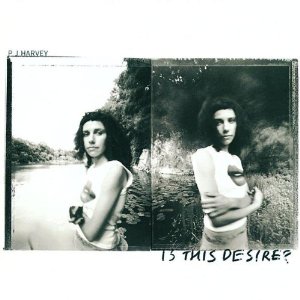
SOUNDTRACK: PJ HARVEY-Is This Desire? (1998).

After the (to me) disappointing To Bring You My Love, PJ Harvey came back with Is This Desire? This disc seems like it took the techniques she explored on To Bring and added more structure to her songs.  Harvey’s songs are by nature minimalist, and that’s why I found To Bring disappointing: it was too minimal.  She fleshes things out here–there’s a kind of Nick Cave quality to the disc as well, especially on the opener “Angeline.”  (She had sung with Cave on his then recent disc)).

These first two songs show an amazing range.  “The Sky Lit Up” has some odd guitar effects and some crazy screams later in the song.  It’s less than 2 minutes long.  As is “My Beautiful Leah,” which is over the top noisy and distorted.  It’s as sinister a song as Harvey has written.  “The Wind” has a wonderful whispered vocal, but it is dynamic and allows her quiet background music to forge its own path).  The harmony vocals are a very nice touch.

But it’s “A Perfect Day Elise” that shows that for all of Harvey’s textures and sounds, she really is a singles writer.  This is a noisy track, but the chorus is simply beautiful.  A fantastic anthem for the late 90s.

But then the disc takes a turn for the ethereal.  “Catherine” and “Electric Light” are quiet, creepy numbers that never really engage. “The Garden” tries to come out of this quiet, and manages somewhat.   “Joy” is another of Harvey’s spookier songs (she can do insane things with her voice) that is filled with anguish.

After these tracks, Harvey returns to the earlier style of the disc, with the beautiful, haunting (but not creepy) “The River.”  “No Girl So Sweet” follows with a noisy short track utilizing some techno aspects and a lot of distortion.  Harvey rocks this song very hard with some great vocals, too.

The final track is “Is This Desire?” It opens with just drums and Harvey’s voice.  It builds in complexity until it reaches a  delicate chorus.  It’s a really beautiful, if not dark, song an a nice ending to a CD that is something of a mixed bag.

[READ: March 23, 2011] “Pride”

I tend to read a lot of peculiar short stories.  So every once in a while, I really enjoy reading a story that is simply about a person or two trying to get by. And if you ever want to read stories about simple human connection, Alice Munro is the way to go!

This story confused me at first because I normally assume that the protagonist of Munro’s stories is going to be female.  This one didn’t state one way or another for a few paragraphs, so I was reading him as a girl (especially since he was talking about another girl in his town).

But no, it is about a boy.  It opens in the 1920s in a small town in Canada.  The protagonist is a poor but reasonably happy boy–with a harelip.  The girl he is talking about is named Oneida (an unusual name that did not catch on in town).  Oneida’s family is wealthy.  Like in a class by themselves wealthy.  Until, that is, her father makes a bad investment (with his bank’s money) in steam automobiles and loses more than his money. (more…)

Read Full Post »

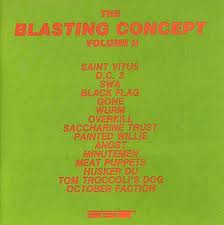
SOUNDTRACK: THE BLASTING CONCEPT Volume II (1985).

I listened to this collection of (then) old and new SST artists almost nonstop the summer I bought this.  I remember my friend Al disliking it quite a bit–except for Hüsker Dü, of course.  (I wonder if he would change his mind about any of it now).

This LP was a kind of transition record from the standard bearers of SST (Black Flag, Hüsker Dü, The Minutemen) to the then new young bands (DC3, Angst, Gone).  The Allmusic review dismisses the disc out of hand, but I think that the disc has held up very well.  I didn’t follow SST records too closely in the 90s so I’m not sure what they were doing, but for whatever reason, most of the bands that the average listener hasn’t heard of were dropped (and sadly most of those discs are long out of print, some never released on CD at all–MP3s do appear to be available). The exception of course is any band that Greg Ginn played in (which is most of them, actually), which he of course has kept in print on SST.

SAINT VITUS-“Look Behind You” This song opens the disc and seems to introduce right away that SST is no longer just a punk label.  This is a very metal sound with a wah wahed and fuzzed out guitar all the way through.  It’s mixed in a weird way (which could be SST), which undermines the real heaviness and actually adds some cool effects.

DC3-“Theme From an Imaginary Western” as mentioned, an awesome track.

SWA-“Mystery Girl” a fuzzy distorted track.  It’s heavy, but not very heavy.

BLACK FLAG-“I Can See You” is one of those Black Flag tracks that is all about Greg Ginn’s weird guitar.  He plays a simple melody out of tune with crazy guitar solos over the top.  Rollins is on vocals which are mostly spoken here.  It’s a bizarre throwaway kind of song that I really like.

GONE-‘Watch the Tractor”  This is a wonderful instrumental.  High speed with a great riff that propels about half of the song.  The other half is a heavy kind of mosh that breaks up the proceedings nicely.  This is one of the few bands that no one has heard of from thee days of SST that actually have the album still in print (because Greg Ginn is on it).

WURM-“Death Ride” is not a very good song, but one which I always liked for its simplicity and stupidity. The screamed chorus is really catchy.

OVERKILL-“Over the Edge”  This is not the famous metal band Overkill, but a different metal band named Overkill who got shuffled aside by the (arguably) better, bigger one.  This is the only song I know from this Overkill (now known as Overkill L.A.) and I really like it.  It has a great riff and vocals like Lemmy.

SACCHARINE TRUST-“Emotions and Anatomy” is one of several odd, improvised tracks on this compilation. It seems like perhaps everyone is playing his own thing and the lyrics are some strange little rant.

PAINTED WILLIE-“The Big Time” is more raucous style of song, reminiscent of earlier SST recording.  The most interesting part comes at the end with the falsetto voices threatening to take over the song.  They play a kind of sloppy punk-lite that would likely be very popular today.

ANGST-“Just Me” After DC3 this is my second favorite unknown song on the album.  It has a great bass line with some angular guitars over the top.  It actually sounds a lot like later Hüsker Dü, and there’s nothing wrong with that.

MEAT PUPPETS-” I Just Want to Make Love To You” I’ve like the Meat Puppets for ages.  And this absurd cover of the blues song is one of the oddest songs this odd band has recorded.  The solo sounds like it comes from under a volcano.  It’s not a great song (and should probably be two minutes shorter), but it is kind of fun.

MINUTEMEN-“Ain’t Talkin’ ‘Bout Love” The always awesome Minutemen engage us with this awesome cover of Van Halen’s “Aint Talkin’ ‘Bout Love.  In 1 minute they undermine all of the overblownedness of the original.  Check out the live version here.

HÜSKER DÜ-“Erase Today” This is simply fantastic.  This is an early punk song of theirs.  Catchy and fast and wonderful.

OCTOBER FACTION-“I Was Grotesque” Another weird improv piece.   It’s filled mostly with drums and strange rantings–kind of beatniky.  Here’s a live show from the band from 1984.

TOM TROCCOLI’S DOG-“Todo Para Mi”  This song has a cool riff. Although Troccoli’s voice is questionable at best.  It more or less devolves into a nonsense jam and is too long at 6 minutes.  It’s not a great way to end the album, but maybe it’s last for a reason.

[READ: March 21, 2011] “Who Am I?”

I have been hearing about Demetri Martin for a few years now.   How he’s the hot new comic. And yet I’ve never come across anything he’s done (even though I think Comedy Central repeated his shows practically on the hour when they first aired). So this short piece is my first exposure to him.  I’m going to assume it is not a fair representation of his comedy as he is normally a stand up and writing is not the same as stand up.  (That’s not to say it’s not good, just that it’s not his natural medium).

This was a short piece in the New Yorker’s Shouts and Murmurs section. It asks and answers the titular question “Who Am I?” (more…)

Read Full Post »

SOUNDTRACK: FLEET FOXES-Live at The Black Cat, Washington, DC, July 7, 2008 (2008).

I still love the Fleet Foxes debut album, and I listen to it quite often.  One of the most impressive aspects of the band is their amazing harmonies.  So how does a band that is so vocal-centric perform live?

In an interview included with the concert, Bob Boilen asks that question.  They explain that the bigger venues are a bit harder because they have to crank up their monitors.  They also try to stay close to each other to be able to hear the harmonies clearly.  Well, they did something right because the harmonies sound very impressive here.

The main problem comes because lead singer Robin Pecknold is sick.  As in, just getting over a major cold, sick. As in, he admits that their last few shows were something of a rip off for the attendees.  Tonight’s show, he says is half a ripoff.  And that is most evident in my favorite Fleet Foxes song, “Mykonos” in which Pecknold’s voice cracks with abandon.  I would feel bad for the audience if the band wasn’t so personable and friendly and generally cool.  They make the best of a rough situation, and again, the backing vocals sound fantastic.

There are also a ton of delays in this show.  Most of them seem technical, although there seems to be a lot of tending to Pecknold’s voice, too.  But as I said, the band is engaged with the audience, telling stories (someone in the band is from DC and he asks if anyone went to high school there), and generally keeping everyone entertained.  It’s probably not their best show ever, but it still sounds great.  You can listen and download at NPR.

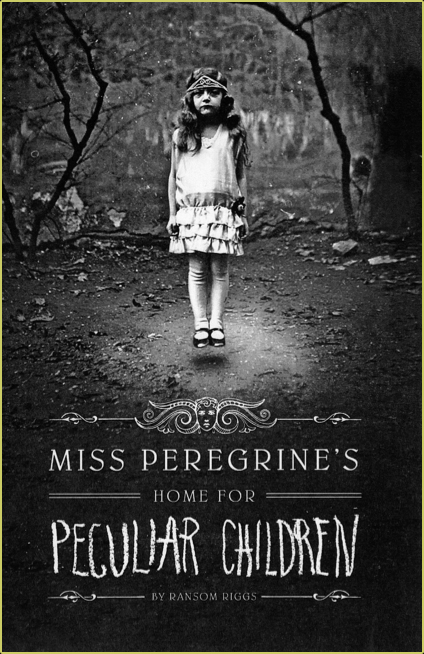
[READ: March 27, 2011] Miss Peregrine’s Home for Peculiar Children

Quirk Books, publishers of mash-ups like Pride & Prejudice & Zombies (as well as many other, well, quirky, titles) has published this fantastically exciting novel.

The cover depicts a creepy girl who is hovering off the ground.  But the girl herself is SO creepy that I didn’t even notice the hovering part.  She is just one of the peculiar children within the book.  And this picture is one of 50 included within the book (I’m only bummed that two pictures were not available in my copy).

So the story opens with Jacob Portman talking about his grandfather.  His grandfather (Abe) was a young boy in Poland during the 1940s.  When the Nazi’s invaded, his family was killed and he was sent to Wales, to the titular Miss Peregrine’s Orphanage (not widely known as a home for peculiar children).  But as details emerge from his grandfather’s version of the tale, things seem not right.

Abe talks about the monsters that chased him out of Poland–but he wasn’t describing Nazis, he was describing actual monsters, with multiple tongues and horrifying faces.  They followed him to Wales and were actually chasing him to that very day, in America.  And when he talked about Miss Peregrine’s house, he talked about the special kids who live there: the girl who could call forth fire out of thin air, the girl who could levitate, and the boy who had bees living inside of him.

Of course, that was all nonsense, just post traumatic stress from being attacked by Nazis, right?

That explanation works until the night that Abe is murdered.  He calls Jacob for help (they think he is going senile).  When Jacob gets to his house, he finds the screen door torn open and Abe missing.  The follow a trail and find Abe, bleeding in the woods.  Jacob thinks he can see the same kind of monster that Abe had always described lurking right nearby in the woods.  Although Jacob’s friend (who drove them to Abe’s house), didn’t see anything.

And now, Jacob’s dreams are plagued by scary monsters.  And he can’t get his grandfather’s cryptic last words out of his head.  Time to see a therapist, obviously. (more…)

Read Full Post »

SOUNDTRACK: DC3-“Theme from an Imaginary Western” (1985).

This song comes from the SST compilation The Blasting Concept Volume II, which came out in 1985.  I bought it on vinyl and was psyched when it came out on CD.   This version of an old Mountain song was one of my favorite songs on the disc (I don’t even know the Mountain version very well).

DC3 was the brainchild of Dez Cadena, former singer for Black Flag.  They put out a couple of albums and then disappeared.  And yet all these years later this song has stayed with me.  For a singer from Black Flag, this song is remarkably poppy (and features a lengthy keyboard solo!).  The real treasure of this song for me comes at the first chorus.  When the band sings “Oh the sun was in their eyes…” the vocals begin in a disparate, perhaps minor key harmony, and then merge into a perfect harmony.   It gets me every time.

DC3’s records have never been released on CD, and the vinyl is out of print. There’s a live CD out, but I’ve never heard it.   So, as far as I can tell, this is the only studio song available in the world.  Maybe the albums are terrible, but DC3 will always be great because of this one track.

Oh, and someone posted it on YouTube

Thanks!

[READ: March 22, 2011] Consider David Foster Wallace [essays 13-16]

This is the final batch of essays from this collection about David Foster Wallace.  The first is about Oblivion and the last three are about his non-fiction.  Perhaps it’s because I have been reading his non-fiction a lot lately (or maybe I enjoy reading essays about nonfiction more than fiction) but I found these to be the most enjoyable essays in the book.

As I’ve stated with each post, because I don’t have a lot to say about the pieces (I’m not an academic anymore), I’m only going to mention things that I found puzzling/confusing.  But be assured that if I don’t mention the vast majority of the article it’s because I found it interesting/compelling/believable.  I don’t feel comfortable paraphrasing the articles’ argument, so I won’t really summarize. (more…)

Read Full Post »

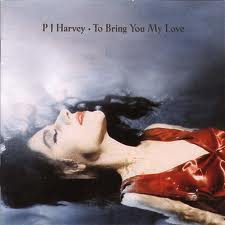
SOUNDTRACK: PJ HARVEY-To Bring You My Love (1995).

After the intensity of Rid of Me, To Bring You My Love ratchets things down a bit.   In fact, it almost seems like Harvey wanted to explore a more mellow side.  I was disappointed in the disc when it came out, although I do think it has a couple of her best songs on it.  The overall tone is simply too atmospheric for me (and I like atmospheric music, I think I just don’t like her version of it).

She dumped the PJ Harvey band, and worked primarily with John Parrish on this disc.  But her voice is deep and resonant throughout the disc.  The disc seems to be easily broken into three styles of song:  brooding, quiet songs; distorted loud romps and catchy songs that have  kind of folk base.

The broody quiet songs dominate the disc.  “Working for the Man” is a very quiet–drums, quiet organ,and a shaker.  “Teclo” and “I Think I’m a Mother” are moody pieces.  After the dynamics of Rid of Me, you expect a big noisy section to come next, but it never emerges.

The louder, more rocking songs are sonically loud.  The title song is pretty much just her and a distorted guitar (not unlike Neil Young), while “Meet Za Monster” has a Tom Waits quality.  Of course, the real power comes from the devastating “Long Snake Moan.”  It’s a five-minute scorcher of a song full of screaming intensity.  And also from the amazing single, “Down By the Water.”  It has an intense distorted bass that buzzes seductively through the whole song.  And when the whispered vocals come in it’s an unexpected sonic triumph.

The third style, acoustic rockers, shows up on “C’mon Billy,” a gorgeous acoustic track with Harvey’s voice strong and proud, and “Send His Love to Me” another intense vocal song.  Both of these songs thread her wonderfully catchy acoustic guitar playing with her rocking sensibilities.

The final track on the disc doesn’t fit neatly into any camp.  “The Dancer” is a moody piece, but Harvey’s vocals are loud and strong and probably the most interesting on the disc.

Even though I don’t like this disc as much as her others, I still acknowledge that there’s some great stuff here.

UPDATE: My friend Lar mentions an interview with PJ Harvey in Mojo.  I’ve made it accessible here.

[READ: March 17, 2011] “Rollingwood”

This is a story about a man who is overwhelmed by his life.  But unlike those of us who suffer from general overwhelmedness, Mather has some very specific problems that conspire against him.

The second, and less obvious one is that his work is less than forthright to him.  His supervisor doesn’t communicate well, there are temps in his cubical and, worst of all, the daycare center where his son goes during the day is closed inexplicably.

The first and more obvious problem is his son, Andy.  Well, more to the point the problem is that his ex simultaneously doesn’t think he does a good job rasing their son, but she also has no problem leaving Andy with him when she runs off with her new boyfriend.

Of course, Mather doesn’t speak up for himself in any of these situations so he is not innocent in the problems.  However, Andy’s mother is pretty much a capital b bitch.  She takes off with her new boyfriend for an unspecified amount of time and doesn’t leave any kind of contact number (Andy has health problems, too), yet she still doesn’t accept responsibility for her actions.  And when Mather’s office’s day care center is closed, there’s not very much that he can do. (more…)

Read Full Post »

SOUNDTRACK: THE TRAGICALLY HIP-Live at Austin City Limits Music Festival 2006 (2006).

I hadn’t heard of this album until I stumbled across it on the Yahoo! music page.  As far as I can tell it hasn’t been released on CD.  Or if it was, it’s no longer in print.  But you can download all of these songs from your online retailer.

Austin City Limits has brought out some great performances, but if the cover photo is to be believed, this is the outdoor music festival and not the usual intimate setting that you see on TV.

This is a seven song EP. I’m not sure if it covers their whole set or not.  But it does touch on many of their high points.  “Courage,” easily one of their best songs,  sounds a bit strained here.  Downie’s voice sounds like he can’t hear the rest of the band (although I suspect he was just being intense).  “The Lonely End of the Rink” sounds great, though. A really solid performance.  “Gus,” one of my personal favorites, also sounds fantastic.  These big anthemic songs work very well in this large setting.

They quiet things down a bit with “Bobcaygeon.”  I’ve always felt that this song really shines live, an it certainly does here.  But there’s little downtime when they rock out with the great “Poets.”  “At the Hundredth Meridian” also rocks really hard, but as with “Courage,” Downie seems less than excited to be singing it.  It just doesn’t have the attention to detail that he brings to the other songs.

The set ends with “Blow at High Dough” and unlike the other older songs, Downie seems to be having a lot of fun with this one.  He plays fast and loose with some lyrics, but the stuff he adds is his usual bizarre stuff.  It was a treat to find this recording, even if it isn’t their best live showing.

[READ: March 9, 2011] “Jackie”

As soon as the story opens, you know it’s going to be unusual: “I made a girlfriend a while ago. String, wax, some chemicals.”  And, indeed, the narrator has made a woman, not an inert sculpture, but a full-fledged woman, who eats and speaks and of course has sex.  He names her Jackie.

After her introduction, we learn about him.  He is an engineer and a pro soccer referee.  She enjoys going to the games.  But aside from the amazing sex (he built her well), she seems mostly disinterested in him.  He senses this but, since he made her, he assumes the best (although he does wish she’d get a job as it’s expensive doing all the fun things she wants to do.

So she gets a job at Imovax, and she is very secretive about her work.  He tries to find out even what the company does but she more or less just blows him off. (more…)

Read Full Post »

SOUNDTRACK: BLACK MOUNTAIN-Live at the Rock n Roll Hotel, Washington DC, February 19, 2008 (From NPR) (2008).

I’ve really enjoyed the two Black Mountain CDs that I have (I’ve yet to hear their debut). Their blend of psychedelia and Black Sabbath is always interesting, especially when singer Amber Webber adds her great harmonies (and leads) to the proceedings.

So it’s astonishing that Webber herself is the sole reason that I can’t listen to this show.

The band sounds great.  The musicians are right on, and the energy is good. But I can’t imagine what possessed Webber to sing the way she does.  At the end of every sung line, she ends with a vibrato that is not so much vibrato as it is staccato.  I thought it was an odd affectation to increase the psychedelicness of the first song, but she does it on every track, even when she sings lead!

Holy cow, is it ever annoyin-in-in-in-in-ing.

There are tracks when she doesn’t participate, and those are fine.  There’s also a song that is mostly instrumental and that sounds great.  But as soon as she starts singing, the whole thing goes downhill.  She doesn’t sing like that on the records, so what ever made her think that was a wise choice for a live show?   To add a really obscure reference, she sounds not unlike Diamanda Galás during her Plague Mask recordings–but that was an operatic style befitting her over the top recording.  It simply doesn’t work here.

Even Bob Boilen, normally an ecstatic reviewer of the shows he hosts seems put out by them.  He says that the band never set up a rapport with the audience.  That’s not exactly true as they do thank everyone for coming out on a Tuesday night.  But there didn’t seem to be a lot of warmth shared between everyone.

Stick to the studio albums!

[READ: March 19, 2011] Half a Life

This book is a memoir by novelist Darin Strauss.  And it opens with the fairly shocking revelation: when he was 18, he killed a girl.  She was a fellow classmate in the grade below his.

He and some friends were driving to a of social event (they were all sober).  She was riding her bike with some friends on the same road.  He saw her, but he was in the left lane, so he wasn’t too concerned and then suddenly she swerved over two lanes and into his windshield.  She died soon after.

He was completely absolved of all blame: police, eyewitnesses, even her family (oh my god, her family), everyone agreed that it was not his fault at all, there was nothing he could have done.  And yet, as he puts it, because of where he was, a girl is now dead.

The rest of the book details how, at 18, one can learn to cope (or not) with the unthinkable.   He has to finish school and prom with all of the kids in his small Long Island town who know that he killed a classmate.  He also can’t stop thinking about her and wonders how he can go on with his life when she won’t be able to do the same.

It’s an emotionally riveting story and I was utterly empathetic.  Not that I’ve had any kind of experience like that, but (especially) now that I have children, I can’t imagine how I would react to such news.  And since Strauss is a sensitive individual I can imagine at how that would eat away at you forever.

By the second half of the book, something newly unthinkable has happened; her family is suing him for $1 million.  Which he obviously doesn’t have.  This trial–and remember he has been exonerated by everyone–lasts on and off for 5 years, all during his college.  And, of course, this isn’t something you tell people–he doesn’t want anyone at college to think of him as a killer–so there’s pretty much no one he can talk to.

The events of the story happened in the 80s.  Strauss has gone on to be a succesful novelist (although I hadn’t heard of him before this book). He also has a family of his own.  Writing this book was his way of trying to cope with this incident that really defined his life.

It’s hard to say much more about the book.  It is really powerful and a simply horrifying thing to consider.  Strauss is a very good writer who never plays for sympathy (he even sides with her family in the beginning). The book is also a remarkably fast read.  Many of his chapters are one or two paragraphs, and you can finish it in a couple of hours.  But that’s also because the story is so gripping.

For ease of searching I include: Diamanda Galas

Read Full Post »

« Newer Posts