 SOUNDTRACK: A HOUSE: On Our Big Fat Merry-Go-Round (1988).
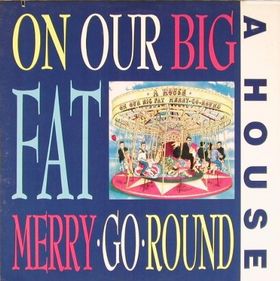 I first heard of A House when “Call Me Blue” came on a Sire records sampler (Just Say Yo). This was a good sampler of college rock music circa 1987, and “Call Me Blue” stood out for me.
I had kind of forgotten about them until I Am the Greatest came out, which I enjoyed very much. I have since gone back and bought their back catalog. This first album sounds so very much like college music circa 1987. It’s not anywhere near as weird as I Am the Greatest. In fact, it’s almost quaint in its college (or Modern as they called it back then) rock sound.
I think that if I had gotten it back then, it would have been a favorite of mine. Listening to it today, it brought back memories of that era, even though this album wasn’t part of that era for me–it just evokes that time so perfectly.
“Call Me Blue” is still a great track.
[READ: August 20, 2010] The Mezzanine
I learned about this book from my friend Rich. He raved about the minimalism of it. (1)
(1. My copy is dated from 1994. Clearly back then I thought it was a great idea to sign and date all of the books I bought. Since then, while working at a library, I find the practice kind of foolish. However, I do appreciate the fact that I know when I bought it. In some ways I wish that I had put a post it note with the date of purchase on all of my books).
I read it back in 1994 and enjoyed it. And since I am in the middle of Ulysses, I thought it would be a nice chaser. (2)
(2. In the comments for Ulysses here, the other readers mention that they are reading other books, too. And I like the idea of the word “chaser” in describing it).
The reason I thought it would make a good chaser is that it is only 135 pages long. And as I remembered, the action of the book takes place entirely on an escalator ride from the ground floor to the mezzanine of the narrator’s office. (3).
(3. Although that is literally true, the narrator reflects back upon many many events in his life, and almost all of them have taken place some time in the past–going back as far as to when he was a kid).
As the story opens, the narrator (4) steps onto the elevator. He has just come back from purchasing a new shoelace. He ruminates about how his other shoelace broke just two days before. And he thinks a million things about shoelaces in a footnote. (5)
(4. whose name we don’t learn until a conversation about three quarters of the way through the book)
(5. Now you see why I’m doing this strained style, which I think I have to stop now.)
Through the course of the novel, the narrator (6) muses on hundreds of things.
(6. Okay one more: I assume Baker himself must share these same thoughts, which almost makes this book non-fiction. In fact, I feel like the only thing that makes this fiction is the made up name of the narrator (and I don’t know if Baker ever worked in an office like this either)).
He thinks about shoelaces and milk (he likes the triangular shape of the cardboard spout better than the old glass circle.) He thinks about ice cube trays (7) and paper bags and Kiwi shoe polish and vinyl records and even counting sheep. He marvels at changes in shampoo products, at stapling bags at CVS and at Penguin classic paperbacks.
(7. Okay, actually this is kind of fun: The one thing that I found hard to fathom was that he had milk delivery as a kid (circa 1971) but he had never used the metal ice try with the pull back handle (which he describes with great accuracy but says he never used). I have used the metal ice try as recently as 1980, so how could not have had one in his house?)
Every chapter focuses on a piece of minutiae that the narrator examines in great detail. Usually, it is an observation about the state of things (some things have been improved while others have lost something–straws that float in a can of soda, for instance). (8).
(8. And holy cow does he hate air blowing hand dryers!).
One of my favorite moments in the book, and the one that made me laugh out loud was the part where, as a child, his mother chastises him for drinking his drink before he finishes chewing what was in his mouth. (9).
(9. He thinks of this because he has just taken a swig of milk while chewing on a cookie).
In his own footnote, he says
My mother has said unexpectedly one afternoon while we both sat at the kitchen table…that it was not a good idea to take a drink of what you were drinking before you swallowed what you were chewing–not, she explained when I asked her why, because you were more likely to choke, but because it was considered rude; rude in a subtler way, apparently, than the childish crudity of talking with your mouth full or “smacking your lips” (a phrase I still don’t fully understand), because though you offered no unpleasant sights or noises to others present, you did allow them to make undesirably detailed inferences about the squelchy mixing and churning that was going on behind your sealed lips (120).
This quote gives you a taste of the style and digressive nature of the writing of the book. And it also shows why it was a terrible choice as a chaser for Ulysses (10).
(10. More on that in a moment).
But what made me laugh about the above quote, was not the quote itself, but the next sentence: “The thought that I had grossed my own mother out at the kitchen table was painful to me”. (11).
(11. I didn’t laugh because it was painful, but following up that long explanation of manners with the idea of “grossing someone out” was a very funny juxtaposition).
As you can see this book has a lot of digressions, inner thoughts and musings. And as such, it is like a contemporary, far less intellectual, and much much shorter cousin of Ulysses. I am not in any way going to suggest there is any similarity of intent or even of content between these two books. Just that Ulysses is discursive and rambling and so is this, and as such it was not a good choice as a “different” book, even if it was much shorter.
As The Mezzanine draws to a close, he creates an estimated list of all of the thought he has during the course of the year (12).
(12. Again, not pushing it, but Ulysses also has a list, although that one is of Bloom’s finances during the day).
It’s a fascinating list which includes:
L. [his girlfriend] 580
Brushing tongue 150
Earplugs 100 (he uses earplugs every night)
Vending machines 31
Friends smarter, more capable than I am 19
Staplers 7
etc. (13)
(13. I have to really question the validity of these numbers. I think he’s lowballing everything. He only thinks of his girlfriend 580 times a year? Less than twice a day? If he uses earplugs every night, he must think about them more than 100 times a year, etc).
I enjoyed the book quite a bit. Although I feel like I must have enjoyed it a lot more back in 1994 because I quickly bought his follow up Room Temperature. (14)
(14. This was just before his breakthrough Vox was a blockbuster).
His musings are interesting (even 20 some years later), but they are a little exhausting. For such a short and lightweight book, it took a lot of brainpower.

 I Just Read About That...
I loved The Mezzanine, and the follow-up Room Temperature, but unfortunately Baker started writing porny little books after that and I lost interest.
I think the first two books work well but, as you noted, they would not have survived ten more pages before the reader got irritated by the sheer lack of anything much happening.
The line I loved from the first one was about how everytime he took Vitamin C he thought of ‘living on Reds, vitamin C and cocaine” from Truckin’ by the Grateful Dead; when I tuck in my shirt in the morning I always think of his advice to tuck one’s shirt into one’s underwear and how I’ll never do it because it sounds really uncomfortable.
‘Chaser’ is entirely appropriate a usage. I sometimes throw in an article or something small and self-contained in the middle of teaching a particularly dense poet. It serves the same function: a sorbet, palate cleanser, between courses.
He did start writing porny books, didn’t he? He has a new article in The New Yorker I think about hanging out with his son and playing video game with him. And I can’t help wonder if all the time, his son was thinking: You wrote The Fermata.
The Dead thing was funny, as was the absurdity of tucking your shirt in your underpants. When he goes on about how clever it was to put your deodorant on through the buttons of your short, I thought…that is clever, but you shouldn’t be 22 when you figure that out, right?
Mmm, sorbet. Maybe that’s nicer than “chaser”
“I learned about this book from my friend Rich.”
I wonder if your Rich is the same Rich who makes an appearance in the ephemeron of my copy of The Mezzanine?
Not likely.
You can see it here, if you want:
I’m going to putter around your blog…
Cheers,
Kevin
My friend Rich would have LOVED the synchronicity of that. Before he died he sold off most of his books, so there’s a minor chance it could be his. I don’t know that he knew anyone named John, though. I love you site by the way, I’ve had a lot of fun browsing around on it!