 SOUNDTRACK: THE DEAD MILKMEN-Beelzebubba (1988).
 Why the hell do you think they call it a burrow owl anyway?
Beelzebubba is pretty close to the pinnacle of The Dead Milkmen’s career. Of the 17 songs, there’s only one or two that fall flat. But there are so many that rise to greatness. The wholly un-PC James Brown-mocking song “RC’s Mom” which is pretty much all about beating your wife is in hugely questionable taste, but the funk is quite funky.
The brilliant “Stuart” is the culmination of all of the white trash mocking/spoken word nonsense songs. And then there’s the outstanding single “Punk Rock Girl.” It is simultaneously catchy as all hell and yet whiny and kind of off-key. It’s really magnificent and was suitably lauded.
The strange thing to me is that the actual released “single” was for “Smokin’ Banana Peels” (an EP with that title was released with an absurd number of dance remixes).
“Sri Lanka Sex Hotel” is an angry rant that references The Killer Inside Me and talks about having sex with everything. It’s pretty bizarre, but is musically fantastic.
True, the back half of the disc suffers somewhat (“Howard Beware” and “Ringo Buys a Rifle” are just okay), but the disc ends with the sublimely vulgar “Life is Shit” a gospel-tinged song that matches Monty Python’s “Always Look on the Bright Side of Life” for faux uplift.
Future DM discs would feature some good songs, but the band pretty much peaked with this one. I’m so bored I’m drinking bleach.
[READ: Week of April 5, 2010] 2666 [pg 637-701]
What a difference a week makes. The style and writing of Part 5 is markedly different from Part 4. It is far more laid back and focuses primarily on one individual, Hans Reiter (who we know from Part One is Archimboldi).
The Part opens with information about his parents: his father had one leg (he lost the other in WW1) and his mother was blind in one eye.
Hans’ father, after losing his leg, was in the hospital, expounding on the greatness of smoking. (He even gives a smoke to a man wrapped head to toe in bandages–and smoke pours out from all the cracks). When he left the hospital, he walked home–for three weeks. And when he arrived back home he sought the one-eyed girl in the village and asked for her hand in marriage.
Hans Reiter was born in 1920. He proved to be unreasonably tall: (At 3 he was taller than all the 5 year olds etc). And he was most interested in the seabed. There is much information from his childhood of his love of the sea (when his mother bathed him, he would slip under the water until rescued). At six he stole a book, Animals and Plants of the European Coastal Region, which he more or less memorized and was the only book he read. And then he began diving, investigating the shoreline.
His father evidently hates everyone and thinks all nations are full of swine (except the Prussians).
Hans also enjoyed walking and he would often walk to the surrounding towns: The Village of Red Men (where they sold peat), The Village of Blue Women , The Town of the Fat (animals and butcher shops); or in the other direction, he went to Egg Village or Pig Village. Or even further along was the Town of Chattering Girls (who went to parties and dances).
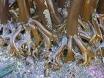 He almost drowned twice. The first time he was initially mistaken for seaweed as he was floating in the water. (After he had discovered laminaria digitata). He also began to draw seaweed in his book. (The seaweed connection is pretty thorough as he was described as looking like seaweed when he was born). The tourist who saved him was named Vogel. He believed in the general goodness of humanity, but he felt that he was a bad person for initially mistaking Hans for seaweed. Vogel also talked endlessly about the virtues of masturbation (citing Kant as an example).
After Vogel rescued Hans, he asked him how he was. That’s when we learn about Hans’ speech “issues.” Instead of saying “nothing” he would say “Nut.” And what’s this wood? “Stav” (Gustav’s wood) or Retas (Greta’s wood).
Hans’ second near-drowning occurred when he was at sea with fishermen. They thought they saw lights at the bottom of the sea. The fishermen came up with elaborate explanations for what it was, but Hans decided to see for himself. He dove in, but had to be rescued several minutes later when he never resurfaced.
When Hans was ten, his sister Lotte was born. Lotte changed Hans; he suddenly became a very empathetic person (but only to Lotte).
At 13, Hans left school. This was 1933, the year of Hitler’s rise to power. A propaganda committee for National Socialism came through the local towns where they had many rallies. Finally, they came to Hans’ town. But Hans’ father (the only living veteran) did not come to the meeting. He was staying at home looking after Lotte. So the National Socialists went to him. They spoke at length, with Hans’ father (who was terrified by them) arguing against all of their basic tenets. As the meeting was drawing to a close, Hans walked in and the recruiter commented: “He looks like a giraffe fish” (652).
Hans lost interest in school, so his teacher suggested that he become an apprentice since school was clearly not for him. He tried several different jobs, but he was too easily distracted and was often more of a burden than a help.
Eventually he began working where his mother did: as a housekeeper for a Prussian Baron, Baron Von Zumpe. The house was empty most of the time, with the Baron rarely visiting. But the baron’s nephew, Hugo Halder, did visit from time to time. He would hole up in the library and read histories. Hans was fascinated by him, and often hung around to dust in the library while Hugo was there. Hugo was absolutely no trouble to the staff.
Once in a while, the baron’s daughter would visit with a huge entourage who partied every night. When the daughter visited, Hugo would always leave as quickly as possible. The servants all though that Hugo was in love with his cousin, but Hans, who knew Hugo better than anyone, knew the truth.
One night, when Hugo was leaving quickly upon the arrival of the baron’s daughter, Hans carried his valise to the waiting car. Hans tripped and out of the valise fell some geegaws which were clearly going to be pawned. Hugo played it cool but from then on, he was “aware” of Hans. And since Hans never said anything, Hugo rewarded him. Sometimes with clothes, but often with lavish tips (which Hans put in a can that he buried in the ground and labeled “For Lotte.”).
Hugo also started talking to Hans. And they became “friends.” Hugo also managed to get Hans to read something other than Animals and Plants. Hugo told Hans about all the authors he had read, and then told Hans to pick his own book. The book Hans chose was Wolfram von Eschenach‘s Parzival. (According to Wikipedia, he is considered one of the greatest epic poets of all time). The thing Hans liked best was that when Parzival rode out to battle, he sometimes rode wearing his madman’s garb under his suit of armor.
Hugo had been stealing more and more from the castle, so Hans told Hugo to ask the staff to move stuff around, so that it wouldn’t be so obvious is something went missing.
In 1936, the baron closed the residence and fired everyone. Hans left to help build the Reich’s highways. But when he got to Berlin, he quit and went in search of Hugo. Hugo got him a job a clerk in a stationery shop and an apartment which he shared with a man named Fücher. Fücher was old and was soon on his deathbed. He told Hans that he could take his job when he died. Fücher’s job was as a watchman at the munitions factory. It paid better, so Hans took it, and now he had much more free time.
Hugo was also friends with a Japanese man who worked at the consulate. His name was Noburo Nismata but everyone called him Nisa. The three friends went out together most nights, partying and going to night clubs. Occasionally their nights of debauchery would culminate at the flat of Grere von Joachinsthaler. Her parties were usually attended by musicians, in particular an orchestra leader who claimed that good music led you to the fourth dimension.
The conductor was swarmed on by groupies and was very hard to sit with. But one night he asked about the trio of Hugo, Nisa and Hans. They sat with him for a time, listening to his theories about the fourth dimension. Finally Hans asked him about the fifth, sixth and seventh dimensions. The conductor felt mocked (although that wasn’t Hans’ intention) so he left. He told Grete that Hans was a time bomb waiting to explode. “Which was untrue” (666). When the parties ended, Hugo and Nisa would hang around, giving Grete massages, but Hans would just stare out the window.
In 1939 Hans was drafted. Hugo and Nisa sent him off by bringing him to a prostitute to get him deflowered. Her name was April. On that first night he didn’t go through with it. But he went back again before her left for the front and had sex with her several times, with her even growing to feel comfortable with him.
Hans hoped to enlist in the Navy, ideally riding in a submarine, but they just laughed at the thought of a man of his size in a sub (he was 6′ 4″ at this time). He was sent to light infantry. His size was seen as a boon during wargames as he would be tall and imposing, but his officers knew he’d be a sitting target during actual combat.
His regiment finally marched on Poland. And we are treated to a lot of soldiers walking through a lot of abandoned towns. The only action they saw was when a soldier jumped out of a tree and punched one of their regimen in the face. Hans’ brigade, prepared for guns and knives didn’t know what to do. Finally, the Pole stopped and fled, and then the soldiers shot him as he ran.
The soldiers eventually marched into a group of officers. The women siting with them looked suspiciously like the daughter of Baron von Zumpe, Hugo Hadler’s uncle.
Another battle loomed in Kutno. The Poles there simply would not surrender. Although it eventually turned out that they just didn’t know how. From October 1939-June 1940 Hans’ batallion didn’t budge. They were within sight of the Maginot Line. During all this time, Hans was holding up quite fine. He was even making his superiors angry because as one of them yelled, ” You’re not afraid of anything!” (673). A fellow soldier, however, began suffering from audio schizophrenia, believing that he could hear soldier’s commands in his head, both in German and in French. Eventually, he ran off and killed himself.
We then get another war story. A soldier found his way into the tunnels under the Maginot Line. He wandered around from one sector to another, believing that he would be lost forever. He noticed that the tunnel was absolutely immaculate: there was no evidence of soldiers at all. And the more he thought the more he decided that there was no military usefulness for having these tunnels here. Coming to this realization, he lay down and slept. And he dreamed that God came to him and said He would help the solider escape the tunnels. Soon after, the solider was awakened by a fellow solider who showed him the way out. He told everyone about the dream, and the soldiers were dismissive, calling it nonsense. But the lost soldier felt confident that God has saved him. Four days later he was hit by a car and killed.
While his regiment was stationed in Normandy, he often went for a swim, regardless of the temperature. He would often hold his breath and look at starfish. The doctor examined hm and found him in good health except for his bloodshot eyes, which the doctor assumed was from drugs. But, in fact, it was from swimming in the salt water with his eyes open.
But soon, his battalion was reassigned to the mountains. Although he could no longer swim everyday, things were once again peaceful. And, then, just as quickly several soldiers from his battalion (and himself) were transported by two tucks. They traveled through the forest and were eventually deposited at a castle. Their duty was to keep the castle clean (although Hans was asked to stand guard as they thought he would not be a good cleaner (!). That afternoon several guests arrived: General Von Berenberg (division commander), Herman Hoensch (writer for the Reich) and two officers. In another car was the Romanian general Eugene Entrescu (rising military star), Paul Popescu (a scholar) and…wait for it…Baroness Von Zumpe!
And even more impressive is that she recognizes him (although he is freakishly tall, so maybe he’s pretty memorable). She insists that he join their party (as a guard) and his commanders say okay.
And then we learn that this is in fact Dracula’s castle. And that leads to all manner of literary discussion and talk of death. The guests all head towards a crypt. When they eventually come back (Hans was on guard and had fallen asleep) some of them look like they’ve seen a ghost while the other half seem smugly mocking of humanity. When they settle again, they have a philosophical discussion, with each person spouting his or her opinions.
The Baroness then explains that she once knew a criminal, a man named Halder. He was charming and had a charismatic aura and her father’s only sister fell in love with him. This drove her father mad and he challenged Halder to a duel. Her father prepared properly for the duel and when the time came he fired effectively. But where was the madman’s bullet? He had not shot yet. He then turned his gun on himself and shot himself in the arm. After returning from the hospital, he ran off with the baroness’ aunt and they soon had a boy, Hugo!
Halder was also a painter, but the Baronness had never seen any of his paintings. Eventually, the Baron deemed Halder to be unfit as a parent and he agreed to look after Hugo.
This of course led to a discussion of art and culture which eventually leads Entrescu to state that nothing about his men is a secret to him. Nothing: “I steal into their dreams” (684).
Staying up later and later, but not feeling tired (and mimicking the premise behind the creation of Dracula) [Did Infinite Summer know that Dracula was part of 2666?] leads them to discuss the merits of Dracula, Vlad Tepes. They all have opinions on the validity of the Dracula story, literary and actual. And Entrescu goes on an on about heroes and Flavius Josephus and the real Dracula who undoubtedly read Seneca.
And when he apologized for going on so long, Popescu picked up the talking stick an started going on about a mathematicians who tried to find some mysterious numbers hidden in the vast landscape (which is kind of like a short story in Last Evenings on Earth). The mathematician was eventually put in a madhouse, where Popescu talked with him. The mathematician explained that there is no such thing as madness. But you’re here! shouted Popescu. Two years later Popescu met the doctor who had treated the mathematician. He declared that the mathematician was schizophrenic and briefly possessed a look of absolute fear.
In the morning, Reiter was shaken awake by Kruse, Neitzke and Wilke. They had found a secret tunnel (another tunnel!) that led throughout the castle. They were especially surprised to find that there was not a single rat in the entire tunnel (they were happy about it, but very surprised). After walking around for a while, they returned to their original place and Kruse and Neitzke left. Hans and Wilke returned to the tunnel where they found spy holes in some of the rooms. First they saw the SS officer writing a letter and then they moved on, then they saw the General. Finally they arrived at the Baroness’ room.
The Barroness, all blonde curls and pale white skin, was lying beneath the hairy back of Enescu. And the graphic sex begins. Enescu’s penis is a foot long, and his sex drive is insatiable. They had sex many times that night. And the Baronness, in the throes of passion, dug her nails into her palms so hard that they bled. While watching and listening to this spectacle, Wilke does what any red-blooded soldier would do and starts playing along, right there in the tunnel. Hans is at first shocked, but then decides what the hell and joins him.
The next morning all the guest went home and Hans was sent back to duty.
While in Romania, Hans requested leave twice. Both times he visited his family. He walked to the Baron’s old abandoned house, but no one knew of the Baronesses’ whereabouts. He also spent time with his sister who was now ten and who loved him unconditionally. Spending time with her made him think that hat no one would ever commit suicide during wartime, their lives are in the hands of others (which is evidently completely naive).
While in the area, he went looking for Hugo. But his flat was now owned by another family who knew nothing about him. Except, that is, for the oldest daughter. Her name is Ingeborg Bauer. She said she knew of Hugo. She grabbed Hans and led him downstairs where she proceeded to kiss him passionately. Hans naturally assumed that she was mad, but she wouldn’t tell him where Hans was unless he kissed her more. At first he disliked the kissing but then found that he enjoyed it.
She asked him to remember her and he promised he would. He even swore to God. But Ingeborg doesn’t believe in God. And, nihilism being the prerogative of teenagers, she doesn’t believe in anything (Hans asked her about a million things she might believe in). So what can Hans swear to? And her answer is Storms and the Aztecs. Hans chooses to swear by the Aztecs, which pleases her and she tells him that Hans must be in Paris. Where else would he be?
This week’s reading ends with the attack on the Soviet Union, June 22, 1941. And the soldiers, while not seeing combat can’t help but see that the forest in on fire, the all-devouring beautiful fire.
COMMENTS
I can’t tell you how much I enjoyed this section and its light and breezy pace. It almost seems as though Bolaño is saying that even Nazi Germany is better than Santa Teresa. The story of the man who would be Archimboldi is fascinating in its details, in its utter determination that we learn everything we can about this man. (And in that respect it is quite similar to much of Bolaño’s oeuvre: detailed biographies of fictional people set in real surroundings.
Bolaño’s awareness and dare I say mastery of the German war machine is pretty astounding. He clearly had some kind of fascinating with Nazis (hence Nazi Literature in the Americas), so perhaps he had studied enough to be able to fully flesh out this war (a war that I know very little about from the German point of view). And, suffice it to say that Bolaño is not sympathetic with the Nazi outlook, it seems pretty clear that the soldiers aren’t political, they’re just there because they have to be.
For ease of searching I include: Bolano

 I Just Read About That...
Leave a comment