 SOUNDTRACK: BLUE ÖYSTER CULT-compilations and live releases (1978-2010).
 For a band that had basically two hits (“Don’t Fear the Reaper” and “Burnin’ for You”) and maybe a half a dozen other songs that people might have heard of, BOC has an astonishing number of “greatest hits” collections.
Starting in 1987 we got Career of Evil: The Metal Years (1987), Don’t Fear the Reaper (1989), On Flame with Rock n’ Roll (1990), Cult Classic (which is actually the band re-recording their old tracks (!)) (1994), and the two cd collection Workshop of the Telescopes (1995). There’s even Singles Collection, (2005) which is a collection of their European singles & Bsides.


 This doesn’t include any of the “budget price” collections: E.T.I. Revisited, Tattoo Vampire, Super Hits, Then and Now, The Essential, Are You Ready To Rock?, Shooting Shark, Best of, and the 2010 release: Playlist: The Very Best of).

 The lesson is that you evidently won’t lose money making a BOC collection.
I don’t know that any of these collections are any better than the others.
The 2 CD one is for completists, but for the most part you’re going to get the same basic tracks on all of them.


 And, although none of them have “Monsters” for the average person looking for some BOC, any disc is a good one.
Regardless of the number of hits they had, BOC was tremendous live. And, as a result, there have also been a ton of live records released. Initially the band (like Rush) released a live album after every three studio albums. On Your Feet or On Your Knees (1975) Some Enchanted Evening (1978) and Extraterrestrial Live (1982) were the “real releases.”


 Then, in 1994 we got Live 1976 as both CD and DVD (which spares us nothing, including Eric Bloom’s lengthy harangue about the unfairness of…the speed limit). It’s the most raw and unpolished on live sets. 2002 saw the release of A Long Day’s Night, a recording of a 2002 concert (also on DVD) which had Eric Bloom, Buck Dharma an Allan Lanier reunited.


 They also have a number of might-be real live releases (fans debate the legitimacy of many of these). Picking a concert disc is tough if only because it depends on the era you like. ETLive is regarded as the best “real” live disc, although the reissued double disc set of Some Enchanted Evening is hard to pass up. Likewise, the 2002 recording is a good overview of their career, and includes some of their more recent work.


 If you consider live albums best of’s (which many people do) I think it’s far to say that BOC has more best of’s than original discs. Fascinating. Many BOC fans believe that if they buy all the best of discs, it will convince Columbia to finally reissue the rest of the original discs (and there are a number of worthy contenders!) in deluxe packages. I don’t know if it will work, but I applaud the effort.
[READ: October 2009-February 2010] State By State
This is a big book. And, since it’s a collection essays, it’s not really the kind of big book that you read straight through. It’s a perfect dip in book. And that’s why it took me so long to get through.
I would love to spend a huge amount of time devoting a post to each essay in the book. But, well, there’s 51 (including D.C.) and quite a few of them I read so long ago I couldn’t say anything meaningful about. But I will summarize or at least give a sentence about each essay, because they’re all so different.
I’ll also say that I read the Introduction and Preface last (which may have been a mistake, but whatever). The Preface reveals that what I took to be a flaw in the book was actually intentional. But let me back up and set up the book better.
The catalyst for the book is the WPA American Guide Series and sort of Steinbeck’s Travels with Charley. The WPA Guides were written in the 1930s as part of the Works Progress Administration. 48 guide books were written, one for each state. Some famous writers wrote the books, but they were ultimately edited (and many say watered down) by a committee. I haven’t read any of them, but am quite interested in them (and am looking to get the New Jersey one). Each guide was multiple hundreds of pages (the New Jersey one is over 800).
State By State is written in the spirit of that series, except the whole book is 500 pages (which is about 10 pages per state, give or take). And, once again, famous writers were asked to contribute (no committee edited this book, though). I’ve included the entire list of authors at the end of the post, for quick access.
So I started the book with New Jersey, of course. I didn’t realize who Anthony Bourdain was until I looked him up in the contributor’s list (I’m sure he is thrilled to hear that). And his contribution was simultaneously exciting and disappointing,. Exciting because he and I had quite similar upbringings: he grew up in North Jersey (although in the wealitheir county next to mine) and had similar (although, again, more wealthy) experiences. The disappointing thing for me was that Bourdain fled the state for New York City (and, as I now know, untold wealth and fame (except by me)) I felt that his fleeing the state, while something many people aspire to, is not really representative of the residents of the state as a whole.
And that dissatisfaction is what I thought of as the flaw of the book (until I read the Preface). In the Preface, Matt Weiland explains that they asked all different authors to write about states. They asked some natives, they asked some moved-ins, they asked some temporary residents and they asked a couple of people to go to a state for the first time. In reality, this decision makes for a very diverse and highly entertaining reading. In my idealized world, I feel like it’s disingenuous to have people who just stop in to give their impression of an area. But hey, that’s not the kind of book they wanted to compile, and I did enjoy what they gave us, so idealism be damned.
For most of the book, whenever I read an essay by someone who wasn’t a native or a resident of a state, I assumed that there weren’t any famous writers from that state. I’ve no idea if that played into anything or not. From what I gather, they had a list of authors, and a list of states (I was delighted to read that three people wanted to write about New Jersey-if the other two writers ever decided to put 1,000 words to paper, I’d love to read them (hey editors, how about State by State Bonus Features online, including any extra essays that people may have wanted to write).
From New Jersey, I proceeded alphabetically. And, I have to say that I’m a little glad I did. I say this because the first few states in the book come across as rather negative and kind of unpleasant. Alabama (written by George Packer) comes across as downtrodden, like a place you’d really have to love to live there. Even Alaska, which ended up being a very cool story, felt like a veil of oppression resided over the state (or at least the part of the state that Paul Greenberg wrote bout.) But what I liked about this essay and the book in general was that the authors often focused on unexpected or little known aspects of each state. So the Alaska essay focused on Native fisherman and the salmon industry. Obviously it doesn’t do justice to the rest of that enormous state, but that’s not what the book is about.
The book is meant to be a personal account of the author’s experiences in the state. (more…)
Read Full Post »

 SOUNDTRACK: BLUE OYSTER CULT-Club Ninja (1986).
 My roommate Glen is the only person that I know who not only owned this record but also played it a lot. No doubt it was his relentless playing of this disc that now leads me to think of it rather fondly, even if it is pretty poorly regarded as far as BOC discs go.
 SOUNDTRACK: BLUE ÖYSTER CULT-The Revolution by Night (1987).
 After the amazing Fire of Unknown Origin, BOC, returned (retreated?) into keyboard-fueled tracks. And we know that where BOC is concerned, keyboards=crossover attempts. Now I don’t know if it’s just my own preferences, but I feel like the lightweight pseudo-metal here is better than their earlier stabs at lightweight pseudo-metal (Mirrors, etc). I assume it’s because I grew up listening to metal around this time, so even if it’s not terribly original, it’s at least comfortable.

 SOUNDTRACK: MARK EITZEL-Candy Ass (2005).
 I’ve liked Mark Eitzel since my friend Lar played me “Johnny Mathis’ Feet” back in college. I got some of his solo discs, but by around 2000, I’d more or less given up on him. Someone donated a copy of this solo album to the library, and since we weren’t keeping it, I brought it home.
 SOUNDTRACK: BLUE ÖYSTER CULT-Cultösaurus Erectus (1980).
 BOC came back with a vengeance on this disc. From the cool title (c’mon that’s a cool title) to the futuristic fossil on the cover, this album is all heavy.
 SOUNDTRACK: TORI AMOS-“Juarez” (from To Venus and Back) (1999).
 This song was the first that I had heard of what was happening in Juarez, Mexico. In AP Magazine (Oct 99) Tori Amos said:
 SOUNDTRACK: BLUE ÖYSTER CULT-Fire of Unknown Origin (1981).
 This was the first BOC album that I bought. The video for “Burnin’ for You” was all over MTV (although I don’t remember it at all, now). And I was an instant convert to BOC. I listened to this disc constantly.
 SOUNDTRACK: A CAMP-Colonia (2009).
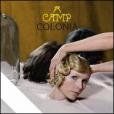 This is the second album from the side project of The Cardigan’s Nina Persson. This disc was created with her husband Nathan Larson from Shudder to Think. Their first album had a country flair to it, but this one eschews that entirely for a pop feel that is entirely different from The Cardigans’ two main styles: the “cheesy” happy pop of “Lovefool” and the bitter guitar pop of their later discs.
 I Just Read About That...