Feeds:
Posts
Comments

Archive for December, 2009

SOUNDTRACK: BLACK SABBATH-Vol. 4 (1972).

When I was younger I liked this Sabbath album a lot more than I do now.  There are some absolutely stellar tracks on here, but most of the songs are a rather peculiar for Black Sabbath.  It showcases ballad-y nature that Ozzy would have for some of his biggest hits twenty years later.

“Wheels of Confusion” opens the disc with a fascinating bluesy sounding guitar solo that turns into a straightforward rocker.  But, as it’s 8 minutes long, there’s a lot of twists and turns.  And it ends with a two and a half minutes of upbeat guitar soloing (with a tambourine keeping the beat!).

“Tomorrow’s Dream” opens with a rocking bendy guitar riff  but in the middle the chorus turns the song into a delicate ballad.  This is followed by “Changes” a full-on piano ballad (!).  It’s catchy, no doubt, and I loved it when I was younger, but I’m not entirely sure it passes the test of time.  This is followed by “FX” which is literally almost two minutes of echoing blips and bleeps, some of which go back and forth on the headphones.  It’s a very strange addition to any disc and is really the perfect example of “filler” unless by some chance this was majorly cutting edge at the time.

This is redeemed by “Supernaut” one of the all-time great Sabbath tunes.  It’s heavy, fast and features a great guitar riff.

“Snowblind” is a another fantastic song.  A great riff, and of course, it’s totally pro-cocaine!  How can you tell?  Well, because at the end of the first verse, you can hear a very unsubtle whisper of “cocaine.”  My, how the band has changed in just a couple of years.  This song also features a ballady mid-section.  It also features an awesome middle bit that rocks very hard (and can be summed as: don’t tell me what to do).  The drugs hadn’t deteriorated Sabbath’s songwriting yet, but give it a couple more records!

“Cornucopia” is one of the weird songs that you find on the second side of a Sabbath album.  It’s a got an awesome slow, doomy opening riff which then turns into a speedy rocker.

When I was kid I really liked “Laguna Sunrise” and I still do.  It’s a pretty acoustic guitar number (with keyboards or strings or something).  After “Changes” you’re not surprised by anything that Sabbath will throw at you, but this song is really shockingly delicate.

“St. Vitus Dance” is probably the most schizophrenic Sabbath song.  The opening guitar riff is so incredibly upbeat, happy and boppy; who knows what will come from it.  And then the verses turn dark and edgy with lyrics about a breakup.  And then the happy guitar bits come back!

The disc ends with “Under the Sun/Everyday Comes and Goes.”  It is once again another wonderfully sludgy guitar riff that turns into a fast rocker (“I don’t want no Jesus freak to tell me what it’s all about!”).  After the verses, you get this wonderfully weird guitar solo that’s like an ascending scale on acid.  Fun!  About three minutes in, it turns into “Everyday…” an uptempo rocker that’s not out of place with the other half of the song, but which does seem like an odd placement.

This disc was strangely experimental for Sabbath.  And, while it’s nice to see them not getting stuck, some of their choices were certainly weird.  And yet all Sabbath fans seem to regard this disc pretty highly (I think it’s the iconic cover that we all remember so fondly).

[READ: December 10, 2009] Unseen Academicals
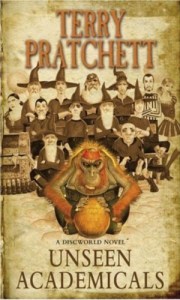
Terry Pratchett knows football (soccer)??!!  In all the years of Discworld books, I don’ think there has been any mention of football (or even any sport).  Who knew he had a 400 page book about football in him?

Oh, and what is wrong with US book publishers?  Look at the utterly lame US cover at the top here.  First of all, the book is about soccer…why are they reaching for the ball with their hands??  Second, look here at this awesome UK cover by Paul Kidby (the official illustrator of Discworld).  Does he not have publishing rights in the US?

American readers, check out this cover.  It is awesome!  It gives you the whole cast, it gives a wonderful graphic of just what you’d be up against when you play this team.  Look, there’s the Librarian!  And, of course, the drawing is great.  Well, at least we have the internet.

But back to the football.  As with any Pratchett book it’s not just about football.  There is a whole bunch of stereotype-busting, inner-strength growing, pop-culture raspberrying, and general hilarity as well.  Oh, and Rincewind is back!  Hooray! (more…)

Read Full Post »

SOUNDTRACK: BLACK SABBATH-Master of Reality (1971).

This album seems to have directly inspired more bands than any other Sabbath record.  There’s the band Masters of Reality (who I’ve never heard) and there’s the 1,000 Homo DJ’s EP and blistering cover for “Supernaut.”

This is one of my favorite Sabbath discs, even though, or maybe because there aren’t as many hits on it.  The story goes that since Tony Iommi had his fingertips cut off (!) he had to downtune his guitar so the strings would be looser and therefore less painful to play.  As such, this disc introduces a sort of “classic” Sabbath sludgy sound.  But even though this album doesn’t get a the airplay of Paranoid any metal fan knows a few of these songs.  “Sweet Leaf,” for instance, is quite well known.  It also makes me laugh because it is so clearly pro-drug (after all those anti-drug songs on the first two discs).  And of course, it opens with that great echoing cough (which I now assume is from someone toking up).

“After Forever” is one of those great Sabbath songs where Geezer Butler’s bass fills stand out throughout the bridges.  It also features one of Tony Iommi’s strangely “happy” sounding opening chords  The song itself is pretty dark but the chords are so upbeat!  The song has a lyric that I found shocking as a kid: “would you like to see the Pope on the end of a rope, do you think he’s a fool?”  And of course, the guitar solo flies wildly around your head from one speaker to the other.

“Embryo” is a strange middle eastern sounding 30 second instrumental that segues into the awesome “Children of the Grave.”  It’s one of those Sabbath songs that sounds menacing all the way through.  There’s a weird clicking sound in the verses that I assume is Geezer Butler’s de-tuned, incredibly loose bass strings slapping the fretboard.  And, of course, it ends with a wonderfully warped ghostly guitar feedback sounds and the whispered “Ch ch ch ch children.”

The second half of the disc is quite different from the first.  “Orchid” is a delightful 90 second acoustic guitar workout.  And it segues into “Lord of This World” a real rock and roll sounding song (featuring some great Ozzy screaming).  “Solitude” is like “Planet Caravan” from Paranoid, in that it’s a slow, trippy psychedelic sense (is it possible that Sabbath didn’t know that they were a metal band?).

Finally comes “Into the Void.”  This was one of the first songs I’d ever learned on guitar.  My guitar teacher liked the down-tuned low E string aspect of it, and I still enjoy playing it today.

As my friend Andrew pointed out the other day, John Darnielle from the Mountain Goats has written a 33 1/3 book about Master of Reality.  While I haven’t read it yet, Darnielle is pretty cool, so I assume it’s a great read if you like this disc.

[READ: November 30, 2009] “Loggerheads”

Not every David Sedaris piece is funny.  We know he’s not a comedian, per se, although he is certainly a humorous writer.  We also know that some Sedaris pieces are kind of disgusting.  He tends to delight in the grotesque.  However, in this piece he combines the disgusting with the non-humorous to create a very unsatisfying piece. (more…)

Read Full Post »

SOUNDTRACK: BLACK SABBATH-Paranoid (1970).

Black Sabbath’s second album is certainly their most famous.  I mean, it features “Iron Man,” the first song everyone learns to play on the guitar.

But the whole first side of the disc is pretty famous.  “War Pigs” is a wonderful anti-war song.  “Paranoid” was their first big hit, and I read recently that it was a last minute addition to the album.  And it’s really short, too!

The next track, “Planet Caravan” is, in context, insane.  It is an incredibly slow, meandering track.  Back in the day, we used to skip this track all the time.  But since then I’ve grown to appreciate this trippy psychedelic song.  It feels a bit long, especially when you want to rock out, but it’s still pretty interesting.

And then there’s “Iron Man,” and, well, there’s nothing much to say about it that hasn’t been said elsewhere.   Except of course that it rocks!

Side Two was pretty unlistened to before CDs made it all one side.  “Electric Funeral” is a major downer about nuclear war, but it has an amazing opening riff with a wonderfully wah-wahed guitar.  “Hand of Doom” begins slowly with what’s more or less just bass and vocals.  And then guitars blare forth like sirens leading to some cool heavy sections.  About half way through it turns into this fast rocking song and becomes yet another anti-drug song.  This anti-drug stance is rather surprising given what lies in store in the not too distant future.

“Rat Salad” is a short instrumental.  It’s one half extended guitar solo with the second half comprising a drum solo.  Despite that, the riff of the song is pretty awesome.  The final track is the wonderfully named “Jack the Stripper/Fairies Wear Boots.”  The opening is another cool riff with lots of drums that melds in to a wonderfully heavy, bad-assed song (“a fairy with boots dancing with a dwarf”).  It ends the album very well.

For a record that’s nearly 40 years old, it’s still remarkably heavy and it set a great standard for heavy metal.

[READ: November 29, 2009] “The Not-Dead and the Saved”

This was a sad story about a woman with a dying child.  The child is older (late teens) and he has been coping with this issue for all of his life.  Consequently, he is cynical and more than a little bitter.

It’s hard for me to be critical of the story seeing as how it won the VS Pritchett Memorial Prize.  However, I didn’t find the story all that compelling. I think it was the completely detached narrator (third person distant, I would say) or maybe it was something else. Whatever it was, I just couldn’t connect to it.

[UPDATE:  December 15, 2009.  The story also just won the National Short Story Award.  Maybe I need to re-read it]. (more…)

Read Full Post »

SOUNDTRACK: BLACK SABBATH-Black Sabbath (1970).

I’ve talked about Black Sabbath quite a bit, so why not take a look at their records directly?

One of the fun surprises about their first disc is the stereo mix (although it was 1970, so maybe one shouldn’t be surprised).  Guitar in one ear, bass in the other and sometimes only a guitar solo in one ear with nothing else going on!  The other surprise is that even though Tony Iommi’s guitar is on fire and he has huge lengthy guitar solos (the one in “Warning” is like 8 minutes long), the other members, especially the drums, really come to the fore.

What can one says about the title track?  The opening thunderstorm (with creepy bell tolling) sets the mood perfectly and then the killer riff kicks in and Ozzy Osbourne’s weird, loud, somewhat whiny and frighteningly frightened voice asks “What is this that stands before me?”  It’s a slow song, especially for one that spawned a genre of fast heavy metal, but it sense of ominousness is tangible.

“The Wizard” undermines everything you think you know about heavy metal since it begins with a harmonica.  However, it is a pretty creepy harmonica, and the melody is certainly spooky.  What’s so fascinating about the song is the drums.  While the whole band plays the somewhat odd riff, the drums have a huge place of prominence in the song, with little snare drum solos after each line (and a prominent cowbell at one point).  There are some wild guitar solos, but you wouldn’t be crazy thinking that this was the  drummer’s band.

The next song is listed as four songs: “Wasp/Behind the Wall of Sleep/Bassically/N.I.B.”  “Wasp” is a short, fairly upbeat instrumental, but “Behind the Wall of Sleep” is where the words kick in.  It’s a pretty explicitly anti-drug song (“turns your body to a corpse”).  And I’m fairly certain there are two vocal tracks, one in each ear.  “Bassically” is the wild bass solo (again, taking away the dominance from the lead guitar). Which leads to “N.I.B”., one of the great, classic Sabbath songs.  An awesome bass riff that propels the song to its climax of “My name is Lucifer please take my hand.”  Although it also features a strangely plaintive refrain of “Your love for me has just got to be real.”

“Wicked World” comes in a little preachy and kind of out of place.  But mostly because it’s got a strangely jazzy feel. It’s not out of the ordinary in concept, it’s just a little less subtle than some of the other tracks.

“A Bit of Finger/Sleeping Village/Warning” is the ending trio of tracks (14 minutes in all) that are really hard to distinguish.  “A Bit of Finger” is a very short acoustic guitar solo (I assume, I mean, the “Sleeping Village” lyrics kick in pretty quickly). But I love that there’s a Jew’s harp in the background.  Then there’s a crazily long guitar solo.  Or, should I say there are two guitar solos: a different one in each ear.  I think that the solo is part of “Warning” (it’s the same melody after all) but who can tell.  “Warning” is another fantastic Sabbath song.  The bass line is great and Ozzy sings one of his oddly plaintive songs of loss: (“the feelings were a little bit too strong”).  But the middle section is an astonishingly long guitar solo, or should I say solos. This solo even stops at one point and he comes out with a whole new melody/solo after that.  And then another solo.  Most of the soloing is in the right ear, which leaves the left ear struggling in vain to hear what’s going on (it’s fun to listen with just the left ear phone in).  With about a minute to go, the song proper returns.  It’s pretty bizarre.  And maybe that’s when Tony Iommi’s ego was placated.

Despite this being one of the first really heavy albums, it still retains a bluesy/jam feel to it.  The songs are long, there’s wild freewheeling guitar solos, and the sound itself isn’t a constant bludgeoning (like later heavy metal), it comes in bursts, which somehow makes it more ominous!

It’s really tremendous.

[READ: November 27, 2009] “Midnight in Dostoevsky”

Although I don’t know where this story is set exactly, I can totally picture the scene.  And I am superimposing it directly onto a location from where I went to college.  I realize that’s totally wrong, but I couldn’t resist.  This story had very weird overtones to me and actually inspired me to want to write a story that has apparently been percolating in my head for years.  We’ll see about that.

Anyhow, as for the story itself, I confirmed my suspicion that DeLillo doesn’t write short stories too often.  According to his Wikipedia site, he wrote one short story in 2002, another in 2007 and then this one.

DeLillo is a postmodern master, which leads one to think that his stories will be convoluted and difficult.  But this story is pretty straightforward.  Two college kids, walking around on a cold winter day spot an old man walking toward them.  They create a backstory for the man and, in the end, attempt to confirm or deny what they have concocted.  Fairly straightforward.

But as with any great story, the real action happens in the characters’ heads, or in this case, in the narrator’s mind and his spoken dialogue with his compatriot. (more…)

Read Full Post »

actsMy original post for this story is largely correct (aside from the fact that the first version I read was lacking the final four paragraphs!)  And so I’m posting it here, but I’ll make changes as necessary:

In the story, a man inflates a huge irregularly shaped balloon in Manhattan.  It takes up several city blocks and, in places, it rests against the skyscrapers.

And that’s it.

Well, not exactly.  The story is about people’s reactions to this enormous thing that takes up the entire sky but about which there is no explanation.  The narrator states that people might have felt better about it if it had an ad or a “message” on the side, but no, his balloon is just soothing earth tone colors.

The story doesn’t end, exactly.  It just sort of stops. [THAT WOULD BE WRONG!]  But the discussion of people and their attitudes and reactions is certainly interesting and says as much about the author as it does about the narrator.  Most critics agree that the story is something of a metaphor for his own art, and that is pretty obvious to see.

Okay, so as I noted, a man inflates a balloon in New York City.  He does it in the middle of the night so when people wake up the balloon is just there, with no explanation.  And it is a large balloon, taking up many many streets.  It reaches up to building tops and kids play on and under the balloon.  But mostly people seem to wonder about it.

One thing I enjoyed about the story is the absolutely innocent nature of it.  I was trying to imagine such a thing as this story happening in 2009, and realizing that you could never do it.  You could never even propose a balloon aloft in the city with no explanation.  Security would be way too intense, and people simply wouldn’t stand for the mystery.

But in 1968, this premise (even if absurd) is delightful.

Now that I have actually finished the story (and yes, I’m still annoyed that this version online was incomplete but somehow passed off as a complete story) my opinion of the ending is radically different.  It doesn’t “just stop.”  In fact, we (the readers) learn why the balloon was inflated (although the citizens of New York do not).  The narrator inflated the balloon for twenty-two days because his beloved was away.  And such a charming and surprisingly sentimental reason is delightful given the analytical nature of the bulk of the story.

This now being my third reading of the story, I find it very engaging.  And I can easily see why it is considered one of his best.

Read Full Post »

SOUNDTRACK: KATE BUSH-Aerial (2005).

This was Kate’s first release in 12 years!  There’s a part of me that would expect unparalleled genius to emerge from a 12 year hiatus, but realistically, what we get is a more mature and confident singer, and songs that sound very much like Kate Bush songs. There’s not a lot of experimentation, although there is a song cycle (two in fact) to hold the disc together.

The first disc (for there are two, totaling about 80 minutes) is listed as “A Sea of Honey”

It opens with “King of the Mountain” a great upbeat single.  Next is “Pi” a fascinating song in which Kate sings out the decimal places of Pi (3.14…).  It’s airy and ethereal, and pretty neat.  “Bertie” is an adorable ode to what I assume is her son. It’s a very sweet love song to a child.

“Mrs Bartolozzi” opens with a piano sequence that sounds very uncomfortably close to a Phil Collins.  And, later in the sings she sings a “sloshy sloshy” part which is pretty odd.  But despite all of this, the song is closest to the Kate of old.

“How to be Invisible” has some really cool choral effects (and is a very neat concept lyrically).  It also features a very nice guitar line that sneaks out of the musical tapestry from time to time.  “Joanni” rocks in Kate’s inimitable way (and it’s about Joan of Arc).  It has also got some fun and funny parts the reflect the Kate of old (screaming vocals way down in the mix and “Mmm Hmms” that are kind of silly).  The disc ends with the gorgeous ballad “A Coral Room.”

The second disc “A Sky of Honey” is more of a complete song cycle (It starts with a Prelude AND a Prologue).  There’s a couple of short songs (90 seconds each) thrown in the middle.  My favorite is the final track, “Aerial” which has a cool dance rhythm (that seems so unlike Kate) which propels the song almost magically.

Overall, this disc doesn’t overwhelm me as much as say Hounds of Love, but it’s a really solid disc and I’ve found myself listening to and enjoying it a lot over the last few weeks.  It’s nice to have Kate back.  I wonder how long it will be for her next disc.

[READ: November 27, 2009] Unspeakable Practices Unnatural Acts

After reading (the incomplete) “The Balloon” (see the post), I decided to give the entire collection a spin.  I didn’t really enjoy the short stories I had read in Harper’s, but I did enjoy “The Balloon,” so I thought it would be worth investigating Barthleme (a little) further.

This collection is a mix of utterly absurdist stories (many of which seem to have multiple vantage points that I found rather difficult to keep track of ).  One of the most noteworthy things about the collection is that it seems to me to be very topical circa 1968.  And I think I’m missing a lot of what is happening in the stories.   I’ll cite examples below, but oftentimes I assume that I’m just not getting something that I should be getting (more…)

Read Full Post »

« Newer Posts