 SOUNDTRACK: SONIC YOUTH-Bad Moon Rising (1985).
A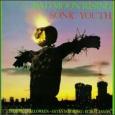 nother Sonic Youth record, another record label. Bad Moon Rising is a pretty big leap from Confusion is Sex, in that there are actual songs. Well, that’s not fair, what I mean is that the songs have structure like proper songs do. In fact, “Death Valley ’69” (with vocals by Lydia Lunch) is quite catchy!
Indeed, the band doesn’t shy away from catchy at all. The opening track, “Intro” is a pretty one-minute guitar piece. And it’s followed by “Brave Men Run (In My Family)” a catchy (!) song sung by Kim. The third track “Society is a Hole” returns to the stark tracks of yore, with Thurston’s despairing vocals, but it introduces guitar harmonics, a key SY staple in songs to come.
And if you like ” I Love Her All the Time,” and who doesn’t, check out this footage from a 1991 concert (complete with Thurston using drumsticks on his guitar).
Despite these signs of lightening up, there are some pretty heavy sounds on this disc. “I’m Insane” and “Justice is Might” sounds kind of like you might think they would based on their titles.
The band has definitely gotten control over the noise they want to make; it doesn’t seem to be enveloping them, (like it envelopes the listener), it’s more at their beck and call. We’re not quite to the levels that prime SY will sound, but it’s pretty darn close.
And songs from the attached Flower EP are okay, but “Flower” is especially good. It has a cool “Love the power of women” spoken piece from Kim that foreshadows some of her really fantastic songs to come.
And just to be difficult, they end the disc with the one-minute “Echo Canyon” which is just as it sounds,an echoic noisefest.
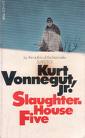
[READ: July 16, 2009] Slaughterhouse Five.
What is worse? Reading a book and not remembering a single thing about it, or not reading a book but convincing yourself that you have? I am stuck with this dilemma as I realize that one of the two options applies to me and Slaughterhouse Five.
I was certain that I read Slaughterhouse Five. In fact, I was certain that I knew exactly when I read it (my junior year of college on Super Bowl Sunday, when I blew off the Super Bowl party to read the book). I realize now that it must have been some other book (but what could it have been?) as I had no recollection of Slaughterhouse Five. At all. Even though the cover of my mass market paperback (which I can’t find online anywhere) was completely familiar and there’s even a dog eared page or two. Huh.
The first thing I want to say about the book is, having read all of the novels that Vonnegut wrote before S5 was a real boon to reading it because so many of the characters from the other books appear in this one! More on that in a moment.
The book is also about the air attack that obliterated Dresden, Germany.
Amazingly, and this is common knowledge after you read the book, Vonnegut was in Dresden at the time of the air attack. In fact, on my copy, the author is listed as “Kurt Vonnegut, a fourth-generation German-American now living in easy circumstances on Cape Cod [and smoking too much] who, as an American infantry scout hors de combat, as a prisoner of war, witnessed the fire-bombing of Dresden, Germany, ‘The Florence of the Elbe’ a long time ago and survived to tell the tale. This is a novel somewhat in the telegraphic schizophrenic manner of tales of the planet Tralfamadore, where the flying saucers come from. Peace.” He was a prisoner of war held underground in a slaughterhouse (#5, in fact). The slaughterhouse was more secure than just about anything else around, so the people that were holed up in the slaughterhouse were some of the only survivors of that attack. (Some 25-35000 people were killed in Dresden).
But the basic premise of the novel is that Billy Pilgrim has come unstuck in time. Billy Pilgrim was in Germany as an American soldier during World War II. He was captured and held prisoner in a slaughterhouse. And, at some point in his life, he was taken by the aliens from the planet Tralfamadore where he was put into their zoo as the only human occupant for many years. (He is eventually joined by Montana Wildhack, the porn star). Billy also has the ability to travel to various points in his life: from when he was a young boy, to the war, to the slaughterhouse, to Tralfamadore, to his life as a married optician after the war and back again.
This book is one of several of Vonnegut’s which features the aliens from the planet Tralfamadore. And no doubt, having aliens in your book will get you labeled as a science fiction writer (something Vonnegut bristled at). But despite the aliens (and the fairly complex descriptions of them and their behavior) the book is not science fiction.
The aliens function very well as a frame of reference for an objective (or at least objective to Vonnegut) witness to humanity, its planet and people. And in this book, the time travel is more of a device to get Billy Pilgrim to experience different things, rather than as cool sci-fi technology. In fact, I can’t think of anything that would make me think that this book was sci-fi, except of course that it has aliens.
But back to the book.
In a more linear book, Billy’s life would be something rather simple: he studies to be an optometrist. He is eventually sent off to war as a chaplain’s assistant where he is incredibly unsuited for the job. He travels around Germany with a few guys who know what they are doing, but he is captured nonetheless. He is moved to Dresden just before the bombing, where he is liberated and eventually sent home. He marries a woman (Valencia) for comfort and money (although he does admit that marriage has been very good), they settle down together and have some kids. At some point he was abducted and lived on Tralfamadore for a few years. And then he and Valencia die (separately).
Since Billy travels back and forth in time he is quite aware of his own death. And he has lived it many times. So it goes.
The Trafalmadorians believe that when someone dies they are not dead, they are just at a different point in their life. For them, time is not linear, and when someone dies they do not mourn, they just say So It Goes. The Trafalmadorians are aware of time in four dimensions, but they cannot alter it. Nevertheless, they say the key to life is to remember the happy moments, not the sad ones.
And so Billy travels back and forth trhoughout his life, experiencing moments again and again. And through all of this he tries to live by the Trafalmadorian maxim of retaining the happy moments. Despite this,Billy still has to interact with other people, who seem to want to add to the unhappy moments.
Roland Weary “saves” Billy several times during the war. Billy is clueless, and more or less clothesless (he was issued ill-fitting army clothes and has lost many of them). Billy has basically given up and is wandering around behind enemy lines aimlessly. Roland, seeing himself as a hero, takes it upon himself to save Billy. He later blames Billy for all of his ills.
Paul Lazzaro is an irritating POW who has been sequestered with Billy (and the other POWs). Lazarro relishes revenge, which he delays for a long time (his description of getting revenge on a dog that bit him is pretty ugly). Lazzaro says he can have anyone killed for $1,000. He hears Roland blame Billy for all of his problems and he vows to take revenge on Billy for him. He also utters the first instance of Vonnegut’s quote “go take a flying fuck at a rolling donut.”
Poor Old Edgar Derby (as he is consistently referred) is a nice teacher who we learn very early on will be executed for stealing a teapot. So it goes.
Howard Campbell (the narrator of Mother Night who was a Nazi propagandist) exhorts the POWs to join the Nazi movement. He tells them that they’re eventually just going to have to fight communism and the Russians anyway, so they should just start the fight earlier by aligning with the Nazis. None of the men fall for it, and Poor Old Edgar Derby stands up to Campbell and tells him what’s what.
When Billy is in the hospital, after the war, he rooms with Eliot Rosewater (one of the main characters of God Bless You, Mr. Rosewater) who introduces Billy to the works of Kilgore Trout.
Kilgore Trout himself also makes an extended appearance in the book. When we first meet him he is a newspaper delivery man trying to get little kids to do all of his hard work. When Billy tells Trout how much he loves his novels, Kilgore is stunned that anyone actually read them. Trout offers many amusing comments throughout his sections of the book
We even meet Bertram Rumfoord, a relative of Winston Rumfoord from Sirens of Titan.
So what all happens in the book? Well, believe it or not, these pieces are more or less a summary of the book. Aside from the war, the real action in the book comes when Billy’s daughter decides that Billy is crazy (because he starts talking about aliens). But Billy isn’t crazy (is he?), he can just get unstuck and exist in the future.
And in terms the future, Vonnegut wrote a few things that seem rather futuristic in 1968: He praises seat belts, which save Valencia’s life. “Nobody was hurt, thank God, because both riders were wearing seat belts. Thank God, thank God.” [Seat belt laws were not passed in the U.S. until 1984. And I can remember my aunt in around 1975, proudly not wearing a seat belt; she was in a car accident and claims that if she had been wearing a selt belt she would have been killed. She’s dead now, so I can’t really confirm details of that story].
Oh, and Valencia’s car had a “Ronald Reagan for President” bumper sticker (in 1968!) [a little research shows that he was considering a run, but he never got on the ballot.]
I’m not quite sure what Vonnegut has up his sleeve in his next book (Breakfast of Champions) but Slaughterhouse Five feels like the culmination both of his need to talk about the war, and of his novels up to this point. While I know that Kilgore Trout makes more appearances later on in his work, I rather expect that we won’t see any of the other characters (unless I’m just totally wrong about that and his characters reappear throughout his career. I’ll find out.)

 I Just Read About That...
Leave a comment