 SOUNDTRACK: KING’S X-Tape Head (1998).
 Tape Head follows the relatively gentle and harmonious Ear Candy with a serious blast of groov-y heavy metal. The album is solidly consistent and very smooth. Despite the heaviness of many of the tracks, it doesn’t have a lot of the angular/unusual chords of their earlier records. It also doesn’t juxtapose them with magnificent harmonies. Rather, we get a lot of group vocals making for a very full sound.
Again, there’s not really a bad song in the bunch, and after a couple listens, you’ll get the melodies stuck in your head. “Groove Machine” starts off the record with a heavy riff. It’s one of the darkest songs on the disc. “Over and Over” is one of the most bass heavy ballads that Kings X have done. It’s not a heavy song, per se, but typically, like “Goldilox” or “Mississippi Moon,” the ballad is mostly acoustic guitars. This one however uses the bass as the prime mover of the song. It’s still a ballad though, and quite a pretty one.
“Ono” is probably the quintessential song to describe Tape Head, though. Not that it’s the best song, but it’s like the album in a nutshell: Riff heavy verses, beautiful choruses (heavy but smooth, not aggressive sounding) and then a wild guitar solo. “Ocean” is a great addition to the Ty-sung canon that has been building since Faith Hope Love. “Little Bit of Soul” is one of their catchiest, smoothest numbers of this period; it’s followed by “Hate You” which is not as heavy as you might expect. “Mr Evil” is the most early- King’s X-sounding of the bunch, where the guitar lines take precedence and the harmonies all come back.
It’s a great, solid disc and a nice companion to Ear Candy.
[READ: September 25, 2008]: The Sirens of Titan

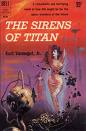 Continuing my series of Kurt Vonnegut books, I progress to The Sirens of Titan. And, while I applaud Vantage Books for the line of all of the Vonnegut titles having that big V on the cover, check out those early releases! So cool.
Anyhow, I had never even heard of this book, so I held very low expectations for it. I was astonished at not only how funny it was but just how much I enjoyed it.
Much of this book seems to be, if not a launching point, at least a basis for many of Vonnegut’s most famous pieces. Tralfamadore, made famous in Slaughterhouse Five, is introduced here. As is Vonnegut’s love of time travel and even space travel. I’ve never really thought about Vonnegut as a science fiction author. He’s always fallen into the realm of literature for me. (Although here’s an article from 1965 in which Vonnegut claims that he has been labeled as sci-fi and would like to get out of the pigeonhole) And yet the sci-fi aspects of the book are impossible to ignore. Aside from travel to Mars, Mercury and the rings of Saturn, the book also concerns a chrono-synclastic infundibula (“those places … where all the different kinds of truths fit together”).
I was curious about the science of outer space the Vonnegut relied on. He explains in this interview:
When I wrote The Sirens of Titan, I found out everything I wanted to know about the solar system from a children’s book. I think it was probably written for an eight year-old. It showed all the planets and described them very nicely and told me about their moons and told me about the moon of Saturn called Titan. My research has not been profound.
But we should move on to the story first. Winston Niles Rumfoord is one of the wealthiest men in America. Frustrated by the lack of progress in space exploration, Rumfoord commissioned his own rocket, set off for outer space with his dog Kazak, and was quickly sucked into the aforementioned infundibula (which means “funnel” in Latin).
What that means for Rumsfoord is that his body (and his dog’s too) is projected throughout time and space in something like a particle beam. Whenever something solid intersects that beam, he materializes. And so, every 59 days, he materializes on earth for an hour.
Only his wife, Beatrice is allowed to see Winston during his materializations where it is presumed that he tells everyone of his visions of the future. But then on one visit he has his wife summon a secret visitor to meet him. One swindler who claims to have been that visitor sold his story to a magazine for thousands of dollars. His story was that Rumfoord told him that by the year ten million A.D. the first million years of humanity had essentially condensed to this: “Following the death of Jesus Christ, there was a period of readjustment that lasted for approximately one million years.” (Rumfoord highly approved this swindling).
The actual visitor of Rumfoord’s was Malachi Constant, the richest, luckiest man alive. Constant is a pretty cocky guy. He owns businesses he doesn’t even know about. But even he is humbled by the intergalactic presence of Winston Niles Rumfoord.
Constant’s back story is very funny: his father became rich by investing on the market based on the Bible (in a hilarious way). Ransom K. Fern, and IRS agent, comes to his hotel room and offers to be his financial manager. When Rumfoord explains that he is doing just fine by himself, thank you, Fern explains that he is so open and honest that he is paying too much in taxes. Fern wants to create a bureaucratic empire because just one “single industrial bureaucrat, if he is sufficiently vital and nervous, should be able to create a ton of meaningless papers a year for the Bureau of Internal revenue to examine.”
Rumfoord tells Constant that in the not too distant future, he will travel to Mars and Mercury, back to Earth, and eventually to Titan, a moon of Saturn. Further, Constant will take Beatrice with him where they will have a child together. Constant is utterly bewildered by this, but assuming it to be the right thing to do, he buys a space ship and then throws a party for two months. When he finally wakes up, he learns that he is broke.
A message from Constant’s dead father tells him to jump on the next offer that comes to him, which just happens to be from a couple of Martians who invite him to join their army. And that’s where the story gets intense. Constant lives on Mars for many years (and a fun couple of chapters).
The Martian Army is planning to invade Earth. It is a fools’ errand. Unk is saved because his automatically piloted ship goes to Mercury rather than Earth. Constant lives on Mercury for many years (and a fun couple of chapters).
Finally, he returns to Earth where he learns that Rumfoord has created the “Church of God the Utterly Indifferent.” The church’s scapegoat is, in fact, Malachi Constant whose luck was often attributed to God, when clearly God didn’t care what happened to Constant, much as the Mississipppi River didn’t care if it rained. Rumfoord welcomes Unk as the glorious Space Traveller, fulfiller of all of his prophecies, and then quickly explains that he must be sent off of the Earth, away from the people who revile him, and be rocketed to Titan.
And from here the story gets REALLY interesting (and mind you it’s only 326 fast reading pages long).
Titan, it turns out is the only place where Rumfoord can materialize all the time. (The path of Titan mirrors the path of his particle beam). Rumfoord has been on Titan for years. During this time, he has befriended a tangerine colored machine named Salo. Salo comes from the planet Tralfamador which Salo translates as both “all of us” and the “number 541.”
Tralfamadore was inhabited by people who sought the meaning of their existence. They built machines to discover this truth, and eventually Salo was sent across the universe with a special message from Trafamadore; one which Salo is not permitted to know. Salo crashed on Titan millions of years ago and is waiting for help from his homeland.
I’ve given away pretty significant chunks of plot in this review, but I’m going to give a spoiler alert shortly. It doesn’t give away a plot point per se, although it does sort of reveal the essence of the book and of Vonnegut’s personality.
BEGIN SPOILER ALERT:
The Tralfamadorians are using the people of Earth to get messages to Salo on Titan. So, basically all of humanity is being controlled by the machines of Tralfamadore. For proof, the meaning of Stonehenge in Tralfamadorian when viewed from Titan is “Replacement part being rushed with all possible speed.”
END SPOILER ALERT
The book does not end dramatically. It ends with a soft and gentle denouement. And, despite all of the humanity bashing, the final lines of the book are incredibly sweet and touching.
This book was really fantastic. And even though I’ve given away a lot of details, there’s still so much more to read. Amazingly, despite all of the heady information, the book was a really easy read. I feel like I flew through it. And I have to say that if I’ve never heard of this book, then Vonnegut’s popular books must be fantastic.

 I Just Read About That...
I’m in the middle of Slaughterhouse-Five right now. It is a trip. Vonnegut’s Man Without A Country addresses the whole science-fiction labeling thing. I guess since he studied science that’s the what he infused into a lot of his stories.
I read Slaughterhouse Five many years ago, and I’m looking forward to reading it again. But now, I’m also looking forward to Man Without a Country. Thanks for the suggestion.