Feeds:
Posts
Comments

dec20133SOUNDTRACK: HANGEDUP-HangedUp [CST016] (2001).
hanged1Hangedup is a noisy band made up of two people: Genevieve Heistek on viola (often looped) and Eric Craven on drums and percussion.  The whole enterprise has a kind of DIY sound—like (very good) first takes done in fit of creative outpouring.

 “Winternational” opens the disc with slow and somber viola.  But after 1:41 the drums come in and the tempo changes into complex song–the way that simple patterns morphs around is really cool. It turns into a great instrumental song, with a low, almost detuned bass sound and lots of percussion. “Propane Tank” has more great weird percussion (sounding like he’s possibly hitting everything in the room). The sounds are manipulated and twisted but make a very interesting beat.  It’s pretty cool “Powered By Steam” builds then slows with some great strings and percussive sounds following in and out of a strong melody.  “New Blue Monday” is more of the same but with a new an interesting beat arrangement and texture. It also has a great ‘riff” and melody .

“Tapping” is mostly drums (tapping). The beginning is a little monotonous although the effects in the background are interesting to try to imagine what they are.  It builds slowly so by around 5 minutes the song has some momentum.  I imagine its interesting to see live and it works for a slow building monster song but its dull compared to the rest of the disc.  “Czech Disco Pt.II” makes up for it with frenetic drums and viola. “Wilt” plays with interesting bell-like percussion.  “Bring Yr Scuba Gear” has building viola; however, this song has bass guitars (guest bassist Ian Ilavsky who is also on “Powered by Steam”) and overdubs by Efrim Menuck which make this the most traditional sounding rock song of the bunch. Which is no bad thing.

Hangedup are certainly experimental but they are very cool and different sounding, too.

[READ: May 5, 2014] “Interview 8 (Mother)”

This is an excerpt from Ball’s novel Silence Once Begun.  As such, it’s a little hard to talk about it fairly.

It begins with an interviewer’s note that he was awoken by Mrs Oda who felt she needed to clear something up.   The rest of the except takes the form of an interview.

Mrs Oda tells a story about Jiro, (presumably her son) about why he cannot be trusted.  Her story concerns Jiro when he was young.  He would pretend that he was a lord and he would preside in judgment over his toys.  All the toys (even things like blocks or spoons) would plead to him for something.  First they would all shout at once and he would declare that they would all be executed if they could not speak in turn.

Then each toy would make its case (perhaps it didn’t like where it was placed last night).  Regardless of what the toy asked for, his response was the same to each one: “Don’t open your mouth again or I’ll have you killed.” Continue Reading »


walrus maySOUNDTRACK: POLMO POLPO-Like Hearts Swelling [CST026] (2003).

polmo“Swelling” is the operative word for this disc from Sandro Perri (who is the only person in the band).  Perri layers waves of music.
The album is comprised of drones and loops and is largely ambient in nature.   There’s five songs in 46 minutes. Opening track “Romeo Heart” builds from silence to super loud punk noise.   The 11 minute “Requiem For A Fox” introduces a kind of  underwater heartbeat pulse and detuned sounds.  By around 7 minutes the drums kick in bringing the song to a faster beat until it concludes with an acoustic guitar section and a wild slide solo at song’s end.  “Farewell” builds slowly over 5 minutes with interesting drums sounds.

At 13 minutes, “Sky Histoire” adds a tambourine, which brings in an interesting (albeit minor) percussive element that the other songs didn’t have. By the end, the song is totally intense.  It even has bells and chimes.  The final track, “Like Hearts Swelling” feels like real instruments rather than samples and keyboards.  It features Genevieve Heistek from Hangedup looping and weaving her viola.

Regardless of how great this album is (which it is), if you don;t like ambient music this is not for you.  But if you can get absorbed in the sound, it is a great collection of songs.

[READ: May 1, 2014] “Juno Pluvia”

As this story opens, the narrator, whose name is Hero, is protesting about her cousin Nile.  She tells us to forget about him because a dead body has recently washed up on the beach and that is what we should be worried about.  The man (clad in speedos and nothing else) has been dead for five years–the cold water of Lake Michigan preserved him.  And it was Nile who found him.

When she questions Nile about what he was doing when he found him, Nile says he was fishin’, which she doesn’t believe for a second.  And then she allows us to consider Nile after all: “grease incarnate…did he ever wash?”  And all the while, her mother warned her about him…to never ever get into his van.

Hero relates sadly that she was never invited.  He was never to be her first, she was never to be one of his girlfriends, who were all cross-eyed and bucktoothed anyway.

And thus, the remainder of the story focuses on what she told us to ignore–her cousin Nile. Continue Reading »

[ATTENDED: May 3, 2014] King’s X

I first saw King’s X with my friend Al back in 1992 or so.  I don’t recall much about the concert.  But I knew that they were awesome live, even still, some twenty years later.

I’ve enjoyed nearly everything they’ve released (their last album was in 2008), and when I heard that they were playing three concerts in the area, I decided it was time to see them again.  I almost went to the show in Newtown, NJ on May 2, but we went to a Figaro play instead.  So, I was psyched that they were playing reasonably close by in Sayreville, too.

The Newtown show was a seated event.  The Starland Ballroom is not.  It is a small venue with large “wings” where you can see the band from all kinds of angles (including the side of the stage).  I got there a little later than I intended.  The co-headliners were TT Quick, a band I knew in high school (who are also from NJ), but who I’d forgotten about.  When I saw they reunited for this show,  listened to the one album I had by them (Metal of Honor) and was surprised by how well I remembered it.  But a few snags in my trip to Sayreville (like the impossibly long time it too me to get ear plugs at Shop Rite), got me there with only three songs left in TT Quick’s set.

They were LOUD (so glad I bought the ear plugs), and singer * (who is now singing with Accept) was in good form.  Although when they closed with the song “Metal of Honor” there was no way he was hitting those high notes.

TT Quick is pretty different from King’s X, so I’m not entirely sure how much overlap there was in fans.  But when TT Quick left I got up to about 4 people from the stage (could have easily gotten closer, but I’m not a pusher).  The most shocking thing to me was the man who had his 4 year old son there with him (I offered the guy ear plugs, but he said he had them already).  The kid was a trooper (considering King’s X went on at nearly 11PM.  He lasted a few songs on his dad’s shoulders (right in front of me, grrr), but then crashed about midway through the set.  (which gave me a great view).

But enough about that.  What about the band?  They were awesome! Continue Reading »

[ATTENDED: May 2, 2014] The Figaro Plays: The Marriage of Figaro

marriageAfter last night’s unexpectedly hilarious Barber of Seville, my expectations were much higher for The Marriage of Figaro.

For a brief explanation of these plays, see yesterday’s post.

The Marriage of Figaro is set three years after The Barber of Seville.  [It must be said that the promotional material said they could be seen in any order, but a lot from Barber is referenced in Marriage and since it is set three years later, it really does behoove you to see Barber first].  The situation is interesting: Count Almaviva and Rosine are still married, although the Count is sleeping around and the Countess is despondent (so much for that rush of first love).  But the main plot concerns Figaro.

Figaro is living with them (as Almaviva’s right hand man) and is set to marry the Countess’ Lady in Waiting, Suzanne.  Figaro is gloriously happy, as is Suzanne.  And they cannot wait to get married.  So, unlike the previous play, there are no shenanigans trying to get them together behind the back of someone else.  The shenanigans are of a slightly different sort.

For Suzanne reveals to Figaro that the reason the Count has given them this glorious space in the chateau–which is but mere feet away from the Count’s private room–is that he plans to deflower Suzanne on the night of her wedding to Figaro.  This was, apparently, the Count’s privilege at the time.  Although Count Almaviva ended that policy when he married Rosine.  But he seems ready to reinstate it now.

Figaro doesn’t believe it at first, but is soon convinced.  The Count wants to meet Rosine in the garden on her wedding night.  And so she and Figaro (with the help of Rosine) decide to hatch a plot.  And that’s just one of many plots in this sequel which is much more complicated, has a much bigger cast and pushes three hours in length. Continue Reading »

[ATTENDED: May 1, 2014] The Figaro Plays: The Barber of Seville

barber2I won tickets to see The Figaro Plays at McCarter Theater.  And yes, there are two different plays going on at the same time. I have to say, I’m super impressed that they put on two Figaro plays on alternating days starring many of the same actors—how complicated must that be?

The Figaro Plays are, well, I’ll let the McCarter site, explain:

Stephen Wadsworth makes his triumphant return to McCarter Theatre with The Figaro Plays, two thrilling new translations of the great farces that inspired Mozart and Rossini’s operas: The Marriage of Figaro and The Barber of Seville…. Wadsworth brings his genius to these two delightfully scathing social satires. Figaro, the famous barber, has his hands full with schemes, plots, and a master who chases all the wrong women. Lush, lively, and a little bit naughty, these plays are chock-full of hilarious misunderstandings, passion, disguises, and sumptuous period costumes.

The plays were written by Pierre-Augustin Caron de Beaumarchais, um …who? He wrote three plays about Figaro and Count Almaviva: Le Barbier de Séville, Le Mariage de Figaro, and La Mère coupable.  And so Wadsworth translated, arranged and directed two (I don’t know if the third one was too much to do or not very good or what–according to Wikipedia, it is rarely performed, and the synopsis doesn’t sound great)

So you have certainly heard of these two The Barber of Seville or the Useless Precaution (written in 1773) was turned into Gioachino Rossini’s opera, The Barber of Seville (1816).  The Marriage of Figaro (written in 1778) was turned into the opera Le nozze di Figaro, ossia la folle giornata (The Marriage of Figaro, or The Day of Madness), K. 492, composed in 1786 by Wolfgang Amadeus Mozart,

So that’s a lot of background information, and I knew none of it before seeing this first play.  I wasn’t even sure if there would be music or not.  So no, they were not the operas, indeed, Barber has no music (well, one love song strummed on a guitar).

And it was hilarious. Continue Reading »

harpoctSOUNDTRACK: GLISSANDRO 70-Glissandro 70 [CST037] (2006)

glissThis peculiarly named band comes from the two members of it.  Craig Dunsmuir is in a band called Kanada 70 and Sandro Perri has stuck his name on the end of the word “glissando” which is a musical term for gliding from one pitch to another.

Interestingly the music doesn’t glide so much.  “Something” opens with a simple, pretty repetitive guitar pattern that keeps getting bigger and bigger. And then bird sounds flow over and around.  It’ a very beautiful introduction.  When it starts getting faster and more complex, it’s actually quite a musical feat.   “Analogue Shantytown” follows with an unusual opening.  Someone singing the word “shantytown” into a harmonica. It’s a weird and interesting sound.   When the guitar begins it sounds very 80s King Crimson-like with wild staccato guitar  Then the chords come in, with a simple repetitive rhythm. And then more and more voices start singing different phrases over the top. Like a rocking fugue.

“Bolan Muppets” has another simple, pretty rhythm and simple but lovely guitar line. More layers of voices (who knows what they are saying) propel this song along.  By around 5 minutes (of the 7 minute song) the songs settles down into a simple guitar progression with very nice vocals (in English).  “Portugal Rua Rua” opens with some more nonsense words (unless he’s singing in Portuguese). Then a single guitar plays along with the rhythm. Then some vocals come in English and the song fleshes out a bit more. By the end they start chanting lyrics from Model 500’s “No UFOs”) which gets a little crazy but is quite fun.

The final song is 13 minutes long. It opens with a baritone guitar playing a fast riff. The song starts to add layers of music—drums, percussion, guitar squalls. By 4 minutes it kind of settles into a repeated guitar rhythm with chanting in the background. That stays in a kind of holding pattern for a bit until around 8 minutes when they start messing with the sounds.  It ends with more chanting in a decidedly Talking Heads feel (and indeed they start using a chant from the Talking Heads at the end).

So this proves to be a wild and raucous record.  It has a decidedly dancey sensibility, but is not a dance record.

[READ: April 25, 2014] “Sic Transit”

I really enjoyed this T.C. Boyle story quite a lot.  So much in fact that not only have I been thinking about it all day, but I could easily see him fleshing out the story into a novel.

It’s a simple enough story on the surface.  In a pleasant suburban town, there’s a house that is overgrown and–out of place.  So it’s no surprise to find out that the owner is dead.  But it is disturbing to think that he was dead for eight days before anyone noticed and that they only noticed because of the smell.

That’s when the narrator learns that the mysterious neighbor, the one whose house you couldn’t even see from the street because of the overgrowth of bushes was a singer for a band from the late 70s and early 80s called Metalavoxx.  (I have to say that I feel this band is not quite right for the time they are depicted as having played–I feel like they are about five years ahead of their time with their name and their look).  At any rate, Carey Fortunoff, the singer, is dead.  And the narrator feels strangely compelled to learn more about a man he doesn’t actually care about and never heard of.

Mostly this is because the narrator has just turned fifty and is thinking about mortality.  What must your life be like to die and not be found for eight days? What kind of strange life did this guy live?  So, on a Sunday morning he decides to at least peek in the man’s house.  And when he finds a door unlocked, he decides to go in. Continue Reading »

clockworkSOUNDTRACK: FEU THÉRÈSE-Ça Va Cogner [CST049] (2007).

feu2Bands change sounds from one album to another all the time, but few as radically as this one. From weirdo psychedelic band to French new wave pop band, from 6 minute instrumentals to 2 and 3 minute songs with vocals.


At times the album feels like Kraftwerk meets Serge Gainsbourg (which I know is an unfair reduction, but when your singer mostly talk/sings in a deep French voice, the comparison is apt.  And yet the album is fairly poppy and catchy as well.

“A Nos Amours” opens the disc with three minutes of synth happiness. It even has a section where the music drops out and the bass resumes its place.  Recall in their debut that at 4 minutes of each song something radically different happened.  Now the songs just end. “Visage Sous Nylon” features the more Kraftwerk sound—but it’s an almost organic Kraftwerk (which I know makes no sense but there it is). “Les Deserts des Azurs” has a kind of Tangerine Dream feel with washes of analog synths.

“Le Bruit du Pollen La Nuit” has a weird kind of synthy 70 s rock feel but the music almost drops out entirely (but not quite) while the vocals (in French) are spoken. It feels like it’s mocking and serious at the same time.  It’s also got a discoey chorus singing “You’re just a just a just a pretty boy!”

“Nada” has a synthy almost disco feel.  “Ça Va Cogner” is just over 5 minutes long and consists of various delicate swells of synths.  I kept waiting to hear The Beach Boys “Wouldn’t It Be Nice” burst forth from the waves, until about half way in when it turns into a simple delicate melody and a children’s chorus. “Les Enfants” is a simple ditty with hummed lyrics.  It’s poppy and catchy as anything

“Ferrari en Feu Pt. 2” is a fast synth songs with slap bass. (Part 1 was on the debut and sounded nothing like this).  “La Nuit Est un Femme” is a slow synth track with a female backing vocals over a sung male lead. The end of the song adds some loud textures to this otherwise sweet song bringing in some really interesting tensions.  The disc ends with “Laisse Briller Tes Yeux Dans le Soleil,” a synthy instrumental that ends with cheesy charm.

This album is really wonderful–surprisingly catchy and dancey and yet exotic enough to not sound like anything else that (most) people are familiar with.  All of the Constellation albums are streaming on their site, but this one is especially worth checking out.

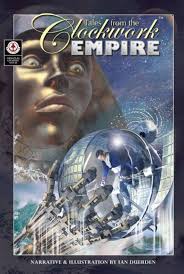
[READ: April 15, 2014] Tales from the Clockwork Empire Book 1

I was very intrigued by this book because of the steampunk nature and because I have a strange fascination with clockwork ideas–a technology that is precise and interesting yet which never really took off beyond clocks and small toys because other technologies were more powerful

I thought that the cover was kind of interesting with this gigantic metal head holding ball.  But on closer look the man in the ball was very poorly computer rendered and that should have been a tip off.  For all of the people in the book have this same unfinished-rendered look.  It looks a lot like storyboards of unfinished versions of Pixar films.  I mean, really cheesy and really unfinished and really unsettling. This is especially noticeable on the rendering of Napoleon Bonaparte in the “end credits” of the book.

I hate to harp on the graphics, but this is a graphic novel after all.  All of the non human elements looks fine, many look even better than fine, bordering on photo realistic.  But the humans all seem ugh, creepy and stiff and just dropped on top of these scenes.  It is terribly distracting and may even make the dialogue feel stiffer than it actually is.  Because the dialogue felt very stiff and mechanical as well.

It is the kind of story that seems historically accurate in the details and works very hard to let you know that it is accurate.  Indeed, in the end of the book Duerden goes to great lengths to show the accuracies in the writing.  But there’s so little flow in the dialogue that it seems like a lecture.  Basically the entire book feels like, not a first draft, but like the draft before the final draft.  Like the book is going to go back to have a final polish to make the dialogue breezier and make the pictures look better.

This is all a shame since I haven;t eve talked about the story yet. Continue Reading »

half pastSOUNDTRACK: FEU THÉRÈSE-Feu Thérèse [CST040] (2006).

feu1Feu Thérèse is a band created because of the hiatus of Le Fly Pan Am.  They offer a melange of styles, as befits the visual arts origins of several of the members.  And yet, there is a solid rhythm section that grounds the band in a wonderful way.

“Ferrari en Feu” opens with 3 minutes of pulsing waves of synths and electronic bird-call-like sounds. It’s unclear exactly what you’re listening to and it seems like the whole album will be a kind of ambient collection.  Then a proper rock song kicks in with chords and notes and drums–it has a cool psychedelic vibe and feels very late 60s.  “Mademoiselle Gentleman” has pulsing bass notes and staccato guitars with a layers of distorted laughing throughout (there’s no “singing” on the first two songs). At around 4 minutes (out of 6) the feedback squalls too and a simple steady beat.

“Tu n’avais qu’une oreille” seems like a traditional song–with singing (in the Serge Gainsbourg, dirty old man style of whisper/singing) which has a middle section that is quite conventional (with ahh ahhs) but again at 4 minutes, the song shifts into a faster drumming section (with more spoken words).  But then a lengthy trippy guitar solo shatters the mellowness.  “L’homme avec couer avec elle” starts with what sounds like horns.  At around 4 minutes in turns into a kind of western but with a crazy clarinet solo accompanied by sped up noises that sound like Pink Floyd’s Ummagumma.  There’s more psychedelic Pink Floyd styles on the final track, “Ce n’est pas les jardins du Luxembourg.”  The song opens with “drips” that sound like “Echoes.”  And then there’s more Ummagumma birds/animals (possibly distorted seagulls?).   At (yes) 4 minutes it turns into a trippy psychedelic organ based song (with Indian music as well).  The song is 12 minutes and leaves no sound unheard.

The music is experimental but it is not terribly “difficult.”  It’s actually quite a fun album which demands multiple listens.

[READ: April 24, 2014] Half Past Danger

The tagline for this book (which is presented like a movie in a number of ways) is Dames. Dinosaurs. Danger.  And the cover features a giant Nazi flag in flames.  Sounds like pulp genius to me.

And so it is.  Stephen Mooney has been an artist for some great graphic novels over the years and this is his first book that he wrote on his own, based on a labor of love–having Nazis fight dinosaurs.  Like a dream come true.

So obviously, this is a story of an alternate past.  Set in 1943 in the South Pacific, an Army battalion is tracking an area when they discover a secret Nazi base.  There are not supposed to be any Nazis this far east, and yet there they are.   Sergeant Tommy “Irish” Flynn is surprised but he gets his team ready to take pictures and prepare a report.  But that loud rumble sounds like the biggest tank they have ever heard.  And then out steps a T-Rex (in a great reveal).  The T-Rex wipes out all of Irish’s company.  Irish escapes with a few photos and little else.

We jump cut to two months later where Irish is drinking in a bar in New York City.  In walks General Noble of the USMC and Elizabeth Huntington-Moss of British MI6.  They request his service.  He tells them to fuck off.  Actually no, he doesn’t.  This is a PG13 story, there’s a few “shite”s and an occasional “damn” but it is squarely in the realm of comics–implied sex, a lot of blood and a few mild words.  A brawl ensues, in which a Japanese fighter helps out Noble & Moss.  And soon Irish is recovering and being told what’s going on.  After some string reluctance, Irish agrees to go back to the island.

Noble proves to be a supremely tough and string fellow.  The Japanese soldier has defected to the U.S. after the non-respectful attack on Pearl Harbor.  And Moss is an enigma.  As they approach the island, there is plane trouble and a wonderfully cool scene in the water (which I won’t spoil but the art and graphics are terrifying and wonderfully drawn and colored–Mooney did the colors for the first chapter, while Jordie Bellaire did the other five).  Continue Reading »

eaveptotterSOUNDTRACK: ELIZABETH ANKA VAJAGIC-Nostalgia/Pain EP [CST035] (2005).

This album is considered an EP, probably because it runs about 33 minutes. And yet with 3 songs and one of them nearly 20 minutes long, it feels like a much bigger release.

The first song, “Nostalgia” is 17 minutes long and begins with three minutes of scratchy violin “warm up” sounds.  Around 3 minutes guitars start playing some simple chords which gives the violin some direction.  Around 4 minutes’ Vajagic voice comes in, throaty and raw like a wounded PJ Harvey crossed with Patti Smith.  The song doesn’t vary all that much in the 17 minutes, but it’s her voice that carries the anguish and pain of the song along.  The interesting touch of the scratching guitars on the edges gives more angst to the song.  Starting around 12 minutes, the song kind of devolves into a series of noises –clicking drums, scratching violins.  A kind of free-form exploration like the beginning was.

So although the song is 17 minutes, it’s really only about nine of actual song.  The rest is sort of an experimental jam, with the volume down quite low in comparison.

Song 2, “Pain” is 12 minutes and opens with a slow guitar melody.  But the real focus is Vajagic’s voice because the instrumentation is basically a guideline.  Until, that is, the 4 minute mark comes around, when the guitar turns electric and more powerful and EAV’s voice goes away for about 3 minutes.  The melody is simple but has a good yearning and building quality with an interesting slow guitar solo meandering around.  Around 8 minutes she begins singing again, repeating the original vocal melody but now with screaming guitars behind her–it’s quite a change and a cathartic introduction of new sounds.  The ending kind of drifts away without ever really letting go.

The final sing is only 4 minutes.  It opens with cracking sounds and a music box.  When the song proper starts there’s more quiet guitars and EAV’s voice and that’s all the song is–like a microcosm of the longer songs and somewhat more powerful for its condensed nature.   Although I do prefer the louder more angsty music she makes, this is a nice showcase for her restraint.

This is the last record that I’m aware of her releasing.

[READ: April 26, 2014] Lord Tottering: An English Gentleman

I saw this comic strip book at work and decided it was interesting looking and might be fun to read.  The title made me laugh as did the Registered Trademark “Tottering-By-Gently” and is a kind of compendium of Lord Tottering comic strips.

Never heard of Lord Tottering?  Me either, but it has been appearing weekly in the magazine Country Life since 1993 and is “phenomenally successful” according to the introduction.  Which also states that Annie Tempest is one of the top cartoonists working in the UK.  (I’ve never heard of her either, but again, that doesn’t mean much).

The cast consists of Daffy Tottering, who reflects “the problems facing women in their everyday life” (if you are rich and British, and live in “their stately home in the fictional county of North Pimmshire).  She also spends time (and I feel compelled to put all of this in here because it is an amusingly long list):

“reflecting on the intergenerational tensions and the differing perspectives of men and women, as well as dieting, ageing, gardening, fashion, food, field sports, convention and much more.” [She must be exhausted].

Her husband is Dicky.  He is basically a retired rich Englishman who hunts and fishes and goes to the kind of club that is mocked endlessly in Snuff Box.

I mock this cartoon a little bit because it is pretty mockable–wealthy aristocrats suffering white people’s problems.  Think of it almost like Cathy for Rich Britons.  And yet, despite all the mocking, I got a chuckle out of a lot of the strips, and I’m sure it brings a smile to many people. Continue Reading »

 superheroSOUNDTRACK: ELIZABETH ANKA VAJAGIC-Stand With the Stillness of This Day [CST028] (2004).

eavlpElizabeth Anka Vajagic is a singing in the vein of Carla Bozulich (whose solo album CST would release a few years after this one).  She has a powerful, raw voice that can go low but can also rage.  She has a lot of control over her voice (which is seems sometimes Bozulich doesn’t) which leads to a lot of tension-filled songs.  EAV plays guitar and some piano.  These songs are also filled with cello, harmonium and an oud.  The songs are slow but powerful, and her voice suits the melodies very well–dark and full of longing.

“With Hopes Lost” has that mournful keening vocal, and the cello really provides that hopeless-feeling component.  “Around Here” is a dark stormy song with aching strings and piano.  “Where You Wonder” is a dark song but with a fight left in it–resistance to the darkness it feels.  The song feels mostly sparse until 4 and half minutes when it rages with a screaming guitar solo and big bold chords.  “Iceland” has probably the most fun chorus of the bunch, something actually sing-alongable.    The next song is called “Why.”  I’m always suspicious of a song called “Why” and this one is a little deservedly so–vague statements are not really anyone’s forte.  She has the keening down well, but it feels a little flat–brevity helps on this one.  “And the Sky Lay Still” opens with a slow echoing guitar, and as it slowly builds, ther’s a great vocal melody that builds for the verse  “Sleep with Dried Up tears” is an acoustic song.  It’s definitely a bit of a downer after the intensity of the album (which is dark but powerful).

EAV is definitely not for everyone.  It depends on your taste for screaming and, your taste for strings instead of heavy guitars to accompany those screams.

[READ: April 23, 2014] The Adventures of Superhero Girl

I grabbed this book from the library because I like Hicks’ work.  When I brought it home, Sarah thought that I brought it for her because it is on her Hub Reading Challenge List.  But no, I liked Hicks enough for myself (so selfish–although I did let her read it first).  She loved it, and so did I.

The Adventures of Superhero Girl is an online comic which Hicks seems to have started in 2010.  Online it is black and white (this book is done with colors by Chris Peters). I didn’t check to see if this is the entire series, but I assume it is. It went on hiatus in 2012 and has been eerily silent ever since.  So at least we have this pretty hardcover document of this hilarious series.

The strip is a genuine, honest to god, comic strip–8 panels and a punchline!  (okay most have fewer than 8 panels, but that’s the set up).  It’s sort of a goof on superheroes, but as the introduction by Kurt Busiek points out, it is really not a parody of the genre.  Superhero Girl is a superhero, with powers (but not amazing powers) and she does help people and she suffers angst from it.  But Hicks plays around with the most basic tropes of super heroes.

Superhero Girl, first of all, doesn’t have a superhero name.  She’s not hugely muscular, she’s not super sexy, she doesn’t wear a sexy costume.  She’s a young Canadian girl in a mask and (sometimes) a cape. She doesn’t have an agonizing backstory.  She just has superpowers and wants to help people. Continue Reading »