SOUNDTRACK: GODSPEED YOU BLACK EMPEROR!-F♯ A♯ ∞ [CST003] (1997).
GYBE is more or less the flagship band for the Constellation label. Their band has spawned many other bands, and nearly every member has played on someone else’s record or released a solo album. Which is why it’s surprising to realize just how few albums they have released.
This first album caused quite a stir. It was released on vinyl and then released (with an extra 29 minute song) on CD. Few bands sounded like this before, and a whole new genre was created around their brand of multi-piece, sorta orchestral post-rock.
There are three songs on this record, but based on some information given in the CD, the songs have been informally broken into parts.
The Dead Flag Blues. The song opens with “The Dead Flag Blues (Intro).” It features a rough-voiced man speaking what I have recently learned is a script by Efrim Menuck. Backed by a string melody, the speaker describes a derelict city, where the government is corrupt and the inhabitants are drunks. After the strings fade, two guitars play a repeating motif with occasional string fills and then a slow solo violin section which fade to silence
For part 2 “Slow Moving Trains” / “The Cowboy…” the sound of a train whistle interrupts the quiet. It’s followed by a series of slow descending notes on a guitar. After a few minutes a twangy guitar comes in to play a Western-ish motif. The rest of the band slowly comes in and creates what sounds like the first real Godspeed sound—a full band making beautiful orchestral instrumental music. It’s all too brief though as it melds into part 3.
Part 3 is known as “The Dead Flag Blues (Outro). It opens with violin and glockenspiel playing a much more upbeat tune. It lingers for around 2 minutes and then the songs ends.
“East Hastings” has three parts as well “…Nothing’s Alrite in Our Life…” / “The Dead Flag Blues (Reprise)” opens with bagpipes and a man ranting. It’s only 1 minute and a half before “The Sad Mafioso” kicks in. This part builds slowly with spare guitars and waves of sound. The guitar reconciles itself to a riff, slow and quiet, with a neat minor note in the middle. It sounds like the kind of thing that is just building to something bigger, slightly more ominous. And as the band kicks in again, the riff becomes much more meaty, but before it can totally take over, it gives way to strings and drums–playing a simple melody that continues the feeling of the guitars. When this ends, far in the distance you can hear a voice singing the melody although it is quickly replaced by two guitars playing the riffs while the strings keep jumping in. And then they start working together, growing bigger and louder and faster. Until it reaches its end with squealing feedback and a man saying “they had a large barge…” which opens up part three, “Drugs in Tokyo” / “Black Helicopter.” This last part opens with a guitar playing harmonic notes along with washes of noise and feedback. Some of the noise sounds, yes, like helicopters (and this is where the band makes some use of the coolness of headphones). It’s a brief section that ends what is technically side one (although I see that the vinyl had about one minute extra at the end of the song).
Track three, “Providence,” is 29-minutes long and has five or six parts, depending on if you include the 3 minutes of silence. “Divorce & Fever…” opens with a lengthy spoken piece by “Blaise Bailey Finnegan III”, who will have his own track dedicated to him on the next GYBE release. The music opens with distorted and backwards sounding guitars. Organs add to the mix and then this short section morphs into part 2. “Dead Metheny…” begins with some quiet guitar notes with the violins playing some mournful notes. But the glockenspiel jumps into play a pretty, fast melody. And then the drums start pounding away while harmonic chords are played over the top. There are simultaneous guitar solos in each ear while the drums continue to play loud and fast.
Kicking Horse on Brokenhill” has a staticy/echoey/distorted voice singing lyrics that are really hard to hear to a melody that is similar to “Amazing Grace.” After that fairly unsettling intro, the band begins a great section with multiple guitars and other instruments playing the same melody (this is the “Godspeed sound” in a nutshell. By the middle of this, it has built to something enormous–full of guitar lines and drums with the support of what feels like the rest of the band.
“String Loop Manufactured During Downpour…” has a distant voice (I assume from a record based on the static) begins singing “where are you going” in a rather haunted echo). The rest of the track is primarily washes of notes and stat icy noise until the 3 minutes of silence which precede the final proper track, “J.L.H. Outro” (stands for John Lee Hooker). It begins with guitars and washes of sound. The guitars begin exploring the main riff in different ways. When the song finally builds to a full band, there are different drum beats in each ear, creating a big cacophony of sound while the guitar wails away.
It’s a pretty great album, with many different elements–weird spoken word and fantastic instrumentals sections.
Godspeed You Black Emperor has had a few lineup changes over the years. They began with some 15 members and ultimately settled on these ten for F♯ A♯ ∞.
Aidan Girt – drums
Bruce Cawdron – percussion
Christophe – violin
David Bryant – guitar
Efrim Menuck – electric guitar
Mauro Pezzente – bass guitar
Mike Moya – guitar, banjo
Norsola Johnson – cello
Thea Pratt – French horn
Thierry Amar – bass guitar
[READ: January 26, 2106] “Cowan”
The previous Walrus story that Bertin wrote (back in 2013) was very dark. And so is this one. But whereas I found “The Eviction Process” compelling, this one I just didn’t like and couldn’t wait for it to be over.
This strikes me a kind of redemption story–the word guilt is mentioned once or twice. And it seems like perhaps this was the author’s attempt to make amends for being a shit heel. Except there is no real sense of redemption or apology or anything of the sort.
The end even seems like the narrator is simply lying. Continue Reading »
SOUNDTRACK: MARIA VOLONTE-Tiny Desk Concert #183 (December 27, 2011).
One of my plans for this calendar year was to write about all of the Tiny Desk concerts from 2016 and from 2011 (to play some catch up). This is the final tiny Desk from 2011! Huzzah.
Maria Volonte is an Argentine singer who interprets tango music in her own way. She also plays folk, Latin blues as well as more traditional music. She plays three songs here and is accompanied by the fantastic harmonica player, Kevin Carrel Footer.
“El Beso Azul” (The Blue Kiss) is a pop-folk ballad expressing menacing sadness. Volonte’s voice is beautiful–full of longing and desire, heartache and sorrow. She plays a very rich and full sounding acoustic guitar and is accompanied by a wonderful bluesy harmonica which plays some amazing lines and riffs.
“Oh Viejo Tren” (Oh, Old Train) is based on a long train ride from the outskirts into the city proper of Buenos Aires. She says, “This is about people chasing their dreams in the city and then falling into reality.” This song is slower and sadder and her voice changes appropriately, even if there is still an air of sultriness about it. The harmonica in addition to playing great “train” sounds, keeps a perfect bluesy accompaniment.
“SF Tango” is an ode to San Francisco and to tango. The song is in English. I like the way she picks her guitar at the beginning and the cool strumming rhythm that the rest of the song has.
Typically, when there’s an interesting quote from the blurb, I post it here, but Jasmine Garsd’s write up is quite lengthy, and it tells an interesting history of the tango as well as some details about Volonte. It also says she can barely listen to “SF Tango” as she finds it so moving. I didn’t find it so, but I did enjoy what she wrote. Read it here.
[READ: January 2, 2016] Our Ladies of Perpetual Succour
I also wanted to make sure I finished all of the posts I started in 2015. This is the last one (although maybe I finished the book in 2016?). So it’s nice to have that burden lifted as well!
I read Warner’s The Sopranos in 1998. I loved it. It was very funny, very raunchy and a delightful way to see girls having wild fun.
Of course, it’s nearly 20 years later and I have a daughter of my own and I can’t help but think that the girls’ behavior is so unsafe, so unwise, so irresponsible!
This play also seems (if memory is any guide) to take the wildness of the girls and condense it. Since there is no narrator to slow things down they are just wild from the get go.
So this play is about six girls. The girls are the only ones in the play–they wind up doing different characters (including men) which sounds like it would be very funny to see). All of the girls are in the choir of Our Ladies of Perpetual Succour Catholic school. And they are all heading to a competition in Edinburgh
The six girls are:
Fionnula (lives in a council house bought with the money from her grandad)
Manda (Mum fucked off, lives with her da, never shuts up about her sister)
Chell (lives up the complex, has had a lot of tragedy in her family)
Orla (diagnosed with cancer but recently returned from Lourdes)
Kylah (parents own their house and she sings in a band)
Kay (stuck-up goody-two shoes, off to university)
The girls are hardened and cynical–they say there have been several pregnancies this year already in their class and they call their headmistress Sister Condom. They are excited to go to the city for this competition not to sing but to get shitfaced and hook up with guys.
Their language is fairly shocking from the starts. It’s one of the girls who says Manda’s mum “fucked off.” And this being Scotland, the word “cunt” is thrown around all over the place.
The girls plan to separate when the get to the city. But first they get started by going to the bar (the girls are afraid to bend over to pick up their cigarettes for fear of flashing the entire bar). They drink. A lot. Even though they are underage. And they get hit on by all sorts of men. One even has the pick up line “Do you know you have 206 bones in your body? Would you like another one in ya?”
And then the girls separate.
Two go home with a guy who is divorced and very sad about it (which leads to a very wild scene–including a moment in which one of the girls portrays a man with an erection–wonder how they did that).
By the end of the night at least one girls has thrown up, at least one girl has hooked up and it sure looks like they have no chance of winning their competition.
Unlike a Hollywood production though, this story is not destined to end with them winning everything (this is no Pitch Perfect). The girls are going back to their hum drum lives after this and they will also have to deal with the realities that a night of debauchery can reveal.
So despite the fact that this play is laugh out loud funny, by the end, it’s not really a comedy. Thanks, Scotland.
Gem Club is a quiet band. During this set there are three members: Christopher Barnes on keyboards and lead vocals, cellist Kristen Drymala and vocalist Ieva Berberian (who is eerily silent and still for much of the performance).
The first song, “Animal” features Barnes on keyboards, playing a simple melody and Drymala, playing a low and loud cello to accompany (when her first note comes in, it’s really striking). She also sings a wonderful harmony vocal. Barnes’ voice is almost a whisper, but between his voice and the vibrato on the keys, it sounds really big (but still quiet). I really enjoyed the way the only “melody” she played on cello was at the very end of the song–a brief riff to signal the end.
“Breakers” opens with some rough cello playing and then a gentle echoed keyboard. Ieva Berberian didn’t do anything in the first song, she just hovered mysteriously in the background. But for the second song she hits occasional tambourine notes (which sound practically like explosions amid the delicate echoing keyboards). Perhaps the most interesting part of the song is watching Drymala tap on some colorful bells with her foot to create a lovely melody.
For the final song, “252” Barnes says it is kind of a beast, (although it doesn’t sound any more complex than the previous two to me). The piano is echoed and Ieva Berberian finally sings backing vocals. Her voice is a little haunting and it works very nicely with Barnes’ voice. The melody is beautiful.
Incidentally, the blurb says that this is the first time they’ve amplified a singer’s voice (they ran his voice through a chorus pedal to give it that otherworldly echo). I have been listening to a lot of loud music lately, and this was a perfect counterpoint.
[READ: December 20, 2015] History’s Naughty Bits
This is the kind of book that promises to be very funny. And then it turns out to be mostly funny but also rather scholarly. Which is not bad thing, it’s just not as raucous as one might have imagined.
Dolby begins by dismissing the idea that “naughty” things are a recent invention and then proceeds to go through the history of human culture to show examples of things that would certainly be considered naughty today (some are quite shocking).
She starts with Classical Greece where women were expected to remain chaste, except for hetairai, high-class courtesans, who were well-educated and respected. That’s some choice. Adultery was considered less of a sin if was committed with a prostitute. Continue Reading »
SOUNDTRACK: I WAYNE-Tiny Desk Concert #180 (December 12, 2011).
This Tiny Desk Concert is just 7 minutes long. I Wayne is a reggae singer and he’s accompanied by an acoustic guitar.
“Real and Clean” is a simple song with the appropriate reggae rhythms used as background to Wayne’s lyrics, part of which go like this:
“let nature take its course / no need to rush no need to force / no need to worry about child support / abandon abused in family court”
“Can’t Satisfy Her” seems to be about a prostitute. The song is from 2004 and the blurb says “he’s largely credited with bringing the roots and rock back to mainstream reggae.” I’m not sure if the NPR office knew the song, but by the end they are singing along. With a comment at the end: “thanks to the NPR chorus.”
It’s certainly catchy and a bit more interesting than the standard reggae fare.
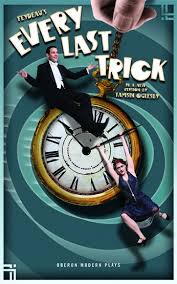
[READ: December 10, 2015] Every Last Trick
I found this book at work. The cover was silly and the full title was “Feydeau’s Every Las Trick in a new version by Tasmin Oglesby.” I saw that it was part of the Oberon Modern Plays collection, which is a collection of short plays and I have read several of them (okay I just looked them up online and there are approximately 960 Oberon plays, I think I’ve read about 6).
Anyhow, this play is based on Le Système Ribadier by Georges Feydeau. I’ve never heard of it or him. But this version is a delightfully over the top farce.
There are four main players: Juan, Gus, Tom and Angela and a fifth one, Knowles.
As the play opens Gus, the servant of Juan and Angela is sneaking in through a window. He steals some of the family’s booze. Then Juan and Angela come in, arguing. Angela is mad at Juan and accuses him of cheating on her. Continue Reading »
SOUNDTRACK: RAGA ROCKERS-“Slakt” [“Slaughter”] (1988), “Hun er Fri” [“She is Free”] (1988) and “Noen å hate” [“Someone to hate”] (1990).
Karl Ove mentions many bands in his books. Raga Rockers appeared twice in this one. I can’t find a ton about them online, because they never really made it beyond Norway, but the Google translated version of their website says:
Raga Rockers is an ingenious rock ‘n roll band that has existed since 1982.
Today the band consists of: Michael Krohn (vocals, lyrics), Hugo Alvar Stein (keyboards / guitar), Eivind Staxrud (guitar), Arne Sæther (keys), Livio Aiello (bass) and Jan Kristiansen (drums).
The band came out of the punk community in the early eighties, but became such a “poppy” large parts of the Norwegian people have founded acquaintance with them. Songs like “She is free” and “Someone to hate” is almost singalong classics! Their greatest triumph came perhaps in 1999 when they played for thousands of ecstatic Norwegians at the yellow stage at Roskilde Festival. (Reviews of the show by Dagbladet (which Karl Ove wrote for) and Dagsavisen–both are in English.
Despite their punk roots and the rather violent song titles, the songs are almost poppy–heavy guitars but simple chords and a singer who doesn’t sound angry at all. In fact, if I didn’t read about their punk roots, I’d swear these songs are kinda goofy.
“Slakt” is a simple song, opening with a 4/4 drum and splashes of guitar. The middle is a bluesy riff with a chorus of “ah ha ha” The lead singer’s voice is mostly kind of deep–not quite what I expected from the heavy guitars.
“Hun Er Fri” is quite different from the others songs. It’s only 90 seconds long and features a piano. The chords are still simple the piano may be playing single notes in fact). The lyrics are pretty much nonstop and kind of fast. It seems like a silly pop trifle and I can see why it’s popular among their fans. The first time I listened to it, I was surprised it ended when it did. This bootleg live version is certainly fun.
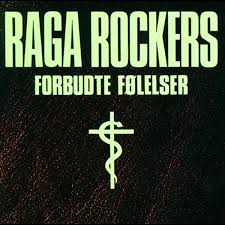
These two songs came from their 1988 album Forbudte følelser [Prohibited feelings]
“Noen å hate” has a bit more of a metal sound, but is essentially the same kind of heavy rock with simple chord progressions. There’s a good solo at the end. A black metal band called Vreid has done a cover of this song (which really only sounds different because the Vreid singer is more growly).
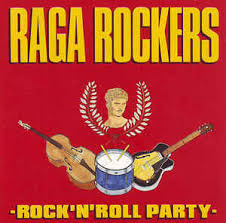
This song comes from their 1990 album Rock n’ Roll Party.
And yes, they are still around. They took a hiatus in the 2000s but came back with three albums 2007’s Übermensch, 2010’s Shit Happens and 2013’s Faktor X.
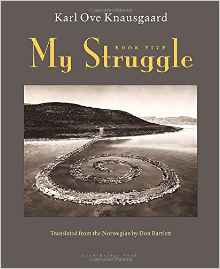
[READ: May 1, 2016] My Struggle Book Five
I realized as I read this fifth book that I should have been keeping a vague sense of the timeline of these books. Specifically, because he opens this book with this: “The fourteen years I lived in Bergen from 1988 to 2002 are long gone.” So if he was born in 1968, this book covers roughly ages 19-33.
So my general outline for the other volumes:
Book Five: 1988-2002 (19-33)
Book Four: 1987 (18)
Book Three: 1968-1981 (1-13)
Book Two: 2008 (40) (with flashbacks to meeting his second wife in 2003 or so)
Book One: 2008 (40) (with flashbacks to his father’s death in 1998 or so)
What era could Book Six possibly be about?
We’ll find out next year in what is said to be the 1,200 page final volume.
So as I mentioned above, Karl Ove talks about the fourteen years he lived in Bergen. And it made me laugh that he says:
The fourteen years I lived in Bergen, from 1988 to 2002, are long gone, no traces of them are left, other than as incidents a few people might remember, a flash of recollection here, a flash of recollection there, and of course whatever exists in my own memory of that time. But there is surprisingly little.
And then he proceeds to write 600+ pages about that time. Continue Reading »
SOUNDTRACK: GABRIEL KAHANE-Tiny Desk Concert #178 (November 26, 2011).
When I saw Kahane a few months ago, he looked very different from the fellow here. (More hair and a beard will do that).
I found Kahane’s music to be really enjoyable even if it was never really that catchy. His songs are complex and thought-inducing, with many layers. Although I found that after listening to his songs a number of times, I could really find the hooks in there.
His voice has a kind of soft quality to it–not quiet, but very much not harsh, which allows his enunciations to be heard quite easily.
For “Charming Disease,” Kahane plays keyboards. He’s accompanied by strings and a guitar (I love the coloration of the guitar). Since he also writes classical music, his pop songs have a distinctly classical feel (even without the string quartet to back him up). So the piano lines that he plays are simple chords, they are full lines. And there are times when the guitar plays beautiful counterpoint to his chords. This song is about an alcoholic (“I took you home and took away your keys”), but you’d never know the darkness of the lyrics from the melody which is bright and cheerful. I love the middle section of the song–the chord progressions during the “Wine Dark Sea” are, in my mind anyway, very Kahane, and they’re what I love about his music.
For “Where Are the Arms” he switches to acoustic guitar. You know the song isn’t going to be simple when he counts of “1, 2, 3, 4, 5, 6” I love that he plays a continuing picked section while the guitar and strings play chords behind him, really fleshing out the song.
As they prepare for the final song, one of the violinists knocks over her music stand and he jokes, how did you fit an 11 piece band back her but we can’t get a string quartet. Someone shouts that it’s the strings–the bows. Kahane says, yes, “One string is two humans–ego and otherwise.” To groans from the band.
For “Last Dance” I love that he sings his vocal melody along with the guitar melody (something Frank Zappa used to do–it’s complex and interesting). And while there is certainly a melody there, he really complicates it with all of the single notes. The strings come in and the song modifies somewhat until his voice seems to resume the complex singing style. But then in the middle of the song (“she begins to sing”) it switches to a very catchy section with a refrain of “sex and cigarettes.” It’s the most immediate thing in the show and shows how poppy Kahane can be. even if the ending is quite abrupt.
He really deserves repeated and close listening.
[READ: February 5, 2016] “Learning to Look at L.A.”
I know Gabriel Kahane from when he opened for Punch Brothers this past summer. I really enjoyed his set and found his album charming and eccentric but very literary.
Turns out that at the time of the release of The Ambassador he wrote this piece for the New Yorker as well. It explores the themes that he delved into for his album, especially architecture in L.A. He even opens with a discussion of Die Hard. Like his song “Villains (4616 Dundee Dr.)” which contains the lyric:
I’ve been thinking a lot
About action movies of the 1980’s
Particularly Die Hard,
Which seems to illustrate
So many of the anxieties
Central to a time + place:
Japanese capital
The waning of the cold war
Pride in a downtown
What did they build it for?
He says that his “affection for this film is one hundred-percent unironic.” Continue Reading »
I first heard Mastodon with their Moby Dick-inspired concept album Leviathan. Since then, their albums have gotten bigger and better, with many more elements (they now have four singers in the band, and a great mix of really catchy stuff along with really heavy, kinda scary stuff). Their latest album, 2013’s Once More Round the Sun has been a favorite of mine for the past three years.
I was supposed to see them at the Starland Ballroom in Sayreville in November of 2014. I even had my ticket purchased. But through a terrible goof on my part, I couldn’t go. I’ve been wanting to see them ever since. They opened for Judas Priest in 2015, but I wanted to see them as a headliner.
They are planning a European Tour this summer, but for some reason, they decided to play one gig in the States, and they chose Philly. I was pretty psyched to get my ticket! I was even more psyched to learn that they played more or less the same set as they did at Starland Ballroom. Honestly, I don’t really like when a band doesn’t mix up their setlists all that much. But in this case, it was fantastic. I didn’t look at the songs before the shows, but I did check to see that most of the songs were from Once More, which was perfect. Continue Reading »
I bought The Dillinger Escape Plan’s first album way back in 1999. It is an abrasive, unpleasant, noisy, harsh record. The band is known for playing “mathcore” which means their songs have lots of stops and starts and weird rhythms. They are also really fast and the chords are more like screeches than actual guitar chords.
I didn’t listen to that album very much and I pretty much forgot about the band, but I saw their name pop up here and there. And now, here they were opening for Mastodon.
I didn’t know that they had been making records for all this time–with many, many line up changes, including a new singer since that first album. As I looked through their discography, I found out that Mike Patton, singer for Faith No More, Mr. Bungle and a dozen other even weirder bands, sang for them on an EP.
And then their new (and current singer) Greg Puciato took over. On the songs that I’ve listened to from their later albums, Puciato sings in many styles. There’s a lot of screaming, but there’s also some crooning and vocals that sound an awful lot like Patton’s (no mean feat).
Reviews said their newer albums were more melodic, so I was interested to hear what they’d do. Continue Reading »
Hospital Ships is a band created by Jordan Geiger, who was in the band Shearwater, among others. In 2011 he released his second album as Hospital Ships. The blurb describes the album as “packed with poppy folk songs and brash rockers enhanced with instrumental flourishes and bursts of guitar feedback,” but for this recording, they strip everything down to the basics: a guitar, banjo, ukulele and a drum with a towel over it to muffle the sound.
Geiger has a rather high-pitched, delicate, almost talking-singing voice and his songs are rather pretty. The band plays 3 songs in just over ten minutes. The first one, “Phantom Limb,” (once my lover, now my friend, you are my phantom limb) has a recurring motif of them saying/singing “ha ha” which is rather catchy.
“Carry On,” features a four-letter word (technically a seven letter word), which might be one of the first times on a Tiny Desk Concert that such a word is uttered. It’s especially funny given how sweet the band sounds. The sentiment of the song is nice though: “To all the women I’ve loved, When I was with you I would say I was better off…. And when I’m gone, carry on, carry on.” There were harmonies in the first song, but they are more prominent in this one (three part) and are quite nice. The banjo player also does a whistling solo.
“Let Me In” made me laugh because he uses the word baby a lot (which Ben Folds said in his Tiny Desk that he has never said in real life, so why would he put in it a song?). But this song is very gentle and sweet–just Geiger on his guitar singing “baby, let me in.”
Geiger’s voice reminds me of a few different people–Ben Gibbard from Death Cab for Cutie especially on the final track; perhaps the Mountain Goats or the Weakerthans. And his songwriting is very good.
[READ: December 26, 2015] Silent But Deadly
I really enjoyed the first Liō collection, and was pretty excited that I could find the second collection so quickly (my library doesn’t have any more collections for some reason, so I’ll have to track the rest down elsewhere). This book collects the strips from February 25, 2007 – December 2, 2007.
Not much has changed from that book to this one, but I think Tatulli’s comic chops have gotten even better.
The strip won me over immediately with the first one in the book. Lio draws a monster and it comes to life. He looks at the marker and it says “magic marker” and he gets a big grin and goes back to work. So simple yet so funny.
It is that big grin–wide open-mouthed just unfettered mischievous delight that occurs in nearly every strip. Continue Reading »
SOUNDTRACK: JOE HENRY-Tiny Desk Concert #176 (November 21, 2011).
I had never heard of Joe Henry, so imagine my surprise to find out that he was releasing his 12th album in 2011. For this Tiny Desk, it’s just him at a stool playing his guitar. He has a very easy vibe, telling stories between songs and playing them with very little fuss.
He opens the show by saying this is, “not exactly like Woody Guthrie playing for the union members but you are working people.”
He plays four songs, “Sticks and Stones,” After the War,” “Odetta” and “Piano Furnace.”
Between the first two songs, he says he first became aware of Tiny Desk Concerts when his friend Vic Chesnutt was on the show (amusingly, he was the second person on the show). He says he has a song on his new record about Chesnutt (Chesnutt had recently died). He doesn’t play it though. At first it seems like he might not be allowed to play it, but then it seems like maybe he just doesn’t get to it.
Rather he plays “After the War” where his guitar sounds like it has an incredible echo on it. That echo is also present on the third song. After which Bob asks him about his guitar.
Joe says he’s had the guitar for 6 years. But the guitar dates back to 1932. He says that he heard things differently with this guitar. It’s got a smaller body and was actually sold as a budget guitar by Gibson (for $19 in 1932). He also jokes that it’s black and looks a bit like a World Wrestling Federation belt.
Then someone asks him about Sam Phillips. Joe says he sold her husband a guitar about 20 years ago. She and her husband have split and Sam got the guitar and has been playing only that guitar for the last 20 years. He says that he loves that she doesn’t plug in her guitar. She plays into a microphone where you can hear the whole guitar and which makes the other players lean in to hear her.
I love the chords he plays in the final song, “Piano Furnace,” even if I don’t know what the song is about. Henry’s voice is familiar. I think he sounds a bit like a number of different singers. And overall, nothing really stands out in his performance, except that everything sounds great and hiss songwriting is really solid. That’s not a bad thing.
[READ: December 20, 2015] Happiness is a Squishy Cephalopod
Mark Tatulli is the author of the Desmond books. I liked the stories, but I didn’t love the drawing style so much. Imagine my surprise to find out that Tatulli has been drawing comics featuring this little boy Liō since 2006 (going forward, I’m leaving off that line over the o, because it’s a real pain).
And even more surprising is that I like the drawing style in the comic quite a bit–it is slightly refined over the Desmond books and is all the better for it.
I am also really surprised to find out that this strip appeared in newspapers across the country. I’ve certainly never heard of it (but then I don’t read newspapers anymore, either).
So Lio is strip about a boy named Lio. Lio is a dark, dark kid. He has a pet squid, he loves monsters and he’s delighted by chaos. Continue Reading »
 SOUNDTRACK: GODSPEED YOU BLACK EMPEROR!-F♯ A♯ ∞ [CST003] (1997).
 GYBE is more or less the flagship band for the Constellation label. Their band has spawned many other bands, and nearly every member has played on someone else’s record or released a solo album. Which is why it’s surprising to realize just how few albums they have released.