Feeds:
Posts
Comments

SOUNDTRACK: VAGABON-Tiny Desk Concert #710 (February 23, 2018).
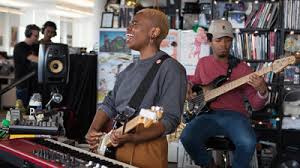
It’s always my favorite artists who play the shortest Tiny Desk Concerts.  August Greene was okay and it went 36 minutes but Vagabon didn’t even manage ten.  Neverthless, there’s something magical about Vagabon.  Her voice is unique, she brings a new perspective to indie rock and she seems pretty nice too.

Laetitia Tamko, the artist known as Vagabon, is a 25-year-old, Cameroon-born musician with a big, tenor voice just bursting with new musical ideas. Though all the songs here are about love, Vagabon also speaks proudly to black women on her 2017 album, Infinite Worlds. There aren’t a lot of black women in this bedroom studio community of independents, a community that, especially in New York, has welcomed her and where she mostly found stimulus and guidance.

Her pride shines bright in her smile and as well it should. For someone self-taught and who’s been playing for only the past four years, her arrangements are adept and thoughtful in an independent rock music scene that can often be lyrically lazy and texturally tepid.

Her album is quite big with loud guitars and crashing drums.  But in this Tiny Desk, it’s just her and her equipment (and a stellar bassist on the second and third songs).

For the first song “Fear & Force,” she plays electric guitar.  There’s some lovely picking and great chords before she sings in her unique voice–whispered and deep (so much deeper than her speaking voice).  I love that she is still picking as she uses her left hand to start the electronic drum machine that makes the song sound so big.  The album version gets really big in the middle but she keeps things quiet here.  The chorus is wonderfully powerful and elliptical.

“Freddy come back, I know you love where you are, but I think I changed my mind.”

I love the abrupt ending too.

We were also treated to a new song during this Tiny Desk performance called “Full Moon In Gemini,” which, coincidentally, was performed on the day of a total lunar eclipse in Leo – she warned us all to “watch yourselves.

It’s amazing to hear her sing so powerfully after her delicate speaking voice.  She introduces Evan Lawrence on bass and his live bass is a tremendous addition.  He plays great lines that really flesh out her playing.  I love the way the song ends.  She sings “I lay in my bed with you it fees so …  so … good,” and the drums and bass continue for ten seconds before she shuts it all down (having already grabbed her mug and taken a sip).

Before the final song she explains that she taught herself how to play these instruments about four years ago.  Since then she’s been “hauling ass.”

Vagabon’s poetry speaks to love. You can hear it in “Cold Apartment.” While she closes the Tiny Desk set with it, it was the first song she ever wrote and one that came to her during a difficult time in her life.

“And we sat on my cold apartment floor
Where we thought we would stay in love
Stay in love”

She says she finds it very gratifying to share it in this powerful way.  The song has a terrific guitar melody with an outstanding accompany bass.  This is all especially true during the bridge/chorus when the bass gets really low and works perfectly with what she’s playing.  I find it actually works even better than on record where the drums are terrific but kind of drown out the bass.

I really hope she comes back around for a tour soon.

[READ: December 30, 2017] Beyond the Western Deep 

Tabby brought this book home and thought I’d enjoy it.  Which I did.

It’s a story of war with rather cute animals drawn by Bennett

It opens with some story telling about the history of this land.  It looks almost like cave drawings chaos and endless nights of war.  Eventually a treaty was signed and the land was divided into four places.

The Ermehn were driven from ancestral lands and made to live in the Northern Wastes (they’re not happy about it).
The Canid established the Kingdom of Aisling and has the strongest army in the land.  They are ruthless and humorless.
The Felis built the crowing achievement city of Gair.
The Vulpin live in the desert kingdon of Navran.
Sungrove is ruled jointly by the Lutren and Tamian races

The seafaring Polcan are poised to invade Sunsgrove.

Confused? Me too. It’s a heck of a lot of backstory for what is a fairly short and simple first part. Continue Reading »

[ATTENDED: March 3, 2018] Andy Borowitz

When we saw Darlingside at SOPAC, the director announced that New Yorker columnist Andy Borowitz would be performing in March.  It was just before Sarah’s mom’s birthday so that seemed like a fun present for her (and us).

I obviously know Borowitz from the Borowitz Report, but I didn’t know anything else about him.  We wondered if he voice would sound weird (it didn’t), we wondered if he would be awkward on stage (he wasn’t) and of course we wondered if he would be funny (he was).

He began the night with some general introductory material about himself and his life.  He made some good anti-Trump jokes and then explained that even though he was preaching to the choir, if he could encourage the choir to get other people to vote in the upcoming election then he had done his job.

He also had merch for sale, and 100% of Andy Borowitz’s profits from merchandise sales benefit The International Rescue Committee to aid refugees around the world.  The merch was simple and straightforward.  Shirts and hats in blue that stated: MAKE AMERICA NOT EMBARRASSING AGAIN. Continue Reading »

SOUNDTRACK: AUGUST GREENE-Tiny Desk Concert #709 (February 21, 2018).

A collective of artists is at the core of August Greene: Common (Lonnie Rashid Lynn), keyboardist Robert Glasper and drummer Karriem Riggins have known each other for a long time.

The blurb says

August Greene was born at the White House in 2016 during a special Tiny Desk concert. It was during that unprecedented performance that the then-untitled ensemble premiered the powerful “Letter to the Free,” an original song for Ava DuVernay’s Netflix documentary 13th that eventually won an Emmy for Outstanding Original Music and Lyrics.

Common says they came together to be an inspirational collective who wanted to foreground women and put women in the foreground.  It is unfortunate, then, that the first song features all men.  But their hearts are in the right place “That’s important in hip-hop, which has long been dogged by an old-line adherence to misogyny, as it lays claim to the world’s most popular genre.”

For the trio’s first visit to NPR headquarters, they brought some special guests: vocalists Brandy, Maimouna Youssef and Andra Day. The band performed four tracks from its upcoming self-titled album (out March 9 on Amazon Music), an impromptu freestyle, and Day’s Oscar-nominated collaboration with Common, “Stand Up For Something,” from the film Marshall. Common described the theme of the Tiny Desk as “Foregrounding Women,” alluding to the attendance of Brandy, Day and Youssef, as well as the spiritual presence of Glasper’s younger cousin, Loren, who passed just a few days prior.  [Common says she “transitioned” which I thought meant she was undergoing gender reassignment surgery–euphemisms are dangerous, people].

This five song Tiny Desk Concert is over half an hour and I enjoyed most of it.  I really like Common and his delivery.

August Greene’s latest single, “Black Kennedy,” connotes dreams of an African-American dynasty, the kind only a royal family assumes. The stark contrasts of disenfranchisement are highlighted by every wish expressed.

Common does the rap, which is solid (Common’s voice is so good) and Samora Pinderhughes sings the chorus. I’m rather surprised by how wimpy his voice is.  He sounds either nervous or like he can’t hit the notes he wants.  And yet somehow I find this charming and his part of the song to be very catchy.  I like the D Dummy is there scratching as well.

Up next is “Practice.”  Glasper doesn;t say much during the show, but he is hilarious when he does.  Common says Robert was playing these chords in the studio.  Glasper: “It was the best thing he ever heard” after some laughs, Common retorts: “I was like it’s a’ight.  Once we my raps, the song turned out right there.

“Practice” is how “Life takes work.  You gotta work on yourself and any craft, any relationship”  The song features one of the queens, Maimouna Youssef, we call her Mumu Fresh.  She sings backing vocals and then does a great rap

sometimes being a woman is like being black twice
i gotta shout fire instead of rape
and you tell me to act nice
look pretty stay slim don’t talk loud
don’t think, don’t feel, don’t act proud
but if I’m at my lowest how are you 100%
god made woman and man for the balance of it
so will the real men please stand up.

While Common is talking a phone goes off.  “So yo, who phone is that?”  ha ha

He talks about one of their favorite songs, “Optimistic” by Sounds of Blackness.  As a hip hop artist, I usually don’t do remakes, but as August Greene I can do what I want.

Common: Anything yo want to say rob?
Robert: Yes, i wrote your rhymes.  Just want everyone to know that.
Common: Yea that’s why on this song my rhymes are sub par cause her wrote them

Rob said we need to get brandy.  Brandy came in with that light.

With a buildup like  that I wanted to like this song a lot more than I do.  Even though Brandy’s voice sounds good, I don’t like her delivery. This was my least favorite song of the day.

He introduces: Burniss Travis on the bass; DJ Dummy, on the 1s and 2s; Karriem Riggins on drums

Common shows off a truly great freestyle.  There’s some great rhymes referencing previous tiny desk episodes, and lines like “rob g cant rhyme like me.”

Introducing that amazing “Stand Up for Something,” he says that people worried with this administration that the world is ending.  The world ain’t ending it’s just god bringing the best out of us.  What’s more important than standing up for something you believe in.  It is designed to inspire hope, to bring the message of Thurgood Marshall to a new generation: “it all means nothing if you don’t stand up for something.”

We had to bring in a revolutionary to sing it so we got the sister Andra Day here.  She jokes “I usually like to underpromise and overdeliver.” But she nails it.  She sounds amazing.  It is by far the best song of the day and a great song in general with a great old-school soul sound.

Common ends with this great rhyme

a president that trolls with hate
he don’t control our fate because god is great
when they go low when we stay in the heights
I stand for peace, love and women’s rights

Later, in “Let Go,” vocalist and August Greene collaborator Samora Pinderhughes sings of overcoming darkness within yourself and finding hope at the bottom of Pandora’s box. It’s about releasing the demons so the hands can hold the blessings.

Common says they first called it “Nirvana” because it reminded them of Nirvana “the group from the 90s who we all love.”  (I love that he had to qualify that).

Pinderhughes, sings “I need to let go.”  It’s such a nice sentiment with a groovy opening bass line and pretty keys at the end.

I love the idea of hip-hop rising to this terrible moment in our history and working together to make things better.

[READ: December 4, 2017] Pelé: The King of Soccer

When I was a kid, Pelé was the be all and end all of soccer.  He was the man like nobody else was.  So I have been surprised in the previous two decades or so to find that he is barely mentioned among the greats.  And I have a theory about that.

Most of the people who care about soccer are not from the States (this is changing a little).  And most of the people I know who support soccer are from Europe.  Pelé is Brazilian and, more importantly, he defeated a lot of Europeans.  Plus, and this is probably the real crux, Pelé was instrumental in introducing soccer to the U.S.–right when I was impressionable enough to fall for it.  My then close friend’s family was really into soccer and we went to a New York Cosmos game (I wonder when that was.  Did I see Pelé play?  I must have).

Anyhow, Pelé was a pretty amazing player, and I’m glad to have this book confirm that for me.  What’s interesting about this book, though, is that it also talks about his personal life.  He was amazing for the kids of Brazil, but a little less amazing for his family (I was surprised to see his terrible personal life in there, primarily because this is a kids book.  But it’s important not to gloss over that kind of thing, too).

I also realized that I knew absolutely nothing about Pelé.  Like, nothing at all.  So this was a great book to fill me in. Continue Reading »

SOUNDTRACK: BIG DADDY KANE-Tiny Desk Concert #708 (February 19, 2018).

I remember Big Daddy Kane, of course, although I don’t think I knew any of his songs.  As far as I can tell, Kane hasn’t released an album since 1998.  But his voice sounds great and he seems pretty content to rap his old hits.

The smooth operator, Big Daddy Kane, still emits that same palpable swag he did as a lyrical heartthrob during his heyday. He strides into the room and fully commands it with his presence.

One of the greatest to ever bless the mic, Big Daddy Kane treated Tiny Desk to an office block party in the true essence of hip-hop.  Kane, aka Dark Gable, was a breakout member of the seminal Juice Crew in hip-hop’s golden era during the latter part of the 1980s. He popularized quick-cadence flows and multisyllabic rhyme schemes.

He performed a short set of classics, including “Smooth Operator,” “Ain’t No Half Steppin’,” “Raw” and a bonus freestyle. Through his warm, engaging and devilishly self-effacing style, the pioneer used an interlude between songs to address the intergenerational divisiveness defining rap today and the importance of fans of all ages supporting whatever they like, while “focusing on what’s positive and keeping that in the spotlight.”

The Concert opens with a great drum beat and a funky bass line for “Smooth Operator.”  The rather wimpy keyboard riff with the sax is kind of a wasted opportunity to give fuller sound to this song.

It’s interesting that Kane–whose voice still sounds deep and full–keeps the old songs with incredibly dates references like “Freddy Krueger walking on Kane Street.”

Mid song Kane says, “stay right here Ben… gonna make this into a family affair.  Are there any smooth operators out there?”  They sing the riff.  Then, “Let me see whats happening behind me.  Jay Dub (John Williams) on sax, is he a smooth operator?”  He is.  Kane tells him to “Make yourself at home” with a good solo.

While that solo is going on, he says “certain members of the band just can’t wait till their turn (looks at keyboardist who had been playing with the solo).  He says, “He’s been with me a long time, he’s the baby of the crew we call him J Minor (Judson Nelson)–most places we play he’s not supposed to be there, he’s not old enough. If I ask you to play like a grown man, how’s that sounds, baby?  He plays a smooth solo.

Kane: “I forgot there was another verse.  I was having so much fun looking at them.”

We should keep this party going.  I saw a couple of these people looking at their watch.  Some of you all might be on lunch break I don’t want to mess it up

“Ain’t No Half Steppin” starts off with simple sax and some more dated lines:  “Friday the 13th, I’m gonna play Jason.”  (Rappers loved horror movies back in the day).  He gets the crowd into it: “Say it like it’s 6’o clock Ain’t no half steppin’.”

“Let me hear you once more…  I lied, just one more time y’all.”

After the song he says, “I’m enjoying myself.  This is all right for real I might fill out an application for a job here next week.  this ai’iiht.”

“I’m gonna do one more song and then were gonna shut it down and this ain’t got nothing with y’all getting back to work, I’m starting to get hot in here.”

A great drum beat starts off “Raw” which is followed by that crazy squeaky sax.  And there’s this one last pop culture line: “The rhymes I use definitely amuse better than Dynasty or Hill Street Blues.

Mid-song, a cool faster drum beat is added–I love the snare sound Matt Lambert gets and then the whole band kicks of for a great riff on bass and sax to end the song–it’s a shame it ended there as it was really taking off.

People don’t want him to leave, so they do a freestyle.  A cool slide bass line from Benjamin Geis and staccato piano.  It’s my favorite music of the show.  And the speed of his freestyle rap is really impressive.  And he (virtually) drops the mic and is off.

It’s a great old school set.

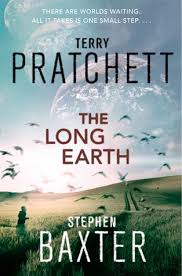
[READ: Summer 2017] The Long Earth

I have read nearly everything that Terry Pratchett has written (I kind of drifted a bit towards the end, but I’ll catch up eventually).  Anyway, I was in the bookstore in Bethlehem, PA and saw this book.  It’s a series I’ve known about but didn’t know very much about.  I decided to check it out to see what it was all about.  I don’t know very much at all about Stephen Baxter except that he’s a hard science fiction writer, meaning he focuses as much on the science as he does on the fiction.

So how does this pair–a hard science writer and a comic parodist of fantasy work together?  Well, honestly the story is much more Baxter than Pratchett. Although since I haven’t read any Baxter, I guess I can’t say that legitimately, but it’s definitely not very Pratchetty.

Well, maybe some of the character interactions are kind of Pratchetty, but certainly not like any of his Discworld characters.  As with any co-writing experience, I wondered how this story was constructed.  So I found an interview with Stephen Baxter from around the time they finished writing the fourth and final book

How did the idea for the Long Earth series come about?

The whole thing was basically Terry’s idea. He’d started work on this project and short stories set in this world back in the ’80s but he got stuck with it.  He wanted to have a very human, level way to access these words. You don’t need to get there on a rocket ship, you can just walk in.  At the same time, the vision for the end was going to be out on a galaxy somewhere.

We’d known each other for years and [about] five years or so ago at a dinner party, Terry [said he] was going through his archives looking for unpublished short stories and things like that and he came across an aborted project from about 30 years ago.  We were just talking about that and it just struck me as immediately a great idea because it’s so simple and yet it’s got endless possibilities.  By the end of that [party] we already had the storylines and Terry was going to send me the material.

Terry was having trouble seeing so Stephen did the typing and then “We fixed each line and each scene together.”

So that’s that sorted.

Baxter also says “it just struck me as immediately a great idea because it’s so simple and yet it’s got endless possibilities.”

And that is the truth.  The story can be summed up pretty easily. Continue Reading »

SOUNDTRACK: BETSAYDA MACHADO Y PARRANDA EL CLAVO-Tiny Desk Concert #707 (February 16, 2018).

How can you not love a band that is decked out in wonderful colors and whose only instruments are percussion?

I love the first song, “Santa Rosa.”  The chorus is super catchy and when they raise the note in the chorus on the “Oh! Santa Rosa” the song just soars.  Although Betsayda Machado sings most of the songs, this one opens with one of the men (in yellow) singing and I really like his voice, too.  I could even figure out the gist of the words.

And the percussion?  Two floor drums, 2 hands drums, shakers and that friction drum.  So cool.

So who are these folks?

The roots of the music of Betsayda Machado y Parranda El Clavo extend to the Venezuelan slave trade, and while the vocals are in Spanish and not an African dialect, the instruments the group plays date back more than 500 years.

The large bamboo cylinders, the djembe-like drums and the large friction drum together create a symphony of interlocking polyrhythms that was unlike anything I’d heard. Machado’s vocals soar over the unrelenting rhythms, and when she harmonizes with the other singers, it creates a choir-like display of African call-and-response vocals.

When discussing African-influenced music from the southern hemisphere, we often focus on countries like Brazil and Cuba, places where the folk music eventually made its way into popular music. Afro-Venezuelan culture and music is rarely featured or even acknowledged outside of the country. As you’ll see in this video, that should change once music fans take in the beauty of Machado’s voice and the power of her historical message.

“Alaé Alaó” is much more somber, but the percussion is incredible–three men playing bamboo sticks against bricks–the details of what they do are fascinating.  The song starts to pick up with bongos and other hand drums as the guy starts singing again.  During the middle of the song one of the women goes out dancing on the main floor with some of the crew.  This can only lead to more dancing.

“Sentimiento”  The guy in yellow sings the beginning of the song and then Betsayda comes in.  The friction drum is back along with all the shakers and percussion.  I love the way they all stop perfectly at the end.

The band includes: Betsayda Machado, Nereida Machado, Youse Cardozo, Blanca Castilo, Adrian “Ote” Gomez, Jose Gomez, Oscar Ruiz.

[READ: November 20, 2017] Science Comics: Dogs

I have enjoyed every Science Comic that has come out, but this might have been my favorite.

In addition to being about a great topic: dogs, it was also updated with a ton of new information that I had no awareness of.  On top of that there’s a ton of scientific information about genetics, evolution and natural selection.  To top it off, it’s narrated by an adorable pup named Rudy who loves a tennis ball.

Once Rudy drags his owner to the dog park, Rudy can tell us all about dogs.

He explains that all dogs are from the species lupus, and yet look at how different all of the breeds are.  So Rudy rushed back to 25000 BP (before present). Continue Reading »
SOUNDTRACK: JETHRO TULL-Aqualung (1971).

I loved Jethro Tull.  I have all of their records up until Crest of a Knave when I must guess I decided that they were uncool (as if they were ever cool).  But man are they ever cool and this book reminded me just how cool they are.

The whole record is solid from start to finish with string rockers, string riffs and then mellow folkie songs in between.  And the dynamic nature of Anderson;s voice–he could be five different characters.

How great is “Aqualung,” the song?  A terrific riff, a gentle middle section, a rocking section, some great bass lines all with some wild acoustic guitar and those lyrics–so graphic, so descriptive.  I am always taken with the drums–little thumps and a cymbal throughout the rocking verse.

It’s followed by the flute intro of “Cross-Eyed Mary.”  There’s rocking guitars and another complex riff with Anderson’s snarling vocals (echos on everything).  “Cheap Day Return” opens with a pretty classical-esque acoustic guitar intro and then Anderson’s more gentle vocals.  It’s a 90 second song that segues into the fairy tale melody of the flute for “Mother Goose.”  There’s some very nice harmonies on this song.

“Wond’ring Aloud” is all folk and the laughing that bounces around the headphones before the great riff of “Up to Me” on both guitar and piano.  And how neat that the lead guitar is circling around in one ear while the flute and vocals are down the middle of the song.

“My God” opens with a lengthy acoustic guitar display.  It’s quite pretty until the minor chords come in.  It’s followed by the piano and that distinctive voice.  Two minutes in, the guitar joins and the vocals get louder and more sneering.  There’s a terrific flute solo (complete with him giving a “yea” in the middle of it) and then a choral accompaniment that adds a whole new level of pious and impiety.

“Hymn 43” has a great heavy riff, chugging guitars and Anderson’s snarling lyrics (and so many whirling guitars solos and even a flute solo throughout).

It’s followed by the minute-long “Slipstream,” a pretty acoustic guitar song with gentle strings and more lyrics obliquely about god.  The song ends with some woozy up and down sliding on the strings which segue into the lengthy classical sounding piano intro of “Locomotive Breath.”

There’s a distant guitar solo under the piano before the guitars get louder and louder for the great chugging riff of the song.

The disc ends with “Wind Up,” a quiet intro on acoustic guitar and vocals that gets slowly louder;  and then the song rocks a swinging beat as he sings of excommunication and being packed off to school.  There’s a wild solo (different in each ear) in the middle of the song, which

and then the end where a jaunty piano accompanies these straightforward lyrics:

When I was young and they packed me off to school
And taught me how not to play the game
I didn’t mind if they groomed me for success
Or if they said that I was just a fool
So to my old headmaster and to anyone who cares
Before I’m through I’d like to say my prayers
Well, you can excommunicate me on my way to Sunday school
And have all the bishops harmonize these lines
I don’t believe you
You had the whole damn thing all wrong
He’s not the kind you have to wind up on Sundays

[READ: July 1, 2016] Aqualung

I have often thought I should read this series.  Of course, the last time I thought about it, there were 50-some books in the series and that seemed like way too many.  Well as of June 2017, there are 120 books in the series, which is an insane series to jump into.

But at work, four of the books came across my desk and if that’s not an invitation to read something, I don’t now what is.  So I’ve decided to read these four and we’ll see if that leads to more.

This was the third book in the series that I’d read.  The first (Colin Meloy’s) was a personal take on one of his favorite records, The Replacement’s Let It Be.  The second (Steve Matteo’s) was a detailed look at the recording sessions of The Beatles’ Let It Be.  This book is all about interpretation–Allan Moore’s take on an album that has fascinated him since his brother bought it over 30 years ago.  He is quick to point out that right and wrong interpretations of art are kinda impossible, but that won’t stop him.  Ian Anderson has written “What listeners get from the lyrics is theirs, what the lyrics are for me is mine.”

Moore breaks the book up into sections–the first situates the album at the time of its release, the rest looks at various songs (including bonus tracks on new releases). Continue Reading »

815SOUNDTRACK: BORIS-DEAR (2017).

The plan was that after 25 years, Boris would retire.  They recorded songs for Dear, but then toured the anniversary of the album Pink.  This inspired them to write more songs, and somehow through all of that, Dear was created (with apparently enough music for two more albums).

Then they toured Dear (a tour I was lucky enough to see) and are still going.  Who knows if they are done.  Who knows if this is their final album.  Either way, this is a doozy.

10 songs and 70 minutes (on the U.S. release), Dear specialized in slow droney heavy songs.  The album opens with seven smacks of a drum before loud heavy chords signal the beginning of “D.O.W.N -Domination of Waiting Noise.”  The vocals are loud but just loud enough to add to the overall drone sound.  Things slow down further with “Deadsong” a deep bass drone with whispered, rather spooky/demonic vocals.

Despite the drones there are moments of catchiness (relative).  “Absoluego” is a faster, downtuned song with a big shouted chorus and “Beyond” is a quiet, moody song featuring Wata on vocals.  About 90 seconds into the song there is blast of metal guitars and drums that lasts for 30 seconds or so before fading out.  When it happens again, one of the guys starts singing too, a faster heavier, catchier melody.

“Kagero” opens with a low rumble.  Eventually a slow, heavy guitar comes in with near falsetto singing.  “Biotope” has a steady pulsing bass drum through the track.  The guitars are slower with an occasional plucked string that resonates. This song even has some ooohs in it.

“The Power” has my favorite Boris riff since “Tu la la.”  It’s got six notes all of which are strangely menacing and yet catchy at the same time. This was a great song to see live.  “Momentio Mori” is slow and menacing with cool echoed/chorused vocals–there’s an Alice in Chains vibe to the vocals.  With about a minute left, the song slows down and grows quiet almost as a lead in to the 12 minute “Dystopia -Vanishing Point.”  This song opens with two minutes of warbly accordion (I loved watching Wata play this part live) and some thundering drums.  It all fades away into some quiet ringing guitars and whispered vocals.  This continues for a few minutes as waves of guitars are added.  And then at 7 minutes the loud guitars and drums blast forth and Wata gets to do a screaming solo for the final 4 minutes.  She is still soloing as the song abruptly ends and switches to the final track.

“Dear” opens with those low downtuned guitars echoing.  I love that the guitars simply slide up to a very high note and hold it until sliding back down.  There’s a muffled chug on the low chords while the heavily echoed vocals ring out.  The song continues like this, a mountain of low rumble, for 9 minutes until it starts to consume itself–feedbacking and disintegrating until it sounds like all of the plugs are pulled.

There’s not a lot of diversity on this disc, which resembles some of their earlier music.  I’m very curious to see what they do next.

[READ: February 9, 2016] “The Republic of Bad Taste”

This story (it feels complete and not like an excerpt, although the title seems unlikely as a short story title) was 20 pages long in this issue of the New Yorker.  That’s one of the longest pieces I’ve seen in the magazine.

And it covers a lot of ground.

Like how does an at-risk-youth counselor agree to commit murder?

It begins by introducing us to Andreas Wolf in East Germany circa 1987.  He is a disaffected youth, an atheist with a super libido and he has found employment at the church on Siegfeldstrasse.  Andreas felt the whole regime was ridiculous.  In fact he felt that a lot of things were ridiculous.  The Republic was just so German that it couldn’t even go after misfits unless it was by the book.

His “job” at the church was as a youth counselor.  He was surprisingly good at it. In part because he really didn’t care and in part because he himself was almost at risk.  He wasn’t really at risk because his father had a good position with the government, but they had more or less disowned him (aside from agreeing to make sure he never got into real trouble).  Plus, he was pretty good-looking so many of the at risk girls found him attractive–with all that implies.

He took advantage of this.  He found that his monetary reward was so pitiful that a reward in beautiful girls made up for it.  At the same time, he did have some scruples.  He never had sex with anyone underage or anyone who had been sexually abused.  What a guy. Continue Reading »

SOUNDTRACK: BORIS WITH MERZBOW-Rock Dream (2007).

Rock Dream was recorded live in November 2006 at Tokyo’s Earthdom festival.  It is a mix of the heaviness of Boris and the noise of Merzbow.  And it is lauded as a spectacular live document.

The Austin Chronicle discussed the album in their overview of Boris’ career, declaring it “definitive live document, an impossibly dense double album that touches down on nearly every point of their career, from Dronevil to Smile’s contorted stairway to heaven (“Flower Sun Rain”), with Merzbow’s electronic manipulations stitching it all together like connective scar tissue.”
In a retrospective review Tiny Mix Tapes, declared Rock Dream to be “not just the best album Boris ever made, but also one of the finest live albums I’ve ever heard.” and that “It’s incredible then that someone recorded Boris and Merzbow that night, because for two hours they got to be the best band on the planet.”

And what live show that opens with a 35 minute song wouldn’t be fantastic?  “Feedbacker” starts quietly with just guitar and Merzbow’s effects.  It has an almost spaghetti western feel to it with all the reverb.  Unsurprisingly, there’s moments throughout the 35 minutes where things dramatically change.  At 6 minutes there’s loud ringing guitars.  At 9 minutes things slow down and then slowly build back up with swells of music from the guitars, keys and effects. At 20 minutes, muted vocals come in and then grow louder.  It feels like it’s building to an end but it turns into faster guitars and a lot of noise.  By 31 minutes things have slowed down heading towards an ending which is primarily Merzbow’s pulsing sounds.  (And there’s so much more going on in that half an hour).

These sounds segue into “Blackout” full of thrashing guitars, crashing cymbals and Merzbow’s noise.  This segues into a song that I gather is only heard here: “Evil Stack” which features a lot of Merzbow’s knob twiddling and noise making and a lot of feedback as well.

This all segues into “Rainbow,”  a far more mellow song that opens with bass harmonics and simple drum beat with Wata’s quiet vocals.  It’s a slinky cool song with a mellow guitar solo.  Merzbow throws in some interesting sounds and and mild noises throughout.

If Disc one showcased their more expansive sound, Disc two opens with a bunch of really short fast loud songs all from Pink.

First off is the raging punk blast of “Pink.”  It is all-out thrash with a lot of yelling from Atsuo and wailing solos from Wata.  It’s followed by the 2 and a half minute rager “Woman on the Screen” with a great punk riff, lots of Atsuo’s screams and of course Merzbow putting a wall of distorrted noise over the top.  The trio concludes with the two minute  “Nothing Special.”  The punky blasts continue with “Ibitsu.”   It’s not from Pink but it’s just as fast.

Things slow down somewhat with “A Bao A Qu.”  It is 4 and a half minute with a lot of squealing feedback and thunderous drumming.  The final four songs return to that epic style–they are alternately 13 minutes or 8 minute long.

“The Evilone Which Sobs” slows things down with more of that reverbed spaghetti-western style guitar.  There’s squeals of feedback, slow plucked guitar and Merzow as this 13 minute song gets under way.  After three minutes the loudest guitar and bass imaginable come crashing through the melody.  The rest of the song is full on loud drone and feedback.  It all slows down for their surprisingly catchy of cover of Pyg’s “Flower Sun Rain,” which sounds just as good live as on record–including Wata’s wailing solo.

The final two songs return to Pink.  “Just Abandoned My-self” runs over 13 minutes and opens with a scream from Atsuo, wailing guitars from Wata and vocals from Takeshi.  The song barely lets up for seven minutes, and when it finally changes pace, it’s more for the guitars to do some e-bow working while Atsuo continues to pound away.  The last four minute are those droning chords with Merzbow making some really interesting sounds while the band plays on.  Merzbow ends the song with a kind of looping siren that leads into the show ending with a great version of “Farewell.”

Unlike the one from Crossing Waltz, Merzbow’s presence make a pretty big difference in the dynamic of “Farewell.”  The band sounds terrific and it’s a fantastic take on this by now iconic song.

For sure this live set isn’t for everyone–it’s loud, there’s some uncomfortable moments–but it really captures a band at full power.  And as with most Boris releases, it had a different cover in Japan.

Disc one   Total length:       49:58
“Feedbacker” (Originally from Boris at Last: -Feedbacker-) 35:05
“Blackout” (Originally from Pink) 5:19
“Evil Stack” 5:04
“Rainbow” (Originally from Rainbow) 4:30
Disc two  Total length:       60:32
“Pink” (Originally from Pink) 4:14
“Woman on the Screen” (Originally from Pink) 2:37
“Nothing Special” (Originally from Pink) 2:14
“Ibitsu” (Originally from Akuma no Uta) 3:35
“A Bao A Qu” (Originally from Sound Track from Film “Mabuta no Ura”) 4:35
“The Evilone Which Sobs” (Originally from Dronevil) 13:41
“Flower Sun Rain” (PYG cover, later released on Smile) 8:04
“Just Abandoned My-self” (Originally from Pink) 13:21
“Farewell” (Originally from Pink) 8:11

[READ: February 21, 2017] “Mrs Crasthorpe”

This story revealed itself slowly and in interesting ways.

We meet Mrs Crasthorpe in the first paragraph.  She is humiliated because her husband’s funeral has just been poorly attended.  It was also, by his own design, in a small, unassuming, frankly embarrassing cemetery.  Mrs Crasthorpe is 59.  Her husband was 72.  Yes, she had married him for money and yet it didn’t really make her a more fulfilled person.  She had cheated on her husband, but he didn’t seem to mind or care.

She had felt herself to be always a rosebud, claiming to be 45 when she was late nearly 60.  She also told no one she had a son.

Then we shift to following Etheridge, a man whose wife is near death.  He is tender to her, caring, but she doesn’t have long to live. Continue Reading »

815

SOUNDTRACK: BORIS-Crossing Waltz (2016).

Boris have put out (by my understanding) eight live albums.  As with most of their releases, they’re not all easy to find.  I happened to get this one because they were selling it at the show I was at (many of their releases seem to be only for sale at the merch table).  This one is from their own Fangs Anal Satan label.  It was released in 2016 but was recorded sometime around 2011.

It happens that this era is one that I know best (they put out three albums on the same day and they are all still available) so this is a fun live album for me since it’s fun to hear the distinctions and their ability to translate them in a live setting.

The disc opens with a two-minute intro–sirens from the opening of “Heavy Rocks 2011” which leads into “Riot Sugar.”  The song is heavy–it rocks out and is full of Atsuo’s whoops and yells–the sign of a real rocking song.  “8” is a song I didn’t know.  It starts with a lot of gong and has some great falsetto vocals.

“Statement” is great to hear live because it’s cool that they can play the songs just like on record.  Not that it sounds like the record exactly, but that they can recreate the music live–and keep it all catchy too.

Then things slow down for a few songs from Wata.  “Attention Please” is quiet and silky with cool guitar and effects.  I love the way Wata delivers the quiet, whispered lyrics.  It’s followed by “Party Boy.”  “Party Boy” appears on two records.  It’s hard to know which “version” this is but this one is slinky, dancey and heavy at the same time (we’ll say Attention Please, since there’s not much synth)..

“Flare” is from a 7″ and it is very heavy.  Then it’s back to Wata singing the really catchy “Spoon” with heavy drums.  The first disc ends with the 16 minute “Missing Pieces” (longer than the album by a few minutes).  Like a good epic, it starts slowly.  After three minutes Atsuo introduces a lot of drums and then the bass and guitar roar for about a minute.  It fades to near quiet once again.  There’s a minute or so of just vocals before the guitars come back, this time with soloing while Takeshi is singing.  Around six minutes in it turns to noise, noise, noise–both guitars on feedback and scraping and the drummer going bananas.  The band stops on a dime for complete silence and then takes off again–noise and more noise.  There’s feedback and gongs and more feedback.  And then at 11 and a half minutes the drums return–continuing through to the end.

Disc two opens with “Window Shopping” which is all about fuzz and buzz, full of Atsuo’s yeahs and a crazy wild solo at the end from Wata. 

Then they move back to some older albums for 2 songs.  “1970” comes from 2002’s Heavy Rocks album (the orange one).  It is full of bass rumble.  It leads to the classic “Pink” with gongs as the transition.  Even all of these years later, these songs are full of power.

“Alierion” is the longer version.  It starts slow and quiet and builds and builds, getting heavier for 12 or so minutes. The last minute is a solo piano melody, a dramatic departure for them.  Then the sirens come in again for “Looprider.”  “Looprider” is eight catchy minutes of shoegazey fun.

The by now standard closing of “Farewell” ends the show.  Hearing those opening notes live was great and it is great here.  The song sounds terrific.

One of the things about Boris live is that their vocals are never clear.  Perhaps if you understand Japanese the vocals are more obvious, but it feels like they may be something of an afterthought, especially live. The band is all about the sonic experience and the vocals, the voice, is just another piece of that.

1.1 Intro  2:35
1.2 Riot Sugar — Heavy Rocks (2011)  4:53
1.3 8 — Japanese Heavy Rock Hits Vol 1 (2009) 4:03
1.4 Statement — Smile (2008)  3:49
1.5 Attention Please — Attention Please (2011)  6:34
1.6 Party Boy — New Album (2011)  3:55
1.7 Flare — Asobi Seksu x Boris 7″ (2012)  4:24
1.8 Spoon — Attention Please (2011)  4:57
1.9 Missing Pieces — Heavy Rocks (2011)  16:01
2.1 Window Shopping — Heavy Rocks (2011)  5:58
2.2 1970 — Heavy Rocks (2002)  5:03
2.3 Pink — Pink (2006)  4:52
2.4 Ailerion — Heavy Rocks (2011)  13:52
2.5 Looprider — New Album (2011)  8:18
2.6 Farewell — Pink (2006)  7:37

[READ: February 8, 2016] “Quaestio de Centauris”

I was sure that I had read or posted about stories from Primo Levi before 2016, but I see no evidence of it.

Perhaps I have never read him, just heard of him.  I don’t know if this story is anything like what he typically writes, but it was a pretty unexpected story topic (continuing with the theme of this issue, apparently).

The story was translated from the Italian by Jenny McPhee.  And, as one might decipher from the title, the story is about centaurs.

The narrator says that his father kept a centaur in the barn.  Although he admonished the boy not to bother it, the bot and the centaur, Trachi, became friends.  Trachi even allowed him to ride on his back from time to time. Continue Reading »
815

SOUNDTRACK: BORIS-Noise (2013).

You really never know what you’re going to get with Boris.  Most of the time, there are multiple editions of releases with different covers and different mixes.

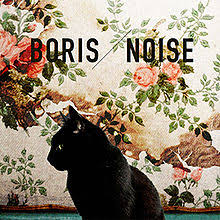
In this case, despite the different covers of this record (see below), the track listing is exactly the same (except that the Japanese version came with a bonus disc).  Total length: 57:52

I like that this album cover parodies (sort of) Nirvana’s Bleach album cover.

“Melody” (黒猫メロディ) 6:40 The disc opens with some ringing alt-rock wit a distorted rocking chorus.   Despite the cover, it’s not like Nirvana, it’s more soaring  there’s catchy backing oohs and a cool hi-hat flourish.

“Vanilla” 4:15 is heavy in the same vein as “Melody” and “Ghost of Romance” (あの人たち) 5:49  has slow guitars and soaring leads with a heavy solo.  “Heavy Rain” (雨) 6:12 starts quite slowly with vocals by Wata and then there’s a big crash and the heavy section follows.  It alternates between quiet and loud at intervals.

“Taiyo no Baka” (太陽のバカ) 3:36 is almost a pop metal sound with dancey vocals and woah hos.  There’s even a simple guitar riff that follows along.  At three and a half minutes it’s a pure pop gem.

“Angel” 18:42 Angel, on the other hand pushes 19 minutes and it’s an epic workout.  It begins with a pretty, quiet guitar riff interlaced with a second guitar and interesting percussion.  There’s slow vocals as well.  But after 6 minutes, a loud distorted guitar interrupts the pretty melody, but it’s only playing an intermittent chord.  Even the powerful drums blasts don’t change the overall tempo of the song until a minute later when it takes on a loud droning quality with harmony vocals and a distorted bass moments.  There’s a soaring guitar solo as well.  By around 10 minutes the song turns into an uptempo rocker with falsetto vocals!  The song seems to climax at 13 minutes with a big gong.  But there’s more.  The song turns into a kind of soaring instrumental with echoing guitars and thumping drums.  With two minutes left the song returns to that opening guitar riff with a tidy solo over the top.  It’s like the song is nicely bookended with itself.  It’s quite the centerpiece.

“Quicksilver” 9:51 Who know what another band might follow a 20 minute song with, but Boris chose a nearly 10 minute song.  It seems at first that “Quicksilver” is going to be a short blast with the super fast pummeling hardcore sound.  There’s screamed vocals and wild drumming but it’snot that simple.  At 3 and a half minutes, the song slows down some although it stays heavy.  By around the 5th minute there;s lou dbacking voclals to accompant the lead vocal.  Once again, a false climax comes at 7 minutes but there’s more feedback to come along with a quiet, pretty guitar outro.  Until the final two minutes when there are loud droning chords that play through to the end.

“Siesta” (シエスタ) 2:50 Siesta is the shortest song on the disc, an instrumental that is kind of pretty and kind of woozy at the same time.  It’s definitely a slow down from the erst of the album and a nice conclusion.

This was the first Boris album I bought and it’s still a favorite.

The Japanese edition (cover to the right) came with this bonus disc, which I’ve not heard.

CD 2 (Another Noise) Total length: 23:26
1. “Bit” 9:35
2. “Kimi no Yukue” (君の行方) 4:51
3. “Yuushikai Revue” (有視界 Revue) 3:32
4. “Discharge” (ディスチャージ) 5:32

[READ: July 23, 2015] “Love is Blind and Deaf”

This was the 2015 New Yorker fiction issue.  It featured several stories and several one-page essays from writers I like.

In addition to those essays on Time-Travel it also included this short piece from Safran Foer.  I hadn’t seen much from Safran Foer recently, so I was interested to read this (very) short story.  It’s all of one page.

Much as Zadie Smith’s story about celebrities was unexpected, so was this one (on the following page in the magazine no less) about Adam & Eve.

We learn that Adam was blind and so never had to see Eve’s hideous birthmark.  And that Eve was deaf and never had to listen to Adam’s whiny narcissism.  And then they ate the apples and knew everything.  Continue Reading »