Feeds:
Posts
Comments

SOUNDTRACK: GIL SHAHAM-“Partitat No. 2 “Gavotte en Rondeau” by J.S. Bach” (Field Recordings, January 12, 2012).

This was the very first Field Recording posted on the NPR site back in 2012 [Gil Shaham: A Violinist’s Day At The Museum].

Shaham plays Bach in the Hirshiorn Museum.

As Gil Shaham wandered through the back offices of the Hirshhorn Museum and Sculpture Garden in Washington, D.C., he said he felt “like Ben Stiller in Night at the Museum.” For this impromptu Bach mini-recital, the violin superstar momentarily became part of the art, bathed in the modish lighting and projections of a multimedia installation during the performance.

He is introduced with the rather amusing:  “A world famous, world renowned violinist who, by the way, starts every morning with a bowlful of Cap’n Crunch.  He told me that.”

I love that this first Field Recording was, like many of NPR’s best things, a spontaneous idea:

A crowd packed the exhibit room to watch as Shaham launched into Bach’s third partita. After the performance, the violinist greeted fans in the museum, many of whom were headed to his concert at the Kennedy Center that night. He seemed surprised and delighted that the guerrilla concert, announced only on local classical station WETA and Twitter that day, drew so many people willing to hear Bach in the afternoon.

[READ: January 22, 2017] “Are We Not Men”

Boyle’s stories aren’t usually as fanciful as this.  But I loved it just as much as many of his other more down to earth stories.  I particularly enjoyed that it was set in the future, although there was no real statement of that until late in the story.  There were hints, which seem obvious in retrospect, but which at first just seemed like hyperbolic or metaphorical.

Like “the dog was the color of a maraschino cherry” or that the lawn incorporated “a gene from a species of algae that allowed it to glow under the porch light at night.”

The story opens with the cherry-colored dog killing an animal in the narrator  Roy’s front yard (on that grass).  He wanted to chase the dog away because it might ruin his grass.  Then he noticed that what the dog had killed was his neighbor Alison’s pig.  She loved that pig and anthropomorphized it.  To try to salvage the pig, he ran up to the dog waving his arms.  It immediately latched onto his forearm instead.

As Roy fights with the dog, the dog’s owner, well, the daughter of the owner, came running across the street.  She looked like a teenager but was actually 11 or 12.  When the girl says, “You hit my dog,” he replies that she bit him.  The girl says Ruby would never do that–she’s just playing.

Amid this horrorshow of blood and violence and death, and a sprinkling of genetic splicing, Boyle throws in a very funny experiment gone wrong.  Crowparrots were a modified bird which blended crows with the invasive parrot population.  It believed that the experiment would turn the parrots into carrion eaters.  But instead it made their calls loud and more frequent.  And they mimicked, so they “were everywhere, cursing fluidly, (“Bad bird! Fuck, fuck, fuck!“).” Continue Reading »

SOUNDTRACK: DAVID WAX MUSEUM-“Born With a Broken Heart” (Field Recordings, January 12, 2012).

This was the third Field Recording in the series [David Wax Museum: Folk Among The Ruins] and it seems to have started a trend of recording musicians in the ruins at the Newport Folk Festival

The video opens with the band climbing through a broken down house.  Then the music starts with David playing the charango and Suz Slezak clapping.  It’s a catchy fun song with handclaps, wonderful vocal harmonies and oohs.

Two minutes into the song a tenor horn adds some depth and bass to the music, making it sound much bigger.  Around three minutes the whole horn section is playing along with a kind of mariachi feel..

At the end of the song you can hear cheering–presumably for the festival itself and not them, but it seems apt as well.

[READ: November 15, 2017] “The Hotel”

I feel like this is an excerpt.  If it’s not an excerpt than I don’t know what.

It’s basically about a woman who lands at an airport.  She is discombobulated from all of the flights and transfers (which seems unlikely but whatever).  The story starts with no explanation at all as to why the woman has flown from Dublin to New York to Milan.  She is now at a layover in Germany or Switzerland or Austria (the signs are all in German).

She can’t read the signs.  It’s very late. The airport seems to be closing down.  Her next flight is leaving in 5 hours.  She figures she will need to be back at the airport in four.  So instead of camping out at Gate 19, she decides to go to look for a hotel.  By the time she checked in , she would get max three hours sleep.  It’s just not worth it in my opinion, but whatever. Continue Reading »

SOUNDTRACK: NICHOLAS PHAN-3 by Britten (Field Recordings, November 20, 2013).

This was 2013’s last Field Recording [Britten Goes Back To Brooklyn With Nicholas Phan].

In addition to providing some powerful vocals and introducing many (including me) to Benjamin Britten’s more down to earth songs, this Field Recording also provides a lot of historical information.

Composer Benjamin Britten, whose 100th birth anniversary falls on Nov. 22nd [2013], is so deeply associated with his native England that he’s on a new 50-pence coin issued by the Royal Mint. This British cultural icon felt so strongly his music should be of a particular place that he set down roots in the seaside town of Aldeburgh, England and stayed there for nearly 30 years until his death in 1976. But he had a surprising two-year sojourn living far from home — in a boisterous, bohemian group house in Brooklyn.

Coaxed to the borough in 1939 by a friend, poet W.H. Auden, Britten and his longtime partner, tenor Peter Pears, moved into 7 Middaugh Street in Brooklyn Heights (an address long claimed by the Brooklyn-Queens Expressway). Their housing situation there could only fairly be described as bohemian. Along with Auden, the house’s revolving cast of residents included novelist Carson McCullers, composer and writer Paul Bowles, and burlesque dancer Gypsy Rose Lee.

So in hopes of evoking something of that 1930s Brooklyn boho vibe, we invited an extremely fine young American tenor Nicholas Phan (pronounced “paan”), who’s become a champion of Britten’s vocal music, to return to Brooklyn on Britten’s behalf, accompanied by harpist Sivan Magen. We shot this Field Recording at 70 Fox House, a communal house in the Fort Greene neighborhood not all that far from where Britten and Pears lived and made their own art.

Amazingly Britten was still writing in the 1970s, and he made arrangements for these in 1976.

Witty and surprising, these songs are full of odd — but beautifully moving — harmonies and textures. It’s a perfect match for Britten and Brooklyn.

The first, “Lord! I married me a wife” is as funny as the title suggests.  Phan sings with great passion and exasperation: “I married a wife, she made me work in the cod rain and snow.”

“She’s like the swallow” is a prettier song with lovely harp playing to accompany it

“Bird Scarer’s Song” is a very different piece, with fast plucked harp that sounds more like piano than a harp and Phan singing aggressively and, yes, frighteningly.  With a big “Ha!” at the end.

[READ: November 5, 2018] “Backpack”

I have enjoyed several of Tony Earley’s stories, but I see that he hasn’t had a piece published in the New Yorker in several years.

Well, this one was great.

It is set up with something specific in mind.  John goes to various stores, buys several slightly questionable items, pays cash, and then heads home.

John is a professor, happily married for decades with a daughter just out of college.  But it is clear he is up to something.

From the items you can kind of imagine what he has planned. It is clear he is going to do harm to someone–either himself or someone else.  And when his wife leaves for the day, John shaves his head and shaves his beard (except for a Fu Manchu mustache), puts on sunglasses and a pirate bandanna and assumes the identity of Jimmy Ray Gallup. Continue Reading »

SOUNDTRACK: ANNA VON HAUSSWOLFF-“Funeral for My Children” (Field Recordings, November 4, 2013).

I remember exploring this Field Recording back in 2013 when it came out.  There is something otherworldly and magical about the pipe organ, even if it is played in a rather fast and clearly secular way like in this song.

One of my [Bob Boilen’s] most surprising discoveries of 2013 is an artfully poppy pipe-organ record called Ceremony, by Swedish singer Anna von Hausswolff. Though she doesn’t consider herself an accomplished pipe organist, von Hausswolff quickly learned the instrument’s power, as well as some of its subtleties.

I talked about this song back in 2013 and felt that the percussion was more interesting than the music.  I don’t feel that way now, although perhaps this live version is different.

When we learned that von Hausswolff was coming to New York City this summer, we started scouting for a church with a pipe organ that could accommodate a small video crew and some secular music. We found Christ Church, a United Methodist church on Park Avenue with a gracious staff who helped us make this work. [Anna Von Hausswolff Finds A Pipe Organ In New York City].

The recording opens with church bells and chimes, which Anna is playing gently on the organ (you can see the switches she presses to get sounds–how high tech!).  Then the drum comes in.  It is a simple beat on a floor tom–click click boom–a martial rhythm to offset the lofty pipe organ.

Once we were set for a location, we lit some candles and moved the pipe organ (not the pipes) into a position that allowed us get the best view of von Hausswolff while keeping percussionist Michael Stasiak distant enough so as not to bury the sound of her voice. In the process, we captured a beautiful rendition of “Funeral For My Future Children,” a song on Ceremony originally recorded at another church — this one in Gothenburg.

It almost comes as a surprise when Anna starts singing as you don;t often hear vocals with a pipe organ.  But her voice has the power and inflection to match this illustrious organ and that thumping drum.  I love when the sound of the organ changes about 4 and a half minutes in–the solo just adds a whole new depth to the piece.  And when she hits a high not just before that, it’s amazing.

[READ: January 18, 2018] “Jack”

This is an excerpt from Robinson’s novel Home.  It’s set in Gilead which is the title of a previous book of hers, so I assume it is some kind of continuation of the town, if not the family.  I’ve never read anything else by her.

Since this is an excerpt rather than a short story it takes a long time for much to happen.  But her writing is pretty great and everything that she writes is rather compelling.

The story opens with Glory, the youngest of six children arriving at her childhood home.  She is greeted by her father who is shockingly frail and thin and… old.  She is moving back home to take care of him now that he is by himself.

The story quickly flashes back to her childhood growing up in the house.  A house that seemed somehow too large, too ungainly for the neighborhood it was in.  How had it changed so much since she left? Continue Reading »

SOUNDTRACK: DANIEL HOPE-three pieces (Field Recordings, August 21, 2013).

The only thing I like more than a Field Recording set outside, is one set in an unlikely building, like the way this Field Recording [Daniel Hope’s Earth And Sky Expedition] is set in the American Museum of Natural History.

When Daniel Hope was a boy, the only thing he loved as much as his violin was his telescope. Gazing into the night sky, he pondered the vastness of space. Now a grown man, Hope still has a penchant for wonder and discovery — especially when it comes to music.

In his latest album, Spheres, Hope returns to the spirit of those early astronomical adventures. His idea, he says, is “to bring together music and time, including works by composers from different centuries who might perhaps not always be found in the same galaxy.” The unifying factor is the big question: Is there anything out there?

What better place to play with that ancient query than the Rose Center for Earth and Space at New York’s American Museum of Natural History. We invited Hope and jazz bassist-composer Ben Allison into the “performance crater” in the Hall of Planet Earth.

As if the Hall isn’t interactive enough — with its glowing orbs and 4.3 billion-year-old zircon crystal — we wrangled afternoon museum-goers to participate in our own Earth and sky expedition. Equipped with small flashlights, they became the twinkling stars surrounding Hope and Allison in the darkened room.

The music seems to live and breathe in the space, as each of the three pieces (spanning four centuries) reverberates a unique voice. “Imitation of the Bells,” with its rippling arpeggios and tolling bass line, comes from the long forgotten Johann Paul von Westhoff, a German violin master who crisscrossed Europe a generation before J.S. Bach. In “Berlin by Overnight,” from contemporary Max Richter, Hope’s violin asteroids whiz past while Allison’s bass propels through outer space. And finally, the otherworldly beauty that is Bach’s “Air on a G String” floats in a safe, gentle stasis.

It’s neat watching the little kids swing their flashlights around while the older kids watch on, bored, from the balcony during “Imitation of the Bells.”  Hope’s violin is flying in a flurry of activity while the bass keeps things grounded.

I’m not sure that I have heard many violin pieces performed with a bass accompaniment.  The bass doesn’t add a lit of melody to the violin work, but it adds a very cool feeling of grounding and rhythm especially in “Berlin by Overnight.”  The piece feels very contemporary with a cool, fast, Glassian kind of repetitiveness.  And the bass adds occasional notes (that feel like rock bass notes, he plucks so hard) to keep the pace going.

The bass is much more pronounced on the familiar J.S. Bach: Air on a G String.  I feel an imperceptible sitting up straight once the first notes ring out of the violin.  But I keep coming back to the bass.  The violin melody is so pretty and so familiar that it’s interesting to listen to the way the bass plays off those notes.

[READ: February 9, 2018] “The Botch”

I have not enjoyed Means’ stories in the past.  They’re usually pretty violent and just not my thing.

This one was a bit more enjoyable until the end.  The only problem with it per se was that it was about a bank robbery and I feel like there’s not much you can say about a bank robbery that hasn’t been said in films and stories already.

But there’s some interesting tweaks.  It is set around the Great Depression–tommy guns and wise guys.  And the mastermind behind the scheme has thought out everything ahead of time.  There is a repeated refrain of “the idea is” which I kind of liked.  Although for some reason it bugged me when it was switched to just “idea being,” which I know is how it would be said, but it bristled. Continue Reading »

SOUNDTRACK: HANNI EL KHATIB-“Save Me” (Field Recordings, August 7, 2013).

I love when Field Recordings like this one [Hanni El Khatib Gets Saved In The Desert] are filmed outside.  For this one Hanni El Khatib and his bandmates head to the Mojave Desert where it is getting cold pretty quickly.

I’ve never heard of Hanni before, and his music is generic enough that I don’t imagine I ever will.  The acoustic guitar plays a simple back and forth chord structure to the rhythm of hand jive.  Hanni plays a series of solos on the electric guitar in between simple verses (although the line about boys in the desert seems apt).

After a misfire with the maraca–it is so loud that Hanni can’t hear himself–the other guitarist suggests he should play it more nonchalantly–like business casual.

There’s nothing bad about the song, it’s just , well, bluesy garage rock, a fairly uninteresting style.  But the setting is sure pretty

The Los Angeles singer-songwriter, on a break from touring in support of his latest album In the Dirt, gamely stripped down his loud, bluesy garage-rock sound and let the stunning backdrop of Joshua Tree National Park provide the drama.

[READ: January 9, 2017] “The Gospel According to García”

This story was short and was packed full of so much.  Especially since Garcia wasn’t even present.

The story is told in second person past as a classroom full of kids watch a man come in.  There are 12 students on the verge of failing.  Seven are seniors.  The man seemed to falter a he walked into the room.

The kids knew this was his first mistake–allowing them to size him up.

He sat down where García used to sit, just like that, as if he had the right to do so.

He tried to get them to speak–maybe we should introduce ourselves–but they said nothing.  He tried to make a joke about breaking the ice, but no one responded. Continue Reading »

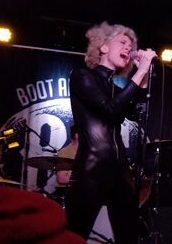
[ATTENDED: November 1, 2018] Guster        

It had been over two years since we’d since Guster and we were going through some withdrawal.  So it was pretty exciting that they were starting their latest tour at out favorite club in Jersey City.

We’d never seen them at the beginning of a tour before and I have to say the rest does them well.  They seemed energetic (which they usually are) but more importantly everyone’s (especially Ryan’s) voices sounded amazing–best I’ve ever heard them.

They have a new album coming out in January so we thought it might be a show of all new songs . But it wasn’t.  They played two brand new songs (and none of the singles that they’ve released so far).  The rest of the show (all 23-2 songs + two improvs) were familiar and more than welcomed.

When we saw them last time, we had seen them three times in 14 months and during those three shows they had played a ton of songs that we hadn’t heard before (or not since a decade earlier). So this show was a lot more songs that we’ve heard (which is still fine).  But with a few that were more or less new.  And of course those wonderful improvs. Continue Reading »

[ATTENDED: November 1, 2018] Zac Clark

Thursday nights are bad music nights for us.  C. and I have a Boy Scout meeting.  During Field Hockey season, T. has practice (or in this case a party).  So arrangements must be made.

We thought the Guster show started at 8:30, which would have given us just the right amount of time to drop of T and get to the show.

But then they moved the show up to 8.  (Irritatingly, Guster had malfunctions with their gear so they didn’t go on until 9:30 anyway).  If there was easy parking we would have made it fine.  But Jersey City on a Thursday night was something of a zoo and it took us fifteen minutes to find a spot (there was a potter’s wheel in the garbage which I seriously considered taking).  Then we had to walk the 8 or 9 blocks (and we had a delicious slice form a gourmet pizza place on 5th) and after security and bathrooms, we basically walked in and heard two and a half songs from Zac Clark. Continue Reading »

SOUNDTRACK: ELI KESZLER & SO PERCUSSION-“Archway” (Field Recordings, July 12, 2013).

This Field Recording [Eli Keszler & So Percussion: Making The Manhattan Bridge Roar And Sing] takes place under the Manhattan Bridge. Installation artist and drummer Eli Keszler wonders, When does an instrument become a sculpture?  Or can it become something architectural?

I didn’t know Eli, but I know his partners Percussion [Eric Beach, Josh Quillen, Adam Sliwinski and Jason Treuting] from a fantastic Tiny Desk Concert.  But this was my first exposure to them in the real world.  Their combination of crotales and big strings is at once bizarre, otherworldly, interminable and very cool.

There is magic in pure sound. And few know that truth as well as the quartet called So Percussion and the installation artist and drummer Eli Keszler — artists who, before this spring, had never met. We thought that they might find kindred spirits in each other.  So as a matter of artistic matchmaking, we at NPR Music decided to invite them to meet and collaborate on a new work that would have its world premiere at Make Music New York, the annual summer-greeting festival of free outdoor concerts across the city. And along the way to creating a world premiere, they brought a New York landmark in as a sixth instrumental partner: the Manhattan Bridge. They named their piece Archway.

So Percussion says that they wrote this piece just for the installation.  The drummers are present at their drums, but what about the rest?

Using a scissor lift, Keszler and an assistant began the long process of fastening piano wires attached to two large weighted boxes to the tops of lampposts near the DUMBO Archway beneath the bridge. More wires stretched from one of the lampposts up to the Manhattan Bridge itself.

The piece juxtaposes light otherworldly rings and deep resonating, almost mechanical lows.   Complete with occasional drum smacks.

By the time that their performance rolled around at 6:30 PM, Keszler and So Percussion created fascinating layers of sound. The shimmering, nearly melodic lines produced by bowing small cymbals called crotales offset sharply articulated snare drums and the grunting roars, squonks and groans of the piano wire installation. It was urbane and thoroughly urban music for a signature city setting.

And so for about 11 minutes you get a combination of low grunting sounds–the engines or the wires?–and chiming crotales.  Occasional snare hits punctuate the sound.

It starts with the mechanical sounds and the sounds of the crotales reverberating.  About 3 minutes into the piece a snare drum and rhythm is added, but very minimally and only for a instant.   Around 4 minutes the drummers start adding more percussive and less tonal sounds, but that is brief and soon enough everyone is doing his own thing, while Keszler plays a very jazzy style of drum on the drum and crotales.  Others are hitting snares and sides of drums.

But by the 10 minute mark it is a full-on drum solo with the gentlest/flimsiest drum sticks around–making little taping sounds (but a lot of them).

I feel like not enough is made of the piano wires –I would love to hear more from them.  I assume that in a live setting all of the cool sounds (ones that become more audible around the 10 minute mark are just reverberating around and around the arch–something that even the best mic’s can;t pick up adequately.

It’s still neat to watch, though.

[READ: January 28, 2008] “The Only Sane Man in a Nuthouse”

This is an excerpt from And the Hippos Were Boiled in Their Tanks, a novel he wrote with Jack Kerouac.  They alternated chapters.  It was written in 1945 but unpublished until 2008.

On a Wednesday night, he went out with Al, Ryko and Phillips.  Agnes didn’t want to join them–she was broke–some people have some pride.  He joked at Philip that he was an artist so he didn’t believe in decency, honesty or gratitude.

They went to diner and a movie and then went to MacDonald’s Tavern, which is a queer place and it was packed with fags all screaming and swishing around.

The rest of the story is a tale of an older gay men checking out the younger men, straight men howling for women, and men hitting on anyone that moves. Continue Reading »

SOUNDTRACK: THE CIVIL WARS-“Kingdom Come” (Field Recordings, November 8, 2012).

I discovered The Civil Wars after they had broken up.  Which is such a shame as they make such beautiful music.

They were Joy Williams and John Paul White and

the two [had] built a gentle, harmony-rich folk-pop sound in which warm chemistry more than counteracts the tension under the music’s surface. Though not a couple themselves — each is married, and Williams just had a baby — they convey many hallmarks of a loving union, particularly in the way she stares at him sweetly as they sing.

That staring is really uncanny–she seems so happy with him.  So it is amazing that at the time of this airing

Williams and White announced that they’ve canceled all of their tour dates in response to “internal discord and irreconcilable differences of ambition.” This, naturally, has fueled talk of a breakup — the assurance that “our sincere hope is to have new music for you in 2013” doesn’t specify whether that music would be made together or separately — which is a pretty crummy development

This Field Recording [The Civil Wars: A Song Of Loyalty, Before It’s Tested] was done in (presumably) happier times — during the Sasquatch! Music Festival in George, Wash.

The pair sing in a field of grapevines.  Just as John Paul arrives, the wind picks up incredibly, almost comically.

Amazingly, given the setting, this song sounds fantastic.  I love that you can hear whistling wind faintly (it might even be cooler if the wind was a bit louder).  But you can see the grapevines (and their hair) blow as the wind picks up.  But their voices and guitar sound perfect.

This song, like every song from The Civil Wars is wonderful.  Their voices are just magical together.  Even if there’s not a lot going on musically (it’s a single guitar although the melody is great), it’s the way they loop their voices together that is just out of this world.

I love them on record, and they sound even better here–White just lets his voice soar at one point and it’s fantastic.

[READ: January 12, 2017] “Back the Way You Went”

I was really puzzled by this story.  I couldn’t tell if it was one story with three parts or three separate stories.  I hoped it was three separate stories because the three pieces don’t seem to go together at all.  But at the same time, the internal parts of each story isn’t entirely coherent either.

Garland
D and F take a woman with them on a weekend getaway.   The woman’s mother recently died.  They go to a honeycomb.  Bees stream through the streets and the night.  D and F are bees too.

But they aren’t, of course.  Because the next day they ride bikes (the woman never learned and is quite bad at it).

Years later she wonders “what it was like for D and F to be thugging her around.”  Thugging?

The next paragraph is a flashback and is a good one.  But each paragraph seems to be separated from each other.  The title appears in the body.

Mexico
In this part “they” go to visit Dad in a home.  He is  in a room with a man whose eyelids don’t close–doctors don’t want to touch them in case they stayed permanently closed.

One Sunday they were coming home from visiting Dad–it was no different from any other visit. but her insides had gone bleak and dangerous. She sat in the back of the taxi thinking about an art work she saw in Mexico

The title of this piece appears in this section as well.  And, again, I enjoyed the part about the art piece and I enjoyed the way her dad tells her this bon mot, but I don’t see how they connect

Trouble in Paradise
Her mother in law Verna is four feet nine.  She feels big and bestial hugging Verna.  Her own mother was also short, but otherwise unalike. She is unlike her own mother except that they both think she needs to shop for clothes because they don’t like the way she dresses.

Vera is telling stories about her best friend Mildred who died.

But the narrator is thinking back to drying dishes with her own mother.

And then the narrator snaps out of it and asks Verna a question about Mildred which she finds quite surprising.  The ending in which she mentions the filmmaker Lubitsch, is just as puzzling as all the rest f the story(ies).