Feeds:
Posts
Comments

Archive for the ‘Yuck!’ Category

 qwikpSOUNDTRACK: THURL RAVENSCROFT AND DISNEY FRIENDS-“Grim, Grinning Ghosts” (1960s).

hauntThis song is the theme to Disney’s Haunted Mansion.  I’ve been to the Haunted Mansion perhaps a dozen times and I recognized a line from it (when the ghosts appear next to you in the ride), but I can’t say I ever paid attention or even thought about to this song before.

It was brought to my attention by John Congleton during his excellent interview with Bob and Robin on NPR.  The whole interview was outstanding–I learned so much from him–but I wanted to focus on this song because he raves about it (and because it is Halloween).  And because I absolutely wanted to type the name Thurl Ravenscroft.

  He loves the vocals by Thurl (who was also the singer of The Grinch songs) and the bizarre chord progression: Am, B, Am, B♭, Am, F, Am, F7, Am, E7, Am.  And about the song, he says:

When I was a kid, I was so attracted to this song, but I was scared of it. The record would sit with my other records and I would see it in there, and I would be like, ‘Do I have the bravery to listen to it right now?’ And sometimes I would, and I was mesmerized by it. But the then I grew up, and I went back and listened to it, and was like, ‘This is brilliant. This is really, really well done.’ I never in my entire life heard background vocals that sounded as tight as that. Never in my life. The harmonies are the tightest harmonies I have ever heard ever. And it’s like, this is for a silly kid’s record — but they were committed to making something special. Everything about that song is incredible to me.

So yes, it’s a goofy song, and if you don’t pay too much attention to it, it’s just a not very scary ghost song, but there’s a lot going on (hand it to Disney for being really into their production values).  Like this note from Wikipedia: “the organist actually played the song backwards to achieve the discord that the composer intended.”

Not bad for a song you only hear if you go on a ride.

[READ: October 19, 2014] Poop Fountain!

I have enjoyed just about everything that Tom Angleberger has written (interestingly, he is famous for his origami Yoda series, which I actually like less than his other books).  This book was actually his first book published.  But he published it under the name Sam Riddleburger and it was called The Qwikpick Adventure Society.  It has clearly been republished since he is now famous.

I brought the book home for Clark but he said he didn’t really like the way it was written (it is typed with handwritten comments).  I actually found it very easy to read and thought it was a super fast read–two hours at most.

So the book starts with a note from Tom Angleberger in which he says that before he wrote books he was a reporter and one of the stories he wrote was about a sewage plant in Crickenburg, Virginia (which is not a real town).  His original article was about how the local sewage plant was getting over-burdened by all the new residents and so it would need to be enlarged.  He went to interview the manager and man did it stink.

He says that many years later a guy called him up to say that he had found a bunch of papers (including his article) in a Qwikpick gas station.  And that’s how he came across this first person account of an adventure to the same sewage plant.

He then tells readers that this was in 2000, before kids had cell phones or the internet, when kids basically just did stuff outside.  And that is how the Qwikpick Adventures Society’s trip to see the Fountain of Poop came about–thre bored kids looking for something to do. (more…)


Read Full Post »

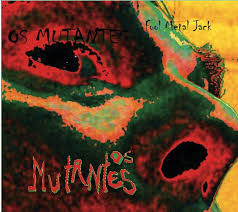
enchanteSOUNDTRACK: OS MUTANTES-Fool Metal Jack (2013).

jackI first heard this album streaming on NPR.  I really enjoyed it and was surprised by how diverse and yet still kinda 1970s hippie-feeling it was.

I didn’t know anything about the music of Os Mutantes before hearing this disc.  In a nutshell (and the details seem pretty complicated), they released 6 albums from 1968-1974 and then broke up.  They reunited in 2009 and this is their second album after reuniting.

I don’t know what any of them did during the intervening years, but it is clear that the psychedelic vibe they explored the first time around never fully left them.  Because even though there are rocking numbers, there are plenty of groovy organs and songs about love on the disc.  And yet the first songs I heard from the album were really quite rocking, so I was surprised by the mellow vibe as the album progresses.

There’s precious little information about the record on the record jacket, but I do know that Sérgio Dias wrote all the music and is the lead singer.  The disc opens with a kind of introductory song, “The Dream is Gone.”  It has a slow opening with cool bass lines and Dias’ voice which is soft and kind of worn sounding.  There are some cool electronic effects sprinkled around and big harmonies.  This leads to the second song, the stomping anti-war track, “Fool Metal Jack” (which I talked about here).  It’s got a big fat bass and menacing riff (as befits a war song). The song is graphic and ugly (with a loud cough in the midst of a verse).  It’s followed by the big old sloppy sounding rocker “Picadilly Willie” with big 70s sounding vocals (I’ve mentioned before that it sounds like Frank Zappa song to me, and it still does). These two songs are so loud and noisy they really belie the psychedelic vibe that the rest of the disc presents.

“Gangjaman” has a reggae feel (with a big round bass) and fun backing vocals.  While “Lookout” has a kind of Santana live at Woodstock vibe–a slinky rocking guitar and big chords.  There’s also some traditional (I assume) Brazilian native singers.  “Eu Descobri” is sung by a female vocalist (in Portuguese I assume) it is a pretty, slinky song with flutes and a cello and echoed vocals.  It hearkens back to the late 60s but still sounds contemporary.

“Time and Space” has more big bass (the bass really sounds great on this disc), but this one is a slow acoustic umber with excellent harmonies.  I love the layered vocals that reminds me of good prog.  “To Make It Beautiful” is an absolute hippie track with lyrics like: “I need to create love with you my love.” It has his great falsetto and buzzy guitars.  It is so far away from the early rockers and yet to me the album doesn’t feel disjointed.  “Once Upon a Flight” is a synthy/guitar rocker, but in a very 70s style. It’s also got a big cello solo at the end.  “Into Limbo” is a jangly slow guitar song with Dias’ voice sounding great.

“Bangladesh” has a long acoustic guitar intro with a very middle eastern feel.  By the middle it turns into a kind of prayer with a repeated chorus of: “Hare Jesus Hare Buddha Hare Judas Hare Rama Hare Krishna Hare Lucifer.”  The final song “Valse LSD” is a complex acoustic song with male and female vocals.  It’s quite pretty.  It doesn’t really feel like the end of the disc (I would have ended with “Bangladesh”), but it’s a good summary of the album as a whole.

 Since I am unfamiliar with Os Mutantes’ earlier work, I can’t really say how this fits into their discography, but I think this is just a great album and I’m looking forward to hearing more of their earlier works.

[READ: October 2, 2014] The Enchanter

naboI have had Nabokov on my list of authors to read for a long time.  I have read and enjoyed a few of his books and planned to read his oeuvre at some point, just not quite yet.  And then, as serendipity would have it, I stumbled on a book of his novellas (the Penguin classic edition) and decided to read them.  Because they aren’t really meant to be taken as one item, I’m going to mention them individually.

The Enchanter was Nabokov’s final work written in Russian.  It was never published during his lifetime.  The Notes to the story in the book suggests that Nabokov had a vague recollection of the story (with many details incorrect), but that he believed he discarded the original version when he moved to America.  He evidently found it after publishing Lolita, but did not feel compelled to publish it.  It was his son who translated and published it after his death.

The Enchanter is something of a precursor to Lolita in that it involves a man who is obsessed with adolescent girls.  What separates this from Lolita (although there are many similar plot contrivances) is the mental state of the protagonist.  He is disgusted by himself.  He knows what he does is wrong, he even imagines himself in animalistic ways.  And yet he cannot help himself.  (This is not to say that that is not present in Lolita, just that it is more or less the focus here). (more…)

Read Full Post »

gulpSOUNDTRACK: PET SHOP BOYS-Elysium (2012).

220px-PSB_ElysiumPet Shop Boys are known for big dancey singles.  And so perhaps it’s something of a surprise to get this album which is pretty but certainly low key.   It’s not like they haven’t written low key songs before, but there’s very little to get up and sing about here.

Which is not to say the album is bad.  It’s actually very good once you accept the lack of big songs.

Of course, having said that, there are one or two anthemic tracks, but the album overall is more introspective (unlike their album Introspective).  The title, Elysium refers to the afterlife where those chosen by the gods would live a happy (after)life, indulging in whatever they had enjoyed in life.  Yes, mortality is on Tennant’s mind.

“Leaving” opens the disc with a great chorus, which leads to this somber opening verse: “Our love is dead but the dead don’t go away.”  And that certainly sets the tone–nice synth rock, but nothing to loud and frenetic.  “Invisible” is a similarly low key song.   This is one of their quiet ballads, with just touches of synth melody: “I’m here but you can’t see me, I’m invisible.”  It’s a definite downer of a song but it’s very pretty.

Of course all that I said about mellow low key albums is belied by the third track: “Winner.”  This was written in time for the 2012 Olympics in London and it is very much an anthem about, well, winning.  It’s kind of obvious (although lyrically it is more in depth than many similar songs), but the melody is just simple and uplifting–(just what you’d want for Olympic documentaries).

“Your Early Stuff” is a much darker song–it is a song written to a “washed up” performer: “you’ve been around but you don’t look too rough and I still quite like some of your early stuff.”  It’s funny but also tender.  “A Face Like That” is the closest thing to a dance single on the album–it’s fast and synthy and the vocals are echoed and repeated.  But even the verses are more low-key than you might expect from the chorus.  “Breathing Space” is another pretty ballad.

“Ego Music” is another faster song, with a very funny premise: “ego music–it’s all about me.”  It’s a slight song but good for a laugh.

“Hold On” also aspires to anthemicness, but it is slower than a typical PSB anthem.  It also has a synth line that is vaguely classical.  Although of all the songs, this one is lyrically the most tautological:  “Hold on, there’s got to be a future or the world will end today.”  “Give it a Go” is a slower, simpler track. Not too memorable, although the chorus is bouncy and catchy h.

“Memory of the Future” has a great synth line and Tennant’s cool accompanying vocals–it’s a classic PSB song and one of my favorites on the disc.  Although I don’t love “Everything Means Something,” the final song, “Requiem in Denim and Leopardskin” is a great ending–slow but very catchy and rather wry and funny.

So this album overall is certainly more, dare I say it, “mature” for the Pet Shop Boys, but they haven’t lost any lustre in songwriting.

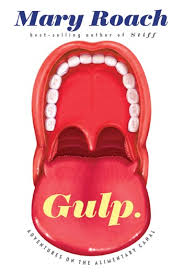
[READ: Summer 2013] Gulp

Yes, that date is correct, I read this book over a year and a half ago.  I meant to write about it then, but I loaned it out to someone and I like to have the book nearby when I write about it.  So I put it off and put it off and now that I have the book back, I will do my best to remember whatever I can about it.

But the thing about this book is that it was so memorable, I won’t have much trouble writing about it anyhow.

Mary Roach investigates the physical properties of eating from pre-digestion through to the end.  And she does it with thorough research and a boatload of humor (sometimes gross out humor, although she warns that that is not her intent–“I want you to say, ‘I thought this would be gross, but it’s really interesting.’  Okay, and maybe a little gross.” (19).

She begins with the nose.  Most people know that the nose contributes tremendously to your sense of taste.  But Roach really explicates how much.  She speaks to a woman, Langstaff, who is a professional sniffer and who is currently staffing the Olive Oil taste Panel at the Olive Center.  She is training novices to be be better at tasting flavors.  But Langstaff herself for instance rarely drinks beer for pleasure even though she is an expert at tasting it.

The most amusing (or not, depending) information here is that there are people who were paid to taste cat food.  Yes.  And that humans prefer cat food with a tuna or herbal flavor over those that taste “rancid,” “offaly,” “cereal” or “burnt.”

Fortunately, the second chapter shows that it is actually dogs who test the dog food.  It turns out that dogs and cats really shouldn’t enjoy dry dog food (cats and dogs are not grain eaters by choice).  Dry dog food was created as a means of convenience for people (and as a way to stop tinning food during the war).  As for your pets, “pet foods come in a variety of flavors because that’s what we humans like, and we assume our pets like what we like.  We have that wrong.  ‘For cats especially…change is often more difficult than monotony.'” (43).  Some other pet observations: cat’s can’t taste sweet (although dogs can and rodents are slaves to it).   (more…)

Read Full Post »

how you dieSOUNDTRACK: DIARRHEA PLANET-“Lite Dream” Live on KEXP (2014).

dpHow to pass up a band with a name like this?  Well, it’s pretty easy, actually.  Who would even want to say their name?

The name conjures images, no, let’s not go there.  The name conjures music that is just abrasive and rude–ten second punks songs.  But in reality, their music is pretty traditional old school heavy metal.  They have 4 lead guitarists after all! (There’s 6 guys in the band altogether, surprisingly, there’s no women).   One of the lead guitarists even plays with his teeth (for a few seconds).

This song is about heavy metal, although I’m not sure what about it.  There’s some big riffs, solos galore.  There’s even a classic 80s style dual lead guitar solo.  There’s big loud drums.  There’s feedback.  It’s everything you think of as heavy metal, with a seeming wink and nod thrown in.

This is basically a goofy feel good band, playing fast heavy metal.  Shame about the band name, though, really.

Watch it all here.

[READ: spring and summer 2014] This is How You Die

It is quite disconcerting to open a Christmas present from your wife and have the first thing you see be the words “This is How You Die.”  To then look at her confusedly and try to interpret the look of excited delight on her face as she wonders why you’re not excited.  Then she explains that it is a sequel to the interesting collection Machine of Death that you both had read several years ago (but which I evidently never posted about).  Sighs of relief and then Christmas can proceed with more merriment.

So over the course of the new year I read these stories and I enjoyed most of them quite a lot.

The premise of the book is that there is a Machine of Death.  This machine states how you will die, but it does not give you a time, place or real definition of what it means by hope you will die.  Statements seem obvious but may in fact be different in some twisted way.  As it says on the back of the book, OLD AGE could mean either dying of natural causes or being shot by an elderly bedridden man in a botched home invasion.  The book revels in the irony that you can know how it’s going to happen , but you’ll still be surprised when it does.

The way the machine works is that you insert your finger, it takes a blood sample and gives you a card with the way you die printed on it.  No matter how many times you do it you will get the same result.  These are the guidelines, and each author made a story with just that set up.

Pretty cool right?  The first collection was really great.  And so is this collection, done by writers and cartoonists that I had never heard of before.  There are 34 stories and 12 comic strips (it’s a hefty collection).  Because each story is basically about how a person dies, I had to think about how best to review the book–without giving away any twists.  So I think the title and a very brief plot will have to suffice.

There’s even a funny promo video for the book (at the end of the post). (more…)

Read Full Post »

peach SOUNDTRACK: FOALS-Holy Fire (2012).

I foalsloved Foals’ debut album Antidotes, it was a modern rock/prog rock/dancable mashup with angular guitars and all kinds of weird time signatures.  Then Foals returned with a new album which I haven’t heard anything of, except to have heard that it was very different.  Then I heard “Inhaler” from this album and I loved it.  It was easily in my top ten songs of 2012.

But it was so different from the Foals of Antidotes that I wasn’t sure what to make of it.  And in fact, that Foals, with all of their angularity, has been replaced by this much dancier version of the band.

“Prelude” is like an extended intro to “Inhaler.” It’s 4 minutes of intro music with chatter and noises.  Then comes “Inhaler,” a slow building song that rises and falls, rises again then falls again and then bursts into a big rocking chorus.  It’s fantastic, it feels louder than is possible for such a song.  “My Number” introduces some of that unusual staccato song style but in a far more dancey framework. The synths are louder and bolder.  I really like this song.   “Bad Habit” is a far slower song, but it’s a nice tempo changer.  And the chorus is still catchy.

“Everytime” brings in more shoegaze elements (so let’s see, there’s angular punk, shoegaze and dance music here).  This song even has a discoey chorus.  “Late Night” and “Out of the Woods” feel even more dancey than the earlier tracks–with a kind of earlier 80s British alt rock flavor–spiky guitars and exotic percussion.  I hear some of the guitar sounds of early U2 as well, especially on the intro of “Milk & Black Spiders” (the rest of the song sounds nothing like U2.

“Providence” brings back some of that louder guitar, coupled nicely with a combination of shoegaze and screamy vocals.  The heavy guitar plays a very nice counterpoint to the picking of the second guitar.  It’s the last great song on the record.  “Stepson” is a slow song, the slowest on the disc, and I fear that it rather runs out of steam.  “Moon” continues the slow drifting sense of the end of the album.  It’s pretty song, but it feels so far removed from “Inhaler” that it seems to be from a different record.

So I’m not entirely sure what to make of this record.  It has a few great songs, and then a number of songs that seem to want to go in a different direction, but what direction that might be remains unclear.

[READ: September 6, 2014] “The Happy Valley”

Lucky Peach 10 is “The Street Food Issue,” and it is a fun issue with all kinds of interesting food you can buy on the street (and recipes to try them at home).

Like food in tubes.  Take “Sausage Quest” (what the locals do with their various sausages all around the world), or “I Went to Thailand and All I Got was a Sausage Stuffed in My Mouth” (I can’t wait to make sausage blossoms).  Beyond sausages there’s a list of the most compelling street foods around the world from New York to Naples to Tunisia. We look at street food vendors in Malaysia and South East Asia.  And then we meet the Lucha Doughnut Man of East LA (Mexican donna vendor by day and masked wrestler by night).

Then there’s some articles that are not about food.  Like the surprising article about the microbiology of used cigarette butts (no butts were eaten).  Or the very interesting history of charcoal (which dates back to Henry Ford).  I had no idea charcoal came from trees.   There’s an essay about rapper Jibbs and his song “Chain Hang Low” which was apparently ubiquitous in 2006 although I don’t know it).  The essay discusses how it used “Turkey in the Straw” as a motif.  Most likely, he took it from the ice cream trucks that he heard as a kid, but there is a whole history of racism packed in to that song, let me tell you.

I enjoyed the idea (throughout the issue) that if you’re in a new place, sometimes you can’t always trust reviews for what’s good, you just have to trust your gut (and your nose).

Then there’s several articles about corn.  Making tortillas or masa–the whole process of nixtamilization.  (more…)

Read Full Post »

lp11SOUNDTRACK: AMASON-“Älgen” (2014).

amasonI was delighted when I heard this song on NPR because of the unexpectedness of it.  It starts out fairly simply with a fast shuffle drum and swirling guitars.  Then comes in a deep, very synthy sounding keyboard playing a simple and straightforward riff.   All of this instrumental section lasts nearly a minute and a half (of a 4 minute song).  Then the vocals come in.  A very deep (and wholly unexpected) voice sings a few words and is quickly followed up by a female voice singing quicker vocal lines, almost speeding up the song.

Amason is a Swedish band (with members connected to nearly every Swedish alt rock band you’ve ever heard of).  And like a lot of Swedish music, it is super catchy but somehow just a little different, which keeps it interesting.  I want to hear more from them (although when you search them, you have to keep saying, no I am not looking for “Amazon”).

[READ: September 6, 2014] “Lobsters”

Lucky Peach 11 was the “All You Can Eat” Issue. So the issue focused a lot on buffets (don’t feel compelled to get your money’s worth, you’ll only get sick). But there was also some interesting twists about all the things you could eat if you were so inclined.

My favorite article was from Mark Ibold, about Pennsylvania Dutch cooking and the amazing buffets you can find in Lancaster. He recommends the popular but for worth it Dienner’s on Lincoln Highway East (next to a fake revolving windmill!). Lisa Hanawalt’s illustrated stories have also become a favorite. This one is set in Las Vegas, with all that that implies.

There’s a tremendous article on Quebec and the stunning foods of the French Canadians, and a very funny article called “Decision Fatigue Related Eating” how as you get tired your food choices suffer as well (WINGS Fri-DAAAAY!”). There’s a lengthy article about crashing weddings in the country of Georgia (where you will likely be invited to a wedding even if it’s your first day there).

There’s several recipes with the main ingredient of celery. Peter Meehan opens with a very funny set up “There are things one can never seem to buy in appropriate quantities at the grocery store…. Celery’s natural packaging comes in one size: more than you can eat…. It’s cheap and it last forever so you buy a whole head…. be honest: isn’t there always a nearly complete head of celery heading toward middle age in the crisper?” This is followed by some possibly good celery recipes. (more…)

Read Full Post »

tpk5SOUNDTRACK: INTERIOR DISPOSITION-“Fornix” (2008).

Critical Injuries Five Years of RehabilitationIt was challenging to find a related song for this week’s reading, although frankly a band called Interior Disposition would fit with just about any DFW passage.  But having a song called “Fornix” paired nicely with the computer problems that the author faced this week.

From the online information, it seems like Interior Disposition is a metal band.  And yet when I tracked down their full album and listened to a bit it’s largely trippy outer space noodling, or as one of the sites labels them: dark ambient.  There’s bubbling sounds and sounds of what I think of as deep space.  It is strangely relaxing and yet with a hint of tension all the way through (so yes, dark ambient is a pretty good sum).

Okay a little more digging tells me that the band is actually a guy, Oleg Hurvatov, who is Russian and also records under several other aliases: the wonderfully named Exploplasmatic Coagulation, and the puzzling Lanceolaria Im Licht Der Laterne

“Fornix” is only 1:46 and is probably a good introduction to the band/album.  If you like the 2 minute sound, the rest is pretty darn similar, just much longer.

[READ: August 18, 2014] Pale Summer Week 6 (§35-§45)

This weeks read was mostly a series of smallish sections.  some of them are entertaining, some of them provide interesting insights into the organization of the Service and of some of the characters.  And some of the sections are just downright funny.  The more I read of this book this time, the more bummed I am that it was never finished.  I even just wish I knew how much more he had planned.  There’s potential for this book to have spiraled out to 800-900 pages, there just seems to be so many things he could have followed up on–the Sylvanshine transformation to mastering RFI; the whole business with the infant, I love it; learning more about Mr. X (although likely there wouldn’t be much more about him); and of course what led to David Wallace leaving the Service and what compelled him now to write about it (which I don’t think is really addressed).
(more…)

Read Full Post »

psbrosSOUNDTRACK: ACCEPT-“Final Journey” (2014).

blindI normally do kids music for kids books, but this book was so un-kid friendly that I decided to tack on a metal song for it.  This song was previewed on Viking’s Choice at NPR.

I loved Accept back in the 80s, but once lead singer Udo left I haven’t really followed them all that much.  New lead singer, Mark Tornillo formed TT Quick way back in the day and since I saw them not too long ago opening for King’s X, I thought I’d see what he sounded like with Accept now.

He doesn’t quite have the weird Teutonic sound that Udo had (how could he, being from New Jersey and all?), but his guttural voice is quite appropriate to the music.  But there’s something missing here with this music.  It sounds a little too generic, compared to the abrasive yet melodic sound that Accept brought to the scene way back when.  I think maybe if it wasn’t Accept I’d be inclined to like it more, because I have high expectations.

You should never read comments on public posts (you can read the few that I get here, of course, as they are usually pretty thoughtful), but one person commented on this song that the chorus sounds like Europe’s “The Final Countdown” which ruined the song for me, and now I have ruined it for you.  Sorry.  Of course the most noteworthy (get it?) thing is the guitar solo which is an extensive working Edward Greig’s “Morning Mood” (and not just a line or two, but the whole thing, pretty much–it actually sounds awesome).

So, this song isn’t going to bring me back to Accept, although I did like it more with each listen.  Nevertheless, it’s nice to know that they’re still rocking Germany.  I also love that they still have the same logo.

[READ: July 27, 2014] The PS Brothers

The cliché is that you can’t judge a book by its cover.  And that proves to be hugely true here.  Indeed, you can’t judge this book by its size (books of this size tend to be for younger readers), or even by its blurb.  The blurb ends with “but what they aren’t counting on is uncovering a crime that can bust apart a dream faster than a dog can sniff out a bone.”  Bear that in mind as I talk about this story (and yes give a spoiler or two by the end).

So this story (judging by the cover and the title) seems pretty darn funny.  Shawn and Russell really want a dog.  Russell has read every book in the library about dogs and Shawn bought a pooper scooper at a garage sale.  There’s a few logistical problems–they don’t live together, they don’t have any money, Shawn’s house is too small for a dog and Russell’s uncle hates dogs.  So what are they going to do?

Then one day they see that a guy is selling Rottweiler puppies for $200 a piece.  They want a big mean dog with a spiked collar who will protect them from bullies (I should have realized that this story might be darker than I expected, but who could have known?).  Shawn and Russell decide to become the PS Brothers, with the PS standing for Pooper Scooper.  They are going to use Shawn’s scooper to pick up neighborhood poop for 10 or 25 cents a poop.  And soon enough they will have the cash. (more…)

Read Full Post »

CV1_TNY_12_23_13Blitt.inddSOUNDTRACK: MALI MUSIC-Tiny Desk Concert #366 (June 21, 2014).

maliMali Music is one man, born in Savannah, GA, but with a somewhat Jamaican vibe.  He plays three songs in this Tiny Desk Concert and each one is quite different.

In the first track, “Fight for You,” he raps over a beat and sample mix played by his DJ (DJ Slow Motion, who is behind the desk with him).  It’s interesting in that he raps with himself (his voice is played by the DJ as well, not looped).  His singing voice in this song tends towards the whiny which I don’t care for, especially since his main voice is so powerful.

The second track, “Make It In” he plays on an acoustic guitar.  The song is clever with lots of amusing asides and slight laughs in the lyrics too.  he more or less raps the verses but sings the chorus.

For the final song, he switches to keyboard (he says he learned piano at a very young age) and he plays a simple, uplifting ballad called “Beautiful.”  There’s a funny moment when he asks the crowd to sing along and then the DJ plays a sample of a crowd singing a long, which makes Mali laugh.

Mali is a pretty positive guy–he talks about things getting better and about himself really making a difference through his music.  It sounds like prideful boasting (and it will be interesting to see if he really does take off), but he also seems sincere in his desire for happiness.  The set reminds me a little of K’naan, at least in spirit.

[READ: June 19, 2014] “The Christmas Miracle”

After really enjoying “The Toast” a few months ago, I was delighted to get another story from Rebecca Curtis and her bristly narrator.

The story opens with the comment that cats were dying, “This happens, of course.”  But in this case they were dying in gory ways not to mention the cats belonged to her nieces.  The girls had seen the dead cats.  The narrator also points out that it is now Christmas, “The most magical, horrible, spiritual, dark, and stressful time of the year.”

Like with another Curtis story, this one is being told to someone, in this case, someone named K, a Russian Communist and “Jewish person who doesn’t believe Jesus was the son of God.”

The narrator explains her situation–she was teaching creative writing but hadn’t written anything herself in years  She had contracted Lyme disease (does this all sound familiar from her other stories?). The disease causes inflammations and bouts of madness and “frank or rude speech, usually set off by eating carbohydrates.”

I love the way that Curtis writes although I’m unclear what Curtis herself believes because her narrator is just so contrary.  Like this awesome sentence:

“If cake was nearby I wasn’t always able to prevent myself from having one bite, then the sugar fed the Bartonella bacteria, which commanded me to eat more, and I would, and then I’d go insane.”  So she asked her sister not to have any sugar filled treats at Christmas.  Which her sister ignored, of course. (more…)

Read Full Post »

karl2SOUNDTRACK: BRASS BED-Tiny Desk Concert #339 (February 24, 2014).

brass bedI expected Brass Bed to be a goofy band because of the snapshot image of them singing into toy microphones.  I was initially disappointed by how normal they were, but I was soon won over by their interesting floating sound. They have this overall trippy underwater vibe (which seems to be accomplished by a bowed slide guitar). This is especially notable on “Yellow Bursts of Age” their best song in the set.  Later the guitar solo is echoey and also underwatery. It’s a very wild sound for a fairly simple song.

They tell a funny story about being from Louisiana and encountering Washington DC snow and (of course) not having an ice scraper (although they did have bag of sand).

“Cold Chicory” is an upbeat sounding song musically although it is kind of a bummer lyrically, but again there’s the great sound of the bow on the slide guitar and the echoey lead guitar. “Please Don’t Go” is a slow song—with more interesting effects from singing into that slide guitar.

The plastic mikes do come out in the last song “Have to be Fine” in which they sing into the echoey mikes for the intro (with very nice harmonies).  They sing the intro for about a minute, and then the slide guitar player takes lead vocals on this simple but pretty song (I don’t know any of their names).

At the end, the NPR folks gave them an honorary NPR ice scraper.

[READ: June 24, 2014] My Struggle Book Three

boyhoodI read an excerpt of Book Three just a few weeks ago.  And in the post about it I said I wouldn’t be reading this book for quite some time.  But then the book unexpectedly came across my desk and I couldn’t resist grabbing it while it was here.  So it appears that I will now have to wait well over a year before Book 4 (which is, I think about 1,000 pages–yipes).  I also see that Book Three is fully called “Boyhood Island” in Britain.

At the end of Book Two, Karl Ove was more or less caught up to the present–writing about what he was then up to (with a few years gap, of course).  So it makes sense that this book is about his childhood–showing us how he came to be the man he is.

The book, amusingly enough, starts off with memories that he cannot possibly remember, and he even says as much.  He is using memories of his parents and piecing together pictures from when he was an infant.  In 1970, (Karl Ove was born in 1968) his family moved to the island of Tromøy tromo(and check out the idyllic picture that Wikipedia had).  This is where Karl Ove spent his (rather traumatic) formative years.  Their island is small, so he knows everyone in his school, but there are some amenities around like the Fina station and the B-Max, and there’s lots of soccer to be played and bikes to be ridden.

Things seem normal at first–he runs and plays with his friends, there is ample green space to run around in, and they have boats to sail on.  And we meet two of Karl Ove’s earliest friends: Geir and Trond (so many people are named in the book, I’m very curious to know if any of them remember him).  In an early scene they chase the end of a rainbow looking for a pot of gold (and have a discussion about what happens to it when the rainbow vanishes (the boys even play a prank on Karl Ove that they actually found the pot,a dn while he doesn’t initially fall for it, he is compelled to go back and they tease him).

But the looming figure here and throughout the book is Karl Ove’s father, who, at least according to Karl Ove’s memory, is pretty much a monstrous dick.  He is demanding and exacting, unforgiving and seemingly uncaring.  He is either bipolar or a drunk, jumping from goofy to outright rage in a mater of seconds.  Karl Ove and his brother Yngve fear him unconditionally and, by the end of the book they both seem to hate him.  The scene where their dad tries and fails to teach Karl Ove to swim is heartbreaking, especially when the dad goes home and tells their mom right in front of him “He’s frightened of water.”  There are dozens of instances of fear and intimidation (often accompanied by a wrenching of Karl Ove’s ear).  Like when Karl Ove turns on the TV for his grandparents (he wasn’t allowed to touch the TV but he wanted to do something nice for them).  After a few minutes, the TV fizzed out and, naturally, he was blamed for it and sent to bed without supper (after some minor physical abuse). (more…)

Read Full Post »

« Newer Posts - Older Posts »