Feeds:
Posts
Comments

Archive for the ‘Summer’ Category

SOUNDTRACK: MIYA FOLICK-Tiny Desk Concert #864 (July 5, 2019).

I feel like I’ve heard of Miya Folick, but I’m not sure where.

Miya Folick was raised a Buddhist in Santa Ana, Calif., and is of Ukrainian and Japanese descent. She sings of conviction, not fiction. I find a stirring sense of truth driving that powerful voice of hers.

She portrays a nice mix of tough and vulnerable in this Tiny Desk Concert.  Between the pink hair and her at times gruff voice (and lyrics), she is bad ass.  But she also sings in a delicate falsetto.

Like on the opening song, Thingamajig” in which her voice (with minimal backing music) fills the room.

Miya Folick began her Tiny Desk Concert with an apology in the form of a song. “Thingamajig” opens with Wynne Bennett’s stark piano. The song is also the lead-off track on Miya Folick’s 2018 album Premonitions. On that version, the song crescendos with strings backed by a vocal loop. Here at the Tiny Desk, we get to hear why Miya Folick is such an astonishing performer, her classically trained voice taking charge, wrapping around those melodic piano lines while singing, “I am sorry / I know I am wrong / So take it all / I want to be out of control.”

For the last verse, Wynne Bennett adds some bass synth notes to flesh out the low end.

She is sweetly nervous after the song… I’m talking because I’m not ready.  I was surprised when she said “This song is called Dead Body,” but I enjoyed the way she turns that title around.

For her second tune at the Tiny Desk, “Deadbody,” she sings, “I need you to know I’m not powerless / My strength lies within my gentleness.” And by the time the chorus kicks in, her little band of two is in full throttle while Miya sings, “Over my dead body,” addressing the cruelty of men toward women.

The song opens with a cool shuffle on the drums from Garet Powell and a single repeated bass piano note while she sings.  For the chorus she adds some simple acoustic guitar chords that add a surprising amount of body to the otherwise stark song.  And she sings really powerfully and intensely for the end of the song.

The last song is called “Cost Your Love.”

I could see a deep appreciation for this day in Miya’s eyes. And before she played her final song, she took a moment to be thankful for being in this space. Miya stopped to say that she’s been watching Tiny Desk Concerts since before she was even playing music. Then she tuned her guitar, took a deep breath and launched into the darkness for her final tune.

Despite the intensity of her vocals and lyrics, she’s funny and personable.

She jokes: I only play one string so that string better be in tune.

Although it’s not a joke because she does only play one string.  But the melody is pretty cool and the songs shifts between that low string melody and very pretty piano.  She showcases both extremes of her voice–rough and growly and gentle and tender.  It’s an impressive performance.

[READ: July 1, 2019] “Kelso Lake”

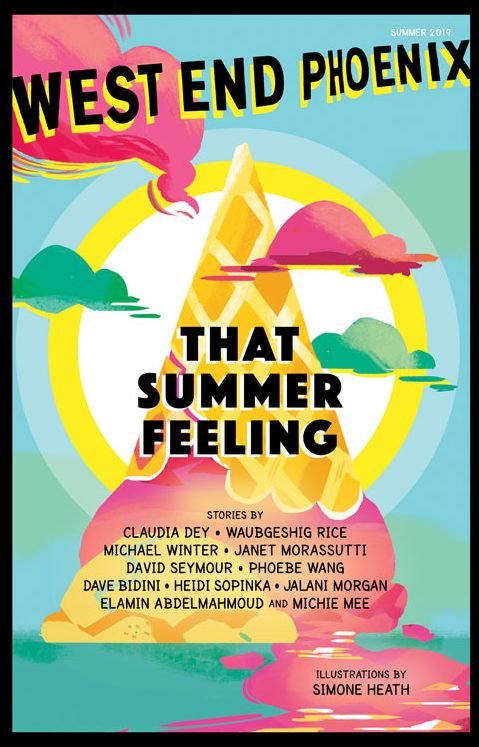
The Summer 2019 issue of The West End Phoenix was a special all comics issue with illustrations by Simone Heath.  Each story either has one central illustration or is broken up with many pictures (or even done like a comic strip).

Each story is headed by the year that the story takes place–a story from that particular summer.

1979.  This story is sort of like a comic strip, but with more elastic panels than the standard boxes.

Every weekend that they could, David’s family would cram into the car with a cooler and towels and head off to Kelso Lake.

There’s even an illustration of Kelso Lake–a bent thumb near the Niagara escarpment.  It was light years from a Mississauga apartment and might as well have been Turks & Caicos. (more…)

Read Full Post »

SOUNDTRACK: BETTY WHO-Tiny Desk Concert #861 (June 26, 2019).

I had never heard of Betty Who before this show and my word did she win me over.  She is so much fun, so entertaining that it makes me want to explore her music (and maybe even see her live show).

However,  Betty Who is an Australian cellist who plays dance pop music.

Her third LP, Betty, falls squarely in the … sun’s-out, buns-out pop genre.

I suspect that as with most of the pop stars who play quietly at Tiny Desk, I will probably much prefer these version to the original–so maybe I should just leave it here.

Some background

She grew up in Sydney, Australia, and started playing [cello] at the age of four (just like Yo-Yo Ma). Maybe it had something to do with her mom being in the room, but emotions ran high for the charismatic and chatty singer. “I didn’t want to be the girl who played cello and sang,” she told the crowd gathered to watch. “‘Cause that girl feels really far away from ass-out, sparkle-covered pop-star me.”

I would not have guessed her pop star ambitions as the first song starts with just her voice and cello.

When all the studio production is stripped away, what’s left are intricate melodies that soar through Betty’s impressive vocal range and relatable lyrics. As the audio engineer for the Tiny Desk concert series [Josh Rogosin], I’m always curious how the vocals will translate without the aid of pitch correction and tons of effects you hear on the album. I’m a sucker for great melody and Betty Who’s raw vocal performance at her Tiny Desk had me in a state of aural ecstasy.

It sounds fantastic.

She plucks the cello for the beginning.  She has a terrific voice, although she sings a little too pop for my full appreciation.  After the first verse, Myla Bocage adds some keyboard notes to flesh out the song.  After another verse, Jemila Dunham adds some cool bass lines.  Her bass throughout the show is pretty excellent.

After a chorus or two, she throws in a bowed cello solo which works perfectly (and sounds great of course).

After the song she is so bouncy and bright and energetic.

She tells us that she always wanted to be a pop star–she likes sparkles and have her ass out.  She wanted to be the love child of Beyonce and Britney Spears.  But she studied classical music since she was little.  She says, “I told myself I would commit to pop star life and dance and do what I always wanted to do and make that vision come true.  And then one day I’d just whip out my cello and say oh P.S. By the way.…  And this is the first time I’ve been able to do this.”

One of my favorite things about Tiny Desk concerts is that artists are often inspired to experiment. Betty Who was in town recently for a three-night residency at D.C.’s famed 9:30 Club where her sound was larger than life. The subwoofers cranked out backing tracks you could feel in your gut and dancers flanked the pop star, punctuating every pulsating beat. But she began her Tiny Desk performance with only her cello and her voice — the first time she’s ever accompanied one of her original songs with the instrument.

Song two is “Friend Like Me,” which is one of her favorite songs she’s written.

She wanted to wrote a song that said, I love you but you make me fucking crazy and I want to punch you in the face or I love you so much but you’re your own worst enemy and you’re taking yourself down.

It’s just her on the acoustic guitar and her voice is really lovely (less loud and poppy)  After a couple of verses Bocage adds some keyboard twinkles.  Some bass fleshes out the song, but it remains a very pretty ballad.

Before the final song, “I Remember,” she introduces the band and says “Ian Barnett on the [drum] pad.  You should come see us, he does much more than this.”

Betty Who says she dreamed of having a Tiny Desk concert ever since she was a teenager. She chose to end hers by asking everyone to sing along to the track, “I Remember.”

Dancing under the stars
Kissing you in the dark
I remember your love, oh
Never giving you up, giving you up, oh.

I love that she gives hand motions and massive encouragement as she teaches everyone the words.  She says she has three plants in the audience.  They’re going to sing loud and you can all mumble along if you want.

She says this song is about real couples “not kind of Instagram we love each other so much.  People who don’t fight, ick, what is that.  The best couples know each other the best and can push each other’s buttons.  It’s an amazing feeling to love someone so much but also want to strangle the life out of them,  They make you the most crazy, but that’s what makes you love them so much.

Betty’s reaction to their singing is wonderful.

She’s great and I hope she starts selling bigger venues.

[READ: July 1, 2019] “Bad Dream Job”

The Summer 2019 issue of The West End Phoenix was a special all comics issue with illustrations by Simone Heath.  Each story either has one central illustration or is broken up with many pictures (or even done like a comic strip).

Each story is headed by the year that the story takes place–a story from that particular summer.

1978: Dave Bidini got his first job working in a record store at the Albion Mall (made famous (to me) in the Rheostatics’ song “Jesus Was Once a Teenager Too”).

It was a dream job–that’s where he bought his 45s and LPs.  It was right across from an Orange Julius! (more…)

Read Full Post »

SOUNDTRACK: SAINT SISTER-Tiny Desk Concert #863 (July 3, 2019).

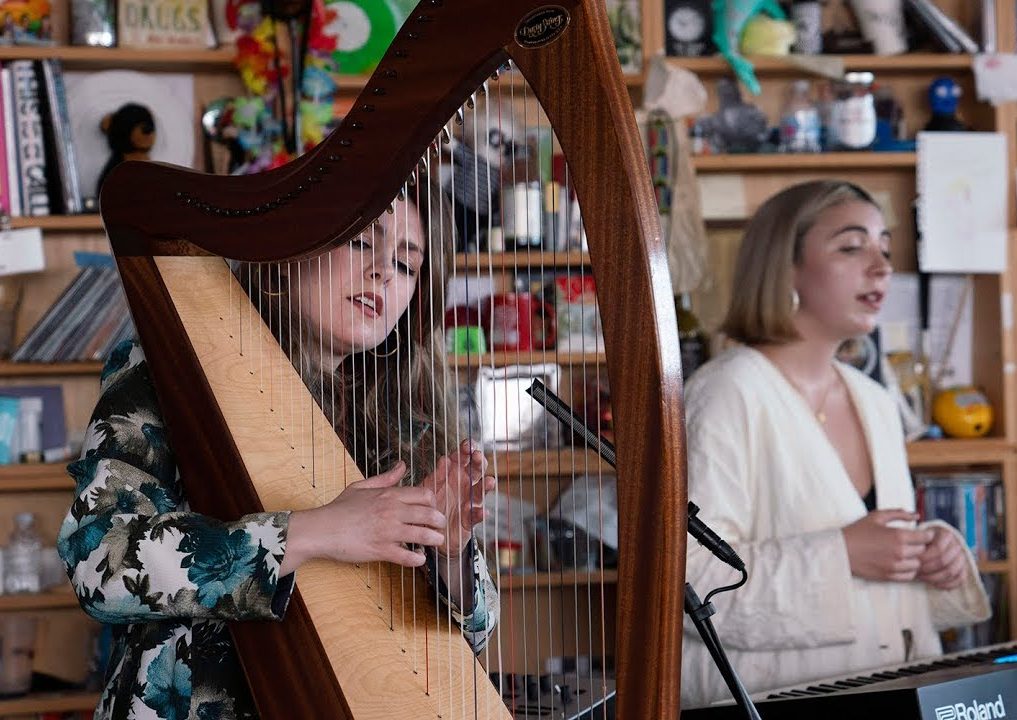
The first surprise from Saint Sister is the harp.  The second surprise comes when you realize that Saint Sister’s music isn’t going to be traditional harp-centric folk songs.

The third is when Morgan Macintyr speaks after the first song and she has a pretty heavy Irish accent.

It’s a surprise because their voices are angelic and accent-free while they sing their pretty songs.

Saint Sister makes the sort of music I’ve been fascinated with for much of my life, music that mixes the organic with the electronic. In this case, the organic sounds come from that Dusty Strings harp and the harmonies of Gemma Doherty and Morgan Macintyre, with electronics performed on keyboards by Morgan and Dek Hynes, and the mostly digital drums of Shane Gough.

So, yes, even if the harp is the centerpiece (“[when] Gemma Doherty pulled her 34-string lever harp from the band’s vehicle; it seemed bigger than all of us”) the rest of the band fleshes out the harp with waves of synths and percussion.

Causing Trouble” opens with single harp notes and echoing drums.  Then Gemma and Morgan start singing and their voices blend beautifully.

You can tell the Irish connection in the lyrics of this song:

We danced from Belfast to the Basin
When you sang, “And it stoned me”
Well it stoned me

“Shape of Silence” is a short instrumental made up of unearthly sounds and voices as Gemma plays a lovely harp melody.  It’s about a minute long and segues into “Is It Too Early? (Kilmainham).”  They sing in a kind of staccato style (and remind me a bit of Lily & Madeleine here).  There’s no much harp in the verses–it’s almost a dance song, but when the synths fade off, the harp returns and sounds even lovelier somehow.

For “The Mater” Dek and Shane leave so it is only Gemma and Morgan.  This song is quieter with just the harp and their voices.

Although the melding of harp and electronics is cool, they sound beautiful with just harp and voices.

[READ: July 1, 2019] “The Not-Okay Corral”

The Summer 2019 issue of The West End Phoenix was a special all comics issue with illustrations by Simone Heath.  Each story either has one central illustration or is broken up with many pictures (or even done like a comic strip).

Each story is headed by the year that the story takes place–a story from that particular summer.

This story is told in comic book style with panels.

1976: If you are Janet, when you are ten years old, the worst thing about horseback riding camp is the horses.  They are massive and muscular and totally in charge.

Much of the camp seemed to be about teaching the horse who was boss. When the kids were told to walk the horses around the ring, that was okay, even if Janet was clearly letting the horse lead.  But when they left the ring to return to the paddock, the horse let Janet know who was actually in charge.  It stopped following the horse in front of it and stopped to eat some grass. (more…)

Read Full Post »

SOUNDTRACK: LARAAJI-Tiny Desk Concert #846 (May 2, 2019).

Who is Laraaji?

I had no idea, and yet, it seems like I should.

40 years ago … Brian Eno produced an ambient album of his music called Ambient 3: Day of Radiance as part of a series of ambient records from Eno that began with 1978’s Ambient 1: Music for Airports. Edward Larry Gordon, now known as Laraaji, was a comedian as well as a musician. I suppose that explains the laughter as part of his meditative and therapeutic music. Laraaji is now in his mid-70s, has released over 50 recordings as well as an abundance of sound-healing sessions.

Laraaji and his musical partner Arji “OceAnanda” Cakouros (“draped in loose-fitted, saffron-tinted clothes, with a table draped in a similar orange fabric — almost the tones of a setting sun”) play an uninterrupted 15 minutes of chillout, which they call “12345678…”

It begins with a small bell, a set of tiny wind chimes and a plucked, angelic zither sounding much like a harp.

Laraaji plays the electric autoharp/zither and has a cool swirling echoing effect on it.  Meanwhile OceAnanda has all manner of percussion at her disposal, including, chimes, shakers, and most surprising, and iPad synth (but that comes later).

The opening is incredibly soothing with just chimes and the autoharp  Laraaji uses a pick and his fingers to create notes and chords.  With the delay on it, it is incredibly chill.

After about two minutes OceAnanda plays some notes on the iPad.  Then around 3 and a half minutes Laraaji picks up drum stick brushes and begins gentle tapping the autoharp.  OceAnanda plays the kalimba, which is a little too loud, but still works nicely.

Then Laraaji began to laugh. I smiled. (His laugh is infectious). Then more of us in the office smiled as he brushed rhythms on his zither and processed the sounds to add delay and intensify the hypnotic pulse.

I agree that his laugh is infectious, but I found it so jarring that his laughter turned into him singing.  Rather than it being fifteen minutes of blissful chill out, it was now a song with words–even if the words were meaningless, or very familiar.  He sang “12345678” and “lum lum lum lum lumalum la”

But since the majority of the song has him singing over it, I soon got used to it and allowed it to wash over me as well.  But, really his voice definitely brings you out of the headspace you’ve created for yourself.  Even if his laugh is indeed infectious.

At seven and a half minutes OceAnanda starts playing a violin melody on the iPad and it works very nicely–slow and pretty with a melody that works, even if it is random.  After a couple minutes she changes the sound of the violin to a more synthy sound, which fits in even better.

With a few minutes left, OceAnanda switches to a shaker which works its own hypnotizing momentum.  And then for the end, she plays a bit more of  that violin iPad while Laraaji sings the words from “this little light of mine.”

And then it all fades and you come back to reality.

[READ: July 1, 2019] “Bacon Fat”

The Summer 2019 issue of The West End Phoenix was a special all comics issue with illustrations by Simone Heath.  Each story either has one central illustration or is broken up with many pictures (or even done like a comic strip).

Each story is headed by the year that the story takes place–a story from that particular summer.

1974: This is a short story about the summer that Michael’s family wanted to build a log cabin on a piece of land in Newfoundland.  It was a popular place and they had next door neighbors at the lake who built a log cabin in what seemed like a weekend.

His parents were from England. But his dad always wanted to be a cowboy and his mom always wanted to live in New York City.  So they settled on Newfoundland. (more…)

Read Full Post »

SOUNDTRACK: CHRISTONE “KINGFISH” INGRAM-NonCOMM (May 16, 2019).

Generally speaking, I don’t like the blues.  I think it’s pretty boring music-wise, with most songs sounding vaguely the same, especially on record.  I would never go to a blues show on purpose.  However, if all blues shows were like this one from Kingfish, I’d go to a lot more.

Christone “Kingfish” Ingram a Mississippi guitar player has a lot of hype around him (XPN loves him) and while I haven’t enjoyed the songs they’ve played, this set was stunning.  And when you learn how old he is, it’s even more incredible.

Ingram’s otherworldly guitar playing and ridiculously rich voice make it hard to believe that he is only twenty years old. He is clearly aware of the absurdity of his talent given his age, as he sings “they say I got an old soul and I ain’t even 21.”

He opened with “Before I’m Old”, off his debut album Kingfish.  The song opens with a lengthy guitar solo and lyrics that are basically an autobiography.  When I was younger, I used to rate guitar players by their soloing skills.  I don;t do that anymore.  In fact I don;t really care if there are solos in songs these days.  But I do still enjoy a guitarist who can play a wicked solo live.

I don’t care much about the structure of “Before I’m Old” because it’s all about the jamming solo he plays.  The great part of the solo is the tone he gets.  It’s just him and a bassist (and a drummer), but it doesn’t sound like a bassist playing notes and a guitarist soloing independently.  His guitar is full enough that it sounds like a bigger band.

But his skills are really tremendous.  He seemingly casually busts out a minute and a half solo mid-song that is exciting and full of passion.  There’s basically two verse sin this five minute song which ends with a little nod to Jimi Hendrix.

Next came “Fresh Out”, which Ingram started solo. Eventually he was joined by his bassist and drummer, but his solo verse demonstrated that in a way, they’re just extras; he can carry this all on his own.

This is a slower, classic blues song about having no love.  But it’s all about the three and a half minute solo.  In the middle of it, he quiets everything down while playing a slow, moody passage while the band is almost silent, playing just enough to keep the song going while Kingfish jams.

The final song, “Out of This Town” is the one I’ve been hearing on the radio.  It’s catchy in a classic bluesy way, but I never thought much about it.  I do like the five note hook and pause just before he sings “out of this town” but otherwise it was just a blues song.

But this live version was a revelation.

Ingram stretched each of his tracks out, squeezing every last drop of possibility out of them. He stretched them so much that he was only able to fit three songs in his twenty minute slot. Like with the two before it, Ingram led “Out of This Town” into an explosive electric blues epic.

This song stretches out to 9 minutes, five of which are the guitar solo.  In the wrong hands, a five minute guitar solo can be an interminable wank-fest.  But Kingfish makes it interesting–you actually don’t want the song to star up again because the guitar is so good.  And yet, when his sings, his voice is deep and rich as well.

This show may even get me to enjoy the song more the next time I hear it on the radio.

[READ: June 1, 2019] “In the Hay”

This essay is a fascinating insight into manual labor, immigration and alcohol.  All in three columns of type.

In 1959, Wolff looked for summer work on the farms along the Skagit River near Seattle.  Wolff was fourteen and kind of small, so he worked at a farm for a bit and then moved on.  Then he met a farmer who paid him better and treated him well, so he settled in.

The more permanent field hands bucked hay, but Wolff was not strong enough to do that, so he hacked weeds or shoveled shit. He would pause from time to time, catching snippets of conversation on the wind.

The following summer he returned bigger and strong and he joined the hay crew.  The crew was four people: Wolff, Clemson, the farmer’s nephew and two Mexican brothers, Miguel and Eduardo. (more…)

Read Full Post »

SOUNDTRACK: TREY ANASTASIO-One Man’s Trash (1998).

This is Trey Anastasio’s first solo album. It is a 30 minute collection of odds and ends (hence the title) and experimental pieces.  There are some kernels of real songs and some simple noise experiments (most of which are shorter).

The first three songs are kernels of songs.  “Happy Coffee Song” is a simple blues riff with a guitar solo and scatting lyrics.  “Quantegy” is three minutes long.  It’s got a bass line like Led Zeppelin’s The Lemon Song but with Trey just narrating about quantegy and materials with synths behind him.  “Mister Completely” sounds like a Phish song with intertwining lines and a catchy riff.

“A Good Stalk” is the first of the experimental noise tracks.  Feedback and backwards drum sounds make a 50 second soundscape that does indeed sound like a “A Good Stalk.”

“That Dream Machine” is a fast looping guitar pattern that sounds like it could be a King Crimson melody from the 80s.  “The Way I Feel” introduces a funky bass line (with cowbell).   “Rofa Beton” is almost three minutes of soft but fast echoing drum patterns.

“For Lew (My Bodyguard)” brings lyrics into the songs again.  This song is about two minutes long, primarily keyboard washes and synths that follow the vocal line for

‘Cause Satan is real on the fainting couch,
I can feel my curved back sink into the hot orange light;
Feels good against my arms.

Mustard walls surround me like soldiers face to face
At the Battle of Trenton.
I can feel my curved back sink into the chapel pew.
While Maurice stands guard outside, no one can defy me.
No one can get by me with Maurice standing guard outside.

‘Cause Satan is real on the fainting couch.
Satan is real inside me,
From my head down to my kidney bean.

Yup.

It’s followed by three way experimental pieces.  “At The Barbecue” is a kind of free jazz saxophone/trumpet experimental piece.  “Tree Spine” is similar to “Stalk” with pulsing deep sounds and what could be the sound of insects eating a tree.  “Here’s Mud In Your Eye” is a minute of splashing sounds–made by mouth?

“The Real Taste of Licorice” returns to proper songs with a lively three minute acoustic guitar piece.

“And Your Little Dog Too” is the longest piece at 4 minutes.  It’s echoing drums and sound effects with Trey yelling in the background.  It sounds like it is meant to be almost a savage dance.

“Jump Rope (fast version)” is thirty five seconds of meandering keyboards and what sounds like fast whipping loops (yes, like a jump rope).  “Jump Rope (slow version)” is not a slowed down version of the above.  In this one the looping sound is like a slow moving UFO.

“Kidney Bean” closes the album.  The phrase kidney bean appeared earlier (in “For Lew”).  The return is an elliptical 30 second song with the loud monotone recitation of “Now we’re talking kidney bean.”

There’s not a lot here for the casual listener.  Or even for big fans.  It’s the kind of thing that would be released for free if that was something that could have happened in 1998. I suspect people were kind of pissed to have paid money for this.

But it is kind of fun, if you like weird Phish nonsense.

[READ: May 1, 2019] “Child’s Play”

Alice Munro is a master of the short story.  This story is utterly fantastic.  They way it is written and the stunning ending are mind-blowing.

The story more or less begins with an introduction to Marlene and Charlene.  They were not twins as people might have guessed (from their names).  They were not even related.  But they were at camp together and they bonded over their similar names.  They bonded over their physical similarities and differences.  They bonded over the camp counselor they didn’t like (Arva, “she even had an unpleasant name”).

Camp was religious, but it was United Church of Canada, so there wasn’t much talk of religion, exactly.  Mostly it was talk of being nice.  But Marlene had a story of being not nice.

There was a girl in Marlene’s neighborhood named Verna.  She was described as her neighbor’s granddaughter, but there was no evidence of Verna’s mother.  Marlene had an aversion to her right from the start.  She told her mother that she hated Verna.

Her mother’s standard reaction was “The poor thing.”  Marlene’s didn’t think her mother liked Verna either rather it was  “a decision she had made to spite me, she pretended to be sorry for her”  She said “How can you blame a person for the was she was born?” (more…)

Read Full Post »

SOUNDTRACK: TERRA LIGHTFOOT-Live at Massey Hall (December 8, 2017).

I know of Terra Lightfoot because she has done some (very minimal) work with Rheostatics.

Amazingly, she is not related to Gordon Lightfoot (how many people have this last name?).

Terra Lightfoot opened for Whitehorse (a double bill I would love to see).  She plays a half a dozen songs.  I thought she might be a sensitive folkie (again that Gordon connection), but it turns out that she rocks (and blues), has a powerful voice and plays a pretty wicked guitar as well.

Lightfoot is a great front woman–engaging and funny–and she has some great stories to tell about each of her songs.

“Stars over Dakota” just rocks out–big guitars, smashing drums (from Joel Haynes) and then settles into a swinging shuffle.  Lightfoot has a singular voice which I quite like.  I also like the little guitar riff she gives after the “gin martinis make dizzy” line.  She is joined mid-song by Melissa McClelland of Whitehorse who sings some amazing harmonies.  That’s two killer voices on one stage.

Drifter is a slower song, with a really lovely opening guitar melody.  She has been inspired in her career by her grandmother and her aunt who both played music.  Her grandmother recently died, but her aunt is still playing.

Introducing the next song “You Get High,” she says she has a special new guitar–a woman made it for me Ashley Leanne from Waterloo, she’s 26.  While Terra’s going to play this acoustic, she invites Daniel Lanois up on the stage.  “Can we get a spotlight on the man here?”  They can’t so he scooches over to her spotlight amid much chuckling.  Lanois plays a beautifully fluid electric guitar while she picks out a lively melody on the acoustic.

“Norma Gale” is about a famous musician from the 70 who played with Loretta Lynn and Johnny Cash and went on a date with Conway Twitty (I guess he didn’t call her back).  While she was doing all these cool things, she was also raising a young son on her own.  So Terra wrote this song for her.  It starts as a pretty, slow ballad but builds nicely with the addition of keys (from Alan Zamatis).

“Hold You” rocks up again, and it’s got a cool call and response with a bass melody (from Maury LaFoy) rumbling along.  “Two Hearts” is a song she wrote in a couple of places in Europe when she was very much in love…. with a couple of people.   The song starts slowly but build to an intense climax with pounding drums and Terra on her knees rocking out,.

Having had a total mis-perception of Terra Lightfoot, this show blew me away and I want to hear more from her.

[READ: January 19, 2019] All Summer Long

This was a fun story about friendship, distance and guitar playing.

As the story open we see Austin and Bina getting ready for 7th grade summer vacation.  They have been friends since they were five years old and have spent all of the previous summers together.  They even created the Combined Summer Fun Index–a way to tally just how much fun they have each summer.

Last summer’s included:

  • Cats petted: 22
  • Went swimming: 51 times
  • $idewalk change: $1.18
  • Sneaked into R-Rated movies: 2 times

But this summer, Austin can’t participate.   He is going to soccer camp for a month.  A whole month.  Summer is ruined–for Bina at least. (more…)

Read Full Post »

SOUNDTRACK: THE BREEDERS-Tiny Desk Concert #731 (April 16, 2018).

Gah!  The Breeders do a Tiny Desk Concert and you only get 3 songs in 11 minutes?

I understand that three songs is accepted for the Tiny Desk, but come on!  Other bands have been eking out nearly 20 minutes, you’ve got Kim Deal and the original line up in front of recording devices having a grand old time and you don’t ask for a fourth song. Well, perhaps they just didn’t want to.

The Breeders play three songs. Two new ones and one old one (which comes not from one of the albums with this original line up, but from Title TK).

What’s most notable about this Tiny Desk is just how goofy they all (especially Kim who is laughing almost throughout the whole show), it seems.

“MetaGoth” seems to open in the middle of the song, like they just started recording while they were jamming.  Josephine Wiggs is on lead guitar, Kim Deal is on bass and Kelley Deal is making some fascinating noises on her guitar (this is especially true later in the song when she seem to be simply scratching up and down the strings with her blue gloves).  Kim and Josephine are duetting lead vocals with Josephine speaking and Kim delicately singing over her.  About midway through the song we cam see that drummer Jim MacPherson is hitting heir roadie in the head with his brushes and the roadie is going “chhhh” to be a cymbal.  The song is weird and cool and very Breeders.

As they set up for “All Nerve” Josephine switches to bass, Kim takes acoustic guitar. Kelley stays on electric guitar but takes over as the spoken vocal  underneath Kim’s quiet leads.   Kelley’s voice is echoed pretty heavily and almost creepily.  It’s got a very cool sound, but is quite short.

“Off You” is a nearly 6 minute delicate, surf rock-feeling song.  The song begins with “Kim Deal’s faux-exasperation at Josephine Wiggs for starting a wind-up toy just before a song.”  Kelley says “you guys can sing along if you know the words.”  Kim chides, “no they’ll be out of pitch, Shut up Kelley.”  They start the song, “1, 2, here we go. fuck, shit, 1, 2, here we go” (Kim apparently messed up but it’s unclear to me what she did.  For this song Kelley switches to bass (and is apparently reading the sheet music).  She has taken off the blue wrist guards she had on.  Kim is on electric guitar and is playing it in a fascinating way–holding it almost vertically and strumming gently on the neck–laughing as she sings the vocals.  Jim doesn;t have anything to do and Josephine isn’t doing much for the first minute or so.  She is sitting up front on a desk but when the time comes she plays bass as well–doing some lead bass lines.  The roadie who was the cymbal is now playing the more lead guitar parts while Kim strums.  There’s a lot going on for such a quiet song.

As the Concert ends, Kim apparently stands at attention just repeating thank you, thank you.  Maybe they didn’t want to do four songs after all.

[READ: April 12, 2018] “How Did We Come to Know You?”

This was a fascinating story that went more or less around the world to talk about family.

Arkady left the Soviet Union with his mother and brother when he was 4.  He now finds himself back in Moscow looking after his elderly grandmother, who is nearly ninety.  As the story opens, he has grown a little tired of “babysitting” her and has let her go out by herself–where she falls on the stairs and needs a hospital.  The ambulance takes her nearly an hour away to a national hospital.

When they left the Soviet Union, Arkady’s brother Dima was 16.  Dima remained Russian in outlook and when the Soviet Union collapsed, he returned to Moscow.  Dima lived with his grandmother and was involved in all kinds of businesses.  He called Arkady to look after their grandmother because he was going to London for (no doubt questionable) business and he didn’t want anything to happen to his grandmother (or her apartment) while he was gone.

As it turns out, Arkady was happy to get out of New York for a time as well. (more…)

Read Full Post »

CV1_TNY_06_08_15_09.inddSOUNDTRACKLUCY DACUS-“Historians” NPR’S SOUTH X LULLABY (March 21, 2018).

I’m looking forward to seeing Lucy Dacus live in a few weeks.  Her music is often spare but grows very intense.  For this particular song it is just her and her guitarist who is creating textures and sounds as Lucy sings clearly and starkly.  She plays the (almost) title track from her new album Historian.

The idea behind our South X Lullaby series was to offer intimate moments with musicians as an antidote to the commotion and deluge that is the SXSW music festival. When we met Lucy Dacus for her Lullaby and found out she’d perform “Historians,” a most somber song from her deeply personal and triumphant album Historian, it felt just right. It’s a song of reflection, the story of two intertwined partners and the way they document one another’s lives and preserve each other’s memories.

With simple but compelling swirls of sound, Dacus begins singing clearly with a bit of softness on the edges of her words.  It’s fascinating to watch her face illuminated by the video around her (the same video that Stella Donnelly performed in front of).

The song is warm despite the sadness inherent in it.

The setting for this performance, by Lucy Dacus and guitarist Jacob Blizard, is an interactive art installation by the multidisciplinary Israeli artist Ronen Sharabani that’s part of the SXSW Art Program. This work, titled “Conductors and Resistance,” explores human-machine interaction in our ever-evolving technological world. The images projected behind Lucy and Jacob are two coffee cups, one empty and one that’s been almost drained, both tangled in and tugged at by a complex series of wires, representing what I think is human communication and miscommunication.  This is just one of three walls onto which images are projected in this installation — you can see another wall behind Stella Donnelly in her South X Lullaby video.

[READ: April 13, 2016] “The Magic Mountain”

Back in June of 2009, The New Yorker had their annual summer fiction issue.  Included in that issue were three short essays under the heading of “Summer Reading.”  I knew all three authors, so I decided to include them here.

This essay was about Aleksander Hemon’s childhood in Sarajevo.

He says that (not unlike Angell) his family had a cabin on the mountain called Jahorina.  His family would spend winter breaks there skiing and partying.  His parents thought it was heaven up there.  But he and his sister hated to go there in the summer. (more…)

Read Full Post »

CV1_TNY_06_08_15_09.inddSOUNDTRACKKEVIN MORBY & KATIE CRUTCHFIELD-“Downtown’s Lights” NPR’S SOUTH X LULLABY (March 20, 2018).

I don’t know if Bob Boilen ever explained how he starte dto get people doing South X Lullabies, but here he explains why he started doing them:

In the midst of all the chaos that is Austin, Texas during the SXSW Music Festival, we seek moments of calm. And so one night, as the week was nearing its end, we made our way to the courtyard of St. David’s Episcopal Church, just a few blocks from the thousands of festival participants and onlookers. There we found a trickling garden-side waterfall, where Katie Crutchfield and Kevin Morby performed “Downtown’s Lights,” from Kevin Morby’s recent album, City Music.

I don’t know Kevin Morby.  I’ve heard of him, but aside from a Tiny Desk Concert, I’ve never explored his music.

“Downtown’s Lights” is a simple folk song.  He’s got a bit of a Bob Dylan delivery in what feels like a very deliberate folk song.  Katie Crutchfield is Waxahatchee who I’m excited to see in a few weeks.  Waxahatchee has been really rocking out the last few albums, so this folk song (and her Southern accent) stand out somewhat.

Their voices work nicely together, and that moment when you hear someone yelling, it almost sounds like a wolf howling.

“Downtown’s Lights” is a song of comfort and prayer for someone who is down and out in the city, and this version, with Katie singing — and the sounds of the city echoing in the background — is wistful and peacefully perfect.

[READ: April 13, 2016] “Two Emmas”

Back in June of 2009, The New Yorker had their annual summer fiction issue.  Included in that issue were three short essays under the heading of “Summer Reading.”  I knew all three authors, so I decided to include them here.

This essay was about Roger Angell’s summer home in Maine.

He says that on late February nights his mind often returns to his family’s cottage in Maine and the books that are on its shelves.

Those books have been there for as long as he can remember, and have been read and re-read every summer.  The list is interesting:

Good Behaviour [Molly Keane], Endurance [Alfred Lansing], Framley Parsonage [Anthony Trollope], Get Shorty [Elmore Leonard], Daisy Miller [Henry James], Dracula [Bram Stoker], Butterfield 8 [John O’Hara], Goodbye to All That [Robert Graves], Why Did I Ever [Mary Robison], Oblomov [Ivan Goncharov], The Heart of the Matter [Graham Greene], Sailing Days on the Penobscot [George Savary Wasson], The Moonstone [Wilkie Collins], Possession [A. S. Byatt], Morte d’Urban [J. F. Powers], Quartet [Jean Rhys], Emma [Jane Austen] and dozens more. [I have to chime in and say that this sounds heavenly].

He says that fat books like Martin Chuzzlewit [Charles Dickens], Orley Farm [Anthony Trollope] and the Forsythe Saga [John Galsworthy] were saved for a tedious week of Down East fog. (more…)

Read Full Post »

« Newer Posts - Older Posts »