Feeds:
Posts
Comments

Archive for the ‘Short Story’ Category

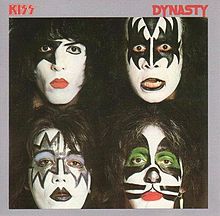
SOUNDTRACK: KISS-Dynasty (1979).

I was pretty excited to buy this album when it came out–a new Kiss album that wasn’t solo albums!  Woo hoo!  And the fact that it was disco?  Well, even though I said I “hated disco,” I didn’t really know what disco sounded like then (and really, aside from the middle “I Was Made for Lovin’ You” it’s not really a disco record) and plus my other favorite band was the Village People (and really, that makes a lot of sense–tw0 bands in over-the-top costumes talking about sexuality that I totally didn’t understand).

So, this album is hard for me to be critical about because it was such an essential part of my childhood, especially “I Was Made for Lovin’ You.”  I love it, and yet I can listen critically and appreciate that it’s really not that good.

But I’ll move on to the other songs.  “Sure Know Something” and “Magic Touch” really don’t seem that out of place chronologically with, say, the Kiss solo albums–they sound an awful lot like something off of Paul’s album.  So, despite the sort of slinky 70’s bass on “Sure Know Something”, they can’t have been that much of a surprise.  The guitar solos are short but have some interesting Ace sounds (I like the harmonics on “Magic Touch”).  It seems that while the other guys were embracing disco, Paul was keeping the Kiss sound alive.

Then there’s the Ace songs.  “2,000 Man” made total sense as an Ace song. I had no idea it was a Rolling Stones cover until fairly recently (and I like Ace’s version much better).  “Hard Times” feels like the sequel to “New York Groove.”  Not the music so much although maybe a little, but the lyrics–now that he’s in the city here’s what happened–the gritty reality. It’s one of Ace’s great, lost songs.  And check it out, Ace sings on three songs here!  (Guess having a #1 hit wasn’t lost on the Kiss powers).  “Save Your Love” has a cool descending chorus and a nice bass feel to it.  Ace certainly wins on this record.

Peter got only one song, “Dirty Livin'”.  In fact, this is the only song that Peter had anything to do with (his drums were re-recorded by Anton Fig).  It reminds me (in retrospect) of the Rolling Stones disco era even more than “2,000 Man,” the backing vocals remind me of something like “Shattered.”  I always liked this guitar solos on this (cool feedback).  Although I liked the song (along with the rest of the album), I don’t think it holds up very well.

Gene only gets two songs.  It amuses me how little he has to do with these late 70s albums even though he is always the leader of the band.  I always liked “Charisma” (I had to look the word up back then) even though it is, admittedly, rather discoey and really not very good.  It is fun to ask “What is my…charisma?”  But “X-Ray Eyes is the better Gene song on this record.  It harkens back to earlier Kiss songs and even has a bit of menace in it.

So, Dynasty was a huge hit for the band.  And they even got to mock it in Detroit Rock City the movie.  Cynical marketing ploy or genuine fondness for disco?  Who would ever know.

[READ: November 1, 2011] “The Brief Wondrous Life of Oscar Wao”

Readers of this blog know that after finding an author I like, I will try to read everything that he or she has written.  Close readers will know that if a writer is reasonably young and reasonably unpublished, I will try to read his or her uncollected work as well.  Well, I really enjoyed Oscar Wao the novel, so I decided to see what else Díaz had written. There’s really not a lot, to be perfectly frank.  There’s his short story collection Drown and a few fiction pieces published here and there (mostly in the New Yorker) and a few non-fiction pieces as well.

So this “short story” from the New Yorker (with the same title as the novel) is in fact an early, mostly the same, version of the Oscar story in the novel.  The thing here is to note the date: 2000(!).  The novel came out in 2007.  So, Junot had been working with this character for easily five years (giving time for the publishing industry to get a book out and all). The remarkable thing the is just how accomplished and polished this piece is and how much of it was used in the novel.

I’m curious to know whether this was written as a short story (it’s quite a long short story) or if it was always intended as a part of a novel.  Interestingly, when you read this story by itself and you realize that it is pretty much all of Oscar’s story in the novel, you realize just how little of Oscar is actually in the novel.  The novel is about Oscar, obviously, but it is really about his family and the fukú that was placed on them by the Trujillo clan.  Oscar is sort of the touchstone for the fukú, and the person whom the narrator knows most intimately but his story is also brief. (more…)

Read Full Post »

SOUNDTRACK: QUEENSRŸCHE-Rage for Order (1985).

Thinks looked to be very different for Queensrÿche on Rage for Order.  I mean, look at them.  On the back of The Warning they were leather-clad hellions.  On Rage, they are quite the dandys (man, I wanted Geoff Tate’s coat!).   This would be the first of many times that they confounded their fans with a style change.

Yet despite the look of them, the album opens with a scorcher, “Walk in the Shadows.”  It’s not as heavy as their earlier songs, but it has perfected many of the elements of those earlier records: the chanted vocals, the great riffs and the screaming solos.  “I Dream in Infrared” shows their they’ve always been interest in technology.  It’s ballady, but it’s got some really sharp guitars and some more soaring vocals.

The keyboards at the end of the song segue into “The Whisper,” the first indication that things would be different on this record–orchestra keyboards hits (which I have always loved) are used to punctuate verses, and there are cool, whispered words (which would be used prominently on Operation: Mindcrime

Then comes the big shock, “Gonna Get Close to You” a weird synth/metal hybrid with a strikingly catchy and poppy chorus (that seems ever-so-80s to me)–see below for a fun surprise about this song.

Then “The Killing Words” opens with a keyboard riff that sounds not unlike 80s-era Marillion–Tate even whispers words not unlike Fish does on early Marillion albums.  Of course, when the chorus comes in it is pure Queensrÿche .  There’s more orchestral hits and cool effects on “Surgical Strike.”

I love everything about the opening of “Neue Regel,” from the unusual guitar to the “steam” sounds used as percussion to Tate’s processed, minimized voice–it makes for a wonderfully claustrophobic song.  It’s made even more so by the overlapping, intertwining vocals later on. 

“Chemical Youth (We Are Rebellion)” is a cool sparse song (the opening in particular). But it also shows their interest in, if not politics, then at least contemporary society (again, more foreshadowing of Mindcrime).  “London” just builds and builds in intensity, while “Screaming in Digital” takes the technological aspect one step further with all kind of sinister synthesized sounds and the crazy way it ends.

The album ends with “I Will Remember,” an acoustic song complete with mournful whistling from Tate.   But even as a ballad, it’s not your typical lyrical content: “And we wonder how machines can steal each other’s dreams.”  I don’t love it as an album ender, although it does wind things down pretty nicely.

This is my favorite Queensrÿche album, hands down.  I know most people like Mindcrime better, but for me, this one is more progressive and showcases a lot of the risks the band was willing to take.

Incidentally, there’s a wonderful review of Rage here, in which I learn that “Gonna Get Close to You” is actually a cover of a song by the Canadian singer Dalbello (who is really crazy and fun, and whom I’ve never heard of until I just looked her up).  How did I not know it was a cover?  (Or more like, I knew it, but forgot it over the last twenty some years)?  I might actually like the original better.

[READ: October 25, 2011] “This Cake is for the Party”

This was a very short story that crammed a lot of emotion into two pages.

As the story opens, Bonnie is finishing a cake for a party.  The party is to celebrate the engagement of Janey and Milt.  Janey is one of Bonnie’s older friends and she’s happy for Janey.  She likes her fiancée, Milt (even if he did just get a black eye).  The black eye came from a misunderstanding.  Milt was in a pub “lasciviously” twirling the mustache that his high school class dared him to grow.  Someone in the pub thought he was making advances on his woman and punched Milt in the face. 

But Bonnie’s boyfriend, David doesn’t like Milt.  He won’t say why, he just doesn’t.  It could very well have to do with the fact that he and Janey used to date, and it’s possible that Janey dumped David for Milt (that’s a little unclear in the story). (more…)

Read Full Post »

SOUNDTRACK: QUEENSRŸCHE-Queensrÿche EP (1983).

Back in high school, I spent many a night listening to M-m-m-m-metal Shop on the radio.  When I first heard “Queen of the Reich” I was blown away.  It was heavy, with blistering guitars and, amazingly, that Voice.  Many is the argument that my friends had about just how great Geoff (Jee-oph) Tate’s voice was. 

But this EP came out before most people had heard of them.  At this state they were a speed metal band from Seattle.  And, yet, despite all of the accolades they would later receive and the huge hits they would have and the prog-metal sound they would develop, for me this EP is the purest Queensrÿche.

I am particularly in love with the wild soloing that happens at the end of “Blinded.”  The guitars are sailing and wailing way.  Then the voices begin chanting and Tate’s voice is screaming (then hitting a minor note) and then screaming again until it just–

Opens the awesome “Lady Wore Black.”  Queensrÿche (yup umlaut on the y, thank you much) have done ballads throughout their career and this is where it started (true, nothing original about a song that starts slow and builds to heavy, but man how heavy this song gets).  The solos are also stellar.

My version of the vinyl has only 4 songs.  The CD added an extra track and the remastered version added like ten more songs.  But to me, these 4 songs are quintessential heavy metal.

[READ: October 27, 2011] “Tenth of December”

This was a surprisingly moving and reasonably dark story from “humorist” Saunders.  I really enjoyed it quite a lot and was very engaged with the whole thing.  And, yes there was a funny line or two in it, but it can hardly be called a funny story.

There are two main characters in the story: Robin, an overweight boy who spends most of his time playing with imaginary friends and Eber, an old man who is slowly losing his faculties.  While they have nothing to connect each other, it soon becomes apparent that their stories will intertwine.

Robin is playing a game in the woods–it’s the kind of game that I think is wonderful for kids to play, and I have to say that I didn’t think it was sad that he had such a creative imagination and played with imaginary friends–of course, since he doesn’t seem to have any friends in real life, I guess it is pretty sad.  (more…)

Read Full Post »

SOUNDTRACK: YEASAYER-Odd Blood (2010).

Sometimes albums have a single that is nothing like the rest of the album.  So you buy the album and hate everything but that one song.  This album is almost the exact opposite.  It opens with a song that is so odd–noisy and with massively manipulated vocals, that you would never guess the rest of the album is like some of the best Depeche Mode-friendly pop in the last thirty years.

That opening song, “Children” is creepy, with lots of percussion and atmosphere.  And it gives you no expectation for what comes next: “Ambling Alp” a bouncy track with a super catchy chorus.  This track reminds me of Erasure at their heyday.

“Madder Red” seems to be comprised mostly of (rather nice) backing vocals) with lead vocals done in a mellow Depeche Mode style.  “O.N.E.” sounds pretty much exactly like a keyboard-heavy alt-radio hit from 1991 (it’s fantastic).  And “Love Me Girl” with its tremendous dual-vocals sounds like one of the best pre-guitar Depeche Mode songs ever.  It’s amazing. 

And yet for all of  this talk of sounding like mid 80s alt rock, Yeasayer adds enough new ideas–recording techniques, fullness of sound and current studio tricks that they don’t sound dated.  Or like a rip off.

The frantic keyboard lines of “Rome” propel that song, while “Strange Reunions” slows things down considerably.  Things pick up again with the chanting and the cool keyboards (and great post chorus riff) of “Mondegreen.” 

The disc ends with “Grizelda.”  It continues with this current groove.  Not the best song, but a decent ending to a great disc.  Just don’t let that first song scare you off of what’s inside.

[READ:  October 21, 2011] “Sez Ner

Sez Ner is evidently a place.  And this story is a snapshot of a day or two of that place. 

Sez Ner has a swineherd, a cowherd, some other farmhands and a priest.  This snapshot shows the men in their daily lives: accepting the fate of the dying animals, pushing the living animals to the edges of abuse and/or not really caring that much about them.  Some animals escape.  Some die.

The priest blesses everyone, takes his bounty and leaves. (more…)

Read Full Post »

SOUNDTRACK: SISKIYOU-Siskiyou [CST067] (2010).

Siskiyou is a fascinating band whose debut album was released on Constellation last year.  The main guy in Siskiyou is Eric Huebert, who was drummer for the Great Lake Swimmers.  He quit the band and moved to an organic farm in British Columbia. And while farming he created this album (which is named for the California mountain range and is not, as a I imagined, a play of the phrase Sick of You (which I will still think regardless of the truth).

There’s a wonderful article at Paste about this album, where I learned a lot about the disc.  The disc was recorded in stairwells (which seems so cool) and at field recordings on the beach.  It was made on the cheap and very independently.  And I love it.

It feels very much like a small solo project (although he is quick to point out that he had help from another Great Lake Swimmer, Erik Arensen, as well as his wife and some friends.  But really, it feels like a vulnerable man singing in his wavering voice over some stark acoustic songs.

But unlike a poppy folk album, this one feels awkward.  The melodies are beautiful, but the lack of polish and production makes the recordings feel more fragile than they might otherwise be.

Indeed, Huebert’s voice, while always on pitch, threatens to just collapse under the strain of recording that first song, the gorgeous “Funeral Song.”  But it’s the second song that tells you this isn’t just a home recording.  “Everything I Have” feels like a great Lou Barlow/Sentridoh song–recorded on lo-fi equipment, until you hear the gorgeous horns come in a play the simple yet very winning melody over the loud folk guitars.  Again, if this had been over-produced it might have veered in cheesy, but the lo fi sound (and the cool lyrics) make this one of the best folk songs I’ve heard in ages (and it’s only 2 minutes long, too).

This is followed by two delicate songs: simple melodies, on either banjo or piano and shuffle drums.  My favorite song is “It’s All Going to End.”  Horns give it a kind of mariachi feel, but lyrically it’s wonderful: “I don’t like you one little bit, keep that shit up man, you’re gonna get hit.” All sung in his delicate wavery voice (and again, under 2 minutes long).

Another highlight is the “cover” of “This Land is Your Land.”  Called “This Land,” it opens with a slow piano melody that doesn’t sound anything like the original.  And then he begins whispering the lyrics–once again totally unlike the original.  But mid way through he changes the lyrics, to a new type of song about how he is never going home.  It turns the song mournful and rather powerful.

“Never Ever Ever Ever Again” is a wonderful song of repetition.  And the two short (just over a minute) tracks, “Inside of the Ocean,” and “We All Fall Down” are charming interludes before the lengthy “Big Sur.”  “Big Sur” starts with an upbeat banjo riff but then settles down into a slow (slightly out of tune) guitar piece.  The slow pace is particularly amusing given the incredibly slowly sung lyrics “So let’s party.  Let’s party.  Let’s party.  Party all night long.”

The disc ends with “Brevity and Insult” a song of static and banjos.

Typically I don’t like slow music, but this album adds so many interesting aspects that it doesn’t actually feel slow to me, it feels interesting and challenging  and strangely uplifting.  And I’m looking forward to their next release.

[READ: October 19, 2011] “Snake

This (surprisingly short) story packs so many different ideas into it that it really jostles the reader’s emotions.   It opens with a woman in a car. She’s in the parking lot of a supermarket waiting for her boyfriend, when she begins watching two boys.  They are playing with something on the ground, although she can’t quite tell what it is.

After seeing them lifting a stick, she realizes that it is a mostly-dead snake that they are playing with.  They don’t see her and she watches them decide what to do with the creature.  They decide to play a prank.  The boys test all of the cars in the parking lot and when they find an unlocked door they drop the snake in. (more…)

Read Full Post »

SOUNDTRACK: COLIN STETSON-Live at SXSW (2011).

NPR has made available three songs from Stetson’s SXSW performance.  I’m not sure why there’s only three songs as surely his set was longer than 15 minutes.

He opens with the first two songs of New History Warfare Vol. 2: Judges, “Awake on Foreign Shores” which segues into the masterful, noisy “Judges.”  It’s a wonderful 7-minutes of music. True, it is not as dynamic as the album (how could it be?), but hearing him play this stuff live, unaccompanied, is amazing.

The final track, “The Righteous Wrath of an Honorable Man” is a beautiful short piece that really shows off his ability to keep these riffs going more or less continuously.  Unlike the other songs, this one is more tenor than bass-sounding (although I believe it is all the same instrument) and it sounds equally impressive.

This is just a taste of what Colin can do, and I do wish there was more from this show available online (the sound is pristine, and you can actually hear him talking, which you can’t do at the All Tomorrow’s Parties show).  The NPR page says that there were four songs.  I’m not sure why the fourth isn’t here, but I’m happy to get at least these three.

[READ: October 10, 2011] “Oubliette”

This was a strange story for me because, really, nothing happened.  Well, that’s not true.  Something happened, but it was told in such a straightforward manner, in such a non-inflected way, that it seemed more like a news account than a story.

It is the brief account of a girl whose mother began treating her worse and worse as she got older.  It seems like a fairly natural deterioration of the relationship between mother and daughter, but then her mother’s behavior becomes more erratic and more violent.  Then one incident causes everything to change.  Her mother is diagnosed with Huntington’s. 

Both the girl and her father visit their mother, knowing that there’s very little they can do for her except to try to keep her calm.  So they hold their tongue and try to be nice.  (more…)

Read Full Post »

SOUNDTRACK: HELLBENDER-Hellbender (1993).

Hellbender is a band that Wells Tower was in before he became a professional writer.  He played guitar and sang backing vocals (and wrote some lyrics, but not on this album).  The drummer, Harrison Hayes is now the drummer for Les Savy Fav and the bassist and singer Al Burian is most notable for his zine Burn Collector (for a time he was the most famous former Hellbender, although I’d never heard of him).  They were always pretty small time, although their third album did receive some attention.

This first album is pretty rough–quickly made and cheaply mastered and yet there are good dynamics, cool breaks and a whole lot of punk.  Al Burian’s voice is in shouty punk mode (lyrics are not all decipherable) and although his voice works it’s a bit samey throughout the disc.  The drums don’t always sound great, but there are often cool drum breaks.  And the guitars are quite assured.  Despite the punk attitude, it’s not all flat out speed.

There are some dynamic breaks, like in the second track “Housebroken,” which has some cool moments when the drums highlight an unexpected tempo changed.  “Clocked Out” was the single they released prior to the CD and it has some real production values (and a very funny intro from a local DJ).  The guitar highlights the trebly end in a kind of ska riff which is quite different from the rest; there’s also some discernable bass lines and a cool bass/guitar solo (punk, yes, but branching out a bit).  It’s a great track.

“Two Twenty Two” made it onto a couple of local compilations.  It has a slightly less heavy feel, with some interesting guitar lines.  “Aisle Ten” has verses that end with some really heavy (reminding me of Metallica) riffs that really punctuate the vocals.  “Peeling” has some cool backing vocal chanting (as well as what sounds like an answering machine message) that sets it apart from the other songs.  “Clarence” has a really long instrumental opening (1 minute out of a 2 and a half-minute song) that shows of more of Burian’s bass lines.

“Couch” was the B-side to “Two Twenty Two” and it has better production values as well–and lots more dynamic parts.  The final song, Retread” is a sorta political song, “Do you remember when we were young–revolution seemed like fun.  I thought I could get things done by yelling at the top of my lungs.”  Not mind-blowing lyrically but a good sentiment nonetheless.

The band is very tight–their breaks and starts and stops are right on–many of their songs end suddenly and the band pulls it off very well.  When I first listened to the album, I thought it was kind of pedestrian, but after really listening, I realized this is a very well-formed debut. It’s an interesting addition to any punk fan’s collection and an interesting footnote for any fan of Wells Tower.  You can find a copy of the disc at Metro/Sea.

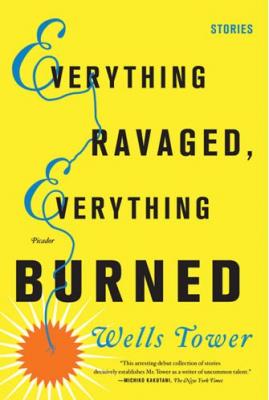
[READ: September 30, 2011] Everything Ravaged, Everything Burned

After talking about Wells Tower for a while and reading all of his uncollected stories and nonfiction, I finally got around to reading his short story collection.  And I think I have an interesting perspective on the book because at least two of the stories were totally reworked from their original release.  Not simply updating a thing or two, but totally revamped.  In my experience, aside from the David Foster Wallace essays that were truncated in their original form, this is the only book I know where the stories inside were totally rewritten for the compilation.

There are nine stories in the collection.  And I have to say as an overview to this book, I can’t get over how much I enjoyed them.  I mean, I knew I liked Tower from what I had read before, but I didn’t expect to enjoy this book quite so much because Tower writes a very manly kind of story.  He usually writes about tough guys and men who have a hard time interacting with their fathers and other situations that are out of my ken.  But Tower upends many conventions in his stories and his prose is tight and succinct and his stories are very quick to read and really enjoyable. (more…)

Read Full Post »

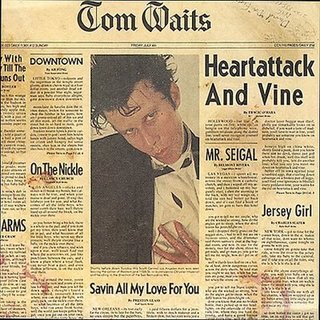
SOUNDTRACK: TOM WAITS-Heartattack and Vine (1980).

This is the final album Waits made before switching labels and starting over as a new, far more artsy artist.  The album cover is crazy, it looks like a newspaper (with all the lyrics to printed like articles on the cover).  And there’s a picture of Waits in a tux, hair askew, looking like the most stricken man alive.  It’s not a pretty cover, but it sure conveys a lot.

“Heartattack and Vine” is agreat noisy bluesy song.  It’s very simple and focuses on Wait’s lyrics and delivery: “I bet she’s still a virgin, but its only 20 after nine”).  Oddly, after that great vocal delivery song, we get the instrumental “In Shades.”  This has a lot of organ (which is a fairly new instrument in his repertoire) that he shows off his skills on, but it’s nothing that spectacular (and it’s recorded live apparently).

“Saving All My Love for You” is a sloppy kind of ballad (not as nice as most of his ballads), but then judging by the cover image, this is not going to be a sweet album.  See also “Downtown,” another rough track like the title song.

Of course, all of the talk of gruff nastiness is rendered false by the beauty of “Jersey Girl.”  Most people know the Springsteen version of this song, but (aside from the strings, which may be a bit much) I think this version exudes more real emotion.   “Jersey Girl” is a really wonderful song (especially if you’re married to a Jersey girl).  But what’s really great about it is that despite all of the sappy emotion (“My little girl gives me everything, I know that some day she’ll wear my ring,” there’s some great reality as well: “I see you on the street and you look so tired, I know that job you got leaves you so uninspired, When I come by to take you out to eat, You’re lyin’ all dressed up on the bed baby fast asleep, Go in the bathroom and put your makeup on, We’re gonna take that little brat of yours and drop her off at your mom’s.”

Sonically the shift from the guitar based blues noise of “‘Til the Money Runs Out” to the string laden ballad “On the Nickel” is pretty jarring. “On the Nickel” is one of Waits’ lullabies that’s not quite a lullaby.  But it’s got that mournful permanence that is hard to beat from Waits (he even performed it in the 2009 concert from NPR).  “Mr Siegel” is a barsy blues song (although it doesn’t sound like his earlier albums at all) and the album ends with the mournful ballad “Ruby’s Arms,”  which Waits sings in his best downtrodden voice. 

This album really showcases the breadth of his talents at this stage of his career.

[READ: September 24, 2o11] “The Ring Bin”

Who could even imagine what the title of this story means?  It’s weird, and it has so many possibilities.  By the time the answer is revealed, the story has gone in so many directions, you almost forget that you cared what the title meant in the first place.

First off, the tone of the story is bizarrely cool.  After a brief, confusing introduction (we’re at a celebrity gala of some sort), the story gives us this: “That’s when our heroine’s cellphone rings.”  It’s a kind of jarring intrusion by the narrator.  But before we can muse on this, the crowd is appalled at her break in etiquette.  And the story continues, “If these people knew the whole truth, they’d be more than annoyed.”  What is going on here?

And then the narrator gives up any pretense of disinterestedness: “I should step back a moment and describe for you the big picture.”  By now, as a reader you are reeling from all oft he broken rules.  

And then we find that this wonderful setting, this gala, is attended only by white people (which makes them all a little uncomfortable) but that the people onstage are a veritable United Nations and that the topic of the gala is tolerance.  Well, who knows what to think. (more…)

Read Full Post »

SOUNDTRACK: TOM WAITS-Blue Valentine (1978).

Waits begins to morph into his later stage persona with this album,  although you wouldn’t know it from the opener, “Somewhere,” yes from West Side Story.   It’s a pretty straightforward Louis Armstrong-style cover, and I wonder what people thought of it.  “Red Shoes by the Drugstore” on the other hand foreshadows some of his crazier songs from later on–it’s kind of a like his beatniky work, but it’s a bit scarier and has less of a jazz feel.  Of course, he hasn’t completed eschewed melody and songwriting with the wonderful “Christmas Card from a Hooker in Minneapolis”–a slow piano ballad.

There’s also the amazing “Romeo is Bleeding” (the inspiration for the title of the movie).  There’s some more wild bluesy songs like “$29.00.”  In fact, Waits seems a bit looser overall (if that’s possible)–his voice is less clipped and beatniky, he’s more wild and perhaps even off beat

“Wrong Side of the Road” merges into later territory although he’s got enough scat style vocals to keep it sounding cool instead of crazy.  “Whistling Past the Graveyard” is one of his most uptempo bluesy songs;  it’s fun and a little crazy.

And yet for all of these forays into the unusual, he still stays firmly footed in what you expect from 1970s Waits: “A Sweet Little Bullet from a Pretty Blue Gun” and “Blue Valentines” are jazzy, smoky, lounge songs, keeping us on solid Waits ground.  He hasn’t stepped far enough away from his original style to alienate listeners yet, but he’s definitely pushing the boundaries of what might be comfortable.

[READ: September 25, 2011] “Starve a Rat”

This story is a sad and lonesome tale (not unlike Torres’ other story that was recently published in the New Yorker–it’s like these two magazines are linked by some kind of fictional umbilicus).

In this one, a 19-year-old boy hooks up with an older man.  The man asks the boy to wear a diaper on their first encounter.  The boy doesn’t but rather, he tries to satisfy him in other ways.  This pickup becomes something more when the man, who initially asked the boy to leave, relents and talks with him through the night.  The boy finds himself being more honest with the man than with anyone else ever.

The leads to some flashbacks about the boy’s history.  Back when he had a girlfriend, what his girlfriend’s parents were like (her mother knew that he was gay) and how much he loved the girl, even though he always knew she was just a beard.

The strange thing about this story is that I couldn’t decide when it was set.  It has a kind of dark tone that makes me think it is a 1970s story, although there is talk of clinics, so maybe it’s the 80s?  He mentions something about albums being not so out of date that they’d be making a statement–so that could be early 90s? (more…)

Read Full Post »

SOUNDTRACK: TOM WAITS- Foreign Affairs (1977).

This album is kind of a split between Waits’ bluesy songs and his “poetic rants.”  The only problem with the album per se is that he’s been doing this kind of stuff for five albums now and while he’s still good at it (great at it, actually), it’s probably time for a change (which he does on the next album).  This is not to say that the songs themselves are weaker than others, or that they are not at least slightly unexpected (the eight minute “Potter’s Field” is quite unexpected), just that when you know what he’s going to be doing,  this album feels like a pre-transition, one might even say a rut.

The disc opens with a pretty piano waltz (“Cinny’s Waltz”) that segues right into his jazzy nightclub sounding (ie. piano and sax) track “Muriel.”  The third track, “I Never Talk to Strangers” is a duet with Bette Midler (which I think makes sense given her persona, but I have simply never liked her–maybe that’s why I don’t like this album as much as I could).

“The Medley of Jack & Neal (about Kerouac and Cassidy) is a long rambling story about the two beats, it ends with a riff on “California Here I Come.”  In a similar vein–alluding to appropriate music–“A Sight for Sore Eyes” opens with the music from “Auld Lang Syne” before turning into one of Waits’ weepy ballads.

The second half of the disc is more storytelling as song.  “Potter’s Field” tells a lengthy story with occasional blasts of saxophone.  About midway through, it begins to sound like more of a musical–with the music adding dramatic effects to the lyrics–this may be a kind of foretelling of his more operatic music from Swordfishtrombones.  “Burma-Shave” is another long story (over 6 minutes).  This one is much darker (a fairly straightforward story of meeting a bad guy and going for a drive), but it’s a pretty good story for all of its noirishness.  “Barbershop” has a great bassline, but it is indeed about getting a haircut.  The album ends with the title cut, a sung ballad.

His next album, Blue Valentine, features electric guitars and keyboards and will change the sound of his songs quite a bit.

[READ: September 25, 2011] “Beatrixpark: An Illumination”

I don’t think I have read too many contemporary Italian authors (Italo Calvino is the only one who springs to mind).  Realistically, this shouldn’t make any difference to anything but this story seemed so off to me that I have to wonder if it’s something about Italian authors or if it is Voltolini is particular.  This story was translated by Anne Milano Appel.

The story begins by explaining that the main character is a man from the south.  Being very conscious of the fact that the author is Italian, not American, I worked hard to think of the bottom of the boot as opposed to Alabama.  Of course, being from Southern Italy doesn’t mean anything to me really, but I kept it in mind.   Then I find out the story is set in Amsterdam.  And then several paragraphs in, we learn that he is from Southern Europe somewhere.  Sigh.  To quote the story, “Gimme a break, provincial middle-aged man from the south!  Fuck off, why don’t you?” (more…)

Read Full Post »

« Newer Posts - Older Posts »