Feeds:
Posts
Comments

Archive for the ‘Short Story’ Category

SOUNDTRACK: NICK KUEPFER-Avestruz [CST072] (2011).
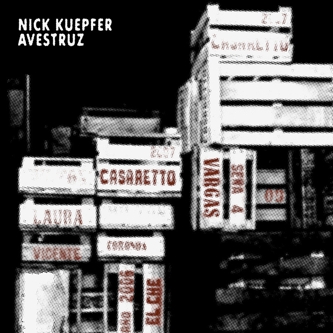
This is the first disc in the Musique Fragile 01 set that I’ll be writing about.  Kueper’s disc is pretty daring, at least for an unsigned artist.

The album is a series of short (1-4 minute) instrumentals, with each one featuring a different instrument as the lead–guitar, accordion, drums, violin.  And yet they aren’t songs so much as sketches, or even soundtracks to an unmade film.  The songs don’t have standard construction–they just seem to ramble on a little bit until they stop.  And yet the whole album has a cohesiveness that creates a picture.  In some places it’s more obvious than others, but you can hear woodpeckers and other birds (or possibly people whistling like birds?). .

I love “Corpse in the Wildflowers” (accordion), “Kettle” (percussion), “Red Sand Market” (acoustic guitar and accordion), “Blue Pig” (guitar and violin) and “Public Transit” (acoustic guitar).  “Tail Still Moves” is a slightly off-kilter sawing kind of song.  It’s not exactly pleasant but it brings an interesting aspect to the disc.  The final instrumental track has a kind of lo-fi Sebadoh feel (cool guitar riffs played on a crappy guitar).

Some of the tracks in the middle don’t really go anywhere “Vampyro” is just kind of meandering and “Bus Windows” is a bit long, but they all add to the soundtrack of this fake movie.  I keep picturing a dry Western town, a windmill creaky in the slow wind.

The final track is very confusing, however, it’s a “live,” poorly recorded song in which Kuepfer sings along with his strumming.  You can barely hear him and I’m nots ure what to make of it.  The birds are pretty, though.

The Constellation site says that these were field recordings done in Argentina.  So that’s pretty cool too.   I’d like to hear more from him, but I’d also like to hear a bit more of a complete idea rather than sketches.

[READ: December 3, 3012] “Fem Care”

This is the first story that I read which was recommended by Karen Carlson.  She describes it like this “As much fun as you can have with menstruation. Literary fiction doesn’t often look at professional women at work. This could be a little chick-lit for a guy. Somehow I’m thinking Carly Simon would be good here [for a soundtrack].”

Karen is pretty much right on the money.  I really enjoyed this story quite a lot.  It deals with women and business and women’s business.  The story takes place at the annual Beauty Summit in Miami.  The unnamed narrator works as a market researcher for a company that sells feminine beauty products.  “Fem Care” is shorthand for her division: feminine care products, a division that lacks any of the sex appeal of, say, skin care products.

The summit sounds dreadful.  As we zoom in on the scene a German man is making everyone laugh as part of  a kind of team building exercise.  The narrator has had enough and excuses herself.  This part in which the department head, Luis, is embarrassed by tampons, when that is what his very division markets is quite funny and is done very well.  And, I might add, the same basic joke was played out on 2 Broke Girls just this week, but Elliott Holt handles it with so much more grace and simplicity that the 2 Broke Girls writers should really read this story. (more…)

Read Full Post »

That’s right, I hopped on a meme bandwagon.  I like most of the Ryan Gosling “Hey Girl” pictures, but this one was particularly amusing.  Thanks, Feminist Ryan Gosling.

Last year I had started a post called “Things to expect in 2011.”  I never finished the post and never published it.  I looked at the draft the other day and was intrigued that not only didn’t I finish what I prepared to read, but as I was prepping this post I wound up with many of the same goals for 2012.  One thing I realized was that it takes longer to read than I think it does.  I have ten McSweeney’s issues left that I want to read.  It won’t take me a month to read one, but it could take upwards of two weeks.  So, that’s almost half a year.   Astonishing. (more…)

Read Full Post »

SOUNDTRACK: DANKO JONES-Below the Belt (2010).

I love Danko Jones.  He’s bad, he’s cruel, he’s crass and he rocks.  He’s everything a 15 year-old boy loves in rock.  And yet there’s something about him that even I (far older than 15) think is wonderful (perhaps he’s the thinking man’s Andrew W.K.?). 

I’m sure it’s because his early stuff was short, fast blasts of over the top machismo.  He hasn’t started too far from that template (his songs are now three minutes, but that’s okay).  And I still love him even if every song is a cliché (and that he still thinks a Cadillac is the height of coolness).

“I Think Bad Thoughts” is a stupid balls-out rocker about how bad Danko is.  Best line, “That’s how it is as a knight in Satan’s service.”  A nice nod to Kiss.  And this song is followed by the very early-Kiss sounding “Active Volcanoes.”  “Tonight is Fine” is a heavy rocker (okay they all are, that’s redundant), but “Magic Snake” is surprising because it seems to be addressing impotence (“It’s friday night but your magic snake don’t slither no more”.)–not doing anything about it, just addressing it.  “Had Enough” has a great sing-along chorus (when Danko is not yelling at you, he croons with the best of ’em).

Of course a song title like “I Can’t Handle Moderation” should tell you all you need to know about Danko (he must have his tongue in cheek, at least I hope he does.  I’ve never seen him in anything other than album covers, so I have no idea what his off-stage life is like).  It’s always a surprise when Danko reveals a softer side.  And even though “Full of Regrets” seems like it would show that softer side, it’s actually about how he’s full of regrets about any lonely nights he spent.  Heh.  “The Sore Loser” is a not very nice song about a woman.  But it’s funny.  “Like Dynamite” is all about sex, of course.

I love the aggressive riff of “Apology Accepted,” it’s faster and more furious (even if it is about accepting an apology).  And the final song “I Wanna Break Up with You” cracks me up.  It’s a song about wanting to break up with someone.  Did he imagine it as a breakup anthem?  Something you play in the background when you dump your significant other?  I particularly like the chanting “break up break up everybody break up” at the end.

There are two bonus songs on the disc (an idea as antiquated as his lyrics, but which is strangely charming).  Neither sounds like it shouldn’t be on the record–they continue what he does so well.  They’re both about guest lists, but I particularly enjoy “Rock n Roll Proletariat.” It sounds a lot like AC/DC but who fits the lyric “I pledge allegiance to the Rock n Roll Proletariat” into a chorus?  Genius!

Yup, his album covers are as sexist as his lyrics.  But there is something just cartoonish enough that I can’t help but think hes a really nice guy under it all (maybe it’s because he’s Canadian).

[READ: December 28, 2011] “Creative Writing”

Sometimes a very short, very well written story can really make your day.  I read this story this morning (because it was so short–a page and a quarter) and I was immediately hooked. 

It opens with a woman, Maya, taking a creative writing course (at the suggestion of her mother).  Maya just had a miscarriage and has been just sitting in the house not doing anything, and her mother thought that an activity wold be beneficial.  Maya’s first story was quite interesting.  [In fact, I LOVE the conceits behind each of her stories and while I immediately thought I’d like to read them, I’m not sure how will they would work beyond the simple concept presented here.  But the ideas are so clever that I wanted to read the full things right then!–maybe make this story longer and include Maya’s full works?]

All of her stories have to do with love or marriage or birth, but in wonderfully metaphorical ways.  The first story, about people who split in half to generate offspring has an ending that her teacher calls wonderful but which her husband finds quite dull.  [Incidentally, I’m all for reading stories from other cultures.  It’s fun and interesting.  But man, sometimes it’s so hard to tell the  gender of a person by his or her name is you don’t know the culture.  This story was written in Hebrew (translated by Sondra Silverston) and the secondary character’s name is Avaid.  In addition to not really knowing how to say the name, I had no idea if it was a male or female name.  I suppose it is not really up to the writer to compensate for ignorant audiences, but perhaps sometime earlier in the story an author can subtly hint at the gender of the person?  (We get the “he” in paragraph three).  Shy of a dramatis personae, there’s little that you can do organically for the story, I suppose. ] (more…)

Read Full Post »

SOUNDTRACKBABE THE BLUE OX-“Basketball” (1998).

This was the first song I’d ever heard from Babe the Blue Ox, and I was hooked (sadly, The Way We Were, where this song is from was their last album).  This is also my favorite songs about sports (and it will never be played in an arena).

It opens with this great funky keyboard over a cool walking bass line.  And after a verse about playing basketball, we get the gorgeous bridge: “pass it to me, I am free, look there’s no one guarding me) sung by one of the women in the band (who sounds vaguely like Edie Brickell).  When the chorus kicks in “And when she gives it to me, I am as high as can be” both singers harmonize wonderfully.

There’s even a cool instrumental break.

Everything about this song is catchy and wonderful.  And it should have been huge.

[READ: December 21, 2011] Grantland

McSweeney’s seems to keep trying to push me away.  Or maybe they are just trying to push me out of my comfort zone.  First they publish Lucky Peach, a magazine about cooking (with recipes that contain ingredients that I couldn’t find anywhere).  I don’t read cooking magazines, but I loved this one.  Now they publish Grantland, a book about sports.  I don’t follow sports.  At all.  I used to play sports and I used to watch sports, and then when I got out of college, I did neither.  I have a very good knowledge of most sports (so I can still follow any game that’s on), but as for actual people playing the games right now–I’m ignorant.  So, why on earth would I want to read this book about sports?

I was pretty sure I would finally not be getting this book until I read the author list: Chuck Klosterman, Colson Whitehead (!), Malcolm Gladwell (?)  I knew this was going to be no ordinary sports book.

So it turns out (and I didn’t know this until just now) that the book is a collection of works from the website Grantland, which is created and run by Bill Simmons.  I haven’t explored the site but it sure looks interesting enough–longish articles about sports and culture and all kinds of interesting things.  And evidently this issue is a sort of best of the website.  The whole Grantland experience, including this book, are connected to ESPN, indeed, ESPN gets a copyright for the book, McSweeney’s is just the publisher.

And this volume was wonderful.  I couldn’t put it down.  I even wound up putting aside a book I was in the middle of to read it.  None of the articles are terribly long and, despite the basketball textured cover (which is very cool–no one can walk by and not touch it) the variety of sports covered is wonderful: from boxing to cricket!  And there are short stories and essays about the entertainment industry as well (articles on Shia LeBeouf and Amy Winehouse (!)).

If I had one complaint about the book it’s that many of the articles don’t give a time from when they were written.  I assume they are all fairly recent but since I don’t follow sports I can’t say for sure.  The other problem is that several of the stories end with a game/match unresolved.  Clearly they have been resolved since then, but even one line saying what happened would be comforting for those of us not glued to ESPN. (more…)

Read Full Post »

SOUNDTRACK: LONDON PHILHARMONIC ORCHESTRA-Angry Birds Theme (2011).

My son, Clark, loves Angry Birds.  I’ve played it a few times and found it enjoyable, but he is obsessed.  He is absolutely the target market for this song.  And who knows maybe it will get him to like classical music.

I wasn’t sure if I’d recognize the tune, but it is already ingrained in my head.

This version is wonderful.  It sounds like it might be from a Tim Burton movie. 

The full CD is a collection of video game themes.  We don’t have a console, so I don’t know any of the other songs on the disc. But I do rather like this one.  I can’t wait to see his face when he hears it.

Check it out on NPR!

[READ: December 15, 2011] “What We Talk About When We Talk About Anne Frank”

This story went from being a (rather) funny piece about Hasidic Jews to being a (rather) emotional story about marriage, religion and self-preservation.

As the story opens, Mark and Lauren are visiting the narrator and Deb.  Deb and Lauren grew up together.  But after school Lauren met Mark and they moved to Israel where they became Hasidic (and took the new names Shoshana and Yerucham).  As the story opens, the narrator (a non-observant Jew) is trying to hold his tongue while these religious folks are well, kind of judging  them.  It’s wonderfully summed up by this comment:

“Jewish to you?” I say.  “The hat, the beard, the blocky shoes.  A lot of pressures, I’d venture, to look jewish to you.  Like, say, maybe Ozzy Osbourne or the guys from Kiss, like them telling Paul Simon, ‘You do not look like a musician to me.'”  [Is there a joke in there since the guys from Kiss are indeed Jewish, or no?]

The narrator and Deb has a son, Trevor, who is sixteen.  The scene where he comes into the room to discover the Hasidic couple is hilariously subtle (very well written).  Then we learn that Shoshana and Yerucham (which Deb calls them) have ten children–all girls.  Yikes.  But the narrator continues to refer to them (at least in his story) as Mark and Lauren.  And the more questions he asks the more we find out that although they keep Holy the traditions, they are a bit lax about some of the rules (maybe?)  I actually don’t know the rules so I don’t know if what they’re doing is “wrong” or not.  And, amusingly there’s a bit in the story in which Yerucham complains about non-Jews giving them shit for what they do–“Can you eat in there?” kind of questions.

So, when the narrator asks if they can drink, Yerucham says he can make the whiskey kosher.  And that starts them on their way. (more…)

Read Full Post »

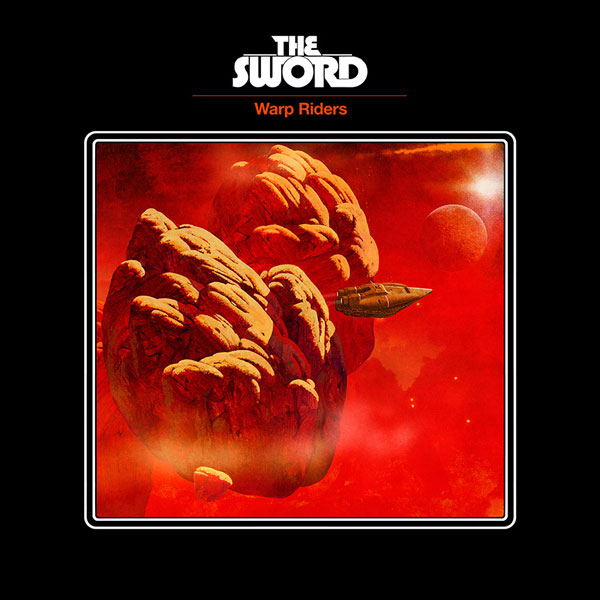
SOUNDTRACK: THE SWORD-Warp Riders (2010).

I have heard some great things about this disc from The Sword–that it was old school metal who usually sang about swords (duh) and sorcery but were warping into the future on this disc.  I put the disc on and was blown away by the opening track, the instrumental “Acheron/Unearthing The Orb.”  It sounds very 80s metal: heavy guitars, and great riffs coupled with tremendous solos.  The second song opens just as strong but then something weird happened.  I hated the lead singer’s voice (my discussion of their previous disc came to the same conclusion).  It doesn’t do ANYTHING that 80s metal should do–it’s neither growling nor yelly nor operatic.  In fact, once the vocals kick in, the song takes on a distinctly non-metal feel.  More specifically, it feels like heavy classic rock from the 70s.  The guitars are still heavy as anything, but the melody and vocals change things.

I really didn’t like the album all of a sudden, until I listened a few times and accepted that this blend actually worked.  Once I acknowledged that it wasn’t what I thought it would be, I wasn’t disappointed by it anymore, and I was able to really enjoy it.  “Tres Brujas” has a simply wonderful sing along chorus that I can’t get out of my head.  And it continues in this vein–heavy riffs (the guitars on “The Chromancer 1: Hubris” and “The Chromancer II: Nemesis” (love the names!) are really heavy) and surprisingly catchy choruses. 

The biggest surprise comes with the song “Night City” which sounds like, well, like Thin Lizzy.  The macho riffs, the swagger, the lyrics, it’s all Lynott.  And once I realized that, I really understood what The Sword was all about, and the disc has been in heavy rotation ever since.  I don’t mean to say that I had to analyze the disc to “get” it, but once it all clicked, it clicked really well.

[READ: December 13, 2011] “The Pharmacist from Jena”

This is my first story from Michael Dahlie and I have to say that I was hooked from the start. 

The story is set in 1912, when the narrator was sent from his home in Stockholm to Winslow, Indiana.  He was sent to work with his uncle as a pharmacist’s assistant. 

It’s in the second paragraph, after the exposition, that things take off: “My uncle was a passionate lover of cocaine and had situated himself in such a way that he supplied nearly all the nearby interested parties.”  He was also renowned as a great “voluptuary and eroticist.”

There is a real plot, which gets established late in the story, but in the beginning, the story is all about the narrator’s adjustment to this life.  How his aunt seemed to believe he was a girl and decorated the room accordingly.  How his uncle had a fight with a bear (long story) in that very girl-themed room (long story) and how the room was soon, no longer girl-themed.

One thing I really liked about the story was the narration.  Like: “At the time I was living in Winslow, it was fashionable for wives of wealthy men to suffer from mental disorders.”

His uncle experimented with shock therapy, but he mostly used it for erotic experimentation.  The end of the shock experiments occurred when a local husband found out what the good doctor was doing (from the burns that his wife received at the doctors hands).  (more…)

Read Full Post »

SOUNDTRACK: ULVER-A Quick Fix of Melancholy (2005).

This EP came two years after Teachings in Silence (with a movie soundtrack and “greatest hits” collection in between).  This first track, “Little Blue Bird” is a simple soundscape with echoey keyboards.  When Garm starts singing, his most emotional side comes through (even if I really can’t understand him most of the time).

“Doom Sticks” belies its name and the EP title by being somewhat upbeat.  There are kind of squeaky keyboards that pulsate through the track.  After about a minute and a half, distorted drums keep a martial beat.  But it quickly morphs into a twinkly section that makes me think of the Nutcracker or some other kind of Christmas special.

“Vowels” is similarly upbeat (the music on both of these two tracks has a vaguely Christmastime feel somewhere in there–not that anyone would think these were in any way Christmas songs, or maybe it’s because I’m listening in mid-December).  For this, we get a return of Garm’s choral voice: deep, resonant and hard to understand (although I undertsand the lyrics are from a poem by Christian Bok).   But the poem quickly makes way for some dramatic staccato strings. 

“Eitttlane” begins with some menacing keybaords and staccato notes, creating a feel of a noir movie.  But when the vocal choir comes in, it gets even more sinister.

These Ulver EPs are really true EPs–stopgap recordings for fans.  Their larger works tend to be more substantial, but these EPs allow them to play around with different styles.

[READ: December 1, 2011] “Laureate of Terror”

Two authors I admire in one article, how about that!  In this book review, Martin Amis reviews Don DeLillo’s first collection of short stories and gives a summary of DeLillo’s work.

Amis opens the article by undermining my plans for this blog.  He states point blank than when we say we love an author’s works, we “really mean…that we love about half of it.”  He gives an example of how people who love Joyce pretty much only love Ulysses, that George Eliot gave us one readable book and that “every page of Dickens contains a paragraph to warm to and a paragraph to veer back from.”  Also, Janeites will “never admit that three of the six novels are comparative weaklings (Sense and Sensibility, Mansfield Park and Persusaion).  [I still hope to read all of the books by the authors I like].

Amis says he loves DeLillo (by which he means, End Zone, Running Dog, White Noise, Libra, Mao II and the first and last section of Underworld).  And he also seems to really like The Angel Esmeralda: Nine Stories,(well, much of it anyway), DeLillo’s first (!) short story collection

His main assement is that these pieces are a vital addition to DeLillo’s corpus.  (more…)

Read Full Post »

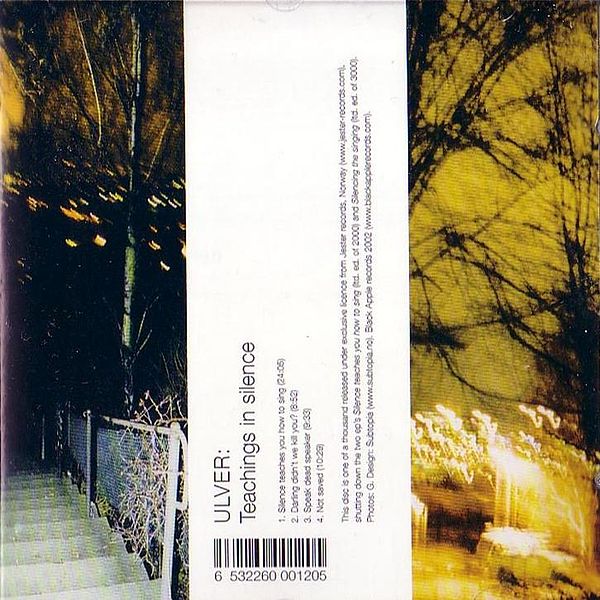
SOUNDTRACK: ULVER-Teachings In Silence (2002).

This EP is a collection of Ulver’s two previous limited edition EPs: Silence Teaches You How to Sing and Silencing the Singing.  It was originally released as a limited edition of 1000 copies, but has since been given wide release.  The two EPs that it replaced were officially retired (after print runs of 2000 and 3000 respectively).

“Silence Teaches You How to Sing” seems like perhaps Ulver has pulled a fast one.  The song starts with static…waves of static.  And you think, what, 24 minutes of THIS?  But after about four minutes, some quiet guitars layer through the static.  By 5 minutes a melody emerges, rather Twin Peaks theme-like.  Static resumes and then another wave of music bursts through and then, around 11 minutes, distant voices can be heard.  As the track nears the end you can hear a distant choir.  And by the end you’re listening so intently that you hear all kinds of things.

That was the only track on the first EP.  The second EP had three shorter tracks.  They are in a similar style to Silence, although there is more music.  “Darling Didn’t We Kill You” has a somber guitar melody and distant choral voices or a buzzing drone.

“Speak Dead Speaker” is more static (it’s easy to see why these two EPs were bundled together).  There’s more Twin Peaks style washes over the static.  I keep picturing the Pacific Northwest.  The last two minutes are a surprise cello version of the themes from the first 7 minutes.  It’s lovely and sorrowful.

The final track is a beautiful melody that repeats itself more and more quietly (with a wonderful loud funeral bell keeping time).  It repeats its cycle three times before ending.

Ulver continues to confound listeners.  Neither one of these EPs is really essential, but they are both interesting and really create a mood.

[READ: November 3, 2011] “Nilda”

This is the final uncollected story (according to Wikipedia anyhow) by Junot Díaz that I was able to access online.  There are two more stories “Invierno” (Glimmer Train 1998) and “Flaca” (Story, Autumn 1999) that I can’t seem to access online.  The rest of the listed short stories appear in Drown

This story is about longing and making the wrong choices.  Having read a bunch of Junot Díaz stories lately, this feels very much like a story he would write (I probably should have read Drown before I read these stories, but when I get to it, I’ll be able to confirm my suspicions).

In this story, Yunior, who is evidently the constant narrator in his earlier works (and in Oscar Wao) knows Nilda from school.  She was a friend of his–a kind of teasable friend–until puberty hit and her chest was to die for.  Unfortunately for Yunior, they were already friends, and she was off with other boys.

Indeed, Nilda was trouble more or less from the start–“brown trash,” he calls her.  Her mother was an alcoholic and Nilda was defiant.  She even spent time in a group home.  But she was nice and easy to talk to.  Dammit, why did she have to start dating Yunior’s brother Rafa? (more…)

Read Full Post »

SOUNDTRACK: ULVER-Perdition City: An Interior Soundtrack (2000).

Uver’s previous EP hinted at what would come next–electronic ambient tunes.  But it didn’t quite prepare anyone for this–a soundtrack to a film that doesn’t exist.  And yet with a title like Perdition City, you can pretty well anticipate the music that’s coming: think noir.

It is more electronica, and yet it is not just electronica.  The opening song “Lost in Moments” has a saxophone (!) solo.  And the song sounds like a perfect David Lynch/noir soundtrack to a dark and stormy night. 

What’s novel about the approach are the electronic noises and eccentric drum beats that punctuate the track.  The second track, “Porn Piece or The Scars of Cold Kisses” is broken into two parts: the first is a low, rumbling section with skittery noises and the second part has soulful singing (Garm, the only consistent member of Ulver (who goes by a different name on just about every record) has a surprising range of voices at his disposal).

“Hallways of Always,” “Tomorrow Never Knows” and “The Future Sound of Music” are sort of ambient tracks.  “Hallways” is quiet while “Future” grows in volume and chaos as the song proceeds.  “Tomorrow” is the most menacing of the three, projecting a state of noise and tension.  The interesting thing about these tracks is that although they seem like pretty conventional electronic instrumentals, they are actually fairly complicated in detail.  Some of the electronic pieces go on a bit too long, but as they are meant to be atmospheric rather than narrative, I guess that’s okay.

“We Are the Dead” bring in vocals again.  This time, it’s a spoken word narration over distorted radio voices.  And “Dead City Centers” also brings back some vocals.  Although only after about 4 minutes of noises and tension.  This time the vocals are more ominous (as the music grows more intense).

“Catalept” is the most interesting track on the disc–a remix of music from Psycho.  While the final song “Nowhere/Catastrophe” is an actual song–verses and vocals!  It’s a fairly soft song but it has moments of darkness that are quite cool. 

As a soundtrack this works wonders.  And if Ulver wanted to get into the soundtrack business, apparently their model of “making up your own soundtrack” worked.  Since this release they have recorded the soundtracks for two external films. 

As an overall release it’s a bit all over the place–jazzy sax, electronica, spoken word.  The mood is pretty consistent though, and although I don’t think I would do what the liner notes recommend: “This is music for the stations before and after sleep.  Headphones and darkness recommended,” I still enjoyed it.

[READ:  November 5, 2011] “Alma”

This is a very short story that falls pretty squarely into standard Junot Díaz territory (he says, having read like four pieces by him). 

I’m fascinated by these stories because Díaz is all about women being super hot and yet they are never objectified.  Well, in some ways they are of course–he lingers over their bodies as he describes them, but they are never just a body.  They are often smart or interesting, they are strong and powerful, and even when they are victimized (some by cheating boyfriends, others by far worse), they either fight back or get themselves to safety.  It’s nice to read about powerful women,even if the point of view is from her boyfriend.

This is the story of a young man falling hard for a hot woman (with a beautiful ass).  What fascinates me about Junot Díaz’s stories is that the women that his narrators fall for are Dominican, but they are also alternative to their culture.  So in this case, Alma is a “Sonic Youth, comic-book-reading alternatina” which makes me like her already. (more…)

Read Full Post »

SOUNDTRACK: TRENCHMOUTH-Inside the Future (1993).

This album came before the other Trenchmouth CD I reviewed.  And it’s safe to say that all of the ideas were still in place for this CD as well. 

What I love about Trenchmouth is that all 4 members seem to be playing different songs and yet they all work so well together.  True, it sounds chaotic and at times unpleasant (such is the nature of punk) and yet when you listen a few times you hear how it all works.

“Telescopic” opens with a crazy punk bass line, the guitars are just screams of noise and the drums are rhythmic yet chaotic (that’s Fred Armisen on drums and he is a wild man).  Then lay over the top the disaffected vocals (which are in a different ke)y and you get one hell of  a punk song.  The feedback squalls at the end let you know that they have no intention of being on the radio.

“Power to the Amplifier” condenses all of that noise into 2 minutes of fury. 

“The Dawning of a New Sound System” starts with some crazy guitar chords (showing you just how weird the guitars are) but this song has a pretty catchy chorus (with backing vocal shouts of “Hail Hail”).  “Yes, This is the Place” offers slightly less abrasive guitars and a very smooth middle section.

“Capsule” actually opens with a sound similar to Prodigy’s “Smack My Bitch Up” and it has a different vocalist (although I don’t know who).    The percussion on “Confectionery” is amazing, while “In the Event of a Struggle” is another 2 minute cycle of styles.  “The Future Vs. Centrifugal Force” sounds the most like that mid 80s SST style that I like so much–kind of a jam feel, but short and punky.

“Sea of Serenity” is listed as “Swing Version”, although I don’t know if there’s another version.  This one has intense guitars (don’t they all) and frantic drumming.   It also has a wonderful third part with a great off-kilter guitar riff.   The final proper song is “Hit Men Will Suffocate the City” and it is more of the same noisy wonderment.  It ends with a great bass line.

The final track is “Now I Have Tasted Life” and it is absolute filler.  A weird addition, it’s 7 minutes of slow melodica noodling and occasional reggae sounding guitars with random percussion  There’s also some feedback squalls.  It sounds like one of their real songs stretched out and slowed down.  It would be okay if it weren’t so long.  But it’s hard to blame anyone for experimentation when the rest of their experimentation is so good.

It’s obvious why Trenchmouth weren’t popular (although you can hear proto-Primus all over this record–I wonder if Les and Ler knew Trenchmouth at all?), but it’s a shame their music is so hard to find.

[READ: November 30, 2011] “The Musical Brain”

I have been meaning to read César Aira for a little while now.  He’s on my list of new authors to check out.  So I was pretty delighted to see this story (translated by Chris Andrews) in the New Yorker.

There are so many wonderful and unexpected aspects to this story that I was constantly kept on my toes.  This also made it somewhat challenging to write about.

The story appears to be autobiographical (we learn late in the story that the narrator is named César), about an incident that happened when he was 4 or 5.   It is set in the Argentinian city of Coronel Pringles and it talks a lot about his family and the town that he lived in.

I loved the strange little details he threw in about his family.  Like his mother’s “invincible suspicion of any food she hadn’t prepared herself” or the provenance and outrageousness of his father’s wallet.

 As the story opens, César remembers a night when the family went out to dinner.  And on that occasion, he recalls the high school headmistress Sarita Subercaseaux holding forth in the corner of the restaurant while people brought her boxes of books.  He concludes (in the present, but had no idea at the time) that they are donations for the new library that is to be built (and of which Subercaseaux will be the head librarian).

He remembers Subercaseaux very fondly both from the library and from school, and when he asks his mother about her, we get the first of many erasures of the past.  His mother informs him that Subercaseaux died long before he was born.  Which of course he knows is impossible.  But his mother’s memory is better than his! (more…)

Read Full Post »

« Newer Posts - Older Posts »