Feeds:
Posts
Comments

Archive for the ‘Sexism’ Category

SOUNDTRACK: CALMA CARMONA-Tiny Desk Meets AFROPUNK: #204/196 (May 2, 2021).

Tiny Desk Meets AFROPUNK was the opening event of AFROPUNK’s “Black Spring” festival. The virtual celebration, hosted by Jorge “Gitoo” Wright, highlighted outstanding talent in Afro-Latin and Afro-Caribbean music across the globe. Our showcase featured four artists who honored their homes and celebrated the art their heritage has inspired.

Calma Carmona got her start in 2013 when the Latin soul singer-songwriter released her first EP and opened for Beyoncé’s The Mrs. Carter Show World Tour in Puerto Rico.

Carmona is mesmerizing as the massive amount of dreadlocks is piled on top of her head.  The setting is fascinating–it looks like an aquarium–a dark hallway with lit windows, but instead of fish there seems to be technology in the windows.  I love how in some scenes, it’s almost totally black–since (almost) everyone is dressed in black as well.

Her music is not dark, though.  Indeed, “When I Was Your Girl” has a kind of reggae feel, at least from the rhythm guitar (which I’m assuming is looped because Pedro “PJ” González is playing lead throughout. Carmona’s voice is quiet and kind of sultry through this song and when she’s supported by her backing singers, Athina Alejandra, Almonte Duluc and Yarinés Salgado, they sound great together.

There’s a lot of drums in these songs, although it’s so dark it’s hard to know who is doing what. Gabriel Oliver plays drums and he, Andres “Kino” Cruz and José “Junny” Elicier all play the barril, a traditional hand drum.

From her hometown of San Juan, Puerto Rico, Calma Carmona delivers a bewitching Tiny Desk performance. Her voice rarely rises above a whisper as she sings over impassioned Afrobeats during her three-song set — but when it does, it’s a gritty, intimidating growl.

That growl is present on “Ella Se Mueve” a darker song with deep bass from Adrián “AJ” Rodríguez and distorted deep keys from J. Rochet.  “PJ” González noodles some guitar solos throughout and you can really hear the barril.  Carmona sang in English on the first song but she switches between English and Spanish here

“Vibra” opens with the three men playing the barril and a slow bass line.  She sings the verses and then throws in a growly rapped verse.  I really enjoy the slinky way the song ends with them singing “and I’ll be on my way.”

And before the send us out, there’s a quick barril serenade.

[READ: May 3, 2021] “How Octavia E. Butler Reimagines Sex and Survival”

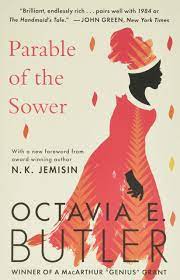
Having read three of Octavia E. Butler’s book recently, I was saving this article (what timing) until all three were done.  And considering the opening line of this article mentions Parable of The Sower (the second book of the three that we read) I’m glad I waited.

Although this is really a book review of her new Library of America Collection (she is the sixth science fiction writer to be featured in the series and the the first Black science fiction writer).  The book collects Kindred (1979) Fledgling (2005) and short stories.

He says, as we have noted

It’s often observed that the Parables, already prescient when they were published, now read like prophecy

But I didn’t know that Earthseed had inspired an opera by folksinger Toshi Reagon and that last September Parable of the Sower was back on the best seller list (we’re so trendy).

The article notes that her protagonists often begin as fugitives or captives but emerge as prodigies of survival only to find that adaptation exacts hidden costs. (more…)

Read Full Post »

SOUNDTRACK: LUEDJI LUNA-Tiny Desk Meets AFROPUNK: #203/196 (May 2, 2021).

Tiny Desk Meets AFROPUNK was the opening event of AFROPUNK’s “Black Spring” festival. The virtual celebration, hosted by Jorge “Gitoo” Wright, highlighted outstanding talent in Afro-Latin and Afro-Caribbean music across the globe. Our showcase featured four artists who honored their homes and celebrated the art their heritage has inspired.

I don’t really understand why this is called AFROPUNK, as there is nothing even remotely punk about any of the music here.  I thought maybe it was a typo, but this music isn’t even terribly funky.  This music is very smooth jazzy

It is quite good though and Luna’s voice is understated and pretty as she sings in Portuguese.

Luna performs from her coastal hometown of Bahia in the city of Salvador, Brazil, where African culture flows in abundance. She is a powerhouse, entrancing and elegant, soulful and spiritual, as she uses her platform to discuss individual and systemic forms of anti-Blackness.

“Lençois” opens with some gentle piano from Gabriel Gaiardo and washes of cymbals (struck with mallets by Sergio Machado).  Then Luna starts singing in a kind of raspy, seductive whisper.  After a verse, Weslei Rodrigo (and his spectacular beard) lay down a smooth, anchoring bass line.

After the first song, she introduces the band.  After she introduces guitarist Vinicius Sampaio, he plays a solo and sings along with himself in a particularly jazzy way.

Elements of jazz and blues are infused with African rhythms as Luna uses music to express her ongoing struggles for autonomy as a Black woman.

She says,

“I feel that we are living in a crazy moment in a crazy time and music has been a safe place for me — the only safe place for me,” Luedji Luna says in a low, alluring voice as she explains the purpose of her latest album, Bom Mesmo É Estar Debaixo D’Água.

“Erro” opens with a slightly more rocking sound and a guitar solo intro.  I appreciate how different these songs sound from each other while still maintaining her overall vibe.  “Chororô” is a little funky, at least from Rodrigo’s bass.  But jazz is the overall vibe.

I really like the way the song’s chorus plays a five note and pause refrain to give a dramatic opening for the piano and guitar solo.  It’s also fun watching Luna dance.

[READ: May 3, 2021] Parable of the Talents [end]

I wound up reading this book very quickly.  I finished it before the deadlines of the first week’s read.  I was totally sucked in.  I hated parts of it–the woes of 2033 were unbearable–but I couldn’t stop reading it.

And wow, did Butler mess around with my head.

Contradict the first page of the story late in the book, but have it be a totally justifiable reason!  Check.

Not reveal why one of the character has a book published until almost the very end and have it be a real surprise!  Check.

Make me completely reassess the tone of the book and why Butler was writing it?  Check.

This break was a pretty fortuitous one because this week’s reading starts with a lengthy introduction from Asha Vere.  She began making up her own Dreamasks when she was 12.  When she was discovered he was punished. But that didn’t stop her from writing fictions to escape her own life.

When she was 15, an enemy in her school told her that her mother was a heathen and a whore–Asha punched the girl and broke her jaw.  She was spared detention by her stepfather who mostly just liked to molest her.

Once the diaries resume, we see what Olamina’s dealing with.  She is desperately seeking her daughter and is still trying to build up Earthseed.  Allie has actually been settling down with Justin.  She’s making furniture and instructing younger kids how to make it as well. But Olamina can’t stay in Georgetown.  She has decided to head up north.  Inexplicably she is going to go to Portland to find her brother–the brother who disagrees with everything she stands for and who ran away from her.

Allie has arranged a traveling companion for her–against her wishes.  Her name was Belen Ross but she went by Len.  She was born to a rich family; however, she was born from a surrogate and once the family had a natural birth, they gave the cold shoulder.  At 18 ,she was kidnapped and held for ransom.  But her family never paid it.  Eventually her captors just abandoned her.  When she returned home she found that her parents has moved to Alaska.  She had no other option but to go to Alaska.

So here were two people going in search of those who don’t want them. (more…)

Read Full Post »

SOUNDTRACK: BORIS-Akuma No Uta (2003).

Boris albums are never an easy thing to find.  This album was originally released in Japan in 2003.  Then it was reissued in America in 2005 with a vastly superior cover.  The cover to the right, a hilarious mock up of Nick Drake’s Bryter Layter album (left).  The original album (cover way below) was only 31 minutes, but the reissue was extended to 39 minutes because that’s how long the Nick Drake album was.

So this new album is quite different from the original: In addition to running an additional 7 minutes, the opening track of the newer version is a totally different take; both use the same riff from “Akuma no Uta,” but the original, shorter track repeats it far less and opens with over a minute of ambient, resonant amp noise absent from the longer version.

I have the newer edition and don’t know the original.  “イントロ” (Intro)” opens with a slow, simple infectious riff and then a sort of soaring siren sound starts.  The four note riff is enveloped in distortion while the backing chords cycle through slowly.  Then comes soaring guitars and washes of noise which stretch this song out to almost 10 minutes.

The opening track lulls you into a false sense of mellowness until “Ibitsu” comes blasting out with heavy rocking guitars, pounding drums and screaming vocals.  Most of the verses are just drums and Atsuo’s singing with an occasional riff from Wata. Then Takeshi joins in on the chorus and turns it into a big old crashing metal song. The middle is a three note riffs before a brief Wata solo and some wild drumming. The end is so loud it seems to blow out the speakers.

There’s a brief pause and then “フリー” (Furi) kicks off even faster and more intense heavy rock.  There’s a fast riff and a chorus that is super fun to sing along to even though I have no idea what they are saying.

“無き曲” (Naki Kyoku)” is a grooving slower song.  The first three minutes are primarily a solo by Wata.  The middle turns into a slow jam with stops and starts.  A slow grooving solo resolves into a another catchy rocking singalong before feedbacking out.  Around five minutes, the vocals come in.  The middle has another solo and some meandering bass from Takeshi–almost like a call and response musical section.

“あの女の音量” (Ano Onna no Onryou) is another big crashing rocker with heavy ponderous chords.  It’s got screaming guitars and shouted vocals but plenty of room for noisy feedback.

The album ends with “”あくまのうた” (Akuma no Uta).  A big gong introduces the three note riff.  Around two minutes the fast guitar riff begins and the song rocks out–a classic short heavy Boris rocker.

[READ: May 1, 2021] “Casting Shadows”

I haven’t read a lot of Jhumpa Lahiri’s stories, but she was very popular a while back.  I’m not sure if she still is.

Perhaps the most fascinating thing about this story is that it was written in Italian (translated by the author, which is also interesting).

Lahiri used to write in English but she has recently begun writing in Italian.  I find that fascinating, especially since she translated this work herself–how different is it than if she had written it in English first, I wonder.

This is the story of an older woman and how she interacts with the world around her. particularly the men.  She was

Never married, but, like all women, I’ve had my share of married men.

It’s a really interesting character study and shows a powerful woman who some people might (foolishly) try to take advantage of. (more…)

Read Full Post »

SOUNDTRACK: PUSSY RIOT-“Virgin Mary, Put Putin Away” (2012).

This song, barely two minutes long, is what caused all of the stir around Pussy Riot.

Pussy Riot are an anarchic artistic collective in Russia.  They aim to provoke and provoke is what they do.

Their history and legacy (even the Wikipedia summary) are pretty fascinating.

So in this song (and video), a “choir” sings a holy-sounding chorus for 22 seconds.  Abruptly, a raw home recorded punk song takes over.

Everything is sung in Russian:

(choir) Virgin Mary, Mother of God, put Putin away Рut Putin away, put Putin away (end chorus)

Black robe, golden epaulettes All parishioners crawl to bow
The phantom of liberty is in heaven
Gay-pride sent to Siberia in chains The head of the KGB, their chief saint,
Leads protesters to prison under escort
In order not to offend His Holiness Women must give birth and love
Shit, shit, the Lord’s shit! Shit, shit, the Lord’s shit!

(Chorus)

The Church’s praise of rotten dictators The cross-bearer procession of black limousines
A teacher-preacher will meet you at school
Go to class – bring him money!
Patriarch Gundyaev believes in Putin Bitch, better believe in God instead
The belt of the Virgin can’t replace mass-meetings Mary, Mother of God, is with us in protest!

After 50 seconds its back to the choir (and the chorus) and  then the punk verses start again.

It’s fairly catchy given what it’s doing.  There’s one more chorus at the end of the song at 1:30 and just like that, it’s over.

Provocation complete.

[READ: April 26, 2021] We Are Pussy Riot Or Everything is P.R.

As the subtitle of this play suggests, this is a reenactment (of a kind) of the Pussy Riot art installation that got them arrested, and the subsequent trial and imprisonment of two members.

The above video shows the events of that day in February 2012 when five masked (in balaclavas) women climbed onto the altar of the Cathedral of Christ the Saviour in Moscow and…danced.

The women were provocatively dressed (by Moscow church standards–they wore bright colors and tights under dresses) and they went on to the altar–a place where no woman (except the cleaning lady) was to ever set foot.

The dialogue of the play inspired by trial transcripts and statements by public officials (Vladimir Putin, Patriarch Kirill) which are available on the internet.  So while Hammond does use creative license, this is a pretty realistic reenactment of events.

The Dramatis Personae is listed in various formations depending on the size of your cast.  But the important main characters are Nadya, Masha and Katya as well as Sergei, a composite of male political activists, prisoners and artists.

The Russian feminist art collective Pussy Riot was formed in the fall of 2011.  Pussy Riot was inspired by the yurodivy (Holy Fools) of Russian history whose purpose was to wake people up to what was going on around them.

In February 2012 they uploaded the above video, “Virgin Mary, Chase Putin Away.”  The video, as you can see, is set on that altar, where women are forbidden.  The Kremlin and the Patriarch of the Russian Orthodox Church took notice.  Three of the four women were hunted down and arrested for “hooliganism motivated by religious hatred.”

When this play was written, Vladimir Putin had just changed the constitution so he could be president for life.  In the story Sergei comments, “So he likes his job. Who can blame him?”

The introduction says that in 2014 Pussy Riot became a brand–this branded Pussy Riot was set to tour the U.S. and I had a ticket until the pandemic cancelled everything.

Nadya has always said that “Feminism that doesn’t benefit men is not my feminism.”  The members are female but they are fighting for all.

Perhaps the most interesting thing about the play is the way it starts. The doors to the theater are locked and everyone–cast and audience are milling about while a group of guards block the way in.  Eventually Pussy Riot members start to cause a scene in the lobby and then blend in with the audience.  When the audience is allowed in they are given a scarf as a head covering.  But pussy riot members try to give them balaclavas instead–the play is quite interactive. (more…)

Read Full Post »

SOUNDTRACKDUCKWRTH-Tiny Desk (Home) Concert Meets SXSW: #189 (April 5, 2021).

Every year, NPR Music participates in the SXSW music festival, whether it’s curating a stage or simply attending hundreds of shows at the annual event in Austin, Texas. Last year, the festival was canceled due to the pandemic, but it returned this March as an online festival. We programmed a ‘stage’ of Tiny Desk (home) concerts and presented them on the final day of the festival. Now, we present to you Tiny Desk Meets SXSW: four videos filmed in various locations, all of them full of surprises.

DUCKWRTH decided to do something special for Tiny Desk Meets SXSW: brand new music. The dynamic R&B singer proceeded to debut two exclusives: a slow jam titled “make u go,” which he dedicates to the “lovers and freaks,” and the upbeat “Birthday Suit,” which KCRW astutely compared to Estelle’s “American Boy.”

The new material wasn’t the only thing that made this Tiny Desk such a treat. For this funky and flamboyant performance, DUCKWRTH dressed his backing band entirely in white and switched up the lighting for each song so that the hue matched the mood he was laying down.

“Kiss U Right Now” [red lights] opens with a muted guitar line from Justin “Jhawk” Hawkins.  After a  soft “Okay” from DUCKWRTH, a kind of sci-fi warbly keyboard comes in from Devin Smith.  And then with a slide on the bass from Solomon “Solo” Smith the song bounces to a start.  DUCKWRTH has a soft croon that he intermixes with rapping verses.   It’s quite inviting and not given to histrionics.

Before “make u go”  [purple lights] he says “Welcome to my Tiny Desk,” he says. “We are gonna play some new songs for y’all if that’s OK. Y’all ain’t got no choice!”  This is mostly gentle keys and then backing vocalists Olivia Walker and Amber Olivia Kiner start by singing the chorus.

He says “Birthday Suit” [white lights] is morning music.  With this amusing line “Meet me in my birthday suit / This ain’t Gucci, it’s way more cute.”  Amber Olivia Kiner sings the lead lines.  The song ends with this refrain:

we look better naked / better in the nude / bend it over baby while in public / we may end up on the news.

“Super Good” [blue lights] is a slow jam with an interesting drum pattern from Darryl Staves Jr.  I really enjoy the simple but synchronized dance steps at the end of the song.

[READ: April 19, 2021] Parable of the Talents [2035]

When this book started I thought that it was an interesting idea to have Lauren’s child go wholly against her.  I even wondered if it was Butler’s rethinking about Earthseed.   Larkin’s attitude about her mother doesn’t exactly change over these chapters, but it does morph a bit.  So much so that by the time chapter seventeen rolls around, Larkin comes across as a bit more of a petulant, jealous person than a critical thinker.

I wonder what my life would have been life if my mother had found me.  I don’t doubt that she would have stolen me from the Alexanders–or died trying.  But then what?  How long would it have been before she put me aside for Earthseed, her other kid?  I was her weakness.  Earthseed was her strength.  No wonder it was her favorite. (265)

2033 was a terrible time and, frankly, a painful read.  The chapter of 2035 tells us that all of Olamina’s diaries from 2034 are lost.  Which is just as well for me since 2034 was a year of the same torture and hellishness and I’m just as happy to not have to read it.

Larkin writes that she met some people who were at Camp Christian (we don’t know how yet) and spoke to a woman named Cody Smith who told her about the attempted uprising by Day Turner and his people–an uprising that failed and that caused a massive increase in suffering for everyone there.

Larkin tells us that everything that was done at Camp Christian was illegal–despite what Jarret tried to make legal. The one thing that seems to have been made legal was the removal of children from their families at the Mexican border because of vagrancy laws. (more…)

Read Full Post »

SOUNDTRACK: LIAM BAILEY-Tiny Desk (Home) Concert #184 (March 23, 2021).

I had heard of Liam bailey but I didn’t really know anything about him.  I’m fascinated by his voice because his British accent comes through as he sings (in the way that Billy Bragg’s accent is quite audible).

For this performance, Bailey teeters between belting and crooning, with emotions that ignite the screen from the top of “Fight” to the closing notes of “Paper Tiger.”

“Fight” is a short song that is primarily made of percussive chords and slaps on the guitar.  For most of the songs, he is playing the chords and you can hear them change but there’s no ringing notes, just muted chords.  Until the very last lines when the music resumes and he sings powerfully.

So it’s all about his voice.

Wiping the sweat from his brow between songs, he exclaims, “We don’t normally have these glaring lights in my living room.  This is my front room by the way welcome. We’re not doing no studio productions. We’re keeping it real. Keeping it raw.”

I don’t know what “Vixit” means.  He says he wrote this and the next song in upstate New York.  The music is a little darker. Trying to figure out he lyrics:

I still have my memories I still hear your song. They were always so vindictive, you always got me wrong. I cherish every day now I’m happy to be alone.  I get every thing I want and I still get stoned.  I’m out of love, I’m out of love never seemed to make sense.

If only I had realized the other side was fine.  If only I had realized.

“Paper Tiger” is another powerful song and once again, the guitar is the vehicle for his voice and lyrics.  Which is not to say the song isn’t good, just that the melody is not as important as the words.

Perched atop an amplifier in front the peeling walls of his living room, he presents three selections from his latest album, Ekundayo, accompanied by one acoustic guitar. Ekundayo, which means “sorrows become joy” in Yoruba, fittingly describes the Nottingham, England, native’s music industry journey thus far. After various projects and record deals, he found it impossible to operate under the confines of a major label. He finally found the liberation he yearned for on Leon Michels’s Big Crown Records, which released Ekundayo last November.

This set is not even ten minutes long, but it’s really solid.

[READ: April 12, 2021] Parable of the Talents [2033]

2033 is a brutal year for Acorn and Earthseed.  The end of the section was really hard to read.

As the year opens, our narrator, who we later learn is named Larkin Beryl Ife Olamina Bankole says that her mother should have left Acorn and gone to Halstead like Bankole asked.  It makes it seem as though perhaps Bankole went without her, but he did not.

“Larkin” is a derivative of Lauren and from the Greek Laurel ,  “Beryl” was his mother–emerald is type of beryl.  “Ife” is the Yoruba word for “Love”

Olamina dna Bankole had actually stayed in Halstead for a short time.  A family was moving from Halstead to Siberia (!) for a better life.  The election of Jarret was the last straw for them.  Bankole is amazed:

If [when I was a boy] anyone had said that Americans would be giving up thier homes and their citizenship and going to make new lives in Siberia, the rest of us would have looked around for a straightjacket for him (130).

Olamina and Bankole stayed in the family’s house while Bankole was trying to decide if he should move there.  Well, he knew he should, he was trying to convince his wife.  She doesn’t want to move but says it was a good trip for her.  Living in a modern house with plumbing.  Being so close to the Ocean.  She could see the appeal.

Bankole had told people that they were leaving.  Or, more specifically, Marc was telling people they were leaving and the faithful were understandably freaked out.  But she convinced them, and herself, that she wasn’t leaving.

When I started this year I was taking notes on things that interested me, but after having finished it and reading all the horrors, it seems bizarre to include little observations about things that made me smile.  But I get to throw this one in because I am a cataloger for a library.

Olimani and Channa have been sorting and cataloging books for their library and Olamina hated to be interrupted, but not too much: “Still, cataloging is tedious” (137).

The first bad news comes from Marc.  After he had been rescued by Olimani and taken in by  Acorn, he decided that he wanted to preach his own Christian beliefs to the people.  He was going to do it without asking his suiter, but Olamina found out and told him to preach at their next Gatehring.  She warned him that he would be questioned about what he said and he was cocksure enough to go on with it. (more…)

Read Full Post »

SOUNDTRACKJUSTIN BEIBER-Tiny Desk (Home) Concert #182 (March 17, 2021).

When Taylor Swift did a Tiny Desk Concert it was HUGE news–the biggest pop star in the world at the Tiny Desk?

I assume at one point Justin Beiber would have made a similar big deal (even if this one is a home show and just a stream like any other). I didn’t even know he was still making music.  So imagine my surprise to hear that the album that these songs come from went to number 1 and that he is the youngest artist to have 8 number one records.  Who is buying Justin Beiber records?   I have no idea.

Especially now that he’s all tattooed up and sleazy looking.

Of course, it’s very likely that I don’t know anything he has done, because I really didn’t know what he sounded like.  He plays four songs here.

“Holy,” another song from Justice, opens this set without the presence of guest Chance the Rapper.

“Holy” is a slow acoustic song (the acoustic guitar from Julian McGuire sounds great).  His musicians are from We the Band.  This is a catchy pop song for sure–the holy holy holy, hold me hold me hold me part is a nice touch.  I like the addition of the record scotching from DJ Tay James in the middle.

But why is he always grabbing his crotch?  Especially the way he grabs it, like he has to pee.  It’s really disconcerting and seems like an unconscious reflex at his point.  It looks particularly weird with his big baggy clothes on.

For “Peaches” he heads over to the keyboard.  Julian McGuire picks up the electric guitar and shows how good he is.  The opening piano melody is slow and pretty.  I really like this song except that the lyrics are so unnecessarily crass.  Why have such a pretty song and yet have your call and response lyrics be so rude

I got my peaches out in Georgia (oh, yeah, shit)
I get my weed from California (that’s that shit)
I took my chick up to the North, yeah (badass bitch)
I get my light right from the source, yeah (yeah, that’s it)

And good lord he repeats the chorus so many times.

Bieber plays the slow piano solo as the scotching begins and then keyboardists O’Neil “Doctor O” Palmer takes over and plays a really groovy melody as the outro to the song.

“Peaches” will exist in a significantly different form when Bieber drops his new album, Justice, on Friday — the track will feature guest vocals from GIVEŌN and Daniel Caesar

For “Hold On” he moves away from the keys.  I prefer him standing in front of the keys because he looks so awkward when he’s just standing there, hunched over and crouching.

The song has pretty echoing electric guitar (Mcguire again).  This song starts out quietly but when it kicks in, what a super catchy song!   It’s got a killer bass sound from Harv and is just  full on bouncer.  This should be huge.   In the middle of the song the band take a verse or two to totally rock out with crashing drums from Robert Taylor as well as ripping guitars and bass.

“Anyone” ends the set as a big old ballad with satisfyingly quiet synths and backing vocals.  This is a really pretty song, but it would work so much better if he didn’t look so scuzzy.  But once again the band totally rocks the end–a big jam that is really awesome once JB stops singing,  McGuire get a ripping solo and the band turns the song into a funk jam with some cool bass and drums and the samples kicking in.

[READ: March 31, 2021] “Seventy-Two Virgins”

Comedy pieces are often funny when they are timely.  I’m not sure what was going on in 2007 that Steve Martin wanted to make a joke about Muslim martyrs enjoying 72 Virgins.  I do recall hearing about that closer to 9/11, but maybe something else new had happened?

I’m not willing to look this up.  How does one even searching for 72 virgins?  But the context is that it was widely believed that Muslim ‘martyrs’ enjoyed rich sensual rewards on reaching paradise.

So without having 72 virgins in the zeitgeist, what’s it like to read this?

Well, this is basically a kind of play with every virgin getting a line.

(more…)

Read Full Post »

SOUNDTRACKSAMPA THE GREAT-Tiny Desk (Home) Concert #173 (February 23, 2021).

I thought that Sampa was actually Sammus, the indie rapper named after the character in Metroid.  So I was a little bummed to find out I had the wrong Sam… rapper.  But I quickly came over to Sampa’s style.

Sampa Tembo is better known as Sampa The Great, an understated title. In her Tiny Desk (home) concert, the poet, rapper and singer-songwriter delivers evidence that it’s more like Sampa the Greatest.  Initially raised in Botswana, Sampa moved to Australia as a young adult and established herself in Sydney’s hip-hop scene. There, she released two mixtapes, 2015’s The Great Mixtape and 2017’s award-winning Birds and the BEE9, all the while generating buzz. She had been based in Melbourne for the last four years, but the next chapter of her musical journey will find her at home in Zambia.

She plays four tracks and her live band is really solid.  She opens with “Rhymes To The East” which features a nice guitar riff by Samuel Masta.  I like the way the backing singers (l-r: Joy Tusankine Namwila, Mwanje Tembo, Tio Nason) sing the end of the rapped lines.

When Sampa really starts flowing her voice is great–a rough gravelly cadence with a Southern African/Australian accent.  It’s especially cool when she introduces the third verse with a snarl

Rhymes beast mother fucker
Tembo from the east put the beast in a trucker
Timbuktu, as I question all the loyalty
Build a big wall when you stole all of the royalties

The end of the song is really catchy, too.

The next three are from her 2019 album The Return.

“Mwana” opens with a drum solo Kasonde “Tek1” Sunkutu.  The song is mostly sung by the backing singers.  Then Sampa starts her flow.  Musically this song is much more spare with gentle keyboards Lazarus “Lalo” Zulu playing around the drums.

As she introduces the band, they jam, with some funky bass from Mapalo “Mapskeys” Mapalo which leads into an improv  that sounds like an island fun.

“Freedom” is up next.

Sampa Tembo is in Lusaka, Zambia, her landlocked African home country.  [She says] “Freedom is what we feel when we perform. And freedom is what the world is in need of right now. In this pandemic it feels like we all need a sense of freedom.”

“Freedom” features some terrific backing vocals. The end has a rocking jam as the singers all give up whooos and Masta plays a ripping solo.

When the camera is in full frame you can see that Sampa’s dress has a really long train which covers almost the entire floor (no wonder she sits through the whole set).

The set ends with “Final Form,” my favorite song of the set.  It’s got a big, heavy noisy riff with thumping bass and wailing guitars.  Her delivery is raw and raspy and really affecting.

The end is particularly cool as the band rocks out punctuating along and singing “Black power!” “Louder!” “Black power!”

Sampa is pretty great, indeed.

[READ: April 12, 2021] Parable of the Talents [2032]

Parable of the Sower ended on a vaguely optimistic note:  Lauren felt that they were ready to set up Acorn, the home of her Earthseed community.  Bankole thought there was no chance it would work.  But this is Lauren’s story, so we’ll assume that the story is tipped in her favor somewhat.

Plus, there’s a sequel, so things must work out reasonably well, right?

Well, surprise!

Parable of the Talents opens up with the news that Lauren is dead.

She is mostly called Olamina during this book because Bankole “doesn’t like my first name, so he ignores it.  That’s fair.  I didn’t like his first name either. It’s Taylor, by the way and I ignore it” (122).

This book is narrated by Olamina and Bankole’s child–unspecified gender and age in the Prologue, although by the end of this week’s reading we can assume the writer is their daughter [Bankole wants her named Beryl and Olamina wants her named almost anything that isn’t Beryl–“such an old fashioned name” (122).  The narrator later says something about high school, so it must be around 2050.

The child shares Olamina’s diary entries, but her basic attitude is that she hates her mother and thinks well of her father and wishes she knew him.

The book opens with this narrator saying “they’ll make a god of her” and the continues with something surprising about that

I think that would please her, if she could know about it.  In spite of all her protests and denials she’s always needed devoted, obedient follower–disciples–who would listen to her and believe everything she told them.  and she needed large events to manipulate.  All gods seem to need these things.  (7)

I never got the sense that Lauren wanted to be a god.  But maybe Olamina does.

She also tells us that Lauren’s middle name “Oya” is the name of a Nigerian Orisha–goddess f the Yoruba people (goddes of the wind, fire, and death, more bringers of great change (50).

Butler wrote this book five years after the Sower.  As I read Talent, I wondered what the intent of this story was. Had she planned all along to have a follower (child or otherwise) criticize Earthseed?  Had five years of thinking about Earthseed made her question the validity of Lauren’s ideas?  I don’t know anything about Butler, about whether she “agreed” with Lauren’s ideas or not.  I don’t have anything besides textual evidence to know how she felt about religion in general.  So was this book a commentary on her own ideas/ideals from five years earlier?  Or is this just interesting storytelling by having a new protagonist dispute the doctrine of the previous protagonist.  Especially if the bulk of this book is made up of Olamina’s diary entries (just like the first book was).

That’s right, even though the book is set after Olamina has died, the book so far is primarily her own diary entries from 2032, By the end of 2032, she is pregnant with, presumably, the person who is narrating this book and criticizing Olamina’s ideas. (more…)

Read Full Post »

SOUNDTRACKKeiyaA-Tiny Desk (Home) Concert #168 (February 11, 2021).

I had not heard of KeiyaA (and have no idea how to say her name), but i was quite stuck by this performance.

KeiyaA is a new performer, and her debut album

Forever, Ya Girl, appeared last year with kismet timing, unveiling her as a fully formed star. The 2020 release is a meditation on the thin line between solitude and loneliness, one that KeiyaA traces and teeters on while defining her Black womanhood.

The set opens with “Do Yourself a Favor.”  For this track KeiyaA sits behind the keyboard a while 13th Law plays a slow funky bass line plays accompanied by finger snaps and backing vocals from the amazingly named Nelson Bandela.

KeiyaA comes out front for the rest of the tracks.

Cornrows braided back with the precision of an architect. Stiletto nails commanding a sampling machine. Gold-glinted lids to match her light-up Beads Byaree earrings. With every move, KeiyaA shines so bright, it’s impossible to look away. And while your eyes are fixated on her person, the music KeiyaA conjures inside Brooklyn’s Electric Garden is what leaves you completely spellbound.

On “Hvnli,” Nelson Bandela plays keys behind a new slow funky bass line.  Keenyn Omari played guitar on the first song but he plays saxophone on this one.  It starts with soft bursts and then he really starts wailing.  With the sax and the syncopated drums from Buz “Hvnli” sounds like a spare jazz song.  She sings:

Gone for so long I prefer to spend time in my pain, hey / Gone for so long I can barely recall the last my phone rang,” she sings on “Hvnli.”

Her album

is a meditation on the thin line between solitude and loneliness, one that KeiyaA traces and teeters on while defining her Black womanhood. Whether it’s through jazzy woodwinds, heavy synths or prickly staccato, the singer-songwriter and multi-instrumentalist shares waves of anguish, depletion, love and elation in a swirling stream of consciousness.

She says that “Most of the work that has carried me has been the writing of Black women Jayne Cortez and Ntozake Shange [she holds up their books] who both speak unabashedly of the plight and joys and general experiences of the Black femme woman.  And those writings are paramount in my work.”

She opens “Finesse Without a Trace” with a wobbly sample and The 13th Law plays some bass chords and splashy drums.  The sample turns into some quotes while Omari plays some wild distorted flute.

The song ends with an improvised flute solo which KeiyaA accompanies with samples and some oohing.  The song slowly morphs into “Rectifiya” a funky piece with response vocals on the chorus.

She ends the whole set with the sampled quote from Nina Simone.

“Everybody is half-dead. Everybody avoids everybody. All over the place…in most situations, most of the time. I know I’m one of those everybodys. And to me it is terrible. And so all I’m trying to do, all the time, is just to open people up so they can feel themselves and let themselves be open to somebody else. That is all. That’s it.”

Apparently the album sounds very different than this Tiny Desk: (The “album version of these tracks boast much of KeiyaA’s own production, affirmations and layered vocals in chorus”).  Perhaps I’m better off just enjoying this and not looking further.

[READ: April 5, 2021] Parable of the Sower [end]

The end of the book provides something of a skeptical feeling of hope for our travelers.   I read in the Foreword that Earthseed was meant to be a trilogy; however, Butler only finished a sequel (and an unrelated novel) before she died.  The Foreword (by N.K. Jemisin also gives a spoiler to Parable of the Talents–uncool!  Even if the books are over twenty years old.

By the way, Jemisin sounds pretty interesting.  Anyone read her?

To me, it is astonishing how many big questions go unanswered in the book.

I had mentioned wondering about the Mars mission and there’s no mention of that again.  We never find out anything about any state east of Central California and we never find out What Happened.  Obviously that information is irrelevant for the characters–they just have to move on–but it’s frustrating not to have even a hint.  [I accept that it wasn’t relevant to Butler, but I’m still curious].  We never hear anything about the community that the corporation bought, either–although there is a kind of follow up with someone from a similar community telling about how badly it turned out for the people living there.

This section starts off with an earthquake.  Earthquakes are bad news in general but in this situation they are much worse because earthquakes tend to cause fires.  And we know who fires attract.  Zahra thinks that they might be able to scavenge for something they can use, but Lauren suspects, rightly, that it would be a dangerous thing to do–druggies and people more violent than they are would be there.  And this proves to be true.

In fact, it proves to be very smart to move on because they wind up putting some distance between themselves and the violent crowds that scavenged the burnt out houses. (more…)

Read Full Post »

SOUNDTRACK: MELANIE CHARLES-Tiny Desk (Home) Concert #165 (January 4, 2021).

I had never heard of Melanie Charles and boy was I in for a treat with this being my first exposure to her.

A Brooklynite proud of her rich Haitian heritage, Charles is conscious of the giant shoulders upon which she stands and takes steps to both honor and advance this music. Behind her, smiling pictures of her guardian angels, Mary Lou Williams and Billie Holiday, encourage Charles while she and her musicians blend the mystique of Haitian folk music with the sorrowful optimism of negro spirituals and the free space for elevation that jazz improvisation allows.

The video opens on a dark screen with samples being manipulated and twisted.  It’s amazing to have the camera fade from black into this really old-fashioned looking scene–upright bass, snare drum and a nearly sepia filter on the video.  And then there’s Melanie Charlie dressed in a beautiful but old-fashioned looking ensemble manipulating all of the sounds.

She is playing from the

Williamsburg Music Center, one of Brooklyn’s last surviving black-owned jazz venues… This performance was a full circle moment for Melanie Charles. The Williamsburg Music Center is owned by Gerry Eastman, a celebrated musician and composer who taught the jazz class Charles and her brother and saxophonist, Rogerst Charles, attended when they were in high school. According to Charles, Eastman “represents a special era of Brooklyn jazz musicians” and created a space that gave these artists a place to perform when all other doors were closed to them.

Then she starts singing French while Jonathan Michel plays a bass solo /melody.  This song is

“Damballa Wedo,” [in which] Charles channels her Haitian roots and delivers a modern twist of a traditional vodou song by Toto Bissainthe. She sings that when we seek transformation, we may become someone who those around us no longer recognize, but that the change is necessary and part of the ancestors’ divine plan. “C’est bon, c’est bon,” she sings.

Up next she offers a little Sun Ra vibration.  She plays a sample and dramatically shuts it off as it loops.  The starkness of the silence is very dramatic.   Then she starts singing

Charles’ arrangement of “Deep River” is inspired by her admiration for Sun Ra. The biography of the eccentric composer, arranger, musician, and early pioneer of Afrofuturism, Space Is The Place rests on a stand behind her. By really digging into his approach and arrangements and using his “spaceship setup as a performance guide,” she breathes new life into this spiritual, injecting it with a potency that is simultaneously somber and otherworldly.

While the sample continues the band picks things up.  The bass and sax play the main melody while Melanie plays some sharp and cool flute accents.

And what a voice!

Before the final song, she introduces the band:

Jonathan Michel: who looks like an upright bassist–he’s got that Ron Johnson turtleneck.  Shout out to Ron Johnson.  On drums, Diego Ramirez: coming in at the last minute and learning the songs over night.  On saxophone, Rogerst Charles, my blood brother, my heart.

The final song is “Dilemma.”

She finishes the set with “Dilemma,” a new song written to find the balance between self-care and showing up for those you love amid the cries for justice during the first summer of the pandemic. On our phone call, Charles explained that the song is an anthem that reminds us to not to “dim your light for anybody” and “remember how vibrant we are, despite what we as black people had to deal with in 2020.”

She plays keys and sings a soft song until the whole band joins in.  After a couple of minutes she she sings a high note and the sax plays the same note a wailing harmony of greatness.

With about two minutes left she starts singing the coda “we’ve been doing alright be we still shine bright.”  The band sings along and she interjects:

We’ve been doing alright
even though we didn’t get our stimulus.
But we still shine bright.

[READ: March 31, 2021] Only Righteous Fights

On December 31 of 2020 I donated some money to Elizabeth Warren (I’m not actually sure to what end it was used–presumably her Senatorial campaign?) to pre-order this collection of speeches (and get a laminated bookmark!).

There are few things more disappointing than reading amazing, inspiring and truly moving speeches by a person who lost a candidacy.

Kamala Harris and Elizabeth Warren were my number 1 and number 2 choices for President.  I didn’t have to worry too much about which one I would ultimately choose, I was just happy they both were so successful (until they weren’t).  Having Harris as V.P. is pretty awesome, and I will acknowledge that Biden (who was my last choice) has been doing a good job thus far (apparently having taken ideas from all the other candidates…which is rather a good idea).

But reading this book and seeing how genuine Warren was (or came across) and how much she cared (or appeared to) for the people she spoke to and about, it is crushing that her campaign didn’t last.

There are five speeches in the book as well as lots of photos.  There’s a few smaller sections as well, like photos from the Selfie Line, Letters to Elizabeth and Pinky Promises.

What’s impressive is how she manages to hit all of her main bullet points and yet how each speech is quite different. (more…)

Read Full Post »

« Newer Posts - Older Posts »