Feeds:
Posts
Comments

Archive for the ‘Sex’ Category

jun9SOUNDTRACK: EX-COPS-“Ken” (2014).

excopsIn this song, I get a vibe of Prefab Sprout singer over a swirly indie band (at least for the verses).  The chorus is bigger–swirling guitars and fast drums, with Ooohs building and building.  And yet the song never quite launches the way “Black Soap” did.

Amalie Bruun doesn’t really contribute to this song.  And while I wouldn’t say she is crucial to the band, something is definitely lacking without her sharing vocal duties.

I wanted this song to be a bit…more, somehow.  I’m not quite sure about Ex-Cops after two songs.  We’ll see if I get blown away by something else later on.

The whole reason I checked out this song was for the video, which is a tribute to The Replacements’ “Bastards of Young” video.

[youtbue=https://www.youtube.com/watch?v=HgRil7yidDg]

[READ: June 17, 2014] “The Adolescents”

This year’s Summer Fiction issue of the New Yorker was subtitled Love Stories.  In addition to the two graphic stories, we have a series of five personal essays which fall under the heading of “My Old Flame.”  I liked that all five writers have slight variations in how they deal with this topic.

Kushner presents a series of past boys that she had crushes on when she was young.  Each one is presented with a “random initial.”  First there was B who looked like an angel.  He asked to carry her books in sixth grade.  It is a sweet introduction until the conflict: an eighth grade girl, she was stridently white, says something about his race.  And in the span of one paragraph, “many things were new to me that day.  B and I never reconnected.”

Next there was D.  D was white and proclaimed that he would hurt others (presumably those who were black).  The race issue was complicated then.

She once kissed M, who was black, although R would have been a better match.  R flirted with her on the playground and treated her like a sexy woman.  (more…)

Read Full Post »

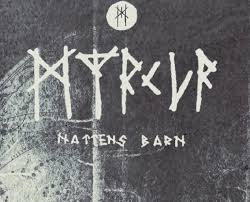
jun9SOUNDTRACK: MYRKUR-“Nattens Barn” (2014).

myrkurMyrkur is a black metal band whose sole member is a woman–Amalie Bruun, a Danish model who co-leads the Brooklyn indie-pop band Ex-Cops.

This six-minute song has elements of black metal (loud guitars, fast drums) and elements that transcend the genre (the first entire minute of beautiful choral voice).  As the song opens, multilayered voices sing (presumably in Danish) about what I imagine is the heavens (I’m curious about a translation, but won’t look for one).  After a minute the heavy guitars kick in–loud, but not scary loud (a kind of pleasant black metal, if you will).

Until 1:43 when she creams, the drums kick in, and it becomes black metal as we all know it is meant to be.  The song is loud fast and heavy.  But unlike most black metal, there are no vocals (at least that I can hear).  So the song cycles through a few sections.  After returning to the more melodic style, that heaviness keeps pushing its way back in.  It all ends rather suddenly after that five minute buildup.  Although there is a return to the choral voices of the beginning.

I’m intrigued by this and I love that the choral voices (something black metal has done in the past) are done (I assume) by Bruun herself, rather than a male band tacking on the ethereal voices.   Her new release is an EP, and I would like to hear some more of it, just to see what kind of vocals she uses.

[READ: June 17, 2014] “Gradual Impact”

This year’s Summer Fiction issue of the New Yorker was subtitled Love Stories.  And thus, we have a series of personal essays which fall under the heading of “My Old Flame.”  There are several short pieces.  And this year there are two illustrated stories by two wonderful artists.

The first is by Alison Bechdel.  Although I honestly don’t know if Dykes to Watch Out For is still an ongoing concern (which is a shame since i have so many of the early books), I love that Bechdel’s “self” character looks an awful lot (bit not identical to) DTWOF‘s Mo.  It brings a sense of comfort to the story (which I know is not her intention, but still).

In this story, the main character talks about falling for a woman in her karate class.  As it opens, the narrator berates herself for breaking off an affair with a woman who was “kind, beautiful, smart, interesting, sane and available.”  She asks, “What the fuck was my problem?” (more…)

Read Full Post »

june2SOUNDTRACK: THE BLACK ANGELS-Indigo Meadow (2013).

indigoThere’s another round of bands with Black in their name.  I had heard good things about this particular “black” band so I decided to get Indigo Meadow, their 4th album.  And while the album cover hints at the type of music (retro psychedelia), I was unprepared for the insane retro feel of this album.

The guitars are fuzzy, the keyboards are straight out of the 70s, there’s a middle eastern vibe and the vocals even sound of that era (a little tinny, a little fuzzy).  The music is a little heavier perhaps than the music of the era (well, except for Black Sabbath, of course)–louder, faster drums, newer guitar noises, things that make it sound new, not just like a lost relic

There’s something minor key and ecstatic about the way the title track builds and builds.  It’s an auspicious opening to the album.  It’s slightly off kilter but ever so catchy.

“Evil Things” has a big old heavy metal riff, but it throws in some different items–a slow soaring chorus and a big old Doors’ keyboard solo (over the top of that heavy metal riff) which creates an interesting mix of sounds.  “Don’t Play with Guns” has a slightly different sound, with a sixties pop chorus (under that psychedelic fuzz of their guitars).  The delicate keyboard opening of “Holland” quickly morphs in to a more retro keyboard sound with more echoed vocals.  It is one of the longer songs on the album at 4 minutes (So despite this album being psychedelic, the songs are all pretty short, emphasizing their pop roots).

Like “The Day” which is only 2 and a half minutes.  “Love Me Forever” has a very Byrds-ian feel, but with a far heavier chorus.  “Always Maybe” has an exotic sounding guitar riff and “Broken Soldier” has a really chorus (for a pretty dark song).

“Twisted Light” alternates between that retro keyboard and a buzzy guitar riff.  And the harmonies reinforce that era’s feel.  “You’re Mine” even sounds like it might be a cover (that chorus is a perfect example of psychedelic pop).  The final song plays with the set up somewhat by having the first two minutes build quietly before the big fuzzy guitars propel the song to the end.

So yes, the album is not original (although it is, since they take a style and aren’t afraid to tweak it) and it does not deviate from the style very much.  But it’s done so well.  And f you enjoy psychedelic pop (with a bit of heavy metal sprinkled on top), this i s an album that you will enjoy.  It’s 45 minutes of fuzzy pop fun.

[READ: August 17, 2014] “Ba Ba Baboon”

This is a story of deception, dishonesty and dogs.  It is told in third person and as we begin, we see that there are two people hiding in a pantry.  It turns out that the protagonist, Brooks, and his sister, Mary, are the ones hiding.  And they are hiding in someone else’s home.  We learn that whoever they are hiding from may have left.  But before we learn why they are in the closet, we learn a bit about Brooks.

He had an “accident” some time ago which did damage to his brain.  Someone smashed the left side of his head with a brick and took his car and wallet.  His memory isn’t what it used to be, but his “old self” likes to make jokes at his own expense (like singing “If I Only Had a Brain”).  And he is also rather different–he can’t tolerate smoke anymore even though he used to be a smoker, he can’t wear any dark clothes and he is intolerant of creases in his pants.  And, worst of all for Mary is that Brooks used to be the one who looked out for her–her big strong older brother, and now it is her turn to look after him.

So why has she gotten him trapped in a closet?  Mary says “we’ve been in here for an hour.  I don’t see the dogs.”  It turns out that on the other side of the flimsy door are two of the biggest dogs they have ever seen.  These are vicious guard dogs who can be turned of with a safe word, which Mary thinks is “Baba Beluga” or something like that. But that clearly isn’t it. The dogs and the house belong to Wynn, a “friend” of Mary’s.  (more…)

Read Full Post »

lp12SOUNDTRACK: OXFORD DRAMA-“Asleep/Awake” (2014).

dramaOxford Drama is, unexpectedly, from Poland.  Their lyrics are in English, although their Facebook site is all in Polish.

“Asleep/Awake” is a slow, synthy track with Małgorzata Dryjańska singing in a breathy whispery voice.  Her voice feels delicate even if the lyrics are somewhat empowering (and she has no discernible accent).  The instrumentation (all synth and electronic drums) is by Marcin Mrówka.  I like the way he throws in some occasional bass lines to add more texture to his simple beats.

The song feels very much like a 90s British trip hop sound.  Although on the more mellow side of trip hop. It’s quite pretty and dreamy.  It’s interesting to hear this kind of music coming out of Poland (although why shouldn’t it, honestly?).  I rather hope they break through in the states.

Their 4 song EP is available on bandcamp.

[READ: September 7, 2014] “Trilobites”

Lucky Peach issue 12 is all about “The Seashore.” And thus there are lots of beach-related foods under discussion. Lisa Hanawalt has a wonderful story about hanging out with otters (if she weren’t so hilariously vulgar (she’s wearing a shirt that says “Every day I’m not covered in otters is a piece of shit”) I’d have my kids read it because it is so cute). There’s a brief article explaining the particular smells of the seashore.

Chris Ying has a hilarious article about sea cucumbers (and just how hard it is to make them appetizing). And there’s a wonderful little section that compares the “sea” version of things to their “land” counterparts. Like the Sea Anemone, the Sea Cow and the Sea Horse and how different they are from the land based creatures with the same names.

There’s an amusing tribute to the Goonies (a movie I haven’t seen in 30 years); and a lot of talk about Crayfish. Perhaps the most interesting of these articles was the seaweed farmers—who basically say that any seaweed is edible, so next time you’re in the ocean, chow down.

And then there’s the clams and abalone and whatnot. This includes a brief explanation of the edibleness of 8 different bivalves. There’s also Robert Sietsema’s trip down the Atlantic Seaboard going to as many clam houses as he can.

There’s also an article about sushi—but not the sushi itself, rather the stuff that comes with it. Like Krab, which is not crab at all, but various fish pieces minced up and dyed to look like crab! Or the wasabi that you get, which is not real wasabi (real wasabi is super expensive ($100/lb)). That green paste is actually horseradish, mustard oil, citric acid and yellow and blue dye.

And what beach/resort issue would be complete without s tory about the Harvey Wallbanger (I enjoyed this history quite a bit).

The issue is also chock full of recipes and then it ends with this piece of fiction

“Trilobites” is set on a downtrodden farm in the South. I wonder if the South gets tired of their fiction depicting fathers as brutal drunks. In this case, there’s this instance of the father whipping the narrator: “One time I used an old black snake for a bullwhip, snapped the sucker’s head off, and Pop beat hell out of me with it.”

He is also not too fond of his mom. Once Pop died, his mother was interested in selling the fam. She’d like to move to Akron where she has family. He has no interest in the farm but doesn’t want to leave either. This exchange, in which they laugh at the funny phrases Pop used to say sums up his attitude:

I think back. “Cornflakes were pone-rakes,’ and a chicken was a ‘sick-un.’
We laugh.
“Well,” she says, “he’ll always be a part of us.”
…I think how she could foul up a free lunch.

The trilobites in the story are in Company Hill, a former river bed that is now home to fossils. The narrator has never been able to find a trilobite.

The narrator pines for his love from high school, Ginny. In her yearbook he wrote “We will live on mangoes and love.” But she left for Florida.

Now she’s back in Charleston on break and asked to visit. But as with many stories full of desperation, especially in the South, nothing good can come from anything.

He has to deal with the man who wants to buy the farm. He can’t really communicate with his mother. The girl who is still around (who is super cute) is jailbait. Even his “date” with Ginny is a disaster. She has a boyfriend back in college, she tells him. But she wants to have fun with him while she’s back. They fool around, but it is ugly and ends with Ginny mad. And even the trilobites don’t come out.

I just didn’t really get this story. I know I am out of my depth in a story like this as the boy huntsfor a “turkle” in the water (which I guess is a turtle). His father used to like “turkle in a mulligan” whatever that means. This is just not my kind of story.

Read Full Post »

backSOUNDTRACK: TOADIES-“Summer of the Strange” (2012).

summerstrageToadies had a hit (which is still played on “Modern Rock” radio today) in 1994 called “Possum Kingdom.”  I really liked the song because the tempo was way off kilter and the lyrics were inscrutable (“Do you wanna die?” “So help me Jesus.”).  And the singer had a screamy kind of voice that sounded like he might be unhinged.  It was a very improbable hit and yet there it was.  And then Toadies went away.

When I heard that they had put out other albums I was surprised, so I looked them up and saw that they got into all kinds of legal grief with their record label during the (abandoned) release of their second album.  And they basically broke up for like ten years. And then they got back together and then re-recorded their delayed album and then put out the album that this song is on.

I’ve only listened to couple of songs from Play.Rock.Music.  I didn’t like the one with the horns (that may have been a remix actually), but overall the albums sounded quite Toadies-like.  And this song (with the very weird–perhaps too intentionally weird) contained some of the craziness of that first single.  It opens with a simple bass and drum set up.  Then there’s some odd ball vocals and some fuzzy smattering of guitars.  Then the guitars roar in and the chorus is strangely catchy, and the lead vocalist sounds like he still might be a bit unhinged.

By the end of the song, the guitar solo is a wild affair and the rest of the band is noisy and distorted and a little sleazy and you kind of leave the song feeling just a bit dirty–a perfect Toadies song.

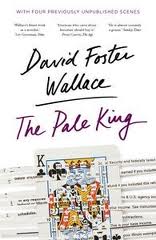
[READ: September 1, 2014] Pale Summer Week 8 (§48-§50)

Because I was on vacation, I didn’t notice that the Pale Summer group read had stayed on an earlier chapter and were just getting the read rolling again.  So, I’m already ahead of the spoiler line.  But since I have this post written and I’m anal retentive, I’m going to post my final sections on the originally slated date (okay a day late for Labor day).  But as a concession to everyone else, I’m going to save the end pages and my thoughts on the book for next week.

So this week’s post is about the end of the book proper.  And next week will contain the comments from Pietsch at the end of the book as well as the additional materials that were included in the paperback.

A lot of information is handed out in these first two sections.  However, it’s not entirely clear what happened. And as with the unfinished book we’re left wondering if any more of the story would have clarified anything. (more…)

Read Full Post »

bandetteSOUNDTRACK: ERNEST RANGLIN-Tiny Desk Concert #382 (August 16, 2014).

ernestErnest Ranglin is a pioneer in ska, by mixing elements of reggae and jazz.  And at 82, he still plays a great guitar.  The solo at about 3 minutes in is really fun and interesting.  What’s interesting about this concert is that Ranglin is playing with a group of very young (compared to him) people.  The backing band is called Avila  and they hold down the beat and the rhythms for the master, sounding like a perfect fit.

They play three songs in fifteen minutes: “Surfin'” and “Jones Pen” which are longish ska instrumentals (“Jones Pen” features a keyboard solo) and “Avila (Oscar’s Song),” which is a more mellow jazzy instrumental.  Sometimes it’s nice to hear some good musicians jamming out with no vocals to complicate what they’re playing, and this is a good example of that.

It’s a lot of ska in one session, but if you like the genre, it’s hard to beat this concert.

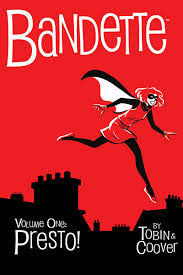
[READ: August 1, 2014] Bandette

Sarah brought this book home and said I would like it and she was very much correct.

Bandette is a young thief living in Paris.  She is adorable and sprightly, wearing a black mask, a red wig and a yellow and black cape.  Even though she is a thief she is a good thief–stealing wonderful things but usually from bad people.  But her charm comes mostly from her fun banter and delightfully light personality.  The story is delightful and the art by Colleen Coover is fantastic–I need to see more from her (and I can, at her website).

As the story opens we see her sneaking into a fancy house where she is accosted by an adorable little doggie whom she asks “Want to come along with me on a robbery?” When the dog bounds off with her, she says “Really! You do you naughty dog! You are as bad as a cat”  She easily finds the target–four small drawings.  But she stumbles upon the owner in bed with a woman (the book just crosses the line out of kid-friendly territory).  He calls for the guards to chase her.  Her acrobatic escape is at once exciting and charming.

As she makes her escape, she calls on her cadre of helpers, assistants and urchins.  These kids love Bandette and help her however they can.  There’s the three ballerinas, there’s the group of street urchins and there’s Daniel, a delivery boy for the awesomely named Rad Thai.  He has a huge crush on Bandette and will help her in any way.

We also see that Bandette is sort of working in league with the police.  Inspector Belgique knows that Bandette is a thief, but he also knows that she can help him with more serious crimes.  Like the one he is currently involved with–a group of men breaking into the bank (real thieving).  The inspector asks Bandette for assistance and she helps in the most unlikely way she can.
(more…)

Read Full Post »

oloveSOUNDTRACK: “WEIRD AL” YANKOVIC-“Jackson Park Express” (2014).

jpaThe final song on Mandatory Fun is a nearly 9 minute epic which is a parody of Cat Stevens’ style of music.  I would never have guessed that without having read this information online.  However, on listening to it more and more I can hear a lot of Cat Stevens-isms (piano lines and style of chord progressions, although definitely not in the singing style).  I also don’t know if the content is meant to be in reference to the Cat (well, a twisted version of the Cat, of course).

I typically love Al’s longer epic songs, but this one didn’t grab me at first.  Yet after a few listens, I’ve really come to appreciate the twisted humor going on here.   The song starts with some simple pretty acoustic guitars but quickly turns epic with swelling strings and backing vocalists.

The story is about two people on the Jackson Park Express bus in Chicago.  The entire relationship that unfolds is entirely in the narrator’s head.  He bases everything that happens upon the looks she gives him and implies everything through his own looks to her.  As with many Al songs, it starts not just mundanely, but actually sweetly.

I was riding to work on the
Jackson Park Express
Seemed like any other day
Then my whole world changed
In a way I never could have guessed
Cause she walked in
Took the seat right across the aisle
I knew we had a special connection
The second I saw her smile

Pretty nice, right?  And so we see the two communicate (in his mind) nonverbally

She smiled as if to say
“Hello, Haven’t seen you on this bus before”
I gave her a look that said
“Huh, Life is funny, you never know what’s in store
By the way, your hair is beautiful

Again, pretty sweet, until we get to the first wonderfully odd Al line (about her hair)

“I bet it smells like raisins”

And it just gets funnier as it goes on:

Then, she let out a long sigh
Which, I took to mean, “Uh”
“Mama, What is that deodorant you’re wearing?
It’s intoxicating
Why don’t we drive out to the country sometime?
And collect deer ticks in a zip-lock baggie”
I also really enjoyed this punchline:
I gave her a penetrating stare
Which could only mean
“You are my answer, my answer to everything
Which is why, I’ll probably do very poorly
On the written part of my driver’s test”

The song gets really dark and creepy, with (hilarious) lines like:

I gave her a look, that said
“I would make any sacrifice for your love–
Goat, chicken, whatever

And the far more creepy:

Whoa-o-Oh, “I’d like to rip you wide open
And french-kiss every single one of your internal organs
Oh, I’d like to remove all your skin, and wear your skin, over my own skin–
But not in a creepy way”

This is also Al’s most “sexual” song ever, with a line about french kissing (true, it is her organs, but whatever), and this hilarious dramatic pause:

Then, I glanced down, at her shirt, for a second
In a way that clearly implied–
“I like your boobs”

and this other hilarious dramatic pause:

I want you inside me…
oh, like a tapeworm”

But the romance was not to be.  She leaves the bus, despite his nonverbal pleading

Think of the beautiful children we could have someday
We could school them at home, Raise them up the right way
And protect them from the evils of the world
Like Trigonometry and Prime Numbers, oh no
Baby, please don’t go”

There is to be no romance on this bus line.

This is truly a love it or hate it song, but as with most of Al’s epic songs, the more I hear it, the more I love it.  And I can’t wait to see if he plays it live.

[READ: August 3, 2014] On Loving Women

This book is a collection of brief stories about women’s first crushes on other women.  I don’t know how the collection was compiled exactly, but it appears that various women told Obomsawin their stories and she made these fun little comic strip panels out of them.  (Helge Dascher translated them into English–she also did Pascal Girard’s book, that I posted about yesterday).

Each story is named (presumably) after the woman who related it to her.  And each one becomes a simple (but not overly simple) version of the attraction.

Mathilde is obsessed with horses and falls for girls with horse faces (the drawing that accompany this are funny because Mathilda is drawn like a kangaroo or something and the girls she likes are horses.  The ending of this one, about how she learns sign language was very touching.

Indeed, in all of the stories, the women have animal heads and human bodies (but not weird hybrid creatures, just cute cartoony creatures). (more…)

Read Full Post »

tpk4SOUNDTRACK: NEGATIVLAND-“Nesbitt’s Lime Soda Song” (1987).

limeThere are multiple references to Nesbitt’s soda in this book.  I am unfamiliar with Nesbitt’s except in this funny little song from Negativland (on their album Escape from Noise).  I have always liked this song, perhaps because it is so simple (and is an actual song) amidst the chaos of the album.

A simple strummed guitar introduces this quaint song about everyday frustrations:

We spent a lovely summer, my wife Elaine and me,
We bought us a great big motor home, with a shower and TV,
We was camping and having a great time, watching Brokaw on Today,
Till a bee flew into the Nesbitt’s Lime Soda, and we had to throw it away.

Now most of the time I’m a peaceful man, but I lost my temper that day,
Just one last bottle of Nesbitt’s Lime Soda, and we had to throw it away.

I’m including the second verse not only because of the sodas listed, which I find endearing, but also because of the phrase “good old Mountain Dew” which reminds me of something DFW would say:

I brought a case of Nehi, and Double Cola, too,
A half a dozen Upper 10’s, and good old Mountain Dew,
I bought a quart of cola-a, to get me through the day,
But just one bottle of Nesbitt’s Lime Soda, and we had to throw it away.

I think most of the Nesbitt’s in the story is orange (that was their big seller) but Nesbitt’s did actually did have a Lime (or I guess Lemon-Lime) soda as well

[READ: August 4, 2014] Pale Summer Week 4 (§23-§26)

After last week’s massive 100 page section inside of one person’s head, it’s nice to get back to some of these smaller sections.  I’m particularly pleased to have another David Wallace section, as I find his the most entertaining.

§23

This is a brief First person section that begins: “Dream:”  Rows of foreshortened faces, many blank doing endless small tasks. It was his psyche teaching him about boredom.  He was often bored as a child, but that boredom was not actual boredom.  Back then he worried and fretted a lot, feeling the “sort of soaring, ceilingless tedium that transcends tedium and becomes worry” (253).  It was anxiety with no object.

He was the nervous delicate son, as opposed to his brother, the gifted driven son whose nightly piano practice coincided with their father’s return from work.  I section that says “after the incident with my own son” (254) reminded me that someone suggested that “Incarnations of Burned Children” may actually fit into this book and it seems like that could be applicable here, although I shudder to think it.  In psychotherapy he realized that his family was Achilles.  His brother was the shield and he was the heel. His father was a warrior, but his mother’s role was unclear. (more…)

Read Full Post »

waterSOUNDTRACK: TRACY SILVERMAN-Tiny Desk Concert #368 (June 28, 2014).

Ttracyracy Silverman is an electronic violinist. In addition to playing the violin, he uses loops to build his sound (I love how many people are using loops these days).  Not only that, he has created his own violin–a six string with frets on the three low strings.  (It’s also shaped more like a guitar than a violin). He gets an incredible breadth of sound out of it (and he is an amazing violinist as well).

He plays three tracks. The first is “Matisse: La Danse,” which really shows off the breadth of his instrument and the effects that he uses.

The second piece he introduces by saying how much he loves listening to NPR and composer BJ Liederman.  So for the second song, which he calls “Sonata No. 4, Opus 37 “All Notes Considered”” he uses pieces of the themes from All Things Considered and Morning Edition.  It’s at once familiar and new, and it’s quite pretty.  He then takes a video of the studio for his Facebook feed.

The final song “Axis And Orbits/Mojo Perpetuo” opens with a trippy pizzicato section, which sounds echoey and almost underwater.  As that section loops, he plays slow, long bowed notes that seems to bring you into outer space.  By the end, after some interesting scratchy guitar-like sounds, he moves into a much faster solo section which really shows of his chops.

I’d never heard of Silverman before but I was pretty impressed with his technique and technology.  It’s a pretty wild ride of music–such diversity and unexpected sounds our of a simple (or not) violin.

[READ: July 5, 2014] Water Baby

I recognized the art from Ross Campbell immediately.  He writes and draws Wet Moon and I find his style (he draws women who are very powerful and very sexual) arresting and confrontational.  This book almost seems like it doesn’t belong at Minx, which tended to skew a little younger.  Even though these girls prove to be younger than I thought, their dress (or lack of—there’s a lot of underwear and tight shirts) is quite risqué (although it proves to be less explicit that Wet Moon).

The story itself was rather unexpected as well.  Brody is a surfer girl. She has cool punky hair and a rocking bod.  But in the first few pages, she is out on the water when she is attacked by a shark and loses a leg.  When she wakes up her best friend Louisa is there, taking care of her.  Since Brody’s mom is working full time, she asks if she can stay with Louisa —the answer is yes, and Louisa becomes an essential part of Brody’s life.  Many of Campbell’s stories focus on the young people, rather than the parents.

Brody soon learns to use a prosthetic leg (and crutches when necessary), but she can’t stop dreaming about the shark (which gets bigger in her dreams and sometimes has legs or comes through walls—it’s pretty terrifying).

Brody gets a call from Jake, and old boyfriend.  Brody hates Jake now and even says she’s off of boys for good.  But he shows up anyhow—he’s blond and hot and maybe a little stupid.  Stupid or not he is a total mooch and he asks to crash with them for a few days.  Jake is clearly crushing on Brody, but he is also making moves on Louisa (who has bigger boobs and tighter shirts).  He even brings a third girl over to fool around with (which freaks out everyone else in the house). But it’s not until the girls wake up one morning to see that Jake has thrown up all over their house that they evict him—which means an immediate drive to Rochester NY. (more…)

Read Full Post »

karl2SOUNDTRACK: BRASS BED-Tiny Desk Concert #339 (February 24, 2014).

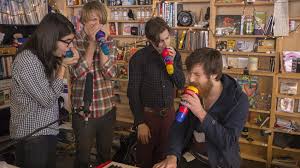
brass bedI expected Brass Bed to be a goofy band because of the snapshot image of them singing into toy microphones.  I was initially disappointed by how normal they were, but I was soon won over by their interesting floating sound. They have this overall trippy underwater vibe (which seems to be accomplished by a bowed slide guitar). This is especially notable on “Yellow Bursts of Age” their best song in the set.  Later the guitar solo is echoey and also underwatery. It’s a very wild sound for a fairly simple song.

They tell a funny story about being from Louisiana and encountering Washington DC snow and (of course) not having an ice scraper (although they did have bag of sand).

“Cold Chicory” is an upbeat sounding song musically although it is kind of a bummer lyrically, but again there’s the great sound of the bow on the slide guitar and the echoey lead guitar. “Please Don’t Go” is a slow song—with more interesting effects from singing into that slide guitar.

The plastic mikes do come out in the last song “Have to be Fine” in which they sing into the echoey mikes for the intro (with very nice harmonies).  They sing the intro for about a minute, and then the slide guitar player takes lead vocals on this simple but pretty song (I don’t know any of their names).

At the end, the NPR folks gave them an honorary NPR ice scraper.

[READ: June 24, 2014] My Struggle Book Three

boyhoodI read an excerpt of Book Three just a few weeks ago.  And in the post about it I said I wouldn’t be reading this book for quite some time.  But then the book unexpectedly came across my desk and I couldn’t resist grabbing it while it was here.  So it appears that I will now have to wait well over a year before Book 4 (which is, I think about 1,000 pages–yipes).  I also see that Book Three is fully called “Boyhood Island” in Britain.

At the end of Book Two, Karl Ove was more or less caught up to the present–writing about what he was then up to (with a few years gap, of course).  So it makes sense that this book is about his childhood–showing us how he came to be the man he is.

The book, amusingly enough, starts off with memories that he cannot possibly remember, and he even says as much.  He is using memories of his parents and piecing together pictures from when he was an infant.  In 1970, (Karl Ove was born in 1968) his family moved to the island of Tromøy tromo(and check out the idyllic picture that Wikipedia had).  This is where Karl Ove spent his (rather traumatic) formative years.  Their island is small, so he knows everyone in his school, but there are some amenities around like the Fina station and the B-Max, and there’s lots of soccer to be played and bikes to be ridden.

Things seem normal at first–he runs and plays with his friends, there is ample green space to run around in, and they have boats to sail on.  And we meet two of Karl Ove’s earliest friends: Geir and Trond (so many people are named in the book, I’m very curious to know if any of them remember him).  In an early scene they chase the end of a rainbow looking for a pot of gold (and have a discussion about what happens to it when the rainbow vanishes (the boys even play a prank on Karl Ove that they actually found the pot,a dn while he doesn’t initially fall for it, he is compelled to go back and they tease him).

But the looming figure here and throughout the book is Karl Ove’s father, who, at least according to Karl Ove’s memory, is pretty much a monstrous dick.  He is demanding and exacting, unforgiving and seemingly uncaring.  He is either bipolar or a drunk, jumping from goofy to outright rage in a mater of seconds.  Karl Ove and his brother Yngve fear him unconditionally and, by the end of the book they both seem to hate him.  The scene where their dad tries and fails to teach Karl Ove to swim is heartbreaking, especially when the dad goes home and tells their mom right in front of him “He’s frightened of water.”  There are dozens of instances of fear and intimidation (often accompanied by a wrenching of Karl Ove’s ear).  Like when Karl Ove turns on the TV for his grandparents (he wasn’t allowed to touch the TV but he wanted to do something nice for them).  After a few minutes, the TV fizzed out and, naturally, he was blamed for it and sent to bed without supper (after some minor physical abuse). (more…)

Read Full Post »

« Newer Posts - Older Posts »