Feeds:
Posts
Comments

Archive for the ‘Sex’ Category

bream SOUNDTRACK: THE INTERNET-Tiny Desk Concert #474 (September 29, 2015).

internetThe Internet are an offshoot of Odd Future.  This is an R&B group fronted by Syd the Kid, and the music is really delicate–almost easy-listening-sounding keys and a ropey bass line.

Syd’s voice is beautiful and soulful and she raps and sing delicately.  Which is why it’s surprising that the first words of the first song are “now she wanna fuck with me / live a life of luxury.”  But after the surprise of these lyrics the chill music is kind of soothing: “roll up an L and light it.” And I love her falsetto for the chorus”

“She blowin up my phone.  All I hear is wha wha, wha wha (Band: wha wha).”

“Under Control” is a song dedicated to her band:  she promises she’ll be there for all of them “when I’m a legend baby and we’re all rich”

Her confidence and casualness is totally infectious. And I love the the wah-wahs effects on the keys as the song nears the end.

The last song is called “Dontcha” which gets a “yes!” from the crowd when she says she’s going to play it.  (That makes her very happy).  She says she’s never done an acoustic version before.  I gather it’s a single, although I enjoyed the other two songs a bit more.

The veering into R&B territory is not my thing, but it’s cool to hear her branch into different genres in one song.

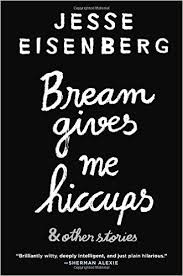
[READ: May 15, 2016] Bream Gives Me Hiccups and Other Stories.

I’ve really enjoyed the comic pieces that I’ve read by Eisenberg–he writes a lot for the New Yorker.  In fact, I had recently decided that I would read and post about all of Eisenberg’s New Yorker pieces at some point in the future.  Well, it turns out that nearly every one of those New Yorker pieces has turned up in this book (there’s three that didn’t).  So that saved some time.

What that means is that most of these pieces are quite short.  And that very few of them are stories in the conventional sense.  They tend to be a few pages long, or sometimes longer pieces done as diary entries.

What is most interesting about Eisenberg’s writing is that most of these stories are funny–some are very funny–but there is also a lot of pathos and sadness in them.  Many of the characters come from broken homes and many of the situations are rather bleak.  And yet he manages to make them funny. (more…)

Read Full Post »

shadowSOUNDTRACK: ERIC CHENAUX-Skullsplitter [CST112] (2015).

chenAn album named Skullsplitter sounds like it should be really heavy and loud.  But if you know Chenaux, you know that that’s not his thing at all.  So what wins?

The traditional Chenaux wins.  At times light and beautiful and at times wobbly and disorienting, Skullsplitter sounds like many other Chenaux releases.  And you either like him or you don’t. His slow songs, vibratoed guitar and really delicate voice either win you or not.

“Have I Lost My Eyes?” has one of the most wobbly guitars I can thing of (even for him).  The slow electric guitar solo is pretty much perpetually played with wah-wah bar in motion.  After 90 second of this, Chenaux’s delicate tenor voice comes in and sings a melody that is not exactly suited to the music, but which doesn’t sound off, either.  Classic Chenaux.

Alternating with the vocal pieces are instrumentals.  Chenaux plays a lot of ringing and delicate solos and overdubs them.  And the instrumentation is pretty varied: Voice, electric guitar, un-amplified electric guitar, nylon-string guitar, speakers, melodica and electronics.  “The Pouget” is roughly two minutes long.  “My Romance” has a kind of warbling guitar solo over some mellotron.  “The Henri Favourite” is another 2 minute slow piece with a slow guitar solo played over some keyboards.  The last instrumental is quite different.  “La Vieux Favori” changes the tone with a bowed sound (although you can see there’s no violin listed–he must be bowing the guitar).  It doesn’t have the same smoothness as the other songs, although it is certainly interesting, especially near the end when it is just that bowed instrument with no accompaniment.

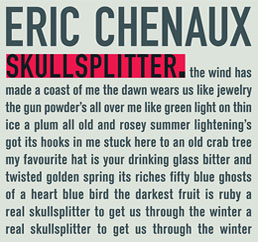
“Skullsplitter” is, as I said, a mellow song just like the others.  His voice is relaxing and calming and the music is also mellow with waves of keys.  I’ve never really tried to figures out the words to any of his songs before–he sings so slowly it’s kind of hard to follow the thoughts.  But the lyrics to this song are the cover art.  And seeing them printed, I still don’t know what they mean.

“Spring Has Been a Long Time Coming” is the most friendly song of the bunch–music and vocals meld perfectly, and Chenaux’s guitar sounds beautiful.  The 8-minute “Poor Time” has a jazzy feel as it unfurls slowly.  It intersperses his vocals with a delicate but wildly-wah-wahed solo.  The final track, “Summer & Time” ends the disc with some pretty acoustic guitars and Chenuaux’s delicately soaring voice.

[READ: June 1, 2016] Lighter Than My Shadow

I was looking on the shelves in the library for some books and I saw this book on the shelf next to them. I loved the title, Lighter Than My Shadow and when I pulled it off the shelf, I really liked the drawing style that Green employs.

I genuinely had no idea that this book was going to be about woman suffering from body issues and anorexia.  It all seems obvious, but i didn’t look that closely at first.  Such a topic could be really hard to read about, but I was also really surprised and delighted at how good the book was.

She covers her mental state in all capacities.  And she really demonstrates the way her body rebelled against herself.  In fact, this was the most compelling and complete look at anorexia that I have ever seen.

There is something about the way her drawings style–simple figures and even simpler backgrounds work perfectly in this story.  She is able to show herself getting thinner without resorting to shocking illustrations (well, there are one or two mildly shocking ones).  The most effective part of the book is the black scribble that hovers around her representing her interior self. (more…)

Read Full Post »

julyaugSOUNDTRACK: RHEOSTATICS (Art Gallery of Ontario, Toronto, ON, September 5, 2015).
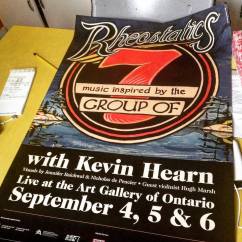
06Sep2015Almost exactly one year ago, my family traveled to Toronto as a mini-vacation.  The impetus was my scoring tickets to see the Rheostatics live for the first for me (and potentially–but not in reality–last) time.

They had called it quits 8 years earlier and were reuniting for the 20th Anniversary of their Group of 7 album–a soundtrack of sorts that was created to celebrate the works of the great Group of 7 artists.  They were scheduled to perform three nights at the Art Gallery of Toronto.

I purchased tickets to the second night assuming that the first night they might be a little rusty and the final night they might be burnt out.  Well, it turns out, that was completely faulty logic.  The first night was pretty great.  The final night was outstanding and my night proved to be the weakest of the three.  Of course, it was still awesome, especially since I didn’t know that it was the weakest at the time).

In terms of recordings, this one is a little less clear than yesterday’s show as well (it was recorded from the upper section of the hall).

The Go7 part of the show was pretty stellar.  You can read my review of the full show here).  During the break after track Six, Dave began talking to us, mostly thanking people and then commenting “we’re totally feeling the love.”  Dave says his dad’s here tonight and he lent us his car for their 1988 tour. (Sorry, dad).

When the Go7 album was over, the band played some bonus tracks.  Last night they played “Claire” and “Horses,” two songs I would have loved to hear.  So when Tim walked up to the mic, I was sure we’d get Claire, but instead, we got “Henry’s Musical Beard,” a one minute song of total what the…?  I can’t imagine when it was ever played before.  But even though i didn’t get the songs I really wanted, I did get some songs that were still awesome: “Bad Time To Be Poor,” “Stolen Car” (amazing!), “Legal Age Life” (much fun), “Christopher” (another favorite), and “Saskatchewan.”

“Bad Time” sounded great–a lovely Tim sung song.  Before “Stolen Car,” Dave described it as a desperation song, there are bad things going on in our country we have chance to change that on Oct 19.  (Hard to believe that our election process was underway at that time as well).  Martin seemed to miss a bit during the song, but was backed up wonderfully by Hugh Marsh on violin.

“Legal Age Life” was a lot of fun.  Before the song began he shouted, “Fuck art, let’s dance.” And dance we did.

Our version of “Christopher” was pretty catastrophic.  Before playing it, Dave introduced it by saying, “Let’s hear it for Saskatchewan.”  But they played “Christopher.”  It has a very cool slow opening, but Martin got really lost during the song.  He repeated lines, forgot words and about half way through, he just ended the song (two minutes shorter than the other ones).  I remember being concerned for him, because he seemed really upset about the performance.

They ended the show with “Saskatchewan” a great song that I love (and we were the only night to get it, so yes, we were lucky indeed).  As I say, at the time, I was so excited to be there and to hear everything.  It is definitely sour grapes to complain about the other nights, and I should just consider myself lucky that I can still hear them.

But between Martin’s stress and Dave’s surprising lack of banter (and, no “Claire” or “Horses”), Saturday was definitely the weakest night of the three.

Amazingly, though, with the various differences, the length of the concert is almost exactly the same length as the first night).

01. One (Kevin’s Waltz)   2:40
02. Two (Earth (Almost))   7:42
03. Three (Boxcar Song (Weiners and Beans))   7:00
04. Four (Landscape And Sky)   0:46
05. Five (Blue Hysteria)   3:55
06. Six (Cello For A Winter’s Day)   8:03
07. Banter   4:05
08. Seven (Northern Wish)   5:09
09. Eight (Snow)   2:05
10. Nine (Biplanes and Bombs)   7:00
11. Ten (Lightning)   8:01
12. Eleven (Yellow Days Under A Lemon Sun)   7:53
13. Henry’s Musical Beard   0:57
14. Bad Time To Be Poor   5:31
15. Stolen Car   8:54
16. Legal Age Life   7:05
17. Christopher   4:27
18. Saskatchewan   7:36

[READ: August 19, 2016] “The Shoe Emporium”

The July/August Summer Reading Issue of The Walrus has a theme of “Love and Lust.”  The theme promised to be a bit more upbeat than the darker stories in the last few issues.  Of course the other two stories this month were a little dark, but this one was pretty much just very funny.

It involves a delightfully convoluted romantic triangle of people working at The Shoe Emporium.  And I loved the way the story was structured.

We begin with Steve, a 40-something year old guy working as a shoe salesman (he has a past).  He is helping a customer and she is kind of smitten with him.  Steve is hunky, and has the best features of his Irish-Canadian heritage showing.

And then the story shifts to his boss, Cathy.  Cathy is 20 years younger than him–although she makes less money.  We lean about Cathy because of a high-tech device that measures the heat of people’s feet (to best get their feet to match a shoe).  Cathy had pressed it to her heart to demonstrate.  She was showing this to the other salesman, Marty.  But Steve saw it as well and thought that he could see an imprint of her nipple in the pad.

When Steve saw that, he was instantly turned on.  Mostly because he typically didn’t think much of Cathy before that.  She’s usually angry–justifiably as she is working two jobs and going to school.  But mostly, she really wants to win the top salesman prize–a  trip to Toronto and tickets to the musical Kinky Boots.

Even though he knows she wants to win, Steve is trying his best to beat her even though he doesn’t care about Toronto or the musical.

The two are pretty close in sales and he is doing a great job today.  Across the store, Cathy has a family with a crying child–never a good sign for mega sales.  Especially since the daughter wants an expensive shoe which the mother doesn’t want to buy.

But what of Marty?  Marty also has a fascinating back story.  Until recently, he lived with his grandmother.  She recently passed away (in a shocking fashion).  She was also a marine biologist and there is some amusing talk of sea cucumbers.  His grief was intense and he went to a gay party (he is 100% gay) and took a lot of drugs.  He’s been in a haze since.  And he has recently hooked up with Cathy.  But it had to have been the grief or drugs because Marty is definitely 100% gay (he thinks Steve is pretty hot too).

Cathy knows Marty is gay, but she believes the hookup has changed things–it was pretty great.

As the story comes to a close we get a close up look at that hook up which is steamy and funny, and we see Steve double down on trying to sell an expensive pair of Saucony to a customer who clearly can’t afford them.

I’d love to see more of this story–I really want more of these three.  This has been my favorite Walrus story in a long time.

Read Full Post »
julyaugSOUNDTRACK: RHEOSTATICS (Art Gallery of Ontario, Toronto, ON, September 4, 2015).

06Sep2015Almost exactly one year ago, my family traveled to Toronto as a mini-vacation.  The impetus was my scoring tickets to see The Rheostatics live for the first for me (and potentially–but not in reality–last) time.

They had called it quits 8 years earlier and were reuniting for the 20th Anniversary of their Group of 7 album–a soundtrack of sorts that was created to celebrate the works of the great Group of 7 artists.  They were scheduled to perform three nights at the Art Gallery of Toronto.

I purchased tickets to the second night assuming that the first night they might be a little rusty and the final night they might be burnt out.

Well, it turns out that the first night was really strong.  There are two recordings of the show on the Rheostatics Live site.  Obviously the content is the same, but the sound is different in each one.  (The Eric Mac Innis recording is quite muffled and bass heavy so you can’t really hear any of the spoken stuff).

The main content of the show-the music from the Group of 7 album is pretty consistent through all three nights.  It’s mostly the length that varies on a couple of tracks and some little details that change from night to night.  On this night for instance the opening speech that in which the man says “every Canadian” does not repeat like it does on the other nights.  It also seems like “Six (Cello for a Winter’s Day)” doesn’t get quite as crazy and loud before the “jazzy” section comes in.

Before they get to “Northern Wish,” Dave introduces “Northern Wish,” by talking about how he wrote it: “The amazing thing about Canada is that every time you leave the door an incredible impossible journey is waiting for you not far from your house.”

They didn’t play “Ten (Lightning)” the first night, so it’s fun to hear all of the audience whoops and wolf howls during the set.

Dave Bidini is in great banter mode, which is no surprise really.

He first starts talking after track six.  “Nice to see you again, you’ve all age well.”  After welcoming everyone he jokes “Really tonight’s about hooking up.  Last night as a bit of a meat market.”  This causes Martin to ask, incredulously, “you’re kidding.”

Upon introducing the record properly he says that this was “music commissioned 20 years ago–remember 1995?”  Someone shouts “Don’t forget the vinyl, Dave.”  So he jokes, “We’ve only been inactive for 8 years and in that time vinyl has made a resurgence.”

They only performed this album “four times over the course of their speckled career.”  Interesting that they will do it three more over the next three nights.

So that leaves the bonus tracks.  The first night they played four: “Claire,” “Easy To Be With You,” “Christopher” and “Horses.”

Before starting “Claire” there’s a little down time so Dave introduces Kevin Hearn and asks him what his favorite snack is.  Kevin: “Have you heard of ants on a log?”  Dave says his is a Cadbury Crunchy bar which “lasts a half hour if you nurse it.” MT: “What kind of chocolate bar eater are you?”  Then Dave asks, “Shall we go around the horn?” to much laughter.  He speculates, “Tim’s gonna say …”  But Tim says “home-grown carrots” which elicits an “ewww.”  Dave says, Tim you’ve changed so.”

As they start “Claire,” Martin introduces Hugh Marsh on the violin.  He says that at the first concert he ever went to Hugh was playing with Bruce Cockburn and now they are very very very close friends.”  He then mentions their other band, Nick Buzz (which Hugh plays in) and he says Nick Buzz “only played four gigs on our career.”  “Claire” is played wonderfully.  They talk about it being kind of obvious (“interesting because it’s totally obvious”) that they’d play it.  But “Easy to Be with You” a track from Harmelodia is a pretty surprising choice–a popular song sure, but certainly not a huge one.  Before the song, he sings Happy Birthday to him mom: “Happy birthday to Sheila / Happy birthday to my mom / She’s 75 years old  / and she’s standing right there.”  In the middle of the song Bidini comments that Stephen Harper is not the Prime Minster of Harmelodia (indeed, he is not).

Dave asks is anyone under the age of 7 is there.  Kevin says: “My dad’s here.”  Dave asks, “Is he a leap year baby?”  Then Kevin explains that it is his dad who is reading the “Tall White Pine” poem.  Then they ask Don if he has any family there.  Don says “All of them.” Dave says “Don’s four families are here.”

The Jeff Robson recording has some weird digital feedback and static.  It’s mostly during the chatting parts, but it does impact the songs a little.  There’s some static on “Christopher,” but otherwise it sounds pretty good.

Before “Horses”someone asks “who should we vote for?” Dave says “Never listen to a pop star when it comes to politics.  Tomorrow will be political night.”

And “Horses” is a dynamite version, notable mostly for the fact that Bidini doesn’t do a spoken word section in the middle of the song (keeping it unpolitical).

01. One (Kevin’s Waltz)   1:47
02. Two (Earth (Almost))   7:33
03. Three (Boxcar Song (Weiners and Beans))   6:16
04. Four (Landscape And Sky)   0:42
05. Five (Blue Hysteria)   4:33
06. Six (Cello For A Winter’s Day)   6:01
07. Chat   5:40
08. Seven (Northern Wish)   5:35
09. Eight (Snow)   1:18
10. Nine (Biplanes and Bombs)   6:13
11. Ten (Lightning)   6:30
12. Eleven (Yellow Days Under A Lemon Sun)   4:50
13. Clarie Intro   1:21
14. Claire   4:47
15. Chat   2:56
16. Easy To Be With You   3:32
17. Chat   3:19
18. Christopher   6:08
19. Horses   8:07

[READ: August 19, 2016] “Never Too Late”

The July/August Summer Reading Issue of The Walrus has a theme of “Love and Lust.”  The theme promised to be a bit more upbeat than the darker stories in the last few issues.

Bev is a man who is long divorced.  He couldn’t provide his wife with children so she left him.  He doesn’t seem very bitter about it and is even still friendly with her as well as her new husband and their children.

Bev owns a farm–he has some horses and cows.  On a cold morning in April, a strange dog appears on his property.  It’s a friendly dog but he wants to get it to its owner so he brings it into town and learns that it belongs to Janice and  “She loses her [dog] at least once a week.”

He goes to Janice’s house and she is very happy that Bev found “Keller.”  He brings the dog upstairs to her place and is surprised to see that she is in an electric wheelchair.  He notices that she is too young to be in it due to age.  And, she’s also very attractive. (more…)

Read Full Post »

julyaugSOUNDTRACK: RHEOSTATICS (Art Gallery of Ontario, Toronto, ON, September 3, 2015–surprise show).

06Sep2015Almost exactly one year ago, my family traveled to Toronto as a mini-vacation.  The impetus was my scoring tickets to see The Rheostatics live for the first for me (and potentially–but not in reality–last) time.

They had called it quits 8 years earlier and were reuniting for the 20th Anniversary of their Group of 7 album–a soundtrack of sorts that was created to celebrate the works of the great Group of 7 artists.  They were scheduled to perform three nights at the Art Gallery of Toronto.  The night before their first show, Thursday the 3rd, there was a tribute show and the Rheos made a surprise appearance.

They played half of the Group of 7 album and a few encores.  The sound is a bit muted but is pretty clear.

The opening track, ” One (Kevin’s Waltz)” is played by Kevin Hearn and sounds great.  For the first proper band song, “Two (Earth (Almost))” they sound tight but maybe a little stiff in the bah bahs.  “Three (Boxcar Song (Weiners and Beans))” is a loose song and the band sounds great. Although I cannot believe that people are talking during the song–especially during Martin’s singing of “Five (Blue Hysteria)” the first time Martin has sung in years!

“Six (Cello For A Winter’s Day)” is usually a noisy/jazzy number.  The recording is a little too muffled to hear details, but the song sounds good, especially Martin’s guitar workout at the end. After this, they skip a few songs and go right to the end, with Kevin’s “Eleven (Yellow Days Under A Lemon Sun).”  Kevin’s voice sounds a little rough I must say.

And then they take time for a little chat with Dave, in which he says “We used to be the Rheostatics.”  And before returning to the album, he says “We’re here for three more night, try the veal.”

For “Northern Wish,” Don Kerr is on cello Tim is on upright bass, and it sounds great, a really beautiful version.

“You guys bought the cheap tickets, eh?  We’re gonna cheapen up this next song for you.  Martin comments “Let’s get fucking cheap.”  They’ll do one more song.  Dave says The other shows will be longer.  “But they’re fucking sold out–Stubhub, folks.”

Martin thanks Kristine Peters and clonazepam [ a seizure medicine, also called an anti-epileptic drug].  Dave jokes, “that’s Martin’s old band.”

As they play a gorgeous Saskatchewan, Dave notes, that it’s their “First time playing together in 8 years.”  Martin plays a slightly off chord and then comments “It’s been a long time.”  But his guitar sounds amazing throughout.

Before the final song, David says “because we can’t stop playing we’re gonna do one more–we gotta catch the last street car (someone in the audience yells “too late.”)  There are the perennial requests for “Horses” with someone shouting “Holy Mackinaw Joe,” but instead they play “Legal Age Life, with Paul Linklater (who played in the tribute show) to play some guitar.

I’m including the setlists from each night mostly for the duration of the songs–they did some versions longer than others, but were mostly right on time–(and to compare encore selections).

01. One (Kevin’s Waltz)   1:47
02. Two (Earth (Almost))   7:14
03. Three (Boxcar Song (Weiners and Beans))   6:47
04. Four (Landscape And Sky)   0:51
05. Five (Blue Hysteria)   3:43
06. Six (Cello For A Winter’s Day)   6:08
07. Eleven (Yellow Days Under A Lemon Sun)   3:32
08. Chat   1:09
09. Seven (Northern Wish)   5:25
10. Encore Chat   2:19
11. Saskatchewan   8:05
12. Encore Chat   1:35
13. Legal Age Life At Variety Store   4:14

[READ: August 19, 2016] “Bye Judy and Good Luck”

The July/August Summer Reading Issue of The Walrus has a theme of “Love and Lust.”  The theme promised to be a bit more upbeat than the darker stories in the last few issues.

This is the story about “Fun-Sized” Judy.  She’s called “Fun-Sized” because of her height: “she’s no more than four-foot eleven, probably twice as wide.”  And, most importantly “None of us would ever fuck her, but we all agree she’s a riot.”

The “none of us” part is interesting because the whole story is written in second person.  as the song progresses it’s unclear if the “we” refers to a group (at times it seems like it) or a single person speaking as a group (which seems more likely at the end).

So despite her unattractiveness, Judy is enjoyed by just about everyone: Judy is a lot of fun, “one of the reasons we love her…. she never knows what she’s thinking.” (more…)

Read Full Post »

guibertSOUNDTRACK: JACKSON BROWNE-Tiny Desk Concert #394 (October 6, 2014).

jbI don’t really think much of Jackson Browne.  He’s always been a staple of classic rock radio, but I never especially sought him out. His voice is unique and recognizable although if pressed I can’t think of the names of any of his songs (but I’d know them immediately if I heard them).

Bob Boilen talked with Browne in his book and that’s where I learned that Browne dated Nico from The Velvet Underground fame and even wrote songs for her.  I also learned that he is quite the activist.  And that he plays a lot in California with various performers (the blurb says “he’s largely free of obligations”–that’s a nice phrasing).

He plays three songs here.  I assume they’re all new as I don’t recognize them.  And they all sound very much like Jackson Browne.  He voice is largely the same although it does crack and break a few times (could that be the setting or the time of day or does he just accept that he’s getting older?).

It’s also interesting that Browne plays the rhythm guitar for most of the songs–allowing Val McCallum to play the lead guitar and Greg Leisz to play “all manner of stringed things” (including the slide guitar solos).

The three songs are “Call It A Loan,” “The Barricades Of Heaven” and “Long Way Around.”  I’m surprised at just how long these three songs are (the whole set comes in around 20 minutes).

Before “Long Way Around” (which is quite political), he says that they’re “Lucky to play for such an informed group.”  Bob says they stopped the news–there’s no news being made–so that Browne could play.

Some of the lines in “Long Way Around” are: “It’s hard to say which did more ill, Citizen United or the gulf oil spill” and “It’s never been that hard to buy a gun, now they’ll sell a Glock 19 to just about anyone.”

The songs are nicely accentuated by the backing vocals of Jeff Young who also plays keyboards for them but which they couldn’t bring.

This is a delightful, mellow (and thoughtful) set of music (with a huge crowd watching).  And there’s a funny moment at the end where someone triggers a James Brown doll and Browne does a pretty good “hit me!”

[READ: March 2, 2016] How the World Was

I was intrigued to read this book by Emmanuel Guibert because I’ve really enjoyed his work lately.  But how was I to know that How the World Was is a prequel of sorts to Alan’s War?  It was also translated by Kathryn Pulver.

This book is a”loving, immersive portrait of Alan Cope.”  Cope was born in 1925 when California was still the frontier and life was simpler and harsher.  And Guibert felt that it was a gift for Cope “in the last moments of his life” (unlike in Alan’s War there’s no word on whether Cope saw this book).

So this book is indeed all about Cope’s childhood.  And while he did have some pretty interesting things happen to him, his childhood was in no way extraordinary.   This is just a simple portrait of growing up in Californians in the 1920 s and 1930s as seen from one man’s eyes. (more…)

Read Full Post »

tny 5.26.08 cvr.inddSOUNDTRACK: PACIFICA QUARTET-Tiny Desk Concert #383 (August 18, 2014).

pacificaIn this Tiny Desk Concert, the Pacifica Quartet explore the world of a single composer, Dmitri Shostakovich.  They will play three movements from different Shostakovich quartets

The quartet consists of Simin Ganatra and Sibbi Bernhardsson on violins, Masumi Per Rostad on viola and Brandon Vamos on cello.

I’m going to quote a ton from the NPR blurb because they know from what they speak.  But I’m going to chime in that these pieces are really cool.  I like Shostakovich, but haven’t really devoted a lot of time to him. His music seems at times playful and at other times very dark.

In the first piece I love how that three note motif recurs in different places and then the piece turns into a delicate pizzicato section.

The second piece is so light-hearted as it starts–pastoral and lovely.  But there hangs a slightly menacing version of that pastoral riff.  I especially enjoyed watching the cellist bow aggressively.  It goes a little crazy towards the end but somehow remains upbeat.

The final piece plays off of the notes of Shostakovich’s initials (they explain all about this in the intro and what the S and H are in terms of musical notes).  It’s amazing to think that these different parts play with those four notes in a different way.  It’s an intense piece and reminds me a bit of Psycho.

From the blurb [with my comments in brackets]:

With the arguable exception of Béla Bartók’s six string quartets, it’s generally accepted that the 15 by Dmitri Shostakovich are the strongest body of quartets since Beethoven….  The Shostakovich quartets are intense, like page-turning thrillers, as they pull you into his world. They are dark and introspective, witty and sarcastic, and stained with the Soviet-era violence and hardship the composer lived through.

Quartet No. 7 in F-sharp minor, Op. 108 (1960) Allegretto
Eerie pizzicato and piercing stabs in the violins help color the twitchy, even sinister, opening movement of the Seventh Quartet. Stalin might have been dead since 1953, but hard-line Soviet politics (including the violent suppression of the 1956 Hungarian uprising) were still in place. The music’s lightness and transparency create a crepuscular feel.

Quartet No. 3 in F major, Op. 73 (1946) Allegretto
The Third Quartet’s first movement looks back to a slightly more pleasant time before World War II. At one point Shostakovich considered a subtitle: “Calm unawareness of the future cataclysm.” The jaunty opening theme, like Haydn after a few beers [now that is a hilarious line], is among the most lighthearted in the 15 quartets. But the mood sobers with an intense double fugue before returning to the opening music and a flashy final page.

Quartet No. 8 in C minor, Op. 110 (1960) Allegro molto
The Eighth Quartet is Shostakovich’s most popular — and one of his most hair-raising. He dedicated it to victims of fascism and war while at the same time creating his own epitaph. The entire quartet is built on a foundation of four notes that spell out his first initial and the first three letters of his last name [watch in the beginning of the piece as they demonstrate these notes]. The second movement juxtaposes violent energy with a tweaked version of a Jewish folk theme from an earlier work.

[READ: February 27, 2016] “The Full Glass”

I never understand how the New Yorker selects what it will publish each week.  Sometimes authors can go for years without a piece and sometimes they can go just a couple of months.  Such is the case with 2008 where there have been many duplicate authors in the span of a few months.  Updike’s last story in the magazine was in January of 2008–that’s barely five months.

Anyway, this story is written from the point of view of a man turning eighty.

He talks about retiring from his job as a wood floor re finisher in Connecticut.  He’s admitting he is his age and is taking a ton of pills every day and what not.

And he reflects on a many things in his life.  Like the bliss of a cold glass of water.  He hates the thought of drinking 8 glasses a day, but a cold glass at night is wonderful [I concur]. (more…)

Read Full Post »

jean-jacques-sempe-the-new-yorker-cover-may-19-2008 SOUNDTRACK: IRENE DIAZ-Tiny Desk Concert #380 (August 9, 2014).

iremeVirtually no infomation is given about Diaz in the blurb for her Tiny Desk Concert.

“My Sweetest Sin” opens as a one minute acapella song before she sits down at the piano and is accompanied by Carolyn Cardoza strumming away intently on ukulele for “Crazy Love.”  Her voice sounds lovely by itself but it sounds even richer when accompanied by the spare instrumentation.

“Lover’s Sway” goes through several genres.  It opens with a jaunty showtune vibe and then slows down for the verses.  And then indeed it gets jaunty once again, in a very different way.

For the final song, “I Love You Madly” she switches to guitar.  She says it was her first love song because she used to write a lot of depressing songs.  This is a pretty, mellow song and she at times sounds a bit like a country singer and a bit like Natalie Merchant.  It’s a little too slow and long for my tastes, but it is very pretty.

Diaz is quite a talent with a nice range of styles.

[READ: February 24, 2016] “East Wind”

This is the story of Vernon, who had moved to an unspecified busy waterfront town just a few months earlier.  A recent spate of vandalism had caused some beach huts to be burned down.  The town was horrified, but he didn’t mind so much because it improved his view to the sea.

He is sitting in a restaurant, and when the waitress asks if he’s done he replies with the cryptic, “All the way from the Urals.” When the waitress is understandably confused he says that’s where the wind comes from.

The waitress, a strong-looking woman, pronounces it Oorals.  He assumes she is Eastern European, perhaps Polish.  He jokes with her that they should o for a swim.  She replies, no swim, although he hadn’t actually meant it.

He became a regular there.  And on another occasion he said to her that they should run away and live in a beach hut.  “I do not think,” she replied.  But then he asked her out and she said yes. (more…)

Read Full Post »

may5SOUNDTRACK: SAINTSENECA-Tiny Desk Concert #377 (July 29, 2014).

saintsenecaLike Highasakite, Saintesenca is another band who plays instruments that are unusual (and whose Tiny Desk Concert is way too short).  But before the music started, I was fascinated by the hair of the band.  Zac Little’s head is partially shaved and his beard is unshaven, but he also has an incredible mustache.  It’s so thick I couldn’t see his mouth moving when he started singing!  There’s also the co-lead singer, Maryn Jones’ hair which is equally fascinating.

And there’s also their instruments.  On the album, they play: banjo, baglama, bulbul, balalaika, bowed banjo, baritone ukulele, bass and bouzouki as well as a stomp box.  For the first song, “Happy Alone,” In this set there is a baglamas (played by Jones), while Little plays a Paul McCartney style bass.  There’s also drums and electric and acoustic guitars.

And their music is fantastic “Happy Alone” has a kind of Decemberists vibe.  There’s a great chorus (and two acoustic guitars accompanying).  The melody is catchy but by the time it comes around a second or third time, it’s a total ear worm.

Between songs they talk about the stompbox.  It’s a roughly 2’x2′ plywood floorboard meant for pounding the beat. The blurb says that “at a show just before this Tiny Desk Concert… Little put his boot right through that floorboard.”  There’s a hole in the box which Jones seems concerned about falling through.  The box also explains why Jones and Little both seem so outrageously tall at this show.

On “Fed Up with Hunger” Little plays a four-stringed guitar (I wish they would say what all of these instrument are).  He plays some wonderfully elaborate chords on it.  Jones sings lead in a very high-pitched delicate voice.  There’s an electric guitar added for the chorus but for the most part this is a stripped down song with some lovely harmonies in the end section.

The final song “Blood Bath” has three distinct parts and it is awesome.  Jones plays bass, Little plays acoustic and the other acoustic guitarist  plays a tiny triangular instrument (a balalaika?).  Little sings in a kind of broken falsetto.  After the first slow verse the whole band kicks in and the song really takes off.  But soon after, the whole band seems to deconstruct the song, playing a few seconds of utter noise before coming back in and following it with a really fast rocking and equally catchy section.  It’s pretty awesome.

I’m going to have to look for more from them.

[READ: May 5, 2008] “Them Old Cowboy Songs”

I was looking through older stories and saw that I had not finished a story by Proulx which was written in a June issue of the New Yorker in this ame year.  How did she ever get two stories within a month of each other?  (And they’re both really really long, too).

This story is dark. Very dark and brutal.  It is set in 1885 and looks at a young couple trying to make it out in the wilderness

Archie is a sixteen year old who lies and says he is 21 to try to get better jobs.  He works a cowboy in Dakota Territory.  In addition to being a hard worker, he is a consummate singer with a golden voice.  He marries a young girl (14), named Rose whose parents don’t approve of him or of her getting married at 14, and they settle in.  The narrator notes: “There is no happiness like that of a young couple in a little house they have built themselves in a place of beauty and solitude.” (more…)

Read Full Post »

2008_04_07-400SOUNDTRACK: HOLLY WILLIAMS-Tiny Desk Concert #373 (July 14, 2014).

holyHolly Williams is a country singer.  Her lineage is hard to deny: the daughter of Hank Williams Jr., half-sister of Hank Williams III, and the granddaughter of country legend, Hank Williams Sr. (she never met him, as he died long before she was born).

She sings three songs.  “Drinkin'” which is very country.  “Railroads” rocks a bit more and has an interesting sounding chorus.  But it’s “Waitin’ on June,” a story song about her grandparents (not on the Williams side) that is beautiful and touching (although I really don’t like the way she sings the word “June,” but that’s just me).

[READ: February 18, 2016] “The House Behind a Weeping Cherry”

This story is about a young Chinese man, Wanren, who has set out for New York to try to benefit his family.  He is shocked to find that he is working in a sweatshop (he left China for this?) pressing clothes.

He has been living in the upstairs apartment of a house owned by Mrs Chen.  But his roommate has just left because he couldn’t handle the fact that the women who lived down the hall were prostitutes (who paid Mrs Chen).

When the roommate moves out Wanren is afraid Mrs Chen will raise the rent. But instead, she asks if he will drive the girls to their appointments at local hotels.  Mrs Chen assures him that he wont get in trouble with the police and he reluctantly agrees.

The rest of the story unfolds with the narrator becoming more friendly with the three girls.

Lili is the meanest of the three. She speaks the best English and answers the phone.  Nana is friendly, but it’s Huong who is the best cook and the prettiest of the three.  Wanren likes her the best.  Lili suggests that he should buy one of them for the night since he has no girlfriend, but he knows not get involved.  He doesn’t want to play favorites even though he has one.

The two of them wind up eating dinner together and sharing their living space a lot more.

He desperately wishes the girls could stop their life and do something legal, but all three of them have serious debts to pay.  Huong owes a Coyote $2000 a month for the expense of getting her to the US.

He learns about the johns and what type of people they are.  Some are married looking for something different.  Some are widows just looking for advice.  For the most part the girls aren’t ever treated that badly. Sometimes the johns go too far–one bit Huong very hard once, and another client turned out to be two men who were both so rough with her so that she couldn’t walk the next day.

One night when a client wouldn’t leave (some made house calls) Wanren stepped in to help.  And now the women like him even more.

This story is something a of a “hooker with a heart of gold” story, but the added details of their illegal status, their trying to raise money to go home and their having to pay off other men puts an interesting twist on it

Finally, the narrator finds them some honest work, but it will never pay enough.  They go to the coyote to see about changing the terms of her payment but he more or less says that if they try plaything he knows where they live.

The story is hopeless.  But somehow the ending adds a slight ray of hope, as unbelievable as it may be.

In writing about the story it seems less good than when I was reading it, but I really enjoyed the characters, especially Wanren, and seeing how his mind worked.  Even if some parts were rather cliched.

Read Full Post »

« Newer Posts - Older Posts »