Feeds:
Posts
Comments

Archive for the ‘Scholarship’ Category

SOUNDTRACK: OKX: A Tribute to Ok Computer (2010).

OK Computer is one of the best records of the 90s.  Every time I listen to it I hear something new and interesting.  So, why on earth would anyone want to cover the whole thing?  And how could you possibly do justice to this multi-layered masterpiece?

I can’t answer the first question, but the second question is more or less answered by this tribute which was orchestrated by Stereogum.

The answer is by stripping down the music to its bare essentials.  When I first listened to the songs I was really puzzled by how you could take a such a complex album and make Doveman’s version of “Airbag,” which is sort of drums and pianos.  Or gosh, where would you even begin to tackle “Paranoid Android?”  Well Slaraffenland create a bizarre symphonic version that excises many things–in fact half of the lyrics are missing–and yet keeps elements that touch on the original.  But it’s an interesting version of the song and shows  a bizarre sense of creativity.  And that is more or less what this tribute does–it makes new versions of these songs.

Mobius Band make a kind of Police-sounding version of “Subterranean Homesick Alien.”  Again, it radically changes the song, making it a fast and driving song (although I don’t care for the repeated “Uptights” and “Outsides” during the verses).

Vampire Weekend, one of the few bands that I actually knew in this collection (and whom I really like) do a very interesting, stripped down version of “Exit Music, for a Film.  The “film” they make is a haunted one, with eerie keyboards.  Again, it is clearly that song, but it sounds very different (and quite different from what Vampire Weekend usually sound like).

“Let Down” (by David Bazan’s Black Cloud) and “Karma Police” (by John Vanderslice) work on a similar principle: more vocals and less music.  The music is very stripped down, but the vocals harmonize interestingly.  Perhaps the only track that is more interesting than the original is “Fitter Happier” by Samson Delonga.  The original is a processed computer voice, but this version is a real person, intoning the directives in a fun, impassioned way.  There’s also good sound effects.

Cold War Kids take the riotous “Electioneering” and simplify it, with drums and vocals only to start.  It’s hard to listen to this song without the utter noise of the original.  “Climbing Up the Walls” is one of the more manic songs on this collection, with some interesting vocals from The Twilight Sad.

There are two versions of “No Surprises” in this collection.  Interestingly, they are both by women-fronted bands, and both treat the song as a very delicate ballad.  Both versions are rather successful.  Marissa Nadler’s version (the one included in sequence) is a little slower and more yearning, while Northern State’s version (which is listed as a B-Side) is a little fuller and I think better for it.  My Brightest Diamond cover “Lucky.”  They do an interesting orchestral version–very spooky.

Flash Hawk Parlor Ensemble (a side project of Chris Funk from The Decemberists) do a very weird electronic version of the song (with almost no lyrics).  It’s very processed and rather creepy (and the accompanying notes make it even more intriguing when you know what’s he doing).

The final B-side is “Polyethylene (Part 1 & 2),”  It’s a track from the Airbag single and it’s done by Chris Walla.  I don’t know this song very well (since it’s not on OK Computer), but it’s a weird one, that’s for sure.  This version is probably the most traditional sounding song of this collection: full guitars, normal sounding drums and only a slightly clipped singing voice (I don’t know what Walla normally sounds like).

So, In many ways this is a successful tribute album.  Nobody tries to duplicate the original and really no one tries to out-do it either.  These are all new versions taking aspects of the songs and running with them.  Obviously, I like the original better, but these are interesting covers.

[READ: November 5, 2011]  McSweeney’s #8

I had been reading all of the McSweeney’s issue starting from the beginning, but I had to take a breather.  I just resumed (and I have about ten left to go before I’ve read all of them).  This issue feels, retroactively like the final issue before McSweeney’s changed–one is tempted to say it has something to do with September 11th, but again, this is all retroactive speculation.  Of course, the introduction states that most of the work on this Issue was done between April and June of 2001, so  even though the publication date is 2002, it does stand as a pre 9/11 document.

But this issue is a wild creation–full of hoaxes and fakery and discussions of hoaxes and fakery but also with some seriousness thrown in–which makes for a fairly confusing issue and one that is rife with a kind of insider humor.

But there’s also a lot of non-fiction and interviews.  (The Believer’s first issue came out in March 2003, so it seems like maybe this was the last time they wanted to really inundate their books with anything other than fiction (Issue #9 has some non-fiction, but it’s by fiction writers).

This issue was also guest edited by Paul Maliszewski.  He offers a brief(ish) note to open the book, talking about his editing process and selection and about his black polydactyl cat.  Then he mentions finding a coupon in the phonebook for a painting class  which advertised “Learn to Paint Like the Old Masters” and he wonders which Old Masters people ask to be able to paint like–and there’s a fun little internal monologue about that.

The introduction then goes on to list the 100 stores that are the best places to find McSweeney’s.  There are many stores that I have heard of (I wonder what percentage still exist).  Sadly none were in New Jersey.

This issue also features lots of little cartoons from Marcel Dzama, of Canada. (more…)

Read Full Post »

SOUNDTRACK: FANFARLO-“Replicate” (2011).

This is the final Fall Music song I’m going to mention.  “Replicate” was Robin Hilton’s song of choice for the fall, and I can see what he liked about it–there’s a lot of unusual sounds going on (in many ways it reminds me of Sparks or maybe sort of early Depeche Mode, although no one in the discussion mentioned them).  It opens with a series of staccato string notes over a repeated lyrics (“it’s gonna, it’s gonna, it’s gonna…happen soon”).  The strings build and build, but they stop before any major climax; they are replaced by a fast, kind of spazzing keyboard melody with more repeated vocals, (“it’s gonna, it’s gonna, it’s gonna…happen soon”).  The staccato notes come back and both sounds build to another near-climax.

Until the chorus comes in with its supremely catchy but very cold “oohs”.   Even the end builds but does not quite achieve the climax one would expect, although it is still satisfying.

It’s a very clinical song, cold and detached (the instrumental break has wood blocks that sound like a woodpecker banging a tree on a winter’s day).  But the vocals are so warm, that they disarm the song of its coldness even if the chorus is “Will it replicate inside our bodies now?”   At first I really didn’t like the song, but after a couple of listens, I really heard what Robin Hilton enjoyed.  And I would like to hear more from them.

The video is pretty neat too:

[READ: September 19, 2011] “Animal Art”

This article was probably the most “academic” and “scientific” of them all five of the JSTOR articles I read.  And by that, I mean, that it was researched and tested and full of abbreviations and as a result it reads very dry.  Which is a shame (well, actually it’s not a shame, the scientific requirements are essential for there to be an academic article published)–what it needs is a cool popular version to lighten it up a bit (and it needs better pictures as well).

The article looks at the bowers of the bowerbird.  The bowerbird is a family of 20 species of bird found in New Guinea and Australia.  Bowerbirds are noted and named for the bowers that the males construct to win a mate (see photo at right).  What’s interesting is that the different species of bowerbird construct similar nests but do things quite differently (some “glue” the sticks of their nest together with either spittle or insect secretions while others weave their sticks together).  But they are all very particular about the nests they build:

When I shifted the position of a decoration, the bower owner either restored it to the original position or else discarded it in the forest.  Decorations changed from day to day as birds replaced wilting flowers and rotting fruit with fresh ones.

The articles sets out to discover whether the traits that the male bowerbird develop in their nests are inherited or are learned.  Diamond believes that they are learned because birds that are not very far apart use different techniques, but immature birds are often seen observing the adult birds to presumably learn from them.  The nests are built by the males, but, similarly, the immature females go with the adult females to inspect the nests, thereby learning what traits to most look for in a nest.

But what seems to have inspired this paper was the bowerbirds’ proclivity for choosing colors to decorate their nests: most use flowers and mosses from the surrounding area, arranging them in beautiful colors.  What Diamond did was to take colored poker chips (a series of uniform shape, size and texture) with varying colors to see if the bowerbird would choose based on color (his scientific conclusion is that it’s really impossible to tell because who knows what other variables are at play, but his more satisfying conclusion.  is that the birds decorate by color.

So, Diamond put the poker chips in front of their bower (on the moss “mat” that looks like a welcome mat).  And with one group of birds:

Within 10-30 minutes [three birds] picked up all chips regardless of color and discarded the in the forest.

While for a different group of birds, they quickly discarded any white chips (and one bird discarded the yellow chips as well).  There was a marked preference for colors in this order: Blue>purple>orange>red>lavender>yellow>white.  While these birds not only embraced the chips and used them for their decorations, other birds stole chips from their rival makes’ nests:

When I placed three chips of each color at bower W6, bird W5 stole within 3hr all blue, orange and purple chips, two red chips and no yellow, lavender or white.

(Poor W6 bird–he really has nothing).  But the study shows that the birds hate the white chips!  He even created a chart that showed that most of the birds kept 100% 0f the blue chips, and most of the purple chips while dismissing almost entirely the yellow chips; none of them kept any white ones.  (One bird in the study seemed to be quite a pig–this is the one who stole from W6–he kept far more than the other birds, including 100 % of orange an 66% of yellow–i wonder if the females thought he was a gaudy show off?)

Incidentally, this study was done in 1986, so it does not account for the more recent discovery that bowerbirds will basically use any old crap to build their nests, provided it is colorful.  Many people find this sad, but the birds don’t seem to mind.   In the article, the author says that one of the birds came up to his colleague, stood on his shoe, and tried to steal the blue docks that he was wearing.  Here’s a picture of a bowerbird with a whole bunch of blue clothespins.

Read Full Post »

SOUNDTRACK: TINDERSTICKS-BBC Sessions (2007).

Another great entry in the BBC Sessions series, this collection of 26 recordings, shows the band in fine form.  This works as a pretty excellent Greatest Hits collections (and surprisingly for a BBC Sessions recording there is only one duplicate song).

On the other hand, there’s not a whole lot of difference between these recordings and the originals.   Some notable exceptions include “Traveling Light” and “Buried Bones” which do not feature the female duet.  “Her” is also notably different since it’s on piano and not guitar.

But I have no criticism about the quality of the recordings. The band sounds wonderful.  Staples’ voice is great and the orchestration is perfect.  And, of course the recording quality is superb (as are all of the BBC sessions that I have are).

If you have the Tindersticks records already, there’s no compelling reason to get this set, but if you’re a fan of the band, it’s nice to have some slightly different versions of these great songs.

[READ: May 18, 2011] 2 book reviews

This month’s review is of two books.  The first is Paula Fox’s new book, News from the World: Stories and Essays.  (The book is also reviewed by Joan Acocella in The New Yorker, May 16, 2011 issue–she takes a much different angle than Zadie, and has a lot more biographical background, so the reviews work in conjunction very nicely).  I don’t know Fox (although perhaps I should, she has written a number of adult books and tons of children’s books), but Fox’s Desperate Characters has been championed by Jonathan Franzen and David Foster Wallace.

Fox sounds like an interesting character (her father was “a writer and a drunk”) and her granddaughter is Courtney Love.  And Zadie asserts that Fox has cultivated self-control and empathy and (in Fox’s own words) “a living interest in all living creatures.”  And in this new collection the interest spreads across fiction, memoir, lecture and essays (with no formal distinction between genres).

Although Zadie is fond of Fox (especially her fiction) she’s harder on Fox the essayist.  She suggests that many of Fox’s essays seem to boil down to the cliché: things were better back then.  But Zadie does make her fiction sound wonderful.  Acocella’s review is similar, saying that no one should start reading Paula Fox with this collection–the reader should go back and start with Fox’s earlier, better works. (more…)

Read Full Post »

SOUNDTRACK: MOGWAI-Come on Die Young (1999).

Mogwai’s second full length record goes in a slightly different direction than Young Team. Although it is still full of somewhat lengthy instrumentals, for the most part, the loud and quiet dynamic that they’ve been mastering over their EPs and Young Team is dismissed for a more atmospheric quality.  There’s also a few vocal aspects that comprise some tracks.  One in particular is very puzzling.

The disc opens with “Punk Rock.”  The music is actually not punk at all; rather, it’s a pretty melody that plays behind a rant about punk rock spoken by Iggy Pop. It’s followed by “Cody,” a kind of  sweet slow song.  This one surprises even more because it has gentle vocals which are actually audible.  The track is surprisingly soporific for Mogwai.

And then comes the real puzzler, “Helps Both Ways” is another slow track. But this time in the background is a broadcast of an American football game.  The announcers begin by telling us about an 89 yard run that was called back due to a penalty, but the game stays on throughout the track.  And I have to admit I get more absorbed in the game than the music. After these few quiet tracks,”Year 2000 Non-Compliant Cardia” is a little louder (with odd effects).  It’s also much more angular than songs past.

“Kappa” is the song in which I realized that much of the songs here are more guitar note based rather than the washes of sounds and noise.  “Waltz for Aidan” is indeed a waltz, another slow track.  It’s followed by “May Nothing” an 8 minute track which, despite its length, never gets heavy or loud or noisy.

“Oh! How the Dogs Stack Up” changes things.  It features a distorted piano which creates a very eerie 2 1/2 minutes.  And it leads into the 9 minute “Ex Cowboy.”  Although the general feeling of “Ex Cowboy” is mellow, there are some squealing guitars and noises as well.  By about 6-minutes the song turns really chaotic, its “Chocky” is another 9-minute song (the disc is very backheavy), there’s noise faintly in the background as a simple piano melody is plucked out.  It’s probably the prettiest melody on the disc, and the noisy background keep its unexpected.  The disc more or less ends with “Christmas steps.”  This is a rerecording of the awesome track from the No Education = No Future (Fuck the Curfew) EP.  It is shorter but slower and it sounds a little more polished than the EP. I actually prefer the EP version, but  this one is very good as well (it’s honestly not that different).

“Punk Rock/Puff Daddy/Antichrist” ends the disc with a fun track sounds like a drunken Chinese western  It’s two minutes of backwards sounds and is actually less interesting than its title.

This is definitely their album I listen to least.

[READ: March 15, 2011] Icelander

It’s hard to even know where to begin when talking about this story.  So I’ll begin by saying that even though it was confusing for so many reasons, I really enjoyed it (and the confusions were cleared up over time).  This story has so many levels of intrigue and obfuscation, that it’s clear that Long thought quite hard about it (and had some wonderful inspirations).

The book opens with a Prefatory note from John Treeburg, Editor (who lives in New Uruk City).  The note informs us that the author of Icelander assumes that you, the reader, will be at least a little familiar with Magnus Valison’s series The Memoirs of Emily Bean.  As such, he has included notes for clarification.  He has also included a Dramatis Personae.  The characters in the Dramatis Personae are the characters from Valison’s series (not necessarily Icelander), and are included here for context.  He also notes that his afterward will comment on the disputed authorship of this very novel.

The Dramatis Personae lists the fourteen people who Valison wrote about inThe Memoirs of Emily Bean.  Except, we learn pretty early on that the The Memoirs were based directly on the actual diaries of the actual woman Emily Bean Ymirson.  Emily Bean died in 1985, but before she died she was an extraordinary anthropologist and criminologist.  She kept meticulous journals of all of her exploits, and Valison fictionalized it (to some people’s chagrin, but to general acclaim).

Emily Bean was also the mother of Our Heroine.  Our Heroine is, indeed, the heroine of Icelander, although her real name is never given.  We learn pretty early on is that Our Heroine’s friend Shirley MacGuffin has been killed.  MacGuffin was an aspiring author (whose only published work appears on a bathroom wall).  Her final text was meant to be a recreation of Hamlet.  Not Shakespeare’s Hamlet, but Hamlet as written by Thomas Kyd.  And, indeed, Kyd’s Hamlet predated Shakespeare’s.

There’s also a lot of excitement with The Vanatru.  The Vanatru lived underground, and had a serious quarrel with surface dwellers who worked hard at keeping them down. The Queen of the Vanatru is Gerd.  She controls the Refurserkir, an inhuman race of fox-shirted spirit warriors who appear literally out of nowhere.

Okay, so how confused are you now? (more…)

Read Full Post »

SOUNDTRACK: LOS CAMPESINOS! Live in studio at KEXP, July 31, 2008 (2008).

For this brief in-studio performance Los Campesinos! play four songs from their debut album Hold on Now, Youngster.  The band sounds great in this setting.  I don’t have this album, so I don’t know if they deviate at all from the originals, but the live versions are tight and very effective.

The interviews are informative and rather gushing (I’ve never heard a DJ kiss the ass of a performer in such a nice way before–and the band seems really flattered by it–it’s all very sweet).  There’s also some fun comments about their screaming tendencies.

What I didn’t notice so much on Romance is Boring was how many different lead singers the band has.  With these four songs, there are enough lead vocalists to show a lot of diversity (and a lot of screaming, too–“don’t read Jane Eyre!”).  And, as one might expect from the later disc, their earlier lyrics are smart, funny and wicked, too.

The difference between Romance and Hold On, seems to be that the band were much punkier on the early disc, and that all comes out in these live tracks.  And the songs are all short: 3 minutes and under.  They really pack a lot in here.

[READ: January 6, 2011] The Facts of Winter

This book is, apparently, an elaborate joke.  It is set up as a book written by French author Paul Poissel.  But unlike the other things that Poissel wrote (his most famous and lasting works were written after this book), this is a collection of dreams.  Specifically, it’s a collection of dreams from random unnamed people in France, circa 1841.

The book is laid out with the original French story on the left page and the translation on the facing page.  I don’t know French, but my minimal French comprehension leads me to think that the translations are accurate.

So, each entry (most about a half a page, some stretch to two pages) is a recounted dream. I didn’t count how many dreams there were, but there’s more or less one a day from January to March.  None of them are outlandishly crazy or dirty or anything like that, but they are amusing to read.  There is a preponderance of canoes in the dreams.

After the dreams we get a lengthy Afterword (which all told, may be longer than all of the dreams combined).  The Afterword details La Farge’s work while translating and learning more about Poissel.  It is rather funny and goes into all kinds of personal details about La Farge and his ex-girlfriend as well as the friend he met in the city of Aix who takes him to all kinds of old ruins. (more…)

Read Full Post »

SOUNDTRACK: AZTEC CAMERA-“Jump” (1984).

This is a wonderfully twisted covered of Van Halen’s “Jump.”  VH’s version of “Jump” is bouncy, lively, fun, it makes you want to yes, Jump!  It was many years after the release of VH’s “Jump” that I heard the Aztec Camera version (even though it was released the same year).  The first time I heard it I assumed it was a joke.

I didn’t know much about Aztec Camera (and actually still don’t–looking at their Wikipedia page I don’t recognize the names of any of their singles).   But I have grown to love this cover of “Jump.”  In fact I prefer it to the original.

The opening chord structure makes me think it’s going to be the Rolling Stone’s “Waiting on a Friend” but instead of Jagger’s ooh oohs we get Roddy Frame’s deep voice practically whispering the lyrics that David Lee Roth made famous.  And it stays with this delightfully mellow acoustic style and pacing throughout.  The guitar work in the bridge is actually much more interesting than the bridge in the Van Halen version (ouch).

The chorus seems kind of odd with his very mellowly saying “jump” (although David Lee Roth doesn’t scream “jump” either, it’s the backing vocals that do the exciting part).  I feel like the original VH version hasn’t held up that well, but the Aztec Camera version shows that it’s quite a good song.

Check it out here.

[READ: Week of November 8] Consider David Foster Wallace [first three essays]

I lied.

I said that I wouldn’t feel up to writing posts about all of the articles in this book on a regular basis.  As it turns out, I don’t have a lot to say about these essays, but I had a few thoughts about each one.  Since there’s a group reading going on, I thought it might be fun to post these thoughts now while people were still speaking about the articles instead of waiting until the end.

Before I say anything about this articles, I want to preface that I’m not going to repeat things that were said in the group read (for a couple of reasons).  Everything here is going to be things that I felt about the article and maybe, if something another reader says really sticks with me, I’ll mention it as an influence on me.

Having said that, in one of the comments, author Clare Hayes-Brady says that her article is a part of a longer thesis.  I found this to be a very useful thing to know, and I assume that she is not the only one who had to compress her article because of size and time constraints.  With that in mind, I’m going to accept that if it seems like the author could/should say more about a certain thing within the article that there is probably a larger version of the piece.

And finally, because I don’t have a lot to say about the pieces, I’m only going to mention things that I found puzzling/confusing.  But be assured that if I don’t mention the vast majority of the article it’s because I found it interesting/compelling/believable.  I don’t feel comfortable paraphrasing the articles’ argument.  Besides, what would be the point of that?

(more…)

Read Full Post »

SOUNDTRACK: BIG BLACK-Kerosene [live] (1990).

It never occurs to me to go looking for live versions of songs online, even though there are clearly  thousands of songs I would like. So, I wait for them to come to me.  My friend Andrew posted a video of this song.  And it’s the first time I’ve seen Big Black live.

I’ve liked Big Black for a while (I got into them after they broke up). It’s not pleasant music by anyone’s standards, but there’s something visceral and unsettling about the lyrics and about Steve Albini’s guitar sound that I really enjoy.

I’ve seen pictures of Albini before, but I’ve never seen him in action, and I have to say, I can’t believe a guy as skinny and frankly, nerdy, as him is making sounds like this (although I can see someone like him being this angry).  Watching him in this video is pretty great.  He’s got huge glasses, his t-shirt is tucked into his pants–no that’s not right, it’s tucked into his guitar strap…how is he holding his guitar up??– and then he plays this guitar that sounds like, what…glass, needles, pins, shards of something, certainly.

And just when you think that the song is only noise, this fantastic bassline kicks in.  The riff is outstanding: it’s heavy and propulsive and balances the sharpness of the guitar perfectly.  In this version, about midway through the song he seems to be walking out into the crowd, and they sort of hold him up or push him back on stage, while he’s playing.  And at the end, of course, he destroys the guitar.

Lyrically, it’s as disturbing as anything Albini has written, but man is it cathartic.   And this live version is even more stark and brutal than the studio version.

[READ: June 2010 & October 12, 2010] “Extreme Solitude”

After reading “The Oracular Vulva,” I decided to re-read this, his recently published story.  When this story came out in June, I heard that to some readers the main character reminded them of David Foster Wallace, and they speculated about whether or not this story was inspired by or a tribute to him.  Unfortunately, I read that analysis before I read the story and it automatically influenced my reading (which if you haven’t read it I have now done to you, sorry).

I’m not in any way convinced that it is about him, although there are many similarities–size, athleticism, chewing tobacco, intelligence, semiotics.  But since I know nothing about DFW personally and I don’t know if Eugenides does either, I won’t pursue that line any further.  I will say that I didn’t find that train of thought terribly distracting while reading, though.

Anyhow, this story is about a senior in college named Madeline.  Madeline was a good student and a good girl.  She had dated some, but never had any crazy affairs (and was a bit uncomfortable when her roommate proudly wore (or displayed) her diaphragm–the joke about wearing it to an event is particularly funny).

By her senior year, after breaking of a long relationship with Barry, Madeleine was prepared to settle into her major: English.  She was excited to read and to read a lot (it was her passion as well as her major).  She also decided to sign up for a Semiotics class, which is where she met Leonard.

The description of the semiotics class is wonderful, from the pretentious students to the insanity of the class assignments–from Lyotard to Derrida and everyone in between, authors that I loved in college but since leaving academia I find so convoluted as to be kind of silly. I adored the sentence: “(Could “the access to pluridimensionality and to a delinearized temporality” really be a subject [of a sentence]?)” (more…)

Read Full Post »

SOUNDTRACK: RUSH-“BU2B” (2010).

I’m a little freaked out that Rush has a song that is just initials (it’s so text message-y).  And, listening to the lyrics tells me that the 2 is for “to.”  That is no way for 50-some year-old men to behave!

Of course, neither is the pounding heavy song that is “Bu2B.”  Like “Caravan,” the song opens with a dark and dirty riff.  The song is not as complex as “Caravan” although it also features a quieter section.  After the verse, the quiet bridge comes as a more natural progression (and it, too has some strong bass stuff going on).

What’s fascinating about the song is that despite its heaviness, it is layered with some really delicate keyboards that plink along the top of the sections.  It showcases both sides of Rush in one track.  And lyrically it’s quite dark as well.

These two early release songs have me really excited for the new album, Clockwork Angels, due out in 2011.

[READ: October 11, 2010] “The Oracular Vulva”

Jeffrey Eugenides was the next writer in the 1999 New Yorker 20 Under 4o issue.

I really enjoyed Eugenides’ The Virgin Suicides, and I regard him highly as a writer (even though I haven’t read very much else by him).  About midway through reading this story I realized it must be an excerpt from Middlesex (which I haven’t read, but hope to one of these days).   The bad thing about realizing this is that it impacted my reading of the end, making it kind of hard to assess the story as a story (which, I realize it isn’t, so maybe it’s moot anyhow).

This excerpt focuses on Dr. Peter Luce (the famous sexologist).  The title of the story certainly implies a degree of sexology, right?  I was surprised however, that the story opens with the doctor in a jungle, studying the Dawat tribe.  Luce, a very comfortable middle class sexologist is miserable out in the jungle, with crazy animal sounds, oppressive heat and, worst of all, little children trying to pull down his pants.

The doctor is studying this tribe because they have very specific gender roles–so specific, that the men and women are not permitted to interact with each other at all, except for once a month for three minutes, for procreation.  So, for sexual outlet, the men engage in oral sex with each other (semen being a very important thing for the young men to consume).  Yet no matter how progressive Dr Luce is, he simply can’t deal with the thought of this young boy, who is trying to do his culture’s most honorable thing.  (more…)

Read Full Post »

SOUNDTRACK: SERENA MANEESH-“Sapphire Eyes” (2005).

I used to keep a list of songs and albums that I would try to find.  On this list was a single or a B-Side by Serena Maneesh.  I’ve lost the list, but someone just donated their debut album to our library.  So I’m excited to check it out.  In the meantime, I found the video for this track so I’ll start there.

For years people waited for the follow up to My Bloody Valentine’s Loveless.  And if David Shields ever does release a disc under that name again, it will be more scrutinized than Chinese Democracy (and possibly less inspired).

So, why not let someone else take up the reigns of shoegazing music some fifteen years later.

This track displays many traits that made MBV so great.  It opens with a slightly distorted female vocalist.  She starts singing before a throbbing bass and noisy, distorted (seemingly backwards) guitars bring in a wall of noise.  But that wall only lasts for a short time before it breaks away and the song builds again, slowly, with more and more parts (the video shows a violin although I can’t hear it).

And then about half way through the song it does what MBV always made me do, pick up my head and go, yes, this is great.  A mildly distorted amazingly catchy bridge peeks out through the noise and grabs on to you.  Then more noise and a little backwards vocals and its over.

Other reviews of the album suggest that this isn’t the only kind of music they play, that they are also heavier and darker; I’m looking forward to the rest of the disc.   First impressions (five years late) are very good here.  Check it out here.

[READ: June 25, 2010] A Reader’s Guide

Despite my fondness for Infinite Jest, I had not read any of the supplementary books about it.  I’d heard of them, of course, but I didn’t feel compelled to get any of them.  Then I saw that this one was very cheap.  And I decided to get Elegant Complexity while I was at it (a few cents to the Fantods).  Complexity is a big honking book, and I don’t have time for it right now, but this reader’s guide is very short and a very quick read.

I had an idea of what to expect from the book, but I didn’t really know who the intended audience was.  So, I was very surprised to see the way it was set up.  The first chapter is a biographical account of DFW including his place in the new writers anti-ironic camp.  It was a good summary but nothing new, and I worried about what I had just bought. (more…)

Read Full Post »

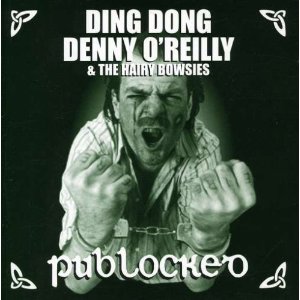
SOUNDTRACK: DING DONG DENNY O’REILLY & THE HAIRY BOWSIES-publocked (1996).

My friend Lar introduced me to this ol’fella (he may have even sent me this CD, as I can’t imagine where I’d have found it on my own).

Ding Dong Denny is the alter ego of Paul Woodfull (who created the Joshua Trio a U2 tribute/pisspull).  And, as I know precious little else about the man, I’ll let the more enlightened pass along the details.

Publocked is a lowbrow amalgam of all kinds of Oirish nonsense.  It’s vulgar and crass and often quite funny.  (Some of the bits stand up to repeated listening–the songs more than the chatty bits, although the chatty bits are especially funny).

Take “The Ballad of Jayus Christ” which sounds like a pretty standard simple ballad until you realize what he’s singing:  “Jaysus O Jaysus As cool as bleeding ice…It’s funny you never rode, coz its you I do my shouting for each time I shoot me load.”

But it’s not all blasphemy.  The “single” “Flow River Flow” is a very sensitive track about the benefits and majesty of the sacred waters (with tin whistles and everything): “When I was just a young man, I sit on the river bank  I loved your gentle water so much I’d have a wank”  With the glorious swelling chorus: “Flow river flow, fuck off to the sea, go where you are wanted, to the deserts of Gobi”

True, now, that’s all kind of crass.  But Ding Dong takes a political stance, too. Take “Spit at the Brits.”  “We Spit at the Brits an we showered’em in a lovely shade of green…we spit at the brits, and then they blew us all to smithereens.”

And what Irishman could ignore the Famine.   “The Potatoes Aren’t Looking the Best” is a view of the famine through the eyes of a farmer.  Shite.

Not everything is a winner, “I Get A Round” is a “cover” of “I Get Around.”   The lyrics are changed to reflect being in a pub (get it?).  And “My Heart Gets So Full (You’d Swear I Had Tits)” is pretty funny, especially since it’s played as an oh so serious ballad, but there’s not much in the world that’s funny for 7 minutes.

So, yes, it’s not quite Joyce, but then Joyce does talk about masturbating by the water, so it’s all equal, right?

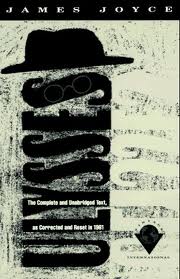
[READ: Week of July 26, 2010] Ulysses: Episodes 7-9

Before I begin, I want to make sure that everyone has checked out Ulysses Seen.  It’s an illustrated rendition of the book.  The details are exquisite and you’ll no doubt pick up things that weren’t as apparent in the proper text.  The only bad thing I can say about it is that it’s not finished yet.  So far Robert Perry has only completed Episode One, and it sure looks like that took a long time (it’s really stunning); but between the details ion the drawing and the extensive reader’s guide that comes with it, one can perch there for quite a while.

I admit that this week’s slog through Ulysses was rather unpleasant for me.  The three episodes included here were massive doses of stream of consciousness.  I actually found them exhausting to read.  Not to mention, in terms of plot advancement, they’re rather paltry. (more…)

Read Full Post »

« Newer Posts - Older Posts »