Feeds:
Posts
Comments

Archive for the ‘Romance’ Category

[LISTENED TO: August 2016] The Penderwicks in Spring

pend-springWe have loved the Penderwick books.  But I remember that when this came out, Sarah read it and was disappointed. Not in the quality of the book, but because the story has moved on.  This book is set about five years after the action of the previous book.

I totally get Birdsall’s desire to write about Batty rather than her older sisters–to move on from what she has written about for three books.  In the previous book Rosalind was more or less absent, so Birdsall is not afraid to progress with her characters.  But those characters are so great, that to have them largely absent from the story was so frustrating!  I missed them all (So I guess she could take that as a compliment).

Of course, the “new” characters are fun, too.  The book is mostly about Batty, but her younger half-brother Ben is older and quite a character (and he gets to show us things from his point of view–the only boy in a family of strong Penderwick girls).  And Batty’s father and stepmother have had a new baby, Lydia, who is just climbing out of her crib and is quite a handful. (more…)

Read Full Post »

solomonSOUNDTRACK: RYAN KEBERLE & CATHARSIS-Tiny Desk Concert #393 (October 4, 2014).

keberleWhen Trombone Shorty played the Tiny Desk I said that I was surprised to see that the leader of the band was a trombone player.  Well, perhaps it’s not that unusual as Ryan Keberle is a trombonist as well.  But unlike many recent jazz performers, Keberle & Catharsis aren’t showing off. As the blurb puts it, “he’s not after any high-concept framing. He’s just targeting the sweet spot where a nifty arrangement meets a solid groove.”

This band plays pretty traditional jazz (complete with upright bass solos and everything). Although, interestingly, their first song is a cover of  Sufjan Stevens song (turns out that Keberle toured with Stevens).  “Sister” is my favorite of their three songs.  I really enjoyed when the full band kicked in after the intro riff from Keberle.  The band has a vocalist, Camila Meza, who mainly does wordless vocal sounds.  As the song nears its end she does sing lead vocals, and it’s quite pleasant.

Her vocals work pretty well for this song, but I didn’t like it is much later.  That could be because “Sister” is a catchy pop song, where the other songs are jazzy.  And I find her singing style to be a little lite-Fm for my tastes.

“Gallop” is a bit faster than the first song.  It moves along at a nice clip and then stops for a bass and drum solo–very very jazzy.  There’s a trumpet solo in the middle of song too (no trombone solos which is interesting, I guess).  The other guys in the band are Michael Rodriguez on trumpet, Jorge Roeder on bass and Eric Doob on drums.

“Zone” opens with two contradicting three note riffs on both trombone and trumpet which is pretty cool.  Then the song settles down to just bass drums and voice and Keberle playing the melodica (beloved instrument of Tiny Desk Concerts) which works but sounds odd in the mix.  It seems like the song is going to end as the music fades to just bass, but it soon picks up again with anew trumpet solo.

I don’t love mellow jazz like this, but these players are excellent.

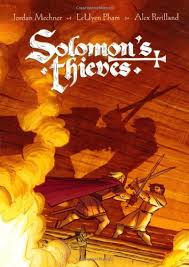
[READ: April 13, 2016] Solomon’s Thieves

I had this book on hold for quite some time.  When it finally came in, I thought, hey this art looks familiar.  And then hey, this book is about the Templar knights, what a strange thing that First Second would have two book about the Templar Knights.   And then as I flipped through it I realized the author and artists were the same.  And for a split second I though, they wrote two books about the Templar Knights?

And then it came to me that the first part of Templar was called “Solomon’s Thieves.”  And that this is indeed the First Part published long before Templar actually came out in full.

So even thought I had read the whole of Templar not too long ago, I decided to read this as well   As far as I can tell it is exactly the same as the first part of Templar.  Although it’s possible that there are some minor changes, I wasn’t sure if things that I didn’t remember were just because I can’t remember everything, you know?

Perhaps because I had read the full book not too long ago, I really enjoyed this run though again.  Since everything looked familiar, it was fun to pick up on things I missed the first time, and to see how things made a little more sense once I could tell who everyone was and what their roles were (there is something to be said for re-reading).

I’m including what I wrote about the first part of Templar here because it’s the same, but if you want more about the whole book or background about the Templar Knights check out the full post.

As the story opens we see Martin, a Knight, looking longingly at a woman, Isabelle.  We learn that he had been “dating” her (or whatever they called it back then) and then one day he found out that she left to be married to the brother of King Philip.  So he joined the Knights.  As they march through the city, we see that they are drunkards and carousers.  They get in all manner of trouble.  And one evening they were heading back to Paris when suddenly the above dictum was established–all Knights were to be arrested.  And Martin is one of them.

But through some excellent machinations (and good fighting) he escapes.  And he soon joins together with a very unlikely band of merry men, including Brother Dominic (a real priest with the tonsure and everything) and Brother Bernard, a loutish drunken man who is not above thieving from people.  Martin is offended at the thought of working with him, and they wind up at odds with each other from the start.  Before the end of the first book, we see that they have a letter revealing where all of the Templar gold and jewels are hidden.

There’s a great bit of accounting work done in which the bookkeeper shows on his ledger that rooms were empty when in fact it appears that the gold was taken out on hay carts.  The bookkeeper, even under torture, swears he knows nothing of the fortune’s whereabouts.

Mechner tells a really exciting story with humor and sadness.  The fact that it’s linked to history is just a bonus.  Another winner for First Second and their #1oyearsof01 anniversary.

Read Full Post »

missouriSOUNDTRACK: STURGILL SIMPSON-Tiny Desk Concert #386 (August 30, 2014).

sturgSturgill Simpson is a (relatively) new country singer that everyone seems to want me to like.  I like some of the musical aspects of his new album, but his voice is just too twangy for me. So even if he’s singing about drugs or whatever, it all just sounds country to me.

Simpson is a funny guy though, he says that “Turtles All the Way Down” is a song that everyone is talking about bit no one gets what it is about.  “It’s about drugs.  And other stiff.”  When the song is over he says he was siting on a porch and a friend said,  “Hey man, you ever heard of DMT?” He said “Nope.”  I hadn’t either but evidently that was the inspiration for that song.

“Time After All” is a pretty song with some wicked guitar playing.

“Life of Sin” is a fast song with what I consider a pretty typical country music riff.  Simpson also has a big powerful voice which he uses to good effect here.

He introduces “Water in a Well” by saying he’s gonna do one for the ladies “I’m just bullshitting, they’re all for the ladies.”  It is a nice ballad that goes on pretty long.

I’d like to enjoy Simpson more as he has been experimenting with interesting ideas, but really, I just can’t get past his voice.

[READ: June 5, 2016] Missouri Boy

I genuinely had no idea what this graphic novel would be about.  I was vaguely familiar with Myrick’s work but wouldn’t have been able to pick it our. Although after reading this I see that his artistic style is quite distinct and his drawings of himself and his father from back in the 1980s are really affecting and powerful.

The overall story of this book is quite simple (and brief) and is done in short episodes.

It begins with the narrator’s birth in 1961.  On the day that he and his twin were born, his grandmother died. (more…)

Read Full Post »

jean-jacques-sempe-the-new-yorker-cover-may-19-2008 SOUNDTRACK: IRENE DIAZ-Tiny Desk Concert #380 (August 9, 2014).

iremeVirtually no infomation is given about Diaz in the blurb for her Tiny Desk Concert.

“My Sweetest Sin” opens as a one minute acapella song before she sits down at the piano and is accompanied by Carolyn Cardoza strumming away intently on ukulele for “Crazy Love.”  Her voice sounds lovely by itself but it sounds even richer when accompanied by the spare instrumentation.

“Lover’s Sway” goes through several genres.  It opens with a jaunty showtune vibe and then slows down for the verses.  And then indeed it gets jaunty once again, in a very different way.

For the final song, “I Love You Madly” she switches to guitar.  She says it was her first love song because she used to write a lot of depressing songs.  This is a pretty, mellow song and she at times sounds a bit like a country singer and a bit like Natalie Merchant.  It’s a little too slow and long for my tastes, but it is very pretty.

Diaz is quite a talent with a nice range of styles.

[READ: February 24, 2016] “East Wind”

This is the story of Vernon, who had moved to an unspecified busy waterfront town just a few months earlier.  A recent spate of vandalism had caused some beach huts to be burned down.  The town was horrified, but he didn’t mind so much because it improved his view to the sea.

He is sitting in a restaurant, and when the waitress asks if he’s done he replies with the cryptic, “All the way from the Urals.” When the waitress is understandably confused he says that’s where the wind comes from.

The waitress, a strong-looking woman, pronounces it Oorals.  He assumes she is Eastern European, perhaps Polish.  He jokes with her that they should o for a swim.  She replies, no swim, although he hadn’t actually meant it.

He became a regular there.  And on another occasion he said to her that they should run away and live in a beach hut.  “I do not think,” she replied.  But then he asked her out and she said yes. (more…)

Read Full Post »

march 21 SOUNDTRACK: PWR BTTM-Tiny Desk Concert #519 (April 4, 2016).

pwrbttmPWR BTTM are the most fun Tiny Desk concert to come along in a long time.  They are a two person—drums and guitar only–queercore band.  The two guys are Ben Hopkins and Liv Bruce.  They are punky and brash and a lot of fun.

Ben plays guitar for the first three songs and they switch off lead vocals.

“Ugly Cherries” opens with an excellent, complex guitar riff played on a very distorted acoustic guitar.  I love that that complicated riff runs through the song and ends with an awesome harmonic’d note.  It’s two minutes of pop punk fun.  And the opening lyrics sets the tone for the song (and the band):  “My girl gets scared, can’t take him anywhere.”

Between songs Ben and Liv are full of jokes and chatter.  Liv says “This is my favorite show that we’ve ever done…its cool to be someone’s lunch break.”

For “Dairy Queen,” Ben switches guitars.  He has an electric guitar this time and Liv sings lead.  Interestingly, this guitar is less distorted than the acoustic.  This is a funny song with the refrain of “right now I’m in the shower.”  There are lots of ideas about things they could do if he wasn’t in the shower like “We can go to Disneyworld and fuck shit up,” At the end of the song Liv moans that he had planned to change Disneyworld to NPR because it is the same syllables, but he forgot.

“Nu 1” returns Ben to lead vocals.  It is a slower song with a simpler guitar riff.  Although once the chorus comes in it’s loud and brash with backing vocals from Liv.  The opening line “God damn everyone’s dumb” is pretty great.  The end of the song has a guitar riff that is similar to the first song, but played in a very different style.

For the final song “C U Around” they switch places with Liv moving to guitar and lead vocals.  As Ben heads to the drums Bob comments on his nail polish and Ben looks over and says “Bob… up here” pointing to his eyes.  While everyone is laughing and Liv is tuning, Ben says

When I was 15 and didn’t think a queer person could ever be in a band….  I  never thought I’d get to throw shade at Bob Boilen.  This is my biggest dream come true.

Then Ben asks how is Liv doing up there and Liv shouts “Guitars are hard!” His guitar playing is very different–more strumming than Ben’s manic style.  The song is slow with a plucked guitar riff and I like the way near the end he starts strumming really hard and gets a cool fuzzed out bass guitar tone while retaining the regular sound of the guitar’s high end.

As you can see from the photo, PWR BTTM dress outlandishly.  Ben is in a bright red dress with sparkly nail polish and really garish facial makeup (with his beard showing through) and swim goggles on his forehead.  Liv is a bit more subdued although when he steps to the front mic you can see that his lipstick is really quite striking.  A few months back Bob said they put on his favorite live show.  If I loved the fifteen minutes of this one I can only imagine how great a 90 minute extravaganza of PWR BTTM would be like.

[READ: March 25, 2016] “A Resolute Man”

Since I’ve read a few pieces by Proulx recently I felt like I knew her M.O.: bad things happen to people who seem innocent, but might not be–usually by strangely named people.  And all set a long time ago.

This one is not far from that description, although it does change things somewhat.  And I enjoyed it a lot more.

I found the beginning to be a little slow going (but that may be because I was anticipating a long slog).  We learn about Captain James Duke.  And this time I marveled at Proulx’s descriptive sentences; “Duke, at fifty, was complicated, dark-haired, and somewhat handsome”.  That’s a lot of things in a few words.  We learn about Duke’s history and then we learn that he has inherited a parcel of land in Boston (he currently lives in England). (more…)

Read Full Post »

earnestSOUNDTRACK: THE SILVER MT. ZION MEMORIAL ORCHESTRA & TRA-LA-LA BAND-Born into Trouble as the Sparks Fly Upward [CST018] (2001).

Born_into_Trouble_as_the_Sparks_Fly_UpwardNotice that the band’s name has gotten longer.  That could be because they have added three new members (which means they are slowly growing to be the size of GYBE anyway). In addition to Efrim, Thierry and Sophie, there is now Becky Foon on cello, Ian Ilavsky on guitar and organ and Jessica Moss on violin (all Constellation stalwarts).

The first song is the nine minute “Sisters! Brothers! Small Boats of Fire Are Falling From the Sky!”  Echoed drum sounds slowly grow louder before a slow violin plays a mournful melody.  But with the new members, there is now a cello to accompany the violin, making this album sound even more classical.  Three minutes in, the piano takes over (and the strings slowly fade).  The piano is a bit prettier and more accomplished sounding (even if it has only been a year since the last album).  Despite the addition of all of the extra instruments, the song still veers pretty far from GYBE territory.  It feels very acoustic (what with the piano), and while the song is repetitive it never feels like it is epic or building towards something–it just grows bigger and more beautiful as more instruments enter the mix.

“This Gentle Hearts Like Shot Bird’s Fallen” opens with what sounds like bird noises, but may actually be a child.  The song is primarily echoed guitars which lay a foundation over which the violins and cellos play slow mournful notes.  The song grows as more instruments  play along, including some gentle percussion, and it all seems to end too soon.

“Built Then Burnt [Hurrah! Hurrah!]” is a spoken piece.  Efrim doesn’t recite the words–it sounds like a child (but may be a young woman).  The reading is dramatic and works very well with the slowly building strings that comprise the bulk of this song.

some lines:

Why are we all so alone here
All we need is a little more hope, a little more joy
All we need is a little more light, a little less weight, a little more freedom.
….
Good words, strong words, words that could’ve moved mountains
Words that no one ever said
We were all waiting to hear those words and no one ever said them
And the tactics never hatched
And the plans were never mapped
And we all learned not to believe
And strange lonesome monsters loafed through the hills wondering why
And it is best to never ever ever ever ever ever ever ever ever ever wonder why

As that song fades, the aggressive strings of “Take These Hands and Throw Them in the River” take over. This song features Efrim singing in full voice–the recognizable voice of SMtZ.  On this song his voice is processed and echoed and so the strange timbre of his voice doesn’t quite register because it sounds so…unusual anyway.  I really enjoy the way this song sounds so much bigger than the rest.  At around 4 minutes, while the song begins to build –both instrumentally and vocally, new strings bring more intensity until the whole thing just fades away to the sounds of actual birds which chirp for about 2 minutes.

“Could’ve Moved Mountains…”is eleven minutes long and shows incredible restraint, especially in the vocals.  It opens with slow bass notes.  The whispered spoken vocals return and the song is kind of ominous..  About three minutes in quiet harmony vocals accompany him and soon after, strings are added and continue to grow louder.  The instrumental section is quite pretty although still melancholy.  Around 8 minutes in, a guitar riff begins playing a similar melody to the strings. It plays for a bit and then the strings rejoin the song, playing a more hopeful melody.  The song ends with some kids talking and singing as the song melds into….

“Tho You Are Gone I Still Often Walk W/You”  This song opens with piano and cello, a sad intro indeed.  I like that after a minute the song jumps keys unexpectedly while keeping the rhythm otherwise the same.  The song doesn’t vary much from this simple piano and strings feel although it ebbs and flows in intensity.

“C’monCOMEON (Loose An Endless Longing)” breaks the melancholy of the previous son with a big buzzy electric guitar chord.  Strings eventually come in and the song builds and builds, complete with interesting percussion.  This song is probably the closest to a GYBE song with a dramatic build and very satisfying chord progressions.  When the fast bass notes kick in around 3 minutes it seems like the song is going to grow even faster, but instead, it fades away to some ringing chimes–what sounds like a giant echo chamber (a really neat effect).  That calm is broken by a series of horns playing one note at a time, louder and louder (this whole middle section reminds me of the middle of “Atom Heart Mother” by Pink Floyd–in fact I have found a number of comparisons to some of Floyd’s trippier moments on this and other albums).  And then the drums come crashing back in.  It’s a very different song that resumes–loud bass, lots of drums and everything mixed loud enough to distort the sound.

The final song is “The Triumph of Our Tired Eyes.”  It opens with guitar harmonics and Efrim’s disatnat voice.  It’s a pretty and delicate song, joined by strings and a genuinely pretty vocal melody: “There’s beauty in this land, but I don’t often feel it.”  And as the strings swell and swell, the voices sing the refrain: “musicians are cowards” over and over.  The song and disc end on a surprisingly quiet and beautiful note.

When the songs ends, there’s a few seconds of children singing lyrics to the “Twinkle Twinkle Little Star” melody although the words don’t fit like: “when we finally cross the barricade…”

I really like the way this album plays with the new style of music the band has embraced but also admits some of the strengths from pretty much everyone else’s other band.

[READ: April 4, 2016] The Importance of Being Earnest–The Graphic Novel

This play is one of the great plays in English literature.  Oscar Wilde is at his best, writing witticism upon witticism–each line is a funny rejoinder to the previous one and the wit is infectious.

The story is fairly simple, but he adds so many twists that it’s almost easy to get lost in the story.  In fact, it’s entirely possible that reading the play is a sure way to get lost in the deceptions.  And that’s why this graphic novel is so excellent.

I’ve always maintained that it is difficult to “read” a play, especially if there are dozens of characters.  The short, one act plays that I’ve been reading over the last years are fairly easy to follow, but when you have 20 named characters in three acts, it’s not always easy to keep people straight.  And that’s why to really appreciate Shakespeare you need to see it.  Well, this graphic novel effectively performs the play for us.  The dialogue is exact and there are no changes from the original (except for any stage directions, which are left out of the text, but are presumably addressed in the art).

What’s (intentionally) confusing about this play is that the two main characters are trying to deceive other people about their identity.  Algernon Moncrieff and John Worthing are two gentlemen–well off, single, clever.  Algy talks about how he likes to go Bunburying.  Which means he has “invented an invaluable permanent invalid called Bunbury, in order that I may be able to go down unto the country whenever I choose.  …If it wasn’t for Bunbury’s extraordinarily bad health, I wouldn’t be able to dine with you.”  This comes up because John has informed Algy that he “has always pretended to have a  younger brother of the name Ernest, who lives in the [city] and who gets into the most dreadful scrapes.”

They have lies in common: each man lies to a group about a phony other person whom they use as an excuse for bad behavior. (they are old friends as well, of course). (more…)

Read Full Post »

naughty SOUNDTRACK: GEM CLUB-Tiny Desk Concert #181 (December 16, 2011).

gem clubGem Club is a quiet band.  During this set there are three members:  Christopher Barnes on keyboards and lead vocals, cellist Kristen Drymala and vocalist Ieva Berberian (who is eerily silent and still for much of the performance).

The first song, “Animal” features Barnes on keyboards, playing a simple melody and Drymala, playing a low and loud cello to accompany (when her first note comes in, it’s really striking).  She also sings a wonderful harmony vocal.  Barnes’ voice is almost a whisper, but between his voice and the vibrato on the keys, it sounds really big (but still quiet).  I really enjoyed the way the only “melody” she played on cello was at the very end of the song–a brief riff to signal the end.

“Breakers” opens with some rough cello playing and then a gentle echoed keyboard.  Ieva Berberian didn’t do anything in the first song, she just hovered mysteriously in the background. But for the second song she hits occasional tambourine notes (which sound practically like explosions amid the delicate echoing keyboards).  Perhaps the most interesting part of the song is watching Drymala tap on some  colorful bells with her foot to create a lovely melody.

For the final song, “252” Barnes says it is kind of a beast, (although it doesn’t sound any more complex than the previous two to me).  The piano is echoed and Ieva Berberian finally sings backing vocals.  Her voice is a little haunting and it works very nicely with Barnes’ voice.  The melody is beautiful.

Incidentally, the blurb says that this is the first time they’ve amplified a singer’s voice (they ran his voice through a chorus pedal to give it that otherworldly echo).  I have been listening to a lot of loud music lately, and this was a perfect counterpoint.

[READ: December 20, 2015] History’s Naughty Bits

This is the kind of book that promises to be very funny.  And then it turns out to be mostly funny but also rather scholarly.  Which is not bad thing, it’s just not as raucous as one might have imagined.

Dolby begins by dismissing the idea that “naughty” things are a recent invention and then proceeds to go through the history of human culture to show examples of things that would certainly be considered naughty today (some are quite shocking).

She starts with Classical Greece where women were expected to remain chaste, except for hetairai, high-class courtesans, who were well-educated and respected.  That’s some choice.  Adultery was considered less of a sin if was committed with a prostitute. (more…)

Read Full Post »

kokoSOUNDTRACK: CAR SEAT HEADREST-Tiny Desk Concert #506 (February 8, 2016).

carseatI only know of Car Seat Headrest from NPR.  They have really liked some of his previous songs and both Bob and Robin raved about his new song “Vincent” (which is really good).

For this Tiny Desk Concert, Will Toledo (who is kind of the only guy in the band, although not currently if you know what I mean) plays acoustic guitar on a tall stool.  Accompanying him are two friends from Leesburg, Va, who don’t actually do anything, and his two band mates who also don’t do anything (well, the drummer plays a toy “desktop” drum set for the song “The Drum”).  And yes, they all sing along during the sing along at the end of song three.

It’s worth mentioning that Toledo has released some 12 albums under the name Car Seat Headrest since 2010 (and Toledo is only 23).  Find them at bandcamp.  Unlike someone like Robert Pollard who has written hundreds of songs that are about 30 seconds long.  Most of Toledo’s songs are really quite long, with multiple parts.  And amazingly, all the parts are pretty catchy,

He plays three songs in this set.  His voice is a little creaky and high-pitched, but it is really-spot on for the kind of songs he writes.  By contrast,. it’s funny to hear how deep his speaking voice is.

“The Drum” opens with a riff that is almost out of tune seeming (like his voice).  The melody lines in the verses are simple but often unexpected.  And lyrically, the song is quite interesting (“the drum reads James Joyce,” “the drum’s in debt”).  And just when it seems like the song could end, it switches to a slower middle section, after which it all comes back to that catchy chorus.  By the end of the song it’s totally grabbed you.

For “Drunk Drivers/Killer Whales,” he pushes his falsetto pretty high.  The  song starts out rather slow but once the verses start properly it picks up.  I love the way in the drunk drivers part he adds vocal melodies that are not in the music to make the song even fuller.   And then unexpectedly, the song shifts gears from the melancholy drunk driver section to the powerfully sung (and I’m not exactly sure how it’s related) “Killer Whales” part. It runs to 6 minutes and is constantly shifting and always stays interesting.

“Sober To Death” is also about 6 minutes long. There’s some great lyrics in here as well “every conversation ends with you screaming.  Not even words just ah ah ahhhhh” (with his voice breaking during the ahhs).   The sing along part at the end has a neat intro where the first guitar line is plucked slowly and the second line picks up speed.  And when everyone sings along it really elevates the song.

After just two listens to this show I was totally hooked and I’m really looking forward to hearing his last album, which is reworking of his earlier songs for Matador Records, and his soon to be released new album with “Vincent” on it.

[READ: February 25, 2016] Koko Be Good

I absolutely adored the art in this book.  I really thought it was outstanding and it has made me search out more of Wang’s stuff (she has a number of online comics at her website).  I also didn’t realize that she drew In Real Life–with Cory Doctorow–her style is similar there but a but less wild as it is here.  And the story is pretty great too.

So this is the story of two main protagonists and a third character who plays a smaller but pivotal role.  Koko is a wild Chinese girl who is carefree and careless.  Jon Wilgur is a tightly wound young man who is planning to change his life pretty drastically.

koko2The story opens with Jon–he is drawn so perfectly, I can’t get over it–a great combination of realism and cartoon style.  He is listening to an audiotape sent by his girlfriend (I love that he is listening to an audio cassette).  He and his girlfriend are planning to move to Peru together very soon. She is currently there and he is about to pack up and head down there himself. (more…)

Read Full Post »

flypanam templarSOUNDTRACK: FLY PAN AM-Fly Pan Am [CST008] (1999).

In the Constellation canon, there were four originators: Godspeed You Black Emperor were orchestral, Do Make Say Think were jazzy, and A Silver Mt Zion had vocals.  But Fly Pan Am was the weirdest one—the played with noise, they broke up their songs, they deconstructed their own work and, especially novel to me, everything was in French on the discs.

Roger Tellier-Craig, the main force behind FPA was in GYBE as well.  So he knows post-rock.

Their debut album is a long affair–an hour’s worth of music (in all of 5 songs) taken from two different recording sessions.  (All translated titles are taken from Wikipedia).

“L’espace au sol est redessiné par d’immenses panneaux bleus…” (“The Floorspace Is Redesigned by Huge Blue Signs…”) is a 13 minute song.   There’s ringing noises as a simple melody is plucked out.  The full instrumentation kicks in adding a repetitive guitar line that seems to fall into the background behind the opening notes that are still playing out.  The guitar lines slowly gets longer and longer, almost like a game of Simon.  By around 6 minutes the song has built up a serious head of steam with the bass and drums moving quickly and the guitar getting really complex. By 7 minutes that pretty guitar has turned into a ringing feedback skronking solo which carries on for a minute or so before fading back. At around 9 minutes the song seems to retreat on itself again. The guitars fade away and the bass seems to get a bit louder with the guitars ringing out. The last minute or so resumes a kind of noisy static sound that tells you the song is over.  That’s a heck of an introduction.

“…Et aussi l’éclairage de plastique au centre de tout ces compartiments latéraux” (“…And Also the Lighting of Plastic in the Center of All Its Lateral Compartments”) is a 9 minute song that opens with more scorching guitars and rumbling bass.  The guitar switches back and forth between a two note melody and a chord (dissonant, of course). The other guitar then plays a different three note melody.  About 2:30 in some noisy feedback and samples start taking over the song.  All the music drops away except for the bass.  By 3:15, all the music had dropped out and its just noisy effects and feedback and then outer space sounds.  After about 4 minutes of that (yes, indeed) the bass comes back in playing a kind of discoey rhythm with the guitar supplying a dancey counterpoint which runs to the end of the song.  It’s their first song where something really catchy is utterly dismantled by noise.

“Dans ses cheveux soixante circuits” (“In Her Hair Are Sixty Circuits”) is 17 minutes long (!) and is one of the most abrasive songs I can recall. The song opens with both guitars each playing a two-note melody which rotates through a round. They sound lovely together as the bass and drums play a slow rhythm. The melody changes a few times and then by around 3 and a half minutes the main guitar line grows faster (6 notes instead of 2) and the background feels a bit more tense.   And then at 5:46, the whole song seems to get stuck on repeat. The bass plays a 2 note rhythm, the drums play the same pattern and the two guitars each play one note over and over.  And over.  Evidently it’s “a half-tone interval.”  And this goes on for 12 minutes.  TWELVE!  The only differences through this whole section come from the digitalia of guest electronic musician Alexandre St-Onge, but they are the most unobtrusive electronics I’ve ever heard and just seem to bubble and prickle gently onto the repetition.  It’s maddening and then trance-like and then maddening all over again.  How can they play the same thing for twelve minutes—and their rhythm remains perfect?

“Bibi à nice, 1921” (“Bibi Nice, 1921”) opens with noises and feedback (which is a nice break from the 12 minutes of repetitiveness. But you soon realize that that’s all you’re getting (aside from some distant rumbling noise in the background). It’s a very silent song. For four minutes (out of ten) and then the full band kicks in for a really rocking section—great guitar lines and propulsive bass and drums. But after two minutes, the sound drops out entirely—pure silence (enough to make you assume the disc froze). It slowly returns after 20 seconds–they are messing with us again.  At 7 minutes a new guitar line comes in—slow and pretty with a slow drum beat.  A solo plays over the top—it is primarily electronic, and sounds pretty cool.   The guitars start playing louder and the song feels like it’s going to build up into something huge, but it soon ends and turns into….

“Nice est en feu!” (“Nice Is on Fire!”) seems like it should be connected to the previous song, but it starts off very different with big bass notes playing a very slow riff.  The guitar starts playing a nice accompanying riff. At 3 minutes in, voices come in singing Ahhs in a nice melody. The liner notes say that Kara Lacy and Norsola Johnson do vocals on “Bibi à nice, 1921” and “Nice est en feu!” but I didn’t hear any vocals on “Bibi.”  At 4:30 the guitar line turns to something else and there’s suddenly a whole bunch of noise flooding the track—sounds of water rushing, maybe—but that goes away and a new melody (slightly dissonant) resumes.  With about a minute left the voices resume—angelic and soaring over the rumbling song.  It ends this weird disc on a very pretty note.

I love the crazy stuff that Fly Pan Am creates, even if some of it is hard to listen to.

[READ: February 23, 2016] Templar

I had actually started to read this graphic novel before Prince of Persia.  But when I saw in the introduction that Mechner talks about Prince of Persia, I decided to grab that one and read it first.  The two have nothing to do with each other, but sometimes it’s nice to get things on order.

Who doesn’t love stories about the Templar knights?  The whole premise of the National Treasure is predicated on them after all.  Not to mention, The Da Vinci Code and the book that he says far surpasses all Templar stories: Foucault’s Pendulum [RIP Umberto Eco].

So Jordan Mechner has done a lot of research (there’s a sizable bibliography at the end of the book) to create the story about a couple of Knights Templar.  He says that “much nonsense has been written about the Knights Templar over the years. I’m proud to say that this book has added to that sum.”  He explains that thousands of knights were indeed killed.  Some knights did escape, but the main plot he constructed probably never happened.   One of the histories he read said that “figures of no importance” did escape, and so that was the basis for Martin, Bernard, Isabelle and their gang–inconsequential Templars and their own story.

He also says (in the preface) that all of the movies about the Knights focus on the treasure, but the Knights’ actual story–their rise and shocking downfall– is even more interesting.  He gives a brief backstory.  Formed during the crusades, the Templars gained fame as the noblest and bravest knights in Christendom.  Their legend grew which increased their numbers.   “They were the Jedi of their time.”  They peaked in the 13th century under the protection of the Catholic Church and The Pope.  Then in October 1307 the king of France ordered the mass arrest of All Templars in his kingdom (15,000 of them).  They were brought before the Inquisition and accused of witchcraft, heresy and sodomy.  Guillaume de Nogaret the king’s chef minister staged a huge show trail.  Prisoners who denied the charges were tortured until they confessed, which made everyone who refused to confess seem like a liar. Despite knowing the truth, the Pope bowed to pressure and Templars were destroyed.  Wow. (more…)

Read Full Post »

persiaSOUNDTRACK: SALTLAND-I Thought It Was Us But It Was All Of Us [CST094] (2013).

Piles of salt mined by local residents sit on the surface of the world's largest salt flats, the Salar de Uyuni, near the village of Colchani November 20, 2007. Bolivian airlines Aerosur and the Canedos family inaugurated this week the first regular flights of its renovated Douglas DC-3S, or Super DC-3, to bring tourists to the Salar, one of the world's natural wonders, in a project that the airline considers a "trip back in time." Picture taken November 20, 2007. REUTERS/David Mercado (BOLIVIA)Becky Foon, who is one of the main creators of Esmerine has another band on Constellation called Saltland.  The big difference with this band is that she sings as well.  And that this album is much more mellow–full of droning sections and a slow, deep bass that keeps the songs moving along.

This disc is very mellow, with lots of slow beats and electronica sprinkled around it.  When Foon sings, she sings in a deliciously slow voice.  So this album is a good one for chilling out.

The disc opens with “Golden Alley” which has some big slow bass notes and strings urging the song along.   When she begins singing, he voice is deep and hushed–an almost whispered sound that feels practically percussive.  There are words, but her voice also works as part of the music.  A bit of a shift in the music occurs near the end that makes it seem like it’s going to be a long song–especially when Colin Stetson starts blowing some saxophone notes–but it actually just signals the end.

“I Thought It Was Us” is an instrumental which features harmonium and cello.  It also has some interesting noises from Stetson.  About a minute and a half in, it shifts to a really catchy melody that runs through much of the rest of the song while the saxophone solo takes off.  It’s a highlight.

“Treehouse Schemes” really stands out as something familiar.  I don’t know if it sounds like something else or if Foon’s voice is so much more distinctive.  But I really like this track a lot.  It has a slow bass line and some stretched out guitars and then Foon sings a simple and lovely melody line.

“Unholy” is a bit more droney with some well used kalimba and Foon’s voice providing mostly wordless notes.  I really like the way at about a minute and a half, fast drums come in and seem to push the song faster, although the tempo never actually changes.  Theres some great tension and then a nice denouement.

“But It Was All of Us” is another slow droning instrumental, with some wordless vocals and some occasional bass notes. It feels almost like Western movie but with a Middle Eastern feel, a Middle Eastern Western?

“Colour the Night Sky” has some quiet, heavily distorted vocals that swirl with the pulsing beat of the drums and bass.   And then about midway through there’s a clean section where the vocals shine through the din, with the words “I have a fairy tale that I read when I’m feeling down.”

“ICA” has some quiet cello swirls and low voices.  And the album ends on a highlight with “Hearts Mind.”  It’s another one with a prominent bass while swirls of sounds float around Foon’s vocals.   It’s the last-minute or so Foon’s multitracked voices create some lovely ascending ooohss.

This album feel s a lot longer than its 38 minutes, possibly because most of the songs are quite long.  It’s definitely a mood creating album, although not as despairing as the album cover hints at.

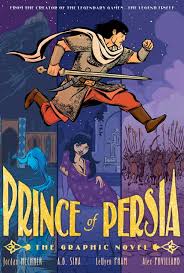
[READ:February 21, 2016] Prince of Persia

The evolution of this graphic novel is pretty fascinating.  And it is one I was completely unfamiliar with since I’m not a gamer.

Back in the 1980s Jordan Mechner created a video game called Prince of Persia.  It was popular and there was a sequel.  And then it kind of went away for a while, but people always loved it so then it came back again as a new series of games.  And a film (released in 2010).  Finally in, 2004 First Second (shoutout to #10yearsof01) contacted Mechner about making a story (not the same story as his games) into a graphic novel.  Mechner has always wanted to make a comic book (he had all the gear before he switches over to video games.  And here it is.

From what I gather, Mechner didn’t really write this story so much as inspire it (and I’m sure he had editorial control or whatever).  The book was written by A.B. Sina.  And it is a new story based on the nebulous ideas of the universe that Mechner had created.

I had actually not even heard of the video game (or the movie) so this was all lost on me. But that’s fine and is not necessary for enjoyment of the book.  Although I admit I found the story a little confusing (not because of not knowing the games), although by the end the way the stories linked up was pretty cool.

This story is set in two different eras (the 9th century and another prince in the 13th century) and has two stories paralleling each other.  The two men of the story are linked by a prophecy.  The story opens with Guiv, a (9th century) prince who had attempted to kill his brother Layth, fleeing the city of Marv after escaping death from Layth’s guards. The story then jumps to a young (13th century) woman, Shirin, who flees the city of Marv in an attempt to escape her father. She soon meets up with Ferdos,

Since Guiv was nearly killed by his brother he leaves the city.  He walks into the mountain where he is accompanied by a spirit animal (a peacock) and is able to fend off lions and boars until he encounters a door.  But inside is a pit made of human skeletons.

I was more interested in the story of Shirin.  She is a rebellious woman who would rather do gymnastic dances than hip shaking ones.  So she cuts her hair and leaves her palace behind.  Frankly her story of learning how rough things are outside of the palace was more interesting than the story of the men.   I guess it is also kind of that we follow her for many pages before she meets Ferdos and then his story takes over.  Not to mention, he seems like he’s just crazy for a while.

Ferdos is full of stories about Layth and Guiv and he imagines that he and Shirin will reprise the roles of these past rulers (Shirin will be Guian, the sister/lover–I’m a little unclear about that).

Eventually we learn that Ferdos has ties to the city of Marv, and that his story is linked to the past in unexpected ways.

The end o the story goes very fast with intense pacing and crossing of stories.  It definitely demands careful reading and maybe even a second reading, to see how the stories line up.

Th one great thing about the book is the way the two story lines are never visually confused–the color palates change depending on the century and the main characters all look different enough (especially Shrin, who looks incredibly sexy with her short hair and different colored eyes).

It’s a really clever and intricate story.   I wonder what fans of the game thought of it.

Read Full Post »

« Newer Posts - Older Posts »