Feeds:
Posts
Comments

Archive for the ‘Religion’ Category

SOUNDTRACK: DAVID FRANCEY AND MIKE FORD-Seaway (2009).

Mike Ford introduced me to Louis Riel on his album Canada Needs You, Volume One.  The song “Louis & Gabriel” features the lyrics “Oh, Louis Reil, here comes your friend Gabriel” outrageously simplistic (it is for kids after all) but so incredibly catchy it’s in my head whenever I see this book.  This is Ford’s most recent album, a collection of songs by himself and David Francey–who I didn’t know before this disc.

Seaway is a collection of 16 songs which are in one way or another about the sea.  Two of the songs appear on Ford’s release Satellite Hotstove, but the rest are new.  I don’t know if Francey’s songs are new or not.  I’m also unclear from the credits if Ford and Francey worked on these songs together (the notes suggest they did) or if they were recorded separately and then compiled.

The songs are primarily folk–simple acoustic numbers, often solo guitar, but sometimes with accompaniment.  Mike Ford has a great, strong voice, and is capable of some interesting stylistic changes.  His songs are more vibrant on this disc.  Francey has a wonderful, almost whispered voice.  He has a gentle Scottish accent which is great for his storytelling songs.  Mostly he speak-sings, but on some tracks, like “The Unloading” he sings a full-bodied chorus.

But it’s Ford’s song that bring a lot of variety to the disc.  “There’s No Rush” has a sort of calypso feel to it and “When You’re the Skip” has a wonderfully dramatic sea-shanty/musical feel to it.   And “21st Century Great Lake Navigators” is a rap–Ford frequently raps a song on his various albums.  His voice is very well suited to it, and his rhymes are clever and often funny.

This is a charming disc.  I wouldn’t say it’s essential, but it’s a good introduction to both singers, and, of course .

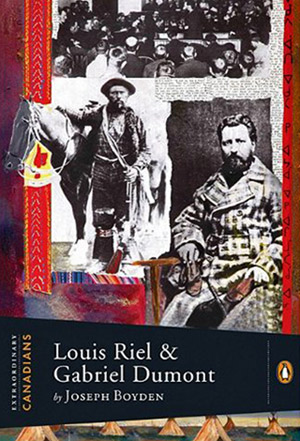
[READ: January 26, 2010] Louis Riel & Gabriel Dumont

Of the six Extraordinary Canadians books, I was least excited to read this one.  I’m not sure why, but I wound up leaving it for last.  But lo and behold it was easily the most engaging and, dare I say, exciting story of the six.  I’m sure part of that is because I didn’t know the outcome (even if Gabriel was somewhat famous in the U.S., I still didn’t know what had happened to him or to Louis).  And by the end of the book, I absolutely couldn’t put it down.

Joseph Boyden is a Métis writer (who I’ve never read before).  It’s obvious from the get-go that he is sympathetic to Riel and Dumont (which is to be expected in a biography, I would think).  He gets a tad heavy-handed about John A. Macdonald, but it seems justified.  For really you can pretty much take only one of two points of view about Riel and Dumont: they are either rebel heroes, standing up for the oppressed Métis, or they are traitors, intent upon destroying Canada’s expansion.

Now, I admit that I don’t know much about Canada’s expansion.  The first prime minister, John A. Macdonald, was instrumental in Canadian Confederation and was the driving proponent for the completion of the Canadian Pacific Railway.   But as with American westward expansion, Native cultures are in the way of this expansion. (more…)

Read Full Post »

SOUNDTRACK: JIAN-The First 6 Songs (2001).
Being American and apolitical in my youth, I had no idea who Pierre Trudeau was until about 2001.  And my first real introduction was through this album by Jian Ghomeshi.  Jian was one of the four guys in Moxy Früvous (and man has his career skyrocketed since then…watch his great interview show Q online–in particular, check out the crazily uncomfortable interview with Billy Bob Thornton or the wonderful hour long interview with Rush).

Moxy Früvous had just broken up and Jian, who was one of my faves in the band, put out the optimistically title The first 6 songs (no other songs have arrived yet).

Jian is a mostly folk rock album which features Jian’s gentle voice.  And gentleness is one of Jian’s trademarks, it would seem.  But more than gentleness, his songs are about accountability and justice.  And yet lyrically, he’s not naive or obvious.  “Quebec City” is about the Summit of the Americas in Quebec City in 2001 (“the whole world is watching”).

I’ve always felt connected to the last track, “Lousy Boy”:

“And a man Is a man If he’s got a gun in his hand
Well I never wanted to destroy I always made a lousy boy….  And I know guys who are just like me
They like hockey and poetry
I think in retrospect that we have won
I’m a full-grown man and I don’t own a gun.”

Früvous has similarly thoughtful lyrics but in addition to the lyrics, the music is always interesting.   So the unexpected chord changes in the bridge to “Astronaut” turn the song from a simple folk song into a moving rocker.  And “Baby Don’t Lie” is a 5 minute track that builds on a folk base and is a catchy sing along.

of course, this all leads to the song “Father (For Pierre Trudeau)” the song that first taught me a little bit about the Prime Minister.  The song covers a few moments of his media-saturated leadership.  But mostly it’s a reflection about Trudeau on the day of his death.  The personal touch of course is that Ghomeshi’s father wanted to meet him (as did Jian) but now they w0uld never get to.  It’s a very touching song, and I have a hard time imagining someone writing a similar song about a President.

It was this song that got me to investigate the life and leadership of Trudeau.  (I even wrote an email to Jian, to which he quickly responded…I only wish I still had that email account active).

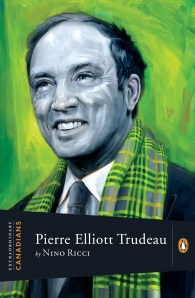
[READ: January 12, 2011] Pierre Elliot Trudeau

This is one of the more exciting biographies that I’ve read.  Which is pretty great.  Although one of the reasons it is so exciting is because he presumes that the reader knows a lot about Trudeau already.  And to be fair, I assume most Canadians would know the global picture (and most of the details) about him already.  So, basically, you get a summary picture of Trudeau, but instead of a quick outline that glosses over details, we get a lot of details, but no gloss.

What I’m getting at is that there are a number of places where Ricci talks about events and movements as if we know them.  So this makes for incredible fluency even if the novice is left puzzling exactly what all the fuss was about.  In fairness, contextually it’s easy to figure out, it’s just a bit surprising.

Another fascinating thing: Ricci skips over Trudeau’s childhood pretty much completely.  The book opens with Ricci’s memory of seeing Trudeau in 1967 when he (Ricci) was a young boy and seeing the way his teachers an adults seemed mesmerized by him.

Nostalgia aside, Ricci quickly explains what a polarizing figure Trudeau has been.  Warmly loved by many and yet (according to Macleans) ranked 5th of all Canadian Prime Ministers (despite being re-elected several times).  Actually, the way that Ricci words it it sounds like he came much lower than that (he says “third tier” which seems much mower than 5th).  And, judging by comments on YouTube videos, utterly hated by others.

The next chapter continues in 1968 at the beginning of Trudeaumania. Treudeaumania sounds a lot like Obamamania–a young, relatively inexperienced politician makes some noise and is thrust into prominence.  (Of course, in 1968, Trudeau only ran for office for a month and a half before being elected–ah the bliss of a short campaign season).

A video of Trudeaumania shows people swooning over him.

The biography does cover some of Trudeau’s earlier years (taken largely from Young Trudeau by Max and Monique Nemni).  He was a somewhat rebellious youth and his teen behavior was full of the usual (and not so usual) rebellions.  But the thing with Trudeau is that it is never clear whether he seriously held certain beliefs or if he was just trying to get a reaction out of people.

He established a society called les X whose purpose was to create an independent Quebec (organized under fascist principles).  les X faded from Trudeau’s life and existence with very little fanfare, and evidently radical groups like that sprang up all the time in Quebec at that time.  Really, it seems to point to his growing bored at his school and with the provincialism of Quebec.

When he left Quebec for Harvard and later for Europe, his mind was expanded and his beliefs opened up accordingly.  He had written many anti-Semitic things in his Montreal youth but once he actually met some Jews, he quickly changed his tune. Indeed, Harvard seems to have really shaped his later outlook in life.  And his exposure to vastly different attitudes during his studying Paris and then later in London exposed him to so much more in the world.

When he returned home to Quebec he found everything small and narrow (which is exactly how it (and he) was when he left it).  And he quickly finds himself embroiled in politics with the Asbestos Strike of 1949.  He took a position (and offered free legal assistance to anyone striking) which raised his profile and quickly made him persona non grata in his province.

This led him to leave for Ottawa, where he was less known and (since his credentials were great) where he could easily get a low position in politics and establish his career.  The main thing he learned, though, was that Ottawa was not the enemy (as is generally held to be true in Quebec).

Trudeau eventually returned to Quebec for Cité libre.  This is one of the things that Ricci glosses over…I’m still not exactly sure what Cité libre is (okay, an influential political journal), but I’m well aware of Trudeau’s involvement in it.  And how it helped him to state his principles and beliefs.

There’s a lengthy passage where Ricci explains how Trudeau’s federalism came to blossom so powerfully for him.  And this argument is one of the reasons why I am in the camp of Trudeau, because even though his piece is meant to be just about Quebec, I find it holds true for the U.S. as well (substitute out Quebec for any special interest).

The sort of independent Quebec he had dreamed of as a young man, he saw now, would only have given greater rein to the ruling elites to exploit nationalism for their own end, as Duplessis has done. In a Quebec obsessed with the survival of French-Canadian culture it was too easy for leaders to manipulate the electorate by promoting vague ideological goals rather than more practical ones, such as those providing infrastructure and employment (103).

Trudeaumania quickly swept him into office, but he was most reviled by his home province which felt betrayed by his turning his back on separatism.  He was the target of an attack by the FLQ, which captured and killed Trudeau’s friend and cabinet minister Pierre Laport. This was known as the October Crisis.  Trudeau’s reaction was swift and hard, he called for martial law (and the Mounties certainly abused their rights). But when questioned about whether he should or could step so hard on a province his answer was “Just watch me”

Now, it turns out that that quote comes at the end of a lengthy interview and makes for a glib soundbite when in fact Trudeau was anything but glib.
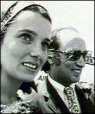
The next big moment of excitement for Trudeaumania was when he married Margaret Sinclair.  For a brief time, they were the it couple.  He was 51, she was just 22, and she was beautiful.  Trudeau seemed to be a confirmed bachelor or at least a consummate playboy, so to have him settled down was quite a story.  But how hard must it have been to be a young woman suddenly thrust into the political spotlight.

Naturally, cracks would surface in their marriage.  In fact, in 1977, Maggie decided to party with The Rolling Stones rather than attend her sixth wedding anniversary party (read the wonderful article in People about it–I love the tsk tsk tone!).

But the penultimate chapter is, mostly, about Trudeau’s disappointments.  He had taken office in a hail of excitement but really had not a lot to show for it.  He was even set for retirement, until he was drawn back in.  And in this final term, he was finally able to achieve his legacy.  And this legacy seems to be summarized by two words: federalism and patriation.  (With the downside being summed up in the word “notwithstanding”).  Now, this is obviously something that Canadians know all about, and it seems foolish to summarize what this meant for readers who lived it.  But for me, who knows precious little about the mechanics of Canadian politics, I was a little lost in the details.

I got the Federalism thing, but the constitution is a bit confusing.  And the whole notwithstanding clause really kind of lost me.  Nevertheless, the chapter that covered this was rather exciting because Ricci writes as if there is one man whose mission is to see him fail.  And this nemesis is Rene Lévesque.  It’s a classic mano a mano battle between two Quebeckers and it’s really rather exciting (especially if you didn’t know the results).

The final chapter talks of Trudeau’s legacy.  And in this chapter Ricci seems to side with Trudeau.  He cites specific examples of being the best man at a same-sex wedding ceremony, something that would not be possible without Trudeau (even though Trudeau never envisioned it).  Indeed, there’s a comment that:

during the 1968 leaders’ debate, Réal Caouette, leader of the Ralliement créditistes, joked that Trudeau’s Criminal Code amendments might lead to a situation where “a man, a mature man, could in the future marry another mature man” Caouette had his joke while Trudeau, awaiting his response time, smiled civilly and held his tongue.

Because I’m not part of the culture, I don’t know to read Ricci’s take on the man.  He is not afraid to show off all of Trudeau’s faults.  In fact, in many instances he rather highlights them.  For instance, the debt under Trudeau expanded exponentially.  When Trudeau took office in 1968 Canada had a debt of $18 billion; when he left office in 1984, that debt stood at $200 billion, an increase of 83% in real terms.  And yet at the end of a nasty passage he will present some evidence which ameliorates Trudeau either in whole or (more typically) in part.

I guess in that sense it is an excellent primer on Trudeau’s political life.  But it’s also personal enough that you can see how one man impacted people.  Not citizens, but people.  And when he describes the people lined up for Trudeau’s funeral it ties right back to Jian’s song.  It really shows the impact that one person can have on the lives of so many.

And, here’s a shameless plug to the folks at Penguin Canada–I will absolutely post about all of the books in this series if you want to send me the rest of them.  I don’t know how much attention these titles will get outside of Canada, but I am quite interested in a number of the subjects, and will happily read all of the books if you want to send them to me.  Just contact me here!

For ease of searching I include: Fruvous, creditistes, Real Caouette, Rene Levesque, Cite libre

Read Full Post »
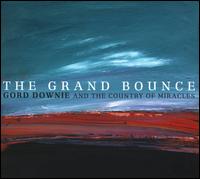
SOUNDTRACK: GORD DOWNIE AND THE COUNTRY OF MIRACLES-The Grand Bounce (2010).

I knew I was going to write about Canadian musicians for this series of Extraordinary Canadians, but I wasn’t sure who would get matched to whom. I figured I’d match Gord Downie to Mordecai Richler, but when I saw this in the liner notes to this disc, I knew I’d made the right choice:

Thank you to the Richler Family for the font you are presently reading.  The Richler font, not publicly available, was created and named for the great Mordecai Richler.  It was commissioned by Louise Dennys, designed by Nick Shinn and graciously made available by Florence Richler.  I am grateful for this honour.

So Gord Downie is the driving force behind The Tragically Hip.  I’m always curious when a guy who pretty much runs a band needs to do a solo album (or three).  And in this case, since the last Hip album was much more mellow and almost country, it seemed like he got some of his less rocky side out on that disc, so what’s the need?  Unless, of course, it’s just the need to play with some other folks once in a while.

Well, whatever the reason, this disc finds Downie in incredible form.  In fact, I think I like this disc better than the last Hip disc (which I did like, but which was a little too mellow overall).  The songs are all great, from the simple folk tracks to the more elaborate rockers.  And, yes, while the disc never rocks as hard as some Hip songs tend to, this is not a simple acoustic guitars and solo vocals record.

“The East Wind” is a wonderful starter.  It’s fairly simple with awesomely catchy lyrics.   I learned that the lyrics are from a quote by Todd Burley.  And they are an awesome way to describe a hostile and violent wind: it’s lazy, because “it doesn’t go around you, it goes right through you.”  Fantastic.

“Moon Over Glenora” sounds a lot like a Hip song.  Downie’s lyrics are almost mumbled and understated until he gets to the end of each verse when he raises his voice an octave for maximum effect.   The stops and starts in the bridge are also great.  “As a Mover” is also smoothly catchy with a wonderful rising chorus.

“The Dance and the Disappearance” is another great conceit.  This song is inspired by a quote from Crystal Pite: “Dance disappears almost at the moment of its manifestation.”  It is suitably dramatic with some great verses.  “The Hard Canadian” is a gentle acoustic number that would not be out of place on the more recent Hip records.  “Gone” feels like a continuation of “Heart,” almost like the slightly more rocking second half of it.

My favorite track is “The Drowning Machine” (I seem to like anything that Downie writes that’s about the sea).  It’s a minor chord wonder, dark and mysterious and wonderfully catchy.  The rock comes back on the rather simple “Night is For Getting.”  It’s probably the least essential track on the disc except that once again the chorus/bridge is really great and memorable.

The last three tracks bring on the mellow, which is a fitting ending for the disc, although since the three t racks take up about 12 minutes, it makes the end drag a bit.  “Retrace” is a country-tinged (steel guitar) mellow track (again, Downie’s voice brings out the excitement) .  “Broadcast” has an extended outro of gentle guitars and piano that for all the world sounds like the end of a disc, so I’m always surprised that there’s a final track after it.   And so the final track “Pinned” feels like filler.  It has a movie projector clicking sound and gentle piano with almost inaudible vocals.  It’s actually a pretty song, but it feels almost discarded here.

One of things I’ve always liked about Downie’s lyrics is that they are atypical of rock songs.  They’re not “about” sex or rock or drugs or swagger or anything like that.  In this case they are about locations and events.  And it really paints a picture.  And speaking of painting, Downie painted the cover art.  The beautiful simplicity of the painting is not unlike the beautiful simplicity of the music on the disc.

Oh and my copy is autographed too! (although I wasn’t there when he autographed it, so it could have been anyone who scribbled on the cover).

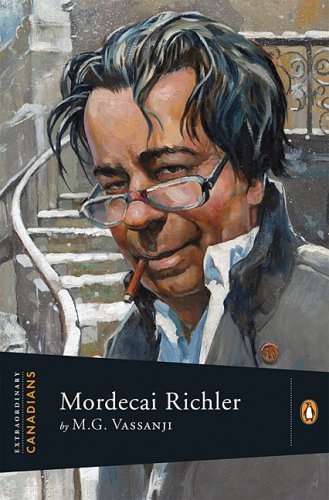
[READ: November 15, 2010] Mordecai Richler

I don’t know a lot about Mordecai Richler, although I feel like whenever I read about him it’s in hushed tones (a neat trick, that).  Nevertheless, for a number of reasons I have wanted to read him for many years but have just never done it.  Now, the stars are aligning with me for Richler.

There’s this book, there’s the cover of the October 2010 issue of The Walrus and the recent filming of his book Barney’s Version (the filming of which is discussed in the same issue).  And then a patron asked for the film of The Apprenticeship of Duddy Kravitz.  So, it’ about time to read one of his books.  But here’s the rub…do I start with the great books or do I start at the beginning and work my way through his career?  And, there’s also a huge new biography coming out (the review of which mentions a wonderfully offensive event in which Richler absolutely dismisses his Jewish audience).

This book was written by M.G. Vassanji.  I feel that I’ve heard of him but I’ve never read him.  And yet listen to this incredible biography:

M.G. Vassanji was born in Kenya and raised in Tanzania.  He attended University in the United States, where he trained as a nuclear physicist, before coming to Canada in 1978.  Vassanji is the author is six novels and two collections of short stories…and he has twice won the Giller Prize.

Damn.

Since I read this right after Coupland’s McLuhan it’s tempting to compare them.  And yet, as I said in that review, it seems quite apparent than Coupland’s book will be like no one else’s, so I won’t say much about that.  Instead, Vassanji opens the book by talking about the similarities between himself and Richler and their few awkward but pleasant meetings.  (In this respect yes, it is sort of like Coupland’s book in that the author puts himself into the text). (more…)

Read Full Post »

SOUNDTRACK: FROU FROU-Details (2002).

Many years ago I bought Imogen Heap’s debut album because it was described as being similar to Tori Amos’ work.  I think that it’s really closer to someone like Heather Nova, but regardless, it was enjoyable, with her cool voice that had an unexpected falsetto thing that I rather liked.

I promptly forgot about her, although the single “Come Here Boy” stuck with me.  I was recently turned on to Frou Frou somewhere even though this album came out almost ten years ago.  Since a decade is a long time I can’t recall if 2002 was the time of this sort of music or not (well, Dido came out in 1999, so maybe this was the tail end?)

Anyhow, this album plays nicely into the continuum of slightly more complex than normal pop songs sung by a woman with a cool if not unique voice.  Heap provides the vocals, and I suppose the most notable quality is her breathiness.  She seems to be able to sing in a whisper, which is pretty neat and, again, there’s that falsetto which doesn’t seem to get higher so much as otherwordly.

She’s an excellent match for Guy Siggworth who creates music (at least I assume he did the music, I’m not sure how it was divided exactly) that is interesting and electronic but also soft and welcoming.  Despite the fact that the music is obviously a dude with a keyboard, his choices are not electronic and dancey, they are more enchanting (although they are also very catchy and dancey).

They work wonders as a team, and if you miss this sort of not-pure pop album (circa 2000), this is a great disc to pick up.  Heap’s voice may be one to get used to, but I find it far more engaging than the autotuned voices circa 2010.

A couple of stand out tracks include: “Must Be Dreaming” which has some especially nifty effects that make the song stand out.  The most Björkian song “Psychobabble” also offers cool sound effects which take it well out of the pop realm (her voice is particularly cool on this track).  And “Maddening Shroud” is probably the best poppy song I’ve heard in a long time.

[READ: January 11, 2011] “The King of Norway”

In my mind Amos Oz is a capital-A Author, somehow promising Thoughts.  Maybe it’s because he writes in Hebrew.  Maybe it’s because of the mystical name Oz, but he seems like a Prophet or something.  And in that respect, I suppose I am simply not full of Grace enough to get the Point of this story.

I know that it is utterly unfair to hold this man up to these made up standards, especially since I’ve never actually read him before.  But that’s all moot, because I feel like there’s more to this than meets the eye and I am just not that interested in finding out what.

It’s utterly coincidental that tonight we watched the first half of A Serious Man (which also features Hebrew prominently), but I am suffused with Jewish thought this evening.  (I enjoyed A Serious Man a lot more than this story, by the way). (more…)

Read Full Post »

[LISTENED TO: November through December 2010] A Portrait of the Artist as a Young Man

I initially ended this post with: “Even though this audio was unabridged, it felt a bit like hearing an abridged version.  I suspect I shall have to actually read the novel again in 2011 to see what I missed.”  Well, I assumed that the audio was unabridged.  But now I see that there is another recording which is 7 discs as opposed to my copy’s 3 discs.  Gadzooks!  In tiny print on the back of the box, I see now that this is abridged.  NO WONDER I felt like so much was left out of the story.  It actually made me think that the story wasn’t all that coherent.  As such, you can kind of disregard this post until I listen to the unabridged version (which is available free for download here).

So, back to my initial review:

I was listening to this audio book while exercising.  The fact that it took me as long as it did to finish the audio book is more of a testament to my lack of exercising than the book itself.  Although I will say that unlike Dubliners, I found that listening to this book (and again, perhaps it was the distance between listenings) to be somewhat unsatisfying.  And of course, as with all of these Naxos CDs, the vocals are recorded so quietly (except when he starts screaming–the hellfire sermon is so loud it scared my family upstairs) that you really have to try to listen hard to hear the whispers.  The final chapter–Stephen’s diary–is read so quietly it was hard to hear over the exercise machine, even with the sound up all the way.

So this is the story of Stephen Daedalus before Ulysses, when he was, as the title states, a Young Man.  My favorite memory of reading this book was when I read the opening aloud to a sick friend who thought that I was messing with her:

Once upon a time and a very good time it was there was a moocow coming down along the road and this moocow that was down along the road met a nicens little boy named baby tuckoo….

Stephen is of course, baby tuckoo, so this novel is more than just the young man days.   But from this baby story, we quickly jump to Stephen at school and we see an episode that impacted his whole life: boys who were teasing him pushed him into a stagnant pool of water. (more…)

Read Full Post »

SOUNDTRACK: THERION-Theli (1997).

I bought this disc when I was living in Boston and I immediately fell for it.  I seem to recall I was doing a lot of driving at the time, and this mix of extreme metal, orchestral accompaniment and twinned vocals was very captivating.  It was also really fun to play very loud on a dark highway.

I’d read a very good review of this disc that claimed it was a big step forward in styles of thrash/black metal (and if you Google reviews for this album they are pretty universally great).  The disc is exemplified by the track “To Mega Therion” which is almost entirely a full choir singing what I guess is the chorus.  The verses are populated by a guy screaming in a guttural voice who is answered by an almost mechanically twinned voice which sounds great but is even harder to understand.  Follow this with a beautiful piano (!) solo not unlike something Randy Rhoads put together for Blizzard of Oz, and add a pounding double bass drum all the way through (truth be told the album could be a little heavier in the bass) and you get a crazy mix of styles which is catchy and creepy at the same time.

It’s hard to match a song like that.  And, admittedly, the band doesn’t quite manage to do so, but the rest of the album keeps up this orchestral death metal throughout.

Reading about Therion has taught me that this album is something of  touchstone for a new genre of metal, called variously symphonic or operatic metal (I suppose we have this to blame for the Trans Siberian Orchestra?).

In addition to the choirs and guitars there are a lot of keyboards. They are disconcerting when you’re thinking death metal and yet really they add an even fuller sound, even if at times they are not as grand or powerful as anything else.  At times the album seems cheesey, but that may have more to do with thirteen years distance than the music itself.

Anyone who has seen The Exorcist knows that choirs can be spooky.  And when you mix it with the heavy guitars and guttural vocals, you get a really cool sinister yet catchy (and possibly uplifting) album.  There are certainly a lot heavier albums, but this one is pretty stellar.

[READ: Summer of 2010, finished December 12, 2010] Lords of Chaos

My brother-in-law gave me this book for my birthday this year.  I was familiar with it as it is fairly well-known in heavy metal circles as a fascinating read.  And so it was.

This book is basically a history of black metal in Norway and how some bands’ antics went beyond music into burning churches and even murder.  The authors present a pretty neutral account of the story.  They let the main participants (criminals) have their say and the interviews don’t comment on their answers, they just let them tell their side of the story.  The authors also know a lot about the music scene.  Of course, in the end, the authors (thankfully) disapprove of the violence.  It makes for an interesting and somewhat conflicting read. (more…)

Read Full Post »

SOUNDTRACK: STEREOLAB-“Everybody’s Weird Except Me” (2010).

I was able to listen to another track from the upcoming Stereolab album Not Music.  This song is just fantastic.  It’s a faster, uptempo track.   Laetitia’s voice is backed by some other female singers (I wonder who they are, is it just Laetitia multitracked?).  And the propulsive beat is infectious.  The backing track of the music sounds like their earlier experiments with “space age” sounds.  Yet the guitar over the top is warm and inviting.

The song drops out at about the 90 second mark and offers a very cool respite from the bopping around that the song is doing.  After the break, the song seems to jump back and forth between this new mellow bit and the bouncy earlier part.  It’s a great track and a welcome opening to their last CD before going on hiatus.  Because, yes, according to the information on the NPR page, Stereolab is going on hiatus.

This CD is full of songs that were created around the time of their previous disc Chemical Chords, and it’s also packed with mixes, remixes and seemingly alternate version of some of those songs.  I haven’t heard the whole disc but it sounds like they’re going out with a winner.

[READ: November 15, 2010] “A Good Death: Exit Strategies”

I’ve mentioned before about my reader-relationship with Vollmann–I feel that I ought to read a lot more of him, yet I haven’t brought myself to do it (those books are huge!).  Nevertheless, I’ll keep reading the new pieces that I stumble upon.

So this piece is a nonfiction essay.  I’m tempted to say it’s more personal than the other pieces that I’ve read because it concerns the death of his father.  Yet from the little Vollmann I have read, it feels like he takes all of his writings very personally and invests himself pretty much bodily into them.

So, this piece, as I said, is sort of about the death of his father.  He died just a few months ago and Vollmann wants to find out a number of answers about death: should he be afraid of it, will he suffer, what should he expect?  So he interviews several “experts” in different fields:  coroners, funeral directors and many religious people of different faiths (Vollmann and his companion/translator are agnostic).  He’s given a vast array of answers, some of which are comforting to him and others just kind of piss him off. (more…)

Read Full Post »

SOUNDTRACK: DAVID CROSS-Bigger and Blackerer (2010).

I’ve liked David Cross for years, both in Mr. Show and everywhere else he’s been (I love comparing his nebbish character in Arrested Development to his obnoxious hippie in Running Wilde). And his standup is just fantastic.

This new(ish) CD (which has the same name but different content as the DVD) is wonderfully obscene and profane and all around hilarious.  What’s particularly fun is the nonsensical “titles” he gives to his bits (although these are more accurate than on his previous disc): “REALLY Silly Religious Crazies, I mean, Double, Triple Crazy!!” and “Random Goofabouts”

The disc opens with a song(!), a swinging song ala Tom Jones which Cross sings (his voice isn’t very good, but he’s never off key, which is something) which actually features some cool time changes and a bit of pathos.  But the jokes are very funny.  He opens with an extended bit about drugs (mostly about drugs he has taken).  It’s a bit long, but the details are hilarious and the payoffs at the end are wonderful.  I also enjoyed that the drug bits are a cautionary tale, yet he never turns preachy, in fact, he inverts expectations throughout.

The race jokes are really great too, especially the MLK license plate bit.  But indeed, Cross really shines when it comes to religion.  I’ve never really heard a riff on Orthodox Jews before, and his dismissal of Catholicism is brutal and short, but it’s the Mormons who get the bulk of his abuse (mostly because of the awesome power they wield), especially since the religion is a sham.

He’s also not afraid to make observations that will offend some (although no one who listens to him) but are spot on.  There’s an excellent bit about Obama haters who bemoan the state of the country but who will immediately fight any “elitist” who bemoans other aspects of the country.  And it very funny, indeed.

Cross has spent some time in England (filming The Increasingly Poor Decisions of Todd Margaret) and his British accent is quite good now (it’s used to excellent effect in heaven).  He also has great rapport with the crowd, who are exuberantly noisy.

This CD is an excellent introduction to Cross’ standup.  The jokes aren’t really timely (although the health care yelling bit will date it somewhat, except that the debate itself will go one for years to come, so maybe it won’t), so even if it’s five years from now, the jokes will still be funny.

Cross is not a delicate comedian and his jokes are not for the faint of heart, but, man, is he funny.

[READ: November 9, 2010] It is Right to Draw Their Fur

Polymath Dave Eggers is back with another fascinating (and fascinatingly bound) title.  This time, the collection contains a series of drawings.  Most of the drawings are of animals and they all feature words on them.  (This sort of thing: Picture + words + humor (from many different artists) is presented in a book that I am currently enjoying called More Things Like This).  Similar items also appeared in McSweeney’s 27 (you can see my Post about that issue here)).

Eggers explains in the introduction that he went to art school.  He was an aspiring painter and then a cartoonist and illustrator.  And in his down time, he spent a lot of time drawing animals.  And they are quite good.  Eggers’ art has an odd quality to it that I can’t quite put my finger on.  All of his pictures seem off in a small way.  It doesn’t make them bad at all, in fact, it actually makes you want to look at them more to see what is off about them.  (I think some people call that “compelling”).

The project comes in a hugely oversized cardboard sleeve (14 inches x 19 inches).  There are 26 large sized posters (they are folded and their unfolded size reaches something like 27″ x 37″).  There’s also a booklet which features even more of these drawings.  The booklet has an appendix with some drawings that are not animals (well, they are humans, so yes, they are animals).  And, the most peculiar part, there’s a bibliography.  The bibliography goes on for four pages and includes all manner of things from Sartre’s Being and Nothingness to Auel’s Clan of the Cave Bear to Gara’s The Presidency of Franklin Pierce to The Collected Poems of William Carlos Williams to Saint-Saens’ Le carnaval des animaux.

You can see two examples here.  In my opinion these are not the best combination art/words in the book (although the drawings are very good).  There are some other ones where the juxtaposition appealed to me much more.

The package is quite expensive (and justified–it is a lot of stuff and beautifully put together), but I have a hard time believing someone would spend $42 on it.  (I received mine as part of the McSweeney’s book club, so that’s nice.)

Read Full Post »

SOUNDTRACK: DAR WILLIAMS-“Teen for God” (2005).

Dar Wiliams has a new disc in which she revisits her old songs (by herself and with guests) and which includes a bonus Greatest Hits disc.  I have listened only once to the disc, but it includes this song which fits perfectly with this story.

Williams has always been an excellent lyricist.  Her rhymes are strong and her descriptions and ideas are first-rate.  Normally, her songs are emotional and intimate, although this one is less so.  It’s serious and funny at the same time.

It begins with a teen at the Peach Branch Horse and Bible Camp where she’ll “pray for the sinners and their drunken car wrecks and vow that I’ll never get high or have sex.”  It’s interesting to compare this song and the implications of the teens for God circa 2005 vs what Franzen is talking about circa the early 1970s.  And it’s fascinating, and rather depressing frankly, how much more conservative times have gotten since then.

What really sells “Teen for God” are the final few verses, where we realize that we shouldn’t take too much of what the teens pledge to be long-lasting (like so many things that teens believe). “You gotta help me, God. Help me know four years from now I won’t believe in you anyhow and I’ll mope around the campus and I’ll feel betrayed all those guilty summers I stayed”

And all of this existential religiousness is set to a perky folk rock song.  The “Teen for God” chorus hits a perfect delayed chord, and is a wonderful singalong.  Perhaps even at a campfire.  On a retreat.

[READ: November 18, 2010] “The Retreat”

This essay is about Franzen’s childhood (always a good source for his stories) when he joined the hippie “Fellowship” at First Congregational Church.  Franzen is older than I am by a  few years, so a lot of things that he writes about from his childhood are things that I knew a little about or caught the tail end of.  So, in this case, I recall my church having Saturday night folk masses, where everyone played acoustic guitars.  I loved it and my parents hated it; when I recently asked a neighbor if they still do that she laughed at me and said they’d stopped it like 25 years ago.  Which explains a lot.

Anyhow, the article discusses an upcoming retreat that the ninth graders would be taking with the other older Fellowship students.  Franzen was a big fish in the 8th grade Fellowship but was a little nervous about the older group.  He loved retreats and wanted to go but didn’t think his parents would approve.  Luckily for him, his parents were in Europe at the time.  [This seems to be some kind of thing that parents did in the 70s–go to Europe for an extended period while the kids stayed home.  My parents never did, mind you, but some seemed to.] (more…)

Read Full Post »

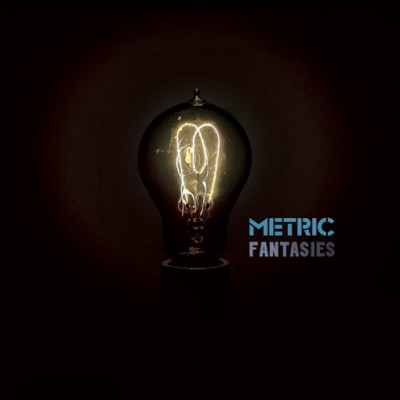
SOUNDTRACK: METRIC-“Gold Guns Girls” (2009).

I mentioned to Sarah that WRFF plays this song all the time and that I really liked it but I had no idea what the band or even the song title was because they never say it.  And, I couldn’t really figure out any of the words (I’m usually working with loud tools) to investigate online.

Well, we were in the car the other day and, of course, they played it again.  Happily, the Prius has a “message” button on the radio that tells you the names of the band and the song title (if the radio station provides it).  Huzzah, here’s the song (hilariously, they played it on the way home from our Halloween party too, proving my point that they really over-play this song).  But I still think its great.

I’ve been interested in Metric for a while (there are members of Broken Social Scene in the band) but for some reason I never listened to them.

This track opens with a fast guitar riff which is undercut by this cool bass riff.  Over the top staccato vocals (that come in unexpectedly) and a nice harmony type vocal (like later period Lush) make this opening really captivating.

The repeated chorus “Is it ever gonna be enough” (with I think whispered “enough”s in the background) remind me so much of the mid 90s alt rock that I love so much.  I have no idea if the rest of the disc is like this, but I have finally bitten the bullet and decided to order the whole thing.  I hope I’m not disappointed.

[READ: 2005 & October 25, 2010] “Bird-Dogging the Bush Vote”

A while ago I read a whole bunch of pieces by Wells Tower.  I intended to read all of the pieces I could find by him and I discovered he had written a few pieces for Harper’s as well as the articles for Outside.  I’m fairly certain I read this story back in 2005 when it came out, as it sounds kind of familiar, but maybe I, like Tower himself, was too bummed with the results to actually read about it in detail.

In this piece, Tower decides to go “undercover” and volunteers at some Bush/Cheney offices in Florida (a pivotal state that year and one in which malfeasance was predicted on a large scale).  Tower is unabashed about his distaste for Bush (to us, not to the Floridians).  He admits that he did feel a bit of hope in the President right after the events of September 11, 2001, but by September 12, he was already disgusted with him again.

And so he spends a few weeks in Florida actually asking people to vote for Bush in hopes of finding something out of the ordinary.  Which, aside from some real mean spiritedness (which I’m sure was the same in the Kerry camp), there was nothing scandalous to report.   Although I will say that the example he gives (telling a Democrat that voting was on the day after the actual election, which I’d seen in a number of other places too, really pisses me off despite its fairly innocuousness and no doubt ineffectiveness–as a librarian I hate telling lies to people). (more…)

Read Full Post »

« Newer Posts - Older Posts »