Feeds:
Posts
Comments

Archive for the ‘Religion’ Category

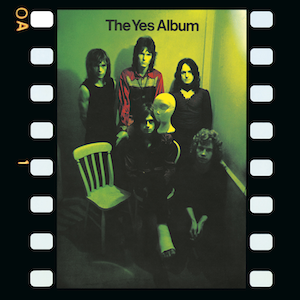
marvel SOUNDTRACK: YES-The Yes Album (1971).

The_Yes_AlbumAnd then came The Yes Album and everything changed.  Whether it was the addition of Steve Howe on guitar or just more confidence in their songwriting, I don’t know, but The Yes Album is leaps and bounds above Time and a Word.

The opening staccato notes of “Yours is No Disgrace” are tight and loud—what is now considered classic Yes sound—Squire’s bass is low and rumbly but ever so precise.  There’s the true Yes keyboard sound and some amazing guitar work.  It’s got a great introduction followed by some excellent harmony vocals (that’s don’t sound psychedelic any longer).  Then comes the great slow jazzy section with the awesome bass meandering through.  The song has so many great parts and they all fit together perfectly.  This is how you make an awesome 10 minute song.  Even the ending which isn’t exactly different adds more drama.

The next song is a live version of “Clap” (apparently not called “The Clap” as our discs say).  It’s a fun romp from then new guitarist Steve Howe.  It’s a delightful masterpiece, although it’s kind of oddly placed (and the fact that it’s live also makes the flow seem odd).  This is all my way of leading up to saying that Fragile is a slightly more cohesive album than The Yes Album even if they are equally excellent.

“Starship Troopers” is another classic with some more great basslines and some really crisp drums. It also has a middle section (acoustic guitar with great vocal harmonies) that really holds the song together very well.  They do a great job at making instrumental sections interesting.

“I’ve Seen All Good People” has a great opening with harmony vocals and acoustic guitar and then a full chorus.  When Squire’s bass comes in at around 3 minutes, it’s like the heaviest thing on earth.  I happened to be listening in only one ear while writing this (never do that with Yes) and for the first time I hear the choral voices sing “Give Peace a Chance” before it switches over to the rocking second half of the song.  “A Venture” is like a truncated version of a Yes song.  It may be the least interesting song on the disc, but that’s just because of the company around it.

“Perpetual Change,” the third 9 minute song opens with some great loud guitars and then some quiet sections where Anderson’s voice really shines.  And just when you think that the song is going to be nine minutes of more or less the same sweet music, at 5 minutes it shifts gears entirely into a crazy staccato section of fast notes and drumming.  It’s such a strange riff (and when the bass starts following a slightly different riff and the guitar solos over the top, it’s beautifully controlled chaos.  And after a minute and a half of that, it switches back to the delicate harmonies of yore.

There’s not a bad song on this disc and depending on your proclivities it is either a little better or a little worse than the next masterpiece, Fragile.

Since almost every Yes album had different personnel, I’m going to keep a running tally here.  Our first change occurs with this their third album:

Chris Squire-bass
John Anderson-vocals
Bill Bruford-drums
Tony Kaye-keyboards
Steve Howe (#2 replaced Peter Banks)-guitar

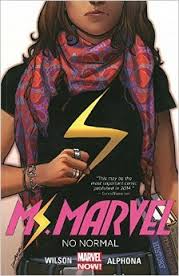
[READ: March 15, 2015] Ms Marvel: No Normal

This collection collects books 1-5 of the Ms. Marvel series (Adrian Alphona is the artist for all of the books).  When I saw it at work, I assumed it was related to the new Captain Marvel series that I had just read.  But it turned out to be a different story altogether.  And I loved the new character that the Marvel universe has added to its fold.

For this story is about Kamala Khan an ordinary girl from Jersey City.  She is a Turkish Muslim with very strict parents.  Her brother doesn’t work but spends all his time praying (much to her father’s dismay).  Her best friend Kiki (call her Nakia now, thank you) has recently found her religion and begun wearing head scarves.  And her other best friend, Bruno, is busy working all the time.

As the story opens, we see these three in the Circle Q where Bruno works (there’s funny joke about “Chatty” Bob, which I liked). In walks a spoiled white girl Zoe who seems nice but really probably isn’t.  Kamala seems to like her but Nakia does not (and Zoe’s insensitivity to Nakia is part of the reason).

Zoe invites them to a party (knowing they won’t go), but Kamala sneaks out and heads to the party anyway.  She immediately doesn’t fit in, and as she wanders away from the festivities a mist covers the ground and she is visited by Captain America, Iron Man and Captain Marvel (in her new female form), and, better yet, she can speak Urdu. (more…)

Read Full Post »

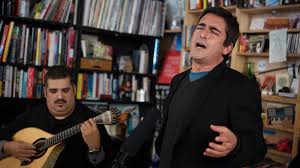
kampung SOUNDTRACK: CAMANÉ-Tiny Desk Concert #441 (May 15, 2015).

camaneCamané is a Portuguese Fado singer. The NPR blurb says that fado, “which means “fate” in Portuguese, emerged from the gritty barrios and docks of Lisbon in the early 19th century and has evolved in fascinating ways. Think of it as the Portuguese blues.”

The songs are sung in Portuguese and I don’t know a word of what’s he’s saying, but as the blurb continues: “[The songs] flow with an ineffable mix of longing, loss and melancholy, framed in resignation. It’s a kind of glad-to-be-unhappy feeling the Portuguese and Brazilians call saudade.”

The most interesting part of this to me was what I thought was a bouzouki but which I see is actually a Portuguese guitar–12 steel strings, played in very fast runs.  While Camané’s voice is clearly the focus (and it is amazing), José Manuel Neto’s Portuguese Guitar is pretty darn awesome.  And the accompaniment by Carlos Manuel Proença on guitar is lovely too.

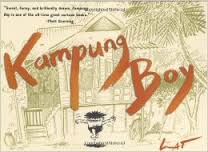
[READ: January 7, 2015] Kampung Boy

This book was written (and drawn) in 1979.  First Second books had it translated and published in 2006.

This is the story of a boy growing up Muslim in rural Malaysia in the 1950s.  Evidently it was serialized in Malaysia back in 1979 (it does feel kind of episodic, but it holds together very well).

It is a charming story of a simple life in the village that is slowly being changed by progress.

It starts with Kampung Boy’s birth and the simple way he was born (midwifed by his grandmother for which she was paid $15) and how he slowly grew from a baby into a naked toddler running around the village.  His aunt worked at the local rubber factory (his parents owned the rubber plantation) where they removed latex rubber from the rubber trees. (more…)

Read Full Post »

ampsSOUNDTRACK: MISSY MAZZOLI-Vespers For A New Dark Age (2015).

missymazzoli_sq-80d1109aad30ab9a4bfe1a45d5c82d99354bc079-s400-c85Missy Mazzoli’s Vespers for a New Dark Age, is a 30-minute suite for singers, chamber ensemble and electronics. The piece was commissioned by Carnegie Hall for the 2014 Ecstatic Music Festival.

It’s a fascinating mix of traditional and contemporary instruments.  And there’s a surprise musician as well: Martha Cluver and Virginia Warnken Kelsey from Roomful of Teeth, provide operatic soprano voices.  Mazzoli’s own ensemble Victoire, provides the music while Wilco drummer Glenn Kotche adds percussion and thunderous pounding.

As the suite opens, electronic chimes sound before the beautifully soaring voices come in (I don’t know who is who).  The instrumentation is complex and the vocals are often in English (but operatic and not always obvious to hear). There’s some great rising and falling notes from various instruments.

The first piece is called “Wayward Free Radical Dreams” and I like the surprise of the simple English phrase “Come on, come on come on” A bell ringing is the segue into part 2, “Hello Lord.”  Over a lonely flute and some synths, the vocalist sings a poem by Matthew Zapruder for lines like: “hello lord / sorry I woke you / because my plans / are important to me / and I need things / no one can buy / and don’t even know / what they are / I know I belong / in this new dark age.”

I love the rising and falling notes of “Interlude 1″ over the fast violin moments.  “Come On All You” opens with some ticking hi-hats and squeaky violins.  There’s a lot of drums in this song—some punctuate the melody until the soprano voice takes over and then around 4 minutes into the section, the drums burst to life.  “New Dark Age” has some moody synths under the soaring voices and “Interlude 2” opens with the sound of big deep bells.

“Machine” has a mechanical staccato feel in both strings and voices.  When it returns to “Come on Come on” refrain (this time with two voices), it’s very cool.  The “Postlude” ends the piece with moody strings and distorted mechanical sounds that overwhelm the voices at times.   The piece ends on an up note but not in an overwhelmingly happy feeling.

The final piece on the disc is not part of the suite, although it fits in sonically.  It is called “A Thousand Tongues (Lorna Dune Remix)” and it has echoing pianos and overlapping synths.  While this piece is pretty it is probably the least interesting of the disc.  Perhaps because there are fewer voices and more synth melodies.  Perhaps because it is a remix.  The song feels fine, but not as compelling as the suite.

I was happy to discover his disc, which really explores different classical motifs.

[READ: March 15, 2015] All My Puny Sorrows

As with many books, but especially those published by McSweeney’s, which I always read, I didn’t really know what this was about.  I can pretty much guarantee it would not have been high on my list had anyone told me it was about dealing with a suicidal sibling.

But what’s great about the McSweeney’s imprint is that they gather such a wide variety of books and most of them are of such good quality that I know I won’t be disappointed.  And this book not only didn’t disappoint, I found it really fantastic.

The story is fairly simple, although from my perspective it was also fairly exotic.  The main action of the book takes place in present day Winnipeg.  But there are flashbacks to the main characters’ childhood in 1979.  And the way it opens–with the family watching as the house that their father built is put on the back of a truck and driven away is one of the more memorable opening passages of a book that I’ve read.

The family consists of the narrator  Yolandi, her older sister Elfrieda and their parents.  And, perhaps most exotic to me they are Mennonites.  Their family is not entirely pious in the tradition in their town–they are seen as somewhat less than observant.  Things were made even worse by the deliberately provocative nature of Elf.  She was creative, she loved to read and she had a real sense of outrage.  The church pastor once accused her of “luxuriating in the afflictions of he own wanton emotions.”  She embraced poetry, particularly the line “all my puny sorrows” and decided it would be her slogan.  So she began spray paining AMPS all over the town. (more…)

Read Full Post »

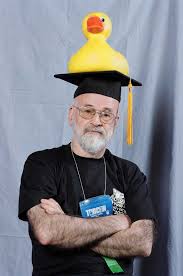
Terry Pratchett [1948-2015]

tpI have been reading Terry Pratchett since I lived in Boston (circa 1993).  I “discovered” him from the book Good Omens, which he co-wrote with Neil Gaiman (who I had also recently discovered).  I recently learned that even though I purchased Good Omens, I had never actually read it.  Duh.  Perhaps I was planning to read it in order after reading his Discworld books.

My fondest memory of reading Discworld is that when I first bought the Discworld books (not easy to get in the States back in 1993), the only versions I could find were these tiny editions (which now I can’t even find evidence of online–perhaps I am the only one who owns them).  I have no idea why they were printed in this preposterous format (the couldn’t have been more than 5 inches square with stupid tiny print).  And I remember diligently reading them at lunch at work.  Which must have looked absurd.  I have these books at home and will have to look up the ISBNs to see their virtual existence.

At any rate, those first four books in the Discworld series all came in that format and I read them all.  And then I proceeded to read through the rest of the series (which would have been up to about book number 17  or so).  At the time of his death there were some 41 books in the Discworld series, including YA books and, geez well so many other things.

And what were they about?  Everything.  Literally. He talked about religion and science.  He talked about metaphysics and witches, he talked about working and police.  He eventually started using popular culture as the basis for a lot of his books–riffing on something or other but never simply parodying them.  His later books advanced the civilizations on Discworld from a more medieval setting to a more contemporary one with newspapers, telephones, money and steam engines.  And of course, there was always Death.  Amazingly he managed to make all of this funny–usually a good laugh every page or two. (more…)

Read Full Post »

spioiledSOUNDTRACK: THE BEATLES-Let It Be (1970).

letOf all the fascinating details about Beatles releases, I don’t think any are more fascinating than the details about Let It Be.  I’m not even close to understanding everything that went on here.  But in a nutshell, it seems that they went into the studio to record an album called Get Back. They were even going to film the whole things.  It got scrapped.  Some members quit the band then rejoined.  And then they recorded Abbey Road.

And then the band did a concert on a rooftop (almost exactly 46 years ago!).  And soon after they broke up. Then some producers decided to release Let It Be as a soundtrack to the documentary made about their recording.  They used some of the material from Get Back and some from the rooftop concert and then Phil Spector got involved and put all kinds of strings on everything and then the album was released in the UK on my first birthday.

There’s lots of snippets of dialogue which seem designed to make it feel like a soundtrack (which it doesn’t).  There’s really short snippets of songs, there’s raw live songs, there’s overproduced string laden songs.  It’s kind of a mess.  But in there are some good songs too.

“Two of Us” is a pretty folkie number that I like quite a lot although I first became familiar with it from a Guster cover (which is pretty fine.  I never quite understood the title of “Dig a Pony,” but it’s a big weird sloppy song. It’s kind of fun to sing along to—especially the falsetto “Beeeecause.”  This song was recorded from their rooftop concert and it feels rawer than some of the other songs.

“Across the Universe” is a lovely song.  Evidently Lennon didn’t contribute much to Let It Be, so they threw this on to give him more content.  I actually know this more from the Fiona Apple version (which I think is actually better than this processed version). I don’t really care for the strings and echoes feel on this version. “Dig It” is a short piece of nonsense. It was exerted from a lengthy jam but for some reason only this little snippet was included on the record–it sounds odd here.

“Let it Be” is quite a lovely song. I don’t really care for the Phil Spectorisms that were done to it—the strings and choruses seem a bit cheesy.  At the same time, the guitar solo (which is quite good) sounds too raw and harsh for the song.  “Maggie Mae” is a traditional song, another bit of fun nonsense.  I like “I Me Mine,” it’s rather dark and the chorus just rocks out.  “I’ve Got a Feeling”, was also recorded on the roof, so it feels raw.  There’s some great guitars sounds on it. Evidently it was initially two songs, and Lennon’s part (the repeated “everybody” section) was added to it.

“One After 909” sounds so much like an early Beatles song–very traditional rock and roll (which means I don’t really like it).  Although the version is raw sounding (it was also recorded from the rooftop) so that’s kind of cool. Huh, Wikipedia says “the song was written no later than spring 1960 and perhaps as early as 1957, and is one of the first Lennon–McCartney compositions.”   “The Long and Winding Road” is where all the controversy comes from.  McCartney hated what Phil Spector did to his song.  He HATED it.  And I have to agree.  It sounds nothing like the Beatles–it sounds very treacly and almost muzaky.  It feels endless.  At the same time, I’m not even sure if the song is that good–it’s so hard to tell after all these years. I think it kind of rips off the transition in “Hey Jude” which was used to much better effect.

“For You Blue” is a simple blues. I like it better than most of the Beatles’ blues, perhaps because of John’s slide guitar (and the funny comments through the song–which makes it seem like the band actually liked each other).  “Get Back” ends the disc as a fun rollicking romp.  I really like this song, although I’m surprised at how short it seems–I thought there was a lengthy outro.  The end of the song (and the disc) has John asking if they passed the audition–lots of fun going on in this contentious recording session.

So it’s not the best career ending disc, although I guess as a soundtrack it’s pretty good.  I’ve never seen the film, and I’m kind of curious to after having walked through all of these Beatles albums.

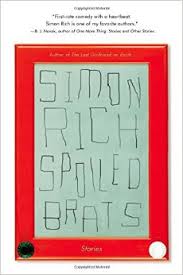
[READ: January 19, 2015] Spoiled Brats

I probably read too much Simon Rich too close together, but it’s so hard to resist him.  I’ve said before that I enjoy his shorter pieces the most, but there were some longer ones in this one which were really good as well.

This is the first book where I thought that Rich went a little too dark (although not as dark as Sarah thought he did).  That’s sort of the point of the book, though, to look at people (especially people named Simon Rich) who are horrible human beings.

“Animals” [New Yorker, April 10, 2013] opens from the point of view of a class hamster.  He is tormented by the children in the class and he knows that when Simon Rich is supposed to feed and give them water that their lives might just be over.  The Simon character is hilarious, and it’s nice to see that revenge is sweet.

“Gifted” wonders what if a child isn’t so much gifted as Satanic–how many euphemisms will be used for this one child?

“Semester Abroad” is the diary of a girl who has gone abroad–to another planet.  And how her insensitivity is handled during an intergalactic crisis.  I enjoyed this one a lot. (more…)

Read Full Post »

 appleSOUNDTRACK: PRIMUS AND THE CHOCOLATE FACTORY with THE FUNGI ENSEMBLE (2014).

Achoclnd after all of that, we catch up to present day Primus.  And this time Tim Alexander is back with them again!  I was supposed to see Primus at a small theater when they toured for the chocolate Factory.  And because of a planning snafu I didn’t get to go.  I had wanted to see the show live before hearing the album.  Sigh.

I was thinking about Les Claypool and covers.  He does a lot of them.  Even though he is clearly a creative tour de force, he also likes to revisit stuff.  His live albums are full of covers, and the Duo de Twang mostly revisited songs he had already done, not to mention how he has re-recorded almost all the songs from Primus’ debut at one point or another.

So it comes as no surprise to me that they would cover the entire Willy Wonka and the Chocolate Factory soundtrack.

The thing to know right off the bat is that Les Claypool is a rather dark and disturbed individual.  And that means that this cover recording is really much more dark and nightmarish than the original (which is quite sweet).  Now true, Wonka is a really dark and creepy figure, and maybe that’s what Les was playing off when he constructed this carnivalesque, dark funhouse mirror version of soundtrack.

And your tolerance for that (and your love of the original) will say whether or not you enjoy this.

This is not fun goofy Primus, this is dark Primus of the “My Name is Mud” and Mushroom Men variety.

“Hello Wonkites” opens this disc with dark and slow bass strings and a slow and menacing melody.  “Candy Man” one of the sweetest songs ever is turned incredibly dark with hypnotic vibes and weird bowed bass sounds.  The way they speed up parts of the song are really disturbing and his vocals are creepy as anything.  This tells you all you need to know about this recording.

“Cheer up, Charlie” is a little bit sweeter as it opens with cellos. But Les’ vocal is weird and a little, yes, disturbing,  Although I don’t really like the original very much so this one works better for me.  “Golden Ticket” is also quite sinister with the mad carnival sounds and the stomping bass.  “Lermaninoff” is a cool 5 second reprise of the Rachmaninoff lock in the movie.

“Pure Imagination” is probably the least creepy of all the songs, although it is still dark and ominous.   It features a lot of percussion, and I read somewhere that Tim doesn’t really play drums on this record, he just hits all kinds of crap that’s around him.  There’s a long instrumental section that is pretty cool.

There are four versions of the Oompa Loompa song, just like in the movie.  Each one is about a minute and a half long.  They’re each quite similar and faithful to the original’s creepy vibe.  They might do better to be spaced out more, but it’s still fun.  The “Semi Wondrous Boat Ride” is actually not nearly as creepy as the original.  “Wonkamobile” is just over a minute long and it is just Les being Les.

“I Want It Now” features lead vocals by Ler!  I don’t know that we’ve ever heard him sing anywhere before.  He doesn’t have a great voice (or he’s trying to be bratty, it’s hard to tell), but it’s such a welcome change to have someone else singing on the disc.

My favorite track is “Goodbye Wonkites” which has a very cool Pink Floyd feel.  The instrumentation is the same as “Hello” but the guitars have this great echo, and the chords that Ler is playing (yes normal chords) sound very much like Pink Floyd to me.  It’s a cool instrumental.

Even though I don’t love this soundtrack, I’d still like to see the stage show that they create for it, which I imagine is just insane.

And that brings an end to the Primus land–a month’s worth of Les and the boys.

That there’s a bad egg.

[READ: January 29, 2015] “Apple Cake”

This story is about a woman who has just entered hospice care.  And yet surprisingly it is not all that sad.

Jeanne was the youngest sister.  Her to older sisters Sylvia and Helen are very different but both were quite upset that it was their baby sister who would die first (even though none of them was actually young).

Since she was in hospice, the family was gathered around pretty much all the time.  The sisters were there constantly and her sons and nieces and nephews all took time off to pay their last respects.  But Jeanne lingered–despite doctors saying that she had only a day or two left, she continued to seem rather strong and coherent.

And really this story turns out to be more about the fighting between the healthy sisters–and their children.  Will they defer to Jeanne’s wishes–like when she asks for a bagel even though she hasn’t eaten solid foods in weeks?  And, most importantly, will they honor Jeanne’s wishes about her death–she wants no funeral, no ceremony, not even a burial.  Or will they follow tradition and have a rabbi preside over her.

And so this fight comes down to Helen and Sylvia.  Even though Jeanne has made her intentions clear to her sons, Helen and Sylvia have always been at odds and will continue to be so: “There was simply the great divide between them: Helen told the truth, while Sylvia tried to paper over everything.”  Helen is insistent that Jeanne see a rabbi and have a proper burial.  But Sylvia and everyone else finds it disrespectful.

And in her grief, Helen begins baking.  After all, she was the baker of the family–Sylvia hadn’t baked in years because her husband was diabetic.  She made apple cake (which was pretty good), almond cookies (which were less so) and a pecan bar which was, well, left uneaten.  And so the food starts piling up, because Helen never threw anything away.

Then one day Sylvia brought in an apple cake, warm and fragrant.  Even Jeanne remarked on how good it smelled.  Which gets Helen indignant.

“It’s my recipe,” Helen said, “I gave that recipe to Sylvia twenty years ago.”
“Yes I remember,” Jeanne said, “she bakes a very good apple cake.”
“I bake the same one!  I brought you apple cake last week.”
“I know, but I like hers better,” Jeanne said.

Eventually Helen convinced the rabbi to see Jeanne.  The rabbi is friendly and accepts that Jeanne is an atheist–Jeanne was looking for a fight but he was very kind.  And she even concedes that she could be buried in her plot.

When Jeane eventually dies, they agree to a simple ceremony.  Helen tries to make it more religious–saying that Jeanne agreed to it–but she is unable to hijack the ceremony.  Sylvia is off course pot off by Helen’s behavior and gets rather sulky.

At the gathering afterward, they agreed it would be catered and no one would bring baked goods.  But as the day dragged on, there suddenly came the smell of fresh-baked apple cake.  The nuclear option had been pulled.

I really enjoyed this story and the inner workings of passive aggressive family troubles.  And the way that Jeanne seemed to supervise the whole thing.

Read Full Post »

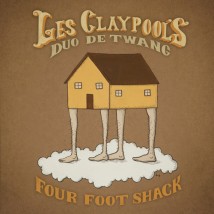
 june30SOUNDTRACK: LES CLAYPOOL’S DUO DE TWANG-Four Foot Shack (2014).

Four_Foot_Shack_coverAfter touring around for the then latest Primus album, Les Claypool and M.I.R.V. guitarist Bryan Kehoe.  They got together for a bluegrass festival and decided to keep going with it.

So this is just Les and Bryan each playing a resonator bass and resonator guitar and twanging up the songs (with extra mandolin and backing vocals on a few tracks by Wylie Woods).

The disc opens with the only new song, a 42 second bit that doesn’t quite prepare you for the nonsense inside.  Because this is really a fun record of covers (Primus songs, Les’ solo songs, and others).

I tend to like the proper Primus versions better, but I really enjoy the way he has transformed them in this format.  “Wynona’s Big Brown Beaver” totally fits in this format and I do like it (the yodel bit is perfect) I just happen to like the bass and guitar better in the original.

The covers include: “Amos Moses” which works fine in this format.  “The Bridge Came Tumblin Down” (by Stompin’ Tom Connors) sounds very Stompin’ Tom.  It’s quite a sad song (thanks Tom).  “Stayin’ Alive” is fantastic–it really works with that style and the “how how how” is funny without being mocking.  “Pipeline” is a surprisingly good surf song for these two instruments–they really rock it out.  Perhaps te second biggest surprise (after Stayin’ Alive) is “Man in the Box” from Alice in Chains.  It projects a “Rawhide” vibe, and works very well It’s also kinda funny with the lyrics: “for some reason I’m buried with my very own shit.”  “Battle of New Orleans,” sounds really familiar although I’m not sure where I know it from.

There are several songs from Les’ solo albums done in twang style.  “Red State Girl” works great in this format (although it makes me sad that we still know who Sarah Palin is).   “Boonville Stomp” I like this version better than any others I’ve heard–some great steel guitar soloing going on in the second half.  The intro to “Rumble of the Diesel” is funny where he says that Seattle people don’t know anything about fishing and they turn on him.  “Buzzards of Green Hill” works really well with the twang, as does “Hendershot” (although I like the way he says “Hendershot” in the original more).  “D’s Diner” is fun in this format, less weird (the original is pretty weird).  And I’d love some malted buttermilk pancakes all day long.

The final song is a cover of Primus’ “Jerry Was a Race Car Driver.”  It feels very different.  The guitar solos are fun–there’s a Benny Hill vibe before the solo for Jimi Hendrix’ “Third Stone from the Sun.”

So while the album is goofy, it’s done in good fun, and the impact is really strong–Les’s songs have always been about rhythm and they translate really well.

[READ: January 29, 2015] “Pink House”

Rebecca Curtis continues to be one of my favorite recent discoveries.  Strangely enough I bought a copy of her short story collection and then proceeded to lose it in my house. How is that possible?

This story comes from a different narrator than the other stories, although she is just as bristly and straightforward as Curtis’ other narrators.  And in the way of delightfully convoluted stories, this one has an unusual setting to get to what it wants to say.

The narrator is at an artist’s gathering . None of the seven people gathered around–a Korean American crime-noir novelist, a Lebanese fantasy writer, a Thai journalist and three Brazilian painters–knew each other.  A foundation had flown them out together to practice their arts for six weeks.  “None of them knew who’d selected them for the residency, or why.”  I love that.

So the narrator decides to tell them a story about a ghost.

She had been living in Manhattan, although she was originally from Maine.  She was barely scraping by but then she was accepted into the MFA program in Syracuse.  She asked them to secure housing for her and she accepted an apartment sight unseen.

Before she left, she decided to have one last fling with her boyfriend.  She makes a point of telling everyone that he is black (she pretty much exclusively dates black men), and there’s an awkward moment where she says that her boyfriend half comic half angry asks, “”You like black cock?”” The rest of this answer is out loud: “I hesitated.  To me the question seemed off, since it was evident that I did.  Who I wondered wouldn’t like such a good thing?”  Meanwhile, the journalist asks her, “This relates to the ghost story?”  She says that it does.

Albeit somewhat tangentially.  She wound up oversleeping on the night she was supposed to pack.  Her parents drove down from Maine to help her move and her father was super mad that she wasn’t ready (he had no intention of sleeping in a hotel in Syracuse).  The whole relationship with her family: her angry father and her mother who believes that she will be going to hell because of her premarital sex is very funny.  It also takes up a large chunk of the story but has little to do with the actual ghost part, well, except for one important thing. (more…)

Read Full Post »

dec8SOUNDTRACK: LER & HERB during the hiatus (1999-2003 & 1994-2003)

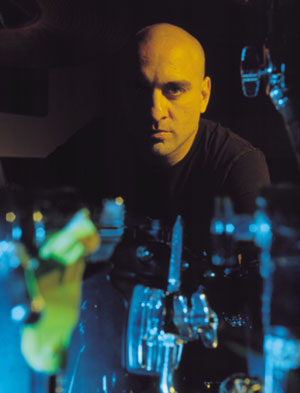
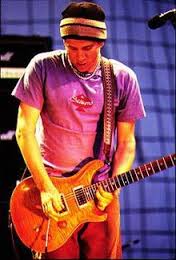
1201_Tim_Alexander_Lead lerDuring the years that Ler and Herb were out of Primus, it’s a fair question to wonder what they were up to.

Larry “Ler” LaLonde was only “on hiatus” for a couple of years.  During that time, Ler created an electronic band (no guitars!) with Brain (who mastered the business and the beats) and DJ Disk (who drank grappa), and The Filthy Ape (who enjoyed a casual snack and read a good book), while Ler himself was on the flying boat (whatever that means).   Take what you will from that.  They released two albums which I’ve written about earlier: Lee’s Oriental Massage 415-626-1837 and God is an Excuse.

They are both electronic and or full of spoken nonsense and neither one is really worth hunting down.

Tim “Herb” Alexander was out of Primus for about 8 years.  And during that time he was rather busy. He started a band called Laundry, which released two albums Blacktongue (1994) (which you can listen to on Youtube) and Motivator (which is on Spotify). He also made an album with a supergroup called Attention Deficit (with Alex Skolnick – Guitar and Michael Manning – Bass).  They made two albums, Attention Deficit (1998) and The Idiot King (2001).  he also drummed on one song on the A Perfect Circle album Mer de Noms.

I haven’t really listened to all of his stuff that much.  Laundry is a sort of noisy kinda Primusy prog metal outfit Blacktongue is noisy than Motivator (and Herb sings lead on the second disc, and his voice is better suited to the music).  I’m curious about Attention Deficit, so I’ll have to give them a listen one of these days.

[READ: January 21, 2015] “Reverend”

This story was actually quite simple in plot, but it revealed a great deal that was hidden.  A man who has just lost his mother, reflects back upon the life he led with his parents and siblings.

The narrator’s father was the titular reverend.  Being a reverend was an extremely important part of his father’s life.  Indeed, he even met his wife when they both considered becoming missionaries.

They had three children–their oldest son–who grew up to be extremely anti-religion; a daughter who was very religious but not very smart and then the narrator who was, by his own admission, completely middle of the road in front of his parents. He didn’t believe in religion, but he never made waves with his parents.  He was smart but he never showed off.  And he believes that this milquetoast attitude may have upset his father more than anything. (more…)

Read Full Post »

nyoct20 SOUNDTRACK: PRIMUS-“South Park” Theme Song (1997).

In 1997, Trey Parker and Matt Stone asked Primus to recsouthparkord a theme song for their new show South Park.  They joked that the show might not even be picked up, but whatevs–it could also be a hit.

Of course, it turns out that this show has probably made Les and the boys more money than anything else they’ve done.

Interestingly, the original song they submitted was 1 minute long (way too long for an intro) and rather slow and creepy.  Rather than have them edit it or re-record it, the South Park team just sped it up (and removed the solos, which they put at the end) and then asked Les to re-sing it.

So here is the original, rather creepy version of the theme song.

And here is the final product

[READ: January 10, 2015] “Ordinary Sins”

This is the story of Crystal.  Crystal works at a local parish as secretary.  She took the job thinking it would be temporary. Then she got pregnant unexpectedly (there’s no father around) and now she is stuck (and grateful that the church is keeping her on).

Her co-worker, Collette, totally disdains her and tries to make things unpleasant for her.  In fairness, Collette tries to make things unpleasant for everyone.

The priest at the Parish, Father Paul, is super nice and quite kind, especially to Crystal.  He seems to give her little bits of encouragement throughout the day.  He is a former alcoholic and from what Crystal can tell, he has more than made up for his sins and (since she knows everything about him, really) he seems pretty devoid of all sin at this point.

He encourages her to go to confession.  Eventually she does.  But during the confession, she confessed a bit more than she meant to, .  And since she knows he knew it was her–how could he not?–she tries to hide from him, believing that things will be weird.  And things do get weird, but they seem to be more weird because of Father Paul not what she said. (more…)

Read Full Post »

[ATTENDED: December 27, 2014] Joseph and the Amazing Technicolor Dreamcoat

josephSarah and her mom love Joseph and the Amazing Technicolor Dreamcoat.  So when I saw that it was playing at the State Theatre for $7/ticket (as part of the Plays in the Park program) I decided to get tickets for all five of us (why not subject the kids to musicals as well?).

I knew the music a little from Sarah playing it, but I didn’t know it that well.  I always thought it was very funny that someone made a huge production out of what is a rather short Bible story.  But it’s a good story and one that I remember from my religion classes, so it seemed like a good afternoon of fun.

And it was.  This was the company’s 20th production of the show (who knew?).  And many of the people had been with the show for many many years.  So it was like a well-oiled machine.

The only thing that we all agreed we didn’t like so much was Joseph (Michael Ferlita). Not that he was bad, but that he was a bass.  And Joseph isn’t a bass.  It was weird, and at times hard to understand–it came across as more operatic than musical-y.  The rest of the performers were very good (as was the orchestra).  I was also delighted that the many of the men were kind of chunky–something you don’t often see on stage. (more…)

Read Full Post »

« Newer Posts - Older Posts »