 SOUNDTRACK: DAVID FRANCEY AND MIKE FORD-Seaway (2009).
 Mike Ford introduced me to Louis Riel on his album Canada Needs You, Volume One. The song “Louis & Gabriel” features the lyrics “Oh, Louis Reil, here comes your friend Gabriel” outrageously simplistic (it is for kids after all) but so incredibly catchy it’s in my head whenever I see this book. This is Ford’s most recent album, a collection of songs by himself and David Francey–who I didn’t know before this disc.
Seaway is a collection of 16 songs which are in one way or another about the sea. Two of the songs appear on Ford’s release Satellite Hotstove, but the rest are new. I don’t know if Francey’s songs are new or not. I’m also unclear from the credits if Ford and Francey worked on these songs together (the notes suggest they did) or if they were recorded separately and then compiled.
The songs are primarily folk–simple acoustic numbers, often solo guitar, but sometimes with accompaniment. Mike Ford has a great, strong voice, and is capable of some interesting stylistic changes. His songs are more vibrant on this disc. Francey has a wonderful, almost whispered voice. He has a gentle Scottish accent which is great for his storytelling songs. Mostly he speak-sings, but on some tracks, like “The Unloading” he sings a full-bodied chorus.
But it’s Ford’s song that bring a lot of variety to the disc. “There’s No Rush” has a sort of calypso feel to it and “When You’re the Skip” has a wonderfully dramatic sea-shanty/musical feel to it. And “21st Century Great Lake Navigators” is a rap–Ford frequently raps a song on his various albums. His voice is very well suited to it, and his rhymes are clever and often funny.
This is a charming disc. I wouldn’t say it’s essential, but it’s a good introduction to both singers, and, of course .
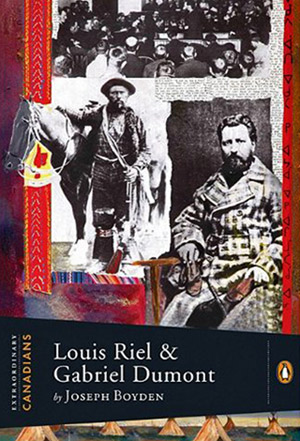
[READ: January 26, 2010] Louis Riel & Gabriel Dumont
Of the six Extraordinary Canadians books, I was least excited to read this one. I’m not sure why, but I wound up leaving it for last. But lo and behold it was easily the most engaging and, dare I say, exciting story of the six. I’m sure part of that is because I didn’t know the outcome (even if Gabriel was somewhat famous in the U.S., I still didn’t know what had happened to him or to Louis). And by the end of the book, I absolutely couldn’t put it down.
Joseph Boyden is a Métis writer (who I’ve never read before). It’s obvious from the get-go that he is sympathetic to Riel and Dumont (which is to be expected in a biography, I would think). He gets a tad heavy-handed about John A. Macdonald, but it seems justified. For really you can pretty much take only one of two points of view about Riel and Dumont: they are either rebel heroes, standing up for the oppressed Métis, or they are traitors, intent upon destroying Canada’s expansion.
Now, I admit that I don’t know much about Canada’s expansion. The first prime minister, John A. Macdonald, was instrumental in Canadian Confederation and was the driving proponent for the completion of the Canadian Pacific Railway. But as with American westward expansion, Native cultures are in the way of this expansion. (more…)

 I Just Read About That...