Feeds:
Posts
Comments

Archive for the ‘Tiny Desk Concert’ Category

june9SOUNDTRACK: RODRIGO AMARANTE-Tiny Desk Concert #384 (August 23, 2014).

rodrigoI hadn’t heard of Rodrigo Amarante before this Tiny Desk Concert.  The photo of him–heavily bearded with a tiny guitar, simply didn’t prepare me for the beautiful rich voice this singer has.

Amarante is from Rio de Janeiro but now lives in Los Angeles (and has no discernible accent).  That tiny guitar is a ‘Harmony parlor guitar from the ’30s, known lovingly as “Butter.”‘

He plays four simply gorgeous songs (only marred slightly by the fact that he has to clear his throat a bunch of times).  Two songs are in English, one is in French and the fourth is in Portuguese.

The opening humming notes of “The Ribbon” are just beautiful and sound so lovely with “Butter” playing along.  When he starts singing, you simply get sucked into his warm enveloping voice.

“Mon Nom” is sung in French and the soft sound of the French sounds even better as he sings.  (Coincidentally, this song contains the word Aubergine, and a woman named Aubergine is the main character of today’s story).

Before the third song, he says he’s not used to these songwriter stools but declines a change.  “I’m Ready” sounds rather different from the other song in English.  He doesn’t sing radically different, but there’s something in his phrasing that changes the tone of the song.  I believe the end of the song is sung in Portuguese.

The final song, “Nada Em Vão” is sung entirely in Portuguese.  Before the song Bob asks if this is the most unusual place he’s played in, and he says he would “like to say yes….”  This song is much more quiet and subtle.  It’s also quite lovely.  And the way it ends is kind of a surprise too.

Amarante is a real find and seems like a super nice guy too. At the end of the show he stretches and says that it’s a nice way to start my day.

[READ: February 15, 2016] “The Prospectors”

I haven’t read much from Russell before so I was really surprised by a lot of things in this story.

It opens with a woman, Aubergine, on a chairlift riding up the side of a mountain.  The woman and her friend Clara were expecting to go to a party at the peak.  The two women had met a man calling himself Eugene de la Rochefoucauld.  They had waited for Eugene at the bottom of the chairlift for an hour, then (after dubbing him Mr No-Show) they set up the chairlift by themselves.

Imagine my surprise to find out a few paragraphs in that they are heading up Mt. Joy, the miracle of the New Deal.  This story is set in WPA times, and they are going up the mountain to see the beautiful new hotel. (more…)

Read Full Post »

tny 5.26.08 cvr.inddSOUNDTRACK: PACIFICA QUARTET-Tiny Desk Concert #383 (August 18, 2014).

pacificaIn this Tiny Desk Concert, the Pacifica Quartet explore the world of a single composer, Dmitri Shostakovich.  They will play three movements from different Shostakovich quartets

The quartet consists of Simin Ganatra and Sibbi Bernhardsson on violins, Masumi Per Rostad on viola and Brandon Vamos on cello.

I’m going to quote a ton from the NPR blurb because they know from what they speak.  But I’m going to chime in that these pieces are really cool.  I like Shostakovich, but haven’t really devoted a lot of time to him. His music seems at times playful and at other times very dark.

In the first piece I love how that three note motif recurs in different places and then the piece turns into a delicate pizzicato section.

The second piece is so light-hearted as it starts–pastoral and lovely.  But there hangs a slightly menacing version of that pastoral riff.  I especially enjoyed watching the cellist bow aggressively.  It goes a little crazy towards the end but somehow remains upbeat.

The final piece plays off of the notes of Shostakovich’s initials (they explain all about this in the intro and what the S and H are in terms of musical notes).  It’s amazing to think that these different parts play with those four notes in a different way.  It’s an intense piece and reminds me a bit of Psycho.

From the blurb [with my comments in brackets]:

With the arguable exception of Béla Bartók’s six string quartets, it’s generally accepted that the 15 by Dmitri Shostakovich are the strongest body of quartets since Beethoven….  The Shostakovich quartets are intense, like page-turning thrillers, as they pull you into his world. They are dark and introspective, witty and sarcastic, and stained with the Soviet-era violence and hardship the composer lived through.

Quartet No. 7 in F-sharp minor, Op. 108 (1960) Allegretto
Eerie pizzicato and piercing stabs in the violins help color the twitchy, even sinister, opening movement of the Seventh Quartet. Stalin might have been dead since 1953, but hard-line Soviet politics (including the violent suppression of the 1956 Hungarian uprising) were still in place. The music’s lightness and transparency create a crepuscular feel.

Quartet No. 3 in F major, Op. 73 (1946) Allegretto
The Third Quartet’s first movement looks back to a slightly more pleasant time before World War II. At one point Shostakovich considered a subtitle: “Calm unawareness of the future cataclysm.” The jaunty opening theme, like Haydn after a few beers [now that is a hilarious line], is among the most lighthearted in the 15 quartets. But the mood sobers with an intense double fugue before returning to the opening music and a flashy final page.

Quartet No. 8 in C minor, Op. 110 (1960) Allegro molto
The Eighth Quartet is Shostakovich’s most popular — and one of his most hair-raising. He dedicated it to victims of fascism and war while at the same time creating his own epitaph. The entire quartet is built on a foundation of four notes that spell out his first initial and the first three letters of his last name [watch in the beginning of the piece as they demonstrate these notes]. The second movement juxtaposes violent energy with a tweaked version of a Jewish folk theme from an earlier work.

[READ: February 27, 2016] “The Full Glass”

I never understand how the New Yorker selects what it will publish each week.  Sometimes authors can go for years without a piece and sometimes they can go just a couple of months.  Such is the case with 2008 where there have been many duplicate authors in the span of a few months.  Updike’s last story in the magazine was in January of 2008–that’s barely five months.

Anyway, this story is written from the point of view of a man turning eighty.

He talks about retiring from his job as a wood floor re finisher in Connecticut.  He’s admitting he is his age and is taking a ton of pills every day and what not.

And he reflects on a many things in his life.  Like the bliss of a cold glass of water.  He hates the thought of drinking 8 glasses a day, but a cold glass at night is wonderful [I concur]. (more…)

Read Full Post »

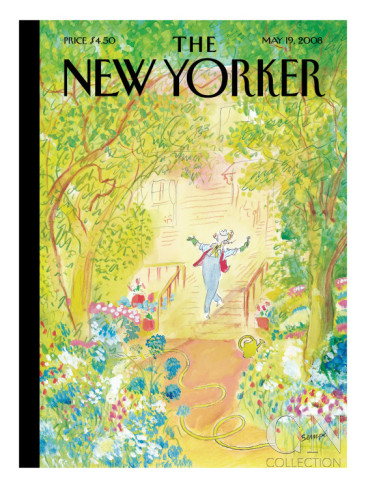
jean-jacques-sempe-the-new-yorker-cover-may-19-2008 SOUNDTRACK: IRENE DIAZ-Tiny Desk Concert #380 (August 9, 2014).

iremeVirtually no infomation is given about Diaz in the blurb for her Tiny Desk Concert.

“My Sweetest Sin” opens as a one minute acapella song before she sits down at the piano and is accompanied by Carolyn Cardoza strumming away intently on ukulele for “Crazy Love.”  Her voice sounds lovely by itself but it sounds even richer when accompanied by the spare instrumentation.

“Lover’s Sway” goes through several genres.  It opens with a jaunty showtune vibe and then slows down for the verses.  And then indeed it gets jaunty once again, in a very different way.

For the final song, “I Love You Madly” she switches to guitar.  She says it was her first love song because she used to write a lot of depressing songs.  This is a pretty, mellow song and she at times sounds a bit like a country singer and a bit like Natalie Merchant.  It’s a little too slow and long for my tastes, but it is very pretty.

Diaz is quite a talent with a nice range of styles.

[READ: February 24, 2016] “East Wind”

This is the story of Vernon, who had moved to an unspecified busy waterfront town just a few months earlier.  A recent spate of vandalism had caused some beach huts to be burned down.  The town was horrified, but he didn’t mind so much because it improved his view to the sea.

He is sitting in a restaurant, and when the waitress asks if he’s done he replies with the cryptic, “All the way from the Urals.” When the waitress is understandably confused he says that’s where the wind comes from.

The waitress, a strong-looking woman, pronounces it Oorals.  He assumes she is Eastern European, perhaps Polish.  He jokes with her that they should o for a swim.  She replies, no swim, although he hadn’t actually meant it.

He became a regular there.  And on another occasion he said to her that they should run away and live in a beach hut.  “I do not think,” she replied.  But then he asked her out and she said yes. (more…)

Read Full Post »

may5SOUNDTRACK: THE FAMILY CREST-Tiny Desk Concert #379 (August 4, 2014).

familycerstI first heard The Family Crest on this Tiny Desk Concert back in 2014 and I immediately fell in love with them.  I received their album for Christmas, and it’s quite fantastic.

The band plays a wonderful mix of over the top chamber prog rock mixed with healthy doses of jazz.

There are seven people in the band, which is centered around guitarist and (amazing) vocalist Liam McCormick.  Their instruments include violin, cello, upright bass, flute, trombone, drums, and guitar but this band rocks hard (and McCormick can wail like the best of them).

The set begins with the jaw dropping “Beneath The Brine” which opens with a great cello riff and is quickly accompanied by violin and flute.  When the full band kicks in, grace notes are added to the riffs to really fill out he song (from the flute and the drums) and it builds until Liam starts singing.  His voice is powerful and strong with a great sense of melody.  The drums, by the way are playing wonderful jazzy patterns and accents.  But it’s around 2:30 that Liam shows just what he can do with his voice as he hits some amazingly powerful high notes.  As the song romps to an end, you can hear all of the instruments adding to the music before the final quite coda.  It’s fantastic.

“Howl” is inspired by jazz.  Liam was trained in opera (which explains a lot) and the band is full of classical fans, so he was excited to add Charlie the jazz drummer “hey man wanna listen to Miles David and drink whiskey?”  The song opens with a big trombone riff before settling into a snappy jazz song.  This song has a number of loud and quiet moments that work well together.  It’s even got a great “ba ba ba ba ba ba” section that is fun to sing along with.

 They ask “one more?”  And Bob says “or stay all day.”  So they play the final song, “Make Me a Boat.”  If you can forgive the little GoPro ad, it’s neat that this relatively unknown band has been embraced by the camera company.  “Make Me a Boat” doesn’t seem like the most obvious choice for a video since the beginning is kind of slow, bit the middle section is really pretty and has a great flowing feel that would work well with a video.  And in this live version Liam does some great improv singing of powerful high notes that really flesh out the melody which the rest of the is playing (no wonder he’s so sweaty by the end).

The album fleshes out the orchestral sense of the band with a 30 piece orchestra which makes these songs even more grand.  The Family Crest was a great find.

[READ: February 22, 2016] “Letting Go”

Sedaris is one of the funniest writers when the topic is smoking.  He is (or was, I suppose) and inveterate smoker.

And I love that he starts the essay with this paragraph:

When I was in fourth grade, my class took a field trip to the American Tobacco plant in nearby Durham, NC.  There we witnessed the making of cigarettes and were given free packs to take home to our parents. I tell people this and they ask me how old I am, thinking, I guess, that I went to the world’s first elementary school.

He starts this essay talking about how much he hated smoking when he was a kid.  His mother smoked all her life and he just hated it.  Not the smoke so much but the smell–he found it depressing “the scent of neglect.”

Of course then he started smoking himself.  He talks about trying to decide which brand to use–the brand you chose was a statement back then.  He chose Viceroy.  And he started smoking them when he was in Vancouver. (more…)

Read Full Post »

2008_05_12SOUNDTRACK: QUETZAL-Tiny Desk Concert #378 (August 2, 2014).

tzalQuetzal are a band from Southern California who have been performing in the Chicano scene for about 20 years.

Guitarist Quetzal Flores plays the Mexican jarana for both rhythm and melody, violinist Rocio Marron adds blues licks into Mexican folk runs and bassist Juan Perez provides a nimble and melodic bottom end.  And then there’s lead singer Martha Gonzalez who has a great voice and is quite the activist.

The first song, “Palomo Vagabundo” is pretty and sad.  The song means vagabond Pigeon and is a story about a beaten up pigeon who still tries to find love.  Quetzal says the whole album is about life of urban animals and how we relate to them.

They introduce the second song “Tragafuegor” which is about a fire breather they saw in Mexico.  He was putting himself in harm’s way to make some change but also shining light on reality.  This is a faster, livelier song with Gonzalez dancing on a box–like Saintseneca.  The dancing rhythms, the great violin and the cool robust bass really make this song stand out.  About the stomp box, this is a tarica from Veracruz, Mexico.  Quetzal explains that Martha is a percussionist by trade as well as a professor as Scripps College in Pomona.

The final song, “Todo Lo Que Tengo” is a beautiful ballad.  Again Martha’s voice soars above the music.

It’s always fascinating to “discover” a band who has been around for 20 years.

[READ: February 23, 2016] “A Man Like Him”

This is in unusual story in that the main character is a man who is obsessed with a story in a magazine.  Teacher Fei is an older man, unmarried and now living with his elderly mother.  She needs his care and he doesn’t mind giving it to her.

The story that he has become fixated on is about a nineteen year old girl who is set out to publicly humiliate her father.  The girl’s mother and father divorced three years ago.  And once the girl turned eighteen she sued her father, suspecting that another woman had seduced hm away from her mother.  She said that he should be punished for abandoning his family and for the immoral act of taking a mistress.

She had also created a website to humiliate the man.  She wanted him to lose his job, his freedom and his mistress. And this angered Teacher Fei (who didn’t know any of them) to distraction. (more…)

Read Full Post »

may5SOUNDTRACK: SAINTSENECA-Tiny Desk Concert #377 (July 29, 2014).

saintsenecaLike Highasakite, Saintesenca is another band who plays instruments that are unusual (and whose Tiny Desk Concert is way too short).  But before the music started, I was fascinated by the hair of the band.  Zac Little’s head is partially shaved and his beard is unshaven, but he also has an incredible mustache.  It’s so thick I couldn’t see his mouth moving when he started singing!  There’s also the co-lead singer, Maryn Jones’ hair which is equally fascinating.

And there’s also their instruments.  On the album, they play: banjo, baglama, bulbul, balalaika, bowed banjo, baritone ukulele, bass and bouzouki as well as a stomp box.  For the first song, “Happy Alone,” In this set there is a baglamas (played by Jones), while Little plays a Paul McCartney style bass.  There’s also drums and electric and acoustic guitars.

And their music is fantastic “Happy Alone” has a kind of Decemberists vibe.  There’s a great chorus (and two acoustic guitars accompanying).  The melody is catchy but by the time it comes around a second or third time, it’s a total ear worm.

Between songs they talk about the stompbox.  It’s a roughly 2’x2′ plywood floorboard meant for pounding the beat. The blurb says that “at a show just before this Tiny Desk Concert… Little put his boot right through that floorboard.”  There’s a hole in the box which Jones seems concerned about falling through.  The box also explains why Jones and Little both seem so outrageously tall at this show.

On “Fed Up with Hunger” Little plays a four-stringed guitar (I wish they would say what all of these instrument are).  He plays some wonderfully elaborate chords on it.  Jones sings lead in a very high-pitched delicate voice.  There’s an electric guitar added for the chorus but for the most part this is a stripped down song with some lovely harmonies in the end section.

The final song “Blood Bath” has three distinct parts and it is awesome.  Jones plays bass, Little plays acoustic and the other acoustic guitarist  plays a tiny triangular instrument (a balalaika?).  Little sings in a kind of broken falsetto.  After the first slow verse the whole band kicks in and the song really takes off.  But soon after, the whole band seems to deconstruct the song, playing a few seconds of utter noise before coming back in and following it with a really fast rocking and equally catchy section.  It’s pretty awesome.

I’m going to have to look for more from them.

[READ: May 5, 2008] “Them Old Cowboy Songs”

I was looking through older stories and saw that I had not finished a story by Proulx which was written in a June issue of the New Yorker in this ame year.  How did she ever get two stories within a month of each other?  (And they’re both really really long, too).

This story is dark. Very dark and brutal.  It is set in 1885 and looks at a young couple trying to make it out in the wilderness

Archie is a sixteen year old who lies and says he is 21 to try to get better jobs.  He works a cowboy in Dakota Territory.  In addition to being a hard worker, he is a consummate singer with a golden voice.  He marries a young girl (14), named Rose whose parents don’t approve of him or of her getting married at 14, and they settle in.  The narrator notes: “There is no happiness like that of a young couple in a little house they have built themselves in a place of beauty and solitude.” (more…)

Read Full Post »

2008_04_21-400SOUNDTRACK: HIGHASAKITE-Tiny Desk Concert #376 (July 25, 2014).

 highkiteFor some reason, some bands play a Tiny Desk Concert that is very short.  It’s especially disappointing when the band is unusual and interesting like Highasakite.

They play only two songs (for a total of 8 minutes), but they cram a lot of interesting sounds into these songs, including a flugabone.  Kristoffer Lo plays that mournful horn and Ingrid Helene Håvik compliments the yearning with words that are mysterious and somewhat dark.

For “The Man on the Ferry” the song opens with the horn playing mournful notes while the percussionist plays a tiny steel drum and Håvik plays a kind of autoharp.  There’s the fascinating lyric: “It made the Indian in me cry.”  (It’s especially interesting since the band is from Norway).

Håvik has an inflection something like Björk’s (although her singing style is very different) and there are some delightful harmonies.

The melody of the second song “Since Last Wednesday” is familiar to me.  Or the combination of steel drum and horn is just really compelling. It’s fascinating to watch the guitarist wield his horn in one hand while holding the guitar with the other and singing harmonies.  The song is also kind of mysterious (that horn again) with the lyrics:

He would never do graffiti or vandalize that house. And he would never be caught spray painting on those people’s walls. But no one has seen or heard from him since last Wednesday.

As the song progresses some really dark lyrics crop up, all under that beguiling melody.

The blurb lists some of their other titles: “Leaving No Traces,” “I, The Hand Grenade,” “The Man on the Ferry,” “Science & Blood Tests” which really says quite a lot about this interesting band.  I definitely want to hear more than eight minutes from them.

[READ: February 20, 2016] “The Repatriates”

I was fascinated by this story because I hadn’t really heard of the phenomenon of Russian emigres returning to Russia because they felt the conditions were better there than in America

The story starts by telling us that Grisha and Lera’s marriage has dissolved.  In 1994 Grisha’s visa had been processed and he was brought to America by Hewlett-Packard.  He found it demeaning and like servitude ans as soon as it was up her quit and got a new job with Morgan Stanley–building market models for mortgage traders (for those of us who doesn’t know what that is, it’s not rally that important).

But Grisha felt empty.  He said there as no spirituality in America (even though he himself was not spiritual)

Eventually Grisha started travelling back to Moscow (they had not been able to sell their apartment there, so he had a place to stay). He would visit old friends and make news ones.  He started going more frequently.  And then one of his trips lasted for two months. (more…)

Read Full Post »

TNY 4.14.08 cvr.indd SOUNDTRACK: HAMILTON LEITHAUSER-Tiny Desk Concert #375 (July 21, 2014).

hamleitHamilton Leithause was the lead singer of The Walkmen.  When they went on hiatus, the guys in the band made solo records.  For this set, Leithauser is accompanied by The Walkmen’s Paul Maroon on guitar and Hugh McIntosh, who played drums in Leithauser’s old band The Recoys.

Leithauser has a big voice and these songs allow him to really wail (in a restrained and tasteful way).  “11 O’Clock Friday Night” has a very folkie feel to it with a big chorus of “you and me and everybody else.”

“Alexandra” is a bit more uptempo and rocking with a cool rumbling bass line provided by the electric guitar (he really gets to belt out the chorus and the bridge in this song).

“5AM” is a moody ballad which shows he can play mellow as well as big.

Incidentally perhaps it was back in 2014, but Leithauser was doing some kind of concert in Philly and they must have advertised it ten times a day for months.  I was rather tired of hearing his name (I didn’t know who he was at the time). I had to look him up and he was fine.  About the same as I felt during this show.

[READ: February 18, 2016] “The Lie”

I have really been enjoying Boyle’s stories.  He has a way of making his protagonists unlikable and yet somehow sympathetic.  But this time, I felt like his protagonist was just too much of an asshole.  He went too far.

Lonnie is a new dad.  He’s a young guy who has married a woman whose nighttime sleepwear is a Cramps shirt and nothing else.  Her name is Clover, but she hates that her hippie parents named her that and wants to change it to Cloris.  He says that Cloris sounds like a detergent and she hates him for that.

Anyway, he wakes up and doesn’t feel like going to his editing job (I may have been more sympathetic if the job were harder).  He is tired of hearing the same people recite the same dialogue every day.  He says he’s not rally an editor, he’s a logger. (more…)

Read Full Post »

2008_04_07-400SOUNDTRACK: HOLLY WILLIAMS-Tiny Desk Concert #373 (July 14, 2014).

holyHolly Williams is a country singer.  Her lineage is hard to deny: the daughter of Hank Williams Jr., half-sister of Hank Williams III, and the granddaughter of country legend, Hank Williams Sr. (she never met him, as he died long before she was born).

She sings three songs.  “Drinkin'” which is very country.  “Railroads” rocks a bit more and has an interesting sounding chorus.  But it’s “Waitin’ on June,” a story song about her grandparents (not on the Williams side) that is beautiful and touching (although I really don’t like the way she sings the word “June,” but that’s just me).

[READ: February 18, 2016] “The House Behind a Weeping Cherry”

This story is about a young Chinese man, Wanren, who has set out for New York to try to benefit his family.  He is shocked to find that he is working in a sweatshop (he left China for this?) pressing clothes.

He has been living in the upstairs apartment of a house owned by Mrs Chen.  But his roommate has just left because he couldn’t handle the fact that the women who lived down the hall were prostitutes (who paid Mrs Chen).

When the roommate moves out Wanren is afraid Mrs Chen will raise the rent. But instead, she asks if he will drive the girls to their appointments at local hotels.  Mrs Chen assures him that he wont get in trouble with the police and he reluctantly agrees.

The rest of the story unfolds with the narrator becoming more friendly with the three girls.

Lili is the meanest of the three. She speaks the best English and answers the phone.  Nana is friendly, but it’s Huong who is the best cook and the prettiest of the three.  Wanren likes her the best.  Lili suggests that he should buy one of them for the night since he has no girlfriend, but he knows not get involved.  He doesn’t want to play favorites even though he has one.

The two of them wind up eating dinner together and sharing their living space a lot more.

He desperately wishes the girls could stop their life and do something legal, but all three of them have serious debts to pay.  Huong owes a Coyote $2000 a month for the expense of getting her to the US.

He learns about the johns and what type of people they are.  Some are married looking for something different.  Some are widows just looking for advice.  For the most part the girls aren’t ever treated that badly. Sometimes the johns go too far–one bit Huong very hard once, and another client turned out to be two men who were both so rough with her so that she couldn’t walk the next day.

One night when a client wouldn’t leave (some made house calls) Wanren stepped in to help.  And now the women like him even more.

This story is something a of a “hooker with a heart of gold” story, but the added details of their illegal status, their trying to raise money to go home and their having to pay off other men puts an interesting twist on it

Finally, the narrator finds them some honest work, but it will never pay enough.  They go to the coyote to see about changing the terms of her payment but he more or less says that if they try plaything he knows where they live.

The story is hopeless.  But somehow the ending adds a slight ray of hope, as unbelievable as it may be.

In writing about the story it seems less good than when I was reading it, but I really enjoyed the characters, especially Wanren, and seeing how his mind worked.  Even if some parts were rather cliched.

Read Full Post »

2008_03_10-400SOUNDTRACK: JOHN GRANT-Tiny Desk Concert #372 (July 13, 2014).

grantI know and like John Grant from his albums after this one.  These three songs perfectly encapsulate Grant’s pop sensibility with his acerbic wit.  His later albums are also a bit more dancey, so it’s interesting hearing these as straight up piano and guitar songs.

On “Where Dreams Go to Die,” he plays piano in a very dramatic fashion and sings in his slow sometimes whispered baritone voice.  The song is pretty and then the lyrics come in: “I’m willing to do anything to get attention from you dear.”  But it’s not until the chorus (with acoustic guitar added) that the melody gros even more catchy and the lyrics grow even more dark:  “Baby…. you’re where dreams go to die and I regret the day your lovely carcass caught my eye.”  There’s  great bass riff on the piano that he plays during the end of the song which ups the drama even further.  It’s quite a song.

In introducing “Sigourney Weaver,” he says that when he was 12 he moved from Michigan to Colorado and he hoped the move would erase his homosexual feelings.  He changed his mind about that “when he got the hang of it.”  The song doesn’t have anything to do with Weaver except as simile: “I feel just like Sigourney Weaver when she had to kill those aliens.”  Although I think the follow-up simile is even better: “I feel just like Winona Ryder in that move about vampires and she couldn’t get that accent right and neither could that other guy.”

“It Doesn’t Matter to Him” is about the inability to deal with the sudden absence of love.  It features the great lyrics: “I am no longer as awkward as I was when I was younger I guess I’m one of those guys who gets better looking as I age.”

Grant is a marvel and his songs, while caustic, are quite fun.

[READ: February 15, 2016] “Raj, Bohemian”

I really enjoyed this story a lot.

I enjoyed the way the story began with a bunch of wealthy city kids doing all kinds of debauched things with no repercussions.  None of them worked, but somehow they were trendsetters.  “We went dancing whenever we felt like it and watched illegal pre-releases of Hollywood blockbusters… By the time the world caught up we usually got bored and moved on.”

They are smug asses, but they aren’t obnoxious about it–“we despised trendies–fashion kids who tried to hard,”

And then we met the narrator’s friend Sunita who throws the best parties.   She had a gorgeous apartment and lived there rent free (for complex reasons).  For this latest party, which promised to be her best, she cryptically said “dress sincerely.” (more…)

Read Full Post »

« Newer Posts - Older Posts »