Feeds:
Posts
Comments

Archive for the ‘NPR/PRI/PBS’ Category

index SOUNDTRACK: LYLE LOVETT-Tiny Desk Concert #257 (December 10, 2012).

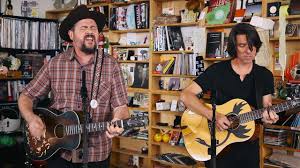
lyleLyle Lovett was the first country musician I ever enjoyed.  And that came mostly from his Large Band recordings.  Lovett, while clearly of the country ilk, is a different kind of country—perhaps it’s because his country comes from Texas.  He is not afraid to bend genres and sing about whatever is on his mind (with a great, unique voice that eschews country flavors.

For this tiny desk it is just Lyle and a fiddle by Luke Bulla.

One of the things I’ve always liked about Lyle is his sense of humor. He doesn’t write funny songs, but some of his songs are funny.  And he himself is very funny–very deadpan–which he demonstrates amply here.

And, according to the blurb, he’s also rather humble

Lovett not only showed up at NPR Music’s offices without an entourage, but also booked his Tiny Desk Concert himself, emailing us out of the blue to express his interest. (Our reply: “We would only agree to have you perform a Tiny Desk Concert if it’s under any conceivable circumstance.”)

So it’s appropriate that Lovett would open this performance at the NPR Music offices by performing “Cowboy Man,” the first track on his 1986 debut: He may be a music-industry veteran, but in many ways, he’s starting over. With a fresh-faced accompanist in fiddler and backup singer Luke Bulla, Lovett gives a loose, engaging performance that feels like both an introduction and a victory lap.  He follows “Cowboy Man” with two songs from 1989’s Lyle Lovett and His Large Band, so this is no mere promotional appearance.

He’s charming right up front.  After the “Cowboy Man,” which sounds great, he looks up and laughs, “thank you very much,” with a sense of wonder.  He starts right into the second song and then stops and stop again and then says “I just about got it.”  He plays the melody for a few bars and the violin comes in and they play a few bars together and then, I gather, Lyle screwed up because he kind of smiles over at Luke and then stops playing and says “you sure you want to play that?”

Everyone laughs, some tension is broken.  And he looks up at everyone.

“This is…it’s kinda weird, right?”  Someone shouts out “Good weird!”  He laughs, “Good for sure, no question.”

Then he picks up a CD off the desk and says, “Just one of those chance meetings.”  He holds up the CD, “Iris Dement, she was just right here.”  To much laughter.  Stephen, who booked the show shouts, “We’ve got all those inventoried, so don’t even think about it.” Which cracks everyone up.

Then he tells a story about meeting Iris’ daughter  He asks them is they know about the Cayamo Folk Cruises.  No one replies so he says “It’s a popu….it’s not that popular.”  He says it is a festival on the water (it must have been one of the first music cruises).  He describes it and says its fun a deal.  And then stops and says “I don’t know why we’re talking about it.”  Then they remind him about Iris Dement’s daughter.

His story about her is very funny, told in a great deadpan way:  I saw this cool chick, about ten years old, leaning against the elevator.  Wearing skinny pants and a hat.  She looked at me in that skeptical way, and I said, so you in a band?  She rolled her eyes, gave me a sideways look.  She said, No.  So I said, Well, you oughta be.  She said, My mom’s in a band.  Who’s your mom?  She said Iris, just like that.  She was cool.

Finally starts playing “If You Were To Wake Up” again and jokes, “Pretend like this is going well.”  It is, the song is very pretty with gorgeous violin.

The final song is “Good Intentions”  He looks at Luke and says. “Play it just…do it however you want.”  Lyle starts the song,  “It’s a sunny day in Sunny…” and he stops and looks at Luke and says “Don’t mess me up anymore, alright?”  To more laughter.  It’s one of his great songs–jazzy and with swell lyrics.  There’s even a plucked violin solo.

I have loved Lyle and his Large Band, but I also like him in this small duet as well.

[READ: January 21, 2015] “Youngthing”

Boy I hated this story.

It is the story of a young Somali thug (nicknamed Youngthing) who has been conscripted into a the Shabaab-led insurgency.

He is sent on a mission for the insurgents.  He is meant to secure (steal) a house for the group.

He doesn’t pay attention, winds up going to wrong place and inadvertently “captures” the wrong house.

There is an innocent old man living there.  We see the story from the man’s point of view we see for half of the story; we see it from Youngthing’s point of view for the other half).  The old man doesn’t realize the trouble he is in right away.  He even manages to convinces Youngthing that everything will be okay. (more…)

Read Full Post »

oct28SOUNDTRACK: JASON LYTLE-Tiny Desk Concert #249 (November 5, 2012).

sonJason Lytle was Grandaddy.  Sure there were other people in the band, but it was pretty much all him.  And then he dissolved Grandaddy and started recording discs under his own name.

I loved Granddaddy, but didn’t listen to any of his solo stuff.  So I don’t really know how different it sounds.  For this Tiny Desk Concert, he plays two songs from his 2012 solo album Dept. of Disappearance and one Grandaddy track.

“Willow Wand Willow Wand” is a catchy song with just him and a drum machine playing a backing beat.  He sounds like the guy from Grandaddy but slightly different….

Introducing “Get Up and Go,” he explains that he’s been really enjoying playing his songs in this stripped down format.  He really likes making records that are big and produced.  And now he likes not feeling pressure to do them in concert that way.  He’s happy to not try to pull off all of the bells and whistles in a live environment.  “Get Up and Go” is a “happy and peppy song and this isn’t a happy and peppy version of it.”

This song is quite slow.  Again its him on guitar but at the appropriate moments in the chorus he hits a key on the keyboard and a little melody (very Granddaddy) plays briefly.

After this song you can hear Stephen Thompson ask “Robin, you like this?” to much laughter.

He says he finished an hour long session at Sirius XM.  He was completely by himself and he was really comfortable.  But playing music in front of people makes him nervous—you’d think he had it down by now.  But he tells us “if you’ve never done it before as weird as you imagine it being… it’s that weird.”

The final song is a request for Grandaddy’s “Jed the Humanoid” and that’s when I realized why he sounds different.  He sings slightly more falsetto in Granddaddy than on the solo songs.  It’s very subtle, but I can hear it.  The original of this song is very synthy, so hearing it on acoustic guitar (with the lyrics very clear) really changes the feel of the song.

After a verse, he turns a knob on the keyboard and this weird frog-like sound bubbles under the song (similar to the one on the record, which is neat).

And as he leaves the Desk, you can hear Robin say “the saddest song in the world.”

[READ: July 20, 2016] “Samsa in Love”

Basing a story on another story can be risky, especially when the story you base yours on is incredibly famous with a first line that many people can quote without looking.

But Murakami does something very interesting with Gregor Samsa in this story.  “He woke to discover that he had undergone a metamorphosis and become Gregor Samsa.”  We don’t know who or what “he” was before this and neither does he.  He’s not even sure exactly what he is–but he knows his name.

The first few paragraphs are all about him getting used to even being human–scoffing at his body, wondering why he was so cold and what that gnawing pain was in his stomach–hunger, it turns out.  He spends several paragraphs just trying to learn how to walk on two legs.  It’s all somewhat comical although not exactly funny.

Finally he gets downstairs–the table has been set for a meal but no one is there. Everything is still warm and yet the house appears empty. No matter, he tucks into the food wand eats everything.  Then he sets about trying to cover himself.  He looks out the window and sees everyone dressed, but he’s not willing to even attempt to put clothes on so he grabs a dressing gown and slips into that. (more…)

Read Full Post »

CV1_TNY_03_18_13Kalman.indd SOUNDTRACK: THE MILK CARTON KIDS-Tiny Desk Concert #232 (July 16, 2012).

milk-cartonI was unfamiliar with the Milk Carton Kids before seeing them on NPR.  I had always assumed they were a punk band with a name like that. Well, nothing could be further from the truth.  The Milk Carton kids are a delightful folk duo.  And they give the origin of their band name a little later in the Concert.

Joey Ryan sings lead and plays rhythm acoustic guitar.  Kenneth Pattengale plays lead guitar and sings beautiful harmonies.  It’s his guitar work that is so disarming because he plays leads throughout the songs, so rather than having the two guitars doing the same thing, his guitar is all over the place–playing beautiful trills and lines while Ryan is singing.

The first song they play is “Michigan.”  I love how in the middle of the song between the melodies and the harmonies it sounds like about three different bands—there’s a kind of Simon & Garfunkel vibe, a Jayhawks vibe, and maybe even a CS&N vibe–and yet it retains their original sound.  There’s some beautiful melodies in the vocals and the lyrics are really good (but sad).

After the song, Bob asks about the neckerchief on Kenneth’s guitar.  he says, “well it looks good.”

Then he explains that in a technical way, “This guitar is a bit crummy.”  When they play higher chords the strings buzz, so the neckerchief keeps that from happening: “It’s practical and it’s alluring—this is what got Stephen to stop at our concert to listen.”

Kenneth then says that Joey usually talks more than this “I don’t know why he’s so demure today.”  Joey deadpans, “I don’t know what demure means, but I’m, sorry if that’s how I’m behaving.”

Before the next song, Joey deadpans, “This is something we’ve been looking forward to for a long time.  Hence our palpable excitement.”

They’re very happy to be behind this desk so “We’ll play you a love song to the desk.  This song is called ‘To the Desk.'”  The song is actually called “Stealing Romance.”  They sing a duet with Ken taking the high notes.   It’s a slow ballad.  During the song you can hear all kinds of sirens going past the offices.  When it ends, Ken says, “I think Joe Biden drove down the street during that one.”  Joey reacts: “Who’s that?”

Then Joey explains the origins of their band name Milk Carton Kids.  The name comes from one of their songs “Milk Carton Kid.”  The song itself is named after a lyric in the song.  He says it’s an attempt to answer the question that’s one everyone’s mind with a completely unsatisfactory answer.  Then he says they’re not going to play that song.

Rather, they play “their happy song” “I Still Want A Little More”which proves to be really fast and uptempo—a real surprise after the other two songs.  Ken is wailing away on his guitar while they sing in great harmony.  There’s some rollicking guitars and singing.  This is my favorite song of the three.

I don’t love their slower songs. Although as far as slow songs go, their setup is great–the harmonies, the interesting guitar.  But I really like the two of them.  They are great performers and excellent storytellers.

[READ: July 20, 2016] “Checking Out”

This story is bookended with a man planning on marrying woman.

Obinze is African, and he is in London on a work visa.  He is arranging a sham marriage to be able to stay in the country.  The arrangement has been set up by some Angolans. They claim that he is a friend of a friend and they’re doing him a favor, but they are keeping lot of the money that is meant to go to his bride.

When he met Cleotilde, he was surprised to see that she was young and pretty.  And it seemed that she was pleased with him when she saw him as well-0ff.  I guess expectations are pretty low in this situation.  He was kind to her from the start, making sure that she was okay doing this. And she said she was–she really needs the money for her family.

Obinzne and Cleo meet up a few times to get their details straight, and he finds that he is really falling for her–although he knows he can’t really act on it until after the marriage. (more…)

Read Full Post »

ny SOUNDTRACK: ROBERT CRAY BAND-Tiny Desk Concert #246 (October 22, 2012).

crayRobert Cray is a well-respected blues singer.  He has a smooth voice and a good bluesy guitar sound.

However, I don’t really like the blues all that much, so this Concert was simply fine to me.  Cray’s band includes bassist Richard Cousins, keyboardist Jim Pugh and drummer Tony Braunagel, “who performs here by tapping a wooden box” (it’s one of those cool box drums).

They play three songs, “Sadder Days,” a sad slow blues with some beautiful guitar soloing.  “(Won’t Be) Coming Home” is a faster, darker song about her leaving him.

“I’m Done Cryin'” is nearly ten minutes long and it is a pretty classic blues song with lengthy solos and much bemoaning that he is still a man.  It’s got some good soling and, I imagine if you like the blues, this is a killer track.

[READ: July 20, 2016] “Naima”

I really didn’t enjoy this short story very much.  It took a really long time before it did anything. I realize part of that is the nature of the story–building up characters and setting up the basis for the relationship–but it felt like half the story was just extraneous.

The crux of the story is that a boy’s mother has died.  (For the first half of the story I was sure the main character was a girl, so I was quite shocked to find out otherwise).  The boy was very close with his mother.  His father was a joyful person while she was alive but in the short period since her death, the father has become very distant.

The only person the boy is close to is Naima, the maid. (more…)

Read Full Post »

2011-07-11-18-ulriksen-birdsSOUNDTRACK: THE WALKMEN-Tiny Desk Concert #234 (July 29, 2012).

The Walkmen perform a Tiny Desk Concert at NPR headquarters in Washington, DC on Tuesday, June 26, 2012.

I know Hamilton Leithauser, the singer of The Walkmen, more than the band itself.  He has gone solo since 2012 and released some songs that have gotten a lot of attention.  Leithauser has a very powerful voice.  Form the blurb I gather that The Walkmen used to be a bit louder/punkier.  But for this set, Leithauser plays an acoustic guitar so this band isn’t getting too abrasive, that’s for sure.

The first song “Heaven” has a swirling guitar and bass motif that reminds me instantly of some 1990s songs.   The song is really catchy and Leithauser never lets up with his powerful singing.  The blurb comments on his voice, that it gives the songs “grit and grace, not to mention hair-raising intensity that feels a little jarring coming from a bunch of guys in crisp button-up shirts.”

“We Can’t Be Beat” begins as a slow verse with just acoustic guitar and singing.  Then the electric guitar plays some ringing notes as the drums play delicate percussion along with it.   About half way through the song, he holds a really long note (“so looooong” and then the whole band picks up the song with a loping sound that propels the song very nicely.

“Love Is Luck” has a nice beat and some great guitar sounds. It’s another catchy song from the band.

I enjoyed this set quite a bit, although I found that after listening a few times I got a little tired of Leithauser “woah oh ing” so much.

[READ: July 21, 2016] “Aphrodisiac”

The aphrodisiac at the heart of this story is interesting and subtle–it doesn’t even exactly seem like a part of the story until the end.

But I found the bulk of the story a little too long and unrelated to the aphrodisiac to be really enjoyable.

The story is about Kishen, a university graduate who had big plans to write a novel about India–to be really sunk into the Indian experience.  He had gone to school in Cambridge, but was now living back home in New Delhi with his mother and older brother Shiv.  Shiv had recently gotten married and Kishen was meeting the bride for the first time.  Her name was Naina.

Kishen found her to be kind of stupid.  However because of his own hang ups, she was the only person he felt comfortable talking to.  She seemed to accept him and even made him part of her circle of girlfriends–they all seemed to be amused by him. (more…)

Read Full Post »

dec15SOUNDTRACK: CAVEMAN-Tiny Desk Concert #207 (April 10, 2012).

caveman Bob Boilen really likes Caveman.  He picked their 2011 album as one of his favorites of the year.

I find their music to be absolutely fine.  But I feel like I’m missing the pop hooks–perhaps it’s different in this stripped down session.  Two guitars bass keys and drums.  The band plays four songs.  “My Time” is a poppy bouncy song.  “Easy Water” is moody with lots of shimmering guitars.

It turns out that the guitarist Jimmy Carbonetti has a shop in the East Village called Cobra Guitars. He made all of the band’s guitars.  Each one is built one at a time.  So there’s a nice plug for the shop.

“Old Vampire” has ringing guitars.  It’s a fun instrumental jam with the singer playing drums along with the drummer.  This song segues into “Old Friend,” another shimmering echoing song.

I really like the sounds the band has–their gentle echoing guitars sound great.  And the singer’s voice fits quite well.  The song even have some catchy spots, but there’s nothing dynamic about them for me to really latch onto.

[READ: March 16, 2016] “The Woman of the House”

The thing that I didn’t like about this story at first proved to be one of its strongest assets by the time I reached the end.

I found the writing to be stiff and rather unwelcoming. It was almost as if the author was trying to keep you out.  I didn’t care for that, but I see how well it worked for the underlying theme of the story.

The plot is pretty straightforward.  It opens on an old man in a wheelchair.  To younger men have come to his house and have offered to paint it.  He haggles with them–gives them a hard time–but they remain stone-faced and silent until he finally agrees.  He asks if they are Polish (the story is set in Ireland) and they nod.

They are not Polish, but it doesn’t matter, they can be if it will serve them.  The man knows that Polacks are good Catholics, which is why he agrees to their work. (more…)

Read Full Post »

tny 12.08.08.indd SOUNDTRACK: DRIVE-BY TRUCKERS-Tiny Desk Concert #574 (October 24, 2016).

drivebyI have never listened to this band.  Their name turned me off right from the start, so I’ve never given them a chance.

I never even knew exactly what they sounded like.  And I’m still not entirely sure if this is what they typically sound like.  But this set is full of mostly uptempo folk rockers that explore some pretty intense subjects.

The first two songs are sung by Patterson Hood with his gravelly voice.

I am somewhat surprised to see that there were two Tiny Desk Concerts in a row with the word Umpqua in it.  But while Blind Pilot’s “Umpqua Rushing” is about a relationship, Drive-By Truckers’ “Guns Of Umpqua” is about the horrific shooting at Umpqua Community College in rural Oregon last year.

There’s apparently always been a serious political current in their music, but it’s been somewhat hidden. But for this album, they started writing songs that address what’s going on right now.  For “What It Means,” he explains, “I wrote this song a couple years ago. I’d honestly be really happy if it was just outdated and something we could leave in the past, but that’s certainly not the case right now.”  It is about the killing of young black men like Michael Brown and Trayvon Martin.

The final song “Once They Banned Imagine” is sung by Mike Cooley who has a much deeper voice.  He says this song is “about things staying the same, and not necessarily in a good way.”  This has more of a country feel, but with some pretty piano.

I wouldn’t say I’ve become a fan, but I’m far more open to their music than I was before hearing this Concert.

[READ: March 14, 2016] “Waiting”

This is only the second Amos Oz story I’ve read (this was translated by Jill Sand D’Angelo and Amos Oz).

It is very simple story, in which not a lot happens (hence the title).

Set in the old village of Tel Ilan, this story follows Benny Avni, the head of the District Council.  He was a considerate man and was well liked by the people of the village.  As is stated any times, “he walked pitched forward, with a stubborn gait, as if he were fighting a strong headwind.”

Benny was sitting in his office in the afternoon when a knock came at his door.  A man named Adel brought him a note from his wife.  Adel has seen her sitting on a bench in the park.  The note cryptically said “Don’t worry about me.” (more…)

Read Full Post »

nydec SOUNDTRACK: BLIND PILOT-Tiny Desk Concert #573 (October 21, 2016).

blind-piot

I really only know Blind Pilot because of NPR–they are favorites of a few of the hosts of All Songs Considered.

I don’t know their music well, but I remember enjoying what I’ve heard.  But I was still surprised by this Tiny Desk Concert because in addition to guitar and drums, there’s an upright bass (bowed and plucked), a ukulele, the ubiquitous Tiny Desk harmonium and a set of vibes!

Evidently since 2008 the band has expanded from a duo to a sextet.

The band plays four songs.  They are lovely folk song.  The vibes add a cool touch to some otherwise simple melodies.  “Umpqua Rushing” is a pretty song with a very catchy bridge.

Introducing “Packed Powder,” Israel Nebeker explains that it stems from when he was a teenager and they used to modify legal fireworks to make them more interesting.  This is my favorite of the four songs primarily because of the wonderful backing vocals during the chorus–when everybody sings “I want to see how the POWDER BURNS!”  It’s a great moment (or three) in the song.

“Don’t Doubt” is a mellow song, quite pretty, with some more lovely harmonies.

They planned to play three songs, but when Israel asks how many they should play, someone on the staff says “…four.”  So someone in the band then says, should we play, “Hot for Teacher” or “Jingle Bells.”  They decide to play “Joik #3.”  Israel explains that it was his first  attempt to write a song called “Joik.”  “I could tell you what that is, but you have Google…and an amazing team of researchers here.”

He says that before the album came out, Ari Shapiro aired it on NPR.  It’s a pretty song and Israel’s voice sounds especially powerful on it.  And, again, when the band sings the loud harmonies, it sounds terrific.

[READ: March 15, 2016] “In Other Rooms, Other Wonders”

Many authors seemed to get two stories in the New Yorker in 2008, but this has to be the closest gap between stories–Sept 15 to Dec 1.

Like the previous Mueenuddin story, the actual story part is pretty simple to recap.  And the sizable length of the story is mostly taken up with details and interior feelings.

And like the previous story, this one is set in Pakistan and looks at someone who might be able to move up a level of class, but who knows that it is a hard road.

The story begins simply enough. Husna needed a job. (more…)

Read Full Post »

TNY 11.24.08 cvr.fnl.indd SOUNDTRACK: BILLY BRAGG & JOE HENRY-Tiny Desk Concert #572 (October 17, 2016).

bragg-henryI don’t really know who Joe Henry is (although I see that he has released 13 albums).  I’ve heard his name mentioned a bunch of times, but I can’t really place him to any specific music.  Billy Bragg, on the other hand, I know very well.

The two recorded an album this year.  And the NPR blurb is pretty interesting:

Earlier this year, Billy Bragg and Joe Henry set off on a journey. They boarded a train in Chicago, bound for Los Angeles. Each time the train stopped for more than 20 minutes in cities like St. Louis and San Antonio, they’d grab their guitars, hop off, find the waiting room and record an old railroad song. The result of this journey is an album called Shine A Light: Field Recordings From The Great American Railroad.

Their voices sound very different and as a result they play off each other very well.

The duo used Lead Belly as a jumping off point for much of this music.  Bragg explains that the jumping off point for this music is a book he has been working on about when British pop music went from being jazz influenced to being guitar led.  In 1956 Lonnie Donegan became the first Briton to get into the charts playing the  Lead Belly song “Rock Island Line.”

On the second song “Hobo’s Lullaby” Henry explains, the railroad is a mythic poverty–railroads conjure a romance in all of us even if we’ve never ridden a passenger train.  As they start, Bragg hasn’t re-tuned his guitar.  He says it’s always him who messes up.  But he usually plays solo, so “If I put something in the wrong key I just sing it in that key and hope no one notices–fortunately my audience… no one comes to hear me sing.”

As they are about to start, he says, “Sorry mate it was a beautiful intro.”  Henry looks at him and says, “It was,” to much laughter.

Before the final song, Henry says he was listening to Lead Belly since he was 15.  “Midnight Special” was a train that ran past Sugarland Prison in Texas.  The story was if the train’s light shined on you as it swept across the yard, that you would be the next to get paroled.

Even though these songs are old,

This concept record could be seen as a nostalgia trip, but both Bragg and Henry will emphatically say that it’s not. These songs and this journey celebrate the modern railroad as a major economic engine and a still-vital form of transportation.

[READ: March 10, 2016] “Ghosts”

Danticat often writes about Haiti and the troubles that arise there.

This story is set in Bel Air–the Baghdad of Haiti. Children in the neighborhood enter art contests by drawing posters that say “It’s not polite to shoot at funeral processions.”

The protagonist is Pascal Dorien.  He is a good kid who tries to stay out of trouble.  His parents own a small restaurant which has the unfortunate location of being in the heart of gangland (his family lives in a nearby town which is a little safer).  Luckily for them (sort of) the gangsters who make the restaurant their evening hangout are kind to the family and think of their place as their haven.

The family originally sold pigeons (both live and as meat) but then the gangsters started buying them to use in a ritual which involved drinking the pigeons’ blood mixed with evaporated milk.  His parents hated this and eventually stopped selling the bird.   Nevertheless the money they made for this ritual allowed them to expand and make even more money.  Which they hoped would allow their children to flee Haiti for safer locations. (more…)

Read Full Post »

6616 SOUNDTRACK: GLEN HANSARD-Tiny Desk Concert #225  (June 17, 2012).

glenWhat can I say about Glen Hansard that I haven’t said already—he’s a powerful singer and a great storyteller.  This is his second appearance on Tiny Desk (although his first solo) and his fourth or fifth concert on NPR.

With The Swell Season, they played for 34 minutes (a Tiny Desk Record).  And this Concert is no shortie either at nearly 22 minutes.

He’s playing songs from his solo album (on that same beat up guitar).   Although he is distinctly himself, without the band(s), he sounds a bit like Cat Stevens and sometimes like Van Morrison (and he looks like Gordon Lightfoot).

He sings rather quietly and then impressively loudly–powerful and passionate.  He is clearly into what he does.

“Love Don’t Leave Me Waiting” is rocking folk song (he throws a coda of RESPECT at the end) in which he really belts out a few parts.  He’s got a delightful “La la la” middle section, and the overall melody is great.

“Bird of Sorrow” is  much more mellow song.  It builds through some verses and allows him to belt out a few lines near the end.

“Come Way to the Water” has him on a 4 string tenor guitar.  Although it is quite clearly a Glen Hansard song, the guitar is much more timid sounding compared to his voice.  And it really does give the song a very different (darker) feeling.  In fact when it’s over, he says, “that was kind of depressing wasn’t it?”

“Lucia” is a “song he hasn’t finished yet” but he’s going to play it because “it’s a little bit happier.”  Although the lyrics are “Lucia, you’re letting me down again / Lucia, your heart’s not in it babe…. And if your heart’s not in it, then your heart’s not in it, babe.”  Not exactly a happy song.  But very pretty.

“The Song of Good Hope” is slower with no big powerful singing, but it’s really heartfelt and intense.

And as always, he is unfailingly polite and thanks everyone for listening.

My friend Jonathan says that he will always try to see Hansard live, and it seems like I should be doing the same next time he comes around.

[READ: January 12, 2017] “At Home in the Past”

The June 6 & 13, 2016 issue of the New Yorker was the Fiction Issue.  It also contained five one page reflections about “Childhood Reading.” 

As soon as I started reading this, I knew that Sarah would want to read it as well.  For although I have not, Sarah has read The Secret Garden, which is what Tessa Hadley is writing about here.

Tessa says that she didn’t own many books as a child–mostly she borrowed from the library.  But the ones she did own she read over and over and “some of them soaked in deep under my skin, composing my private mythology and shaping my mind.”

She says she had a Puffin paperback of Frances Hodgson Burnett’s The Secret Garden.  The cover picture of a dark-haired girl in a white coat standing among thorny bare rose bushes looks just like Mary Lennox is described in the book.

Although it was published in 1911, she felt no separation from the Edwardians.  She felt at home in the past and often preferred it to modernity, which seemed somehow inferior. (more…)

Read Full Post »

« Newer Posts - Older Posts »