Feeds:
Posts
Comments

Archive for the ‘NPR/PRI/PBS’ Category

SOUNDTRACK: HASSAN HAKMOUN-“Balili (My Father)” (Field Recordings, June 11, 2014).

I didn’t know Hassan Hakmoun, but he is one of many West African musicians whose music I have come to really enjoy.  I absolutely love this song.

Hassan Hakmoun’s music is very much rooted in his homeland. Born in Marrakesh, he is from the Gnawa community, whose ancestors were brought from West Africa to North Africa as slaves in the 15th and 16th centuries. Gnawan music and dance, which are central to their spiritual tradition, fuse Muslim mysticism with sub-Saharan traditions in rituals meant to heal the body and lift the soul.

This Field Recording [On a Magical Mystery Tour with Hassan Hakmoun] has a different component to it–it is (so far) unlike any other one.

When we plan Field Recordings, we usually look far and wide to find off-the-beaten-path locations for filming musicians. But a unique opportunity presented itself when a duo called Wanderlust Projects — designers of “transgressive placemaking experiences” for urban explorers, usually in abandoned or otherwise places — invited us to come along on an adventure.

Wanderlust invited a crew of intrepid New Yorkers to accompany the fabulous Moroccan musician Hassan Hakmoun and his band on a mysterious day trip. So we piled into a van with the musicians, and off we all went to points unknown. After a long morning being driven to our secret destination — with no one but the organizers knowing where we were heading — we arrived upstate at the stunning Widow Jane Mine.

Along with providing spectacular visuals, the mine proved to be an oddly fitting location for Hakmoun and his musicians. The Widow Jane is a limestone mine that once supplied cement for such landmarks as the Brooklyn Bridge, the Statue of Liberty and the U.S. Capitol. Hakmoun’s music has found its fullest flower in New York with a highly transnational lineup of nomads.

The song opens with Hakmoun playing a fast riff on his instrument.  I cannot believe that they don;t say what it is–is it homemade?  is there one string or more?  how does he get such a great sound out of fit?).

He starts playing what will be the song’s main riff–a cool fast melody with some counterpoint loud notes.  The percussionist sings along , the flutist plays a solo of sorts and then after about a minute, the drums kick in and the song just rocks.

His band includes

Percussionist Chikako Iwahori is originally from Japan; guitarist Raja Kassis hails from Beirut; flutist Bailo Bah comes from Guinea; and drummer Harvey Wirht is from Suriname.

The sound is incredible.  Whether the caves enhance the music is unclear, but it sounds wonderful there.  The song is about 8 minutes long.  There’s not a lot to it–the riff is repeated almost throughout, but there are great variations throughout. The flute solo, the guitar solo or when he starts stomping his feet on the limestone while wearing bells on his ankles–it adds a great new component to the music.

This is just fantastic.

[READ: January 19, 2018] “Sprawl”

This is an excerpt from Dutton’s novel Sprawl (getting a reprint in 2018).

It’s a little hard to tell what the novel is about from this excerpt but I loved the whole take on suburbia that the export displays.

The excerpt is full of letters, presumably written by the same person (it’s unstated).

The first one is to Mrs Barbauld and is designed as a re-orientation to the neighborhood.  It is a bit confusing so I’m moving on.

The narrator is talking to us, I suppose as if setting the ultimate example: (more…)

Read Full Post »

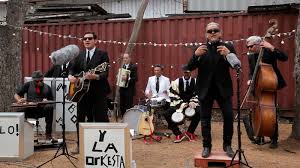
SOUNDTRACK: SERGIO MENDOZA Y LA ORKESTRA-Backyard Show (Field Recordings, June 4, 2014).

This Field Recording [Coffee And Mambo With Sergio Mendoza Y La Orkesta] differs from other ones because it is actually a mini-concert.  Almost like a Tiny Desk Concert outside.

Sergio Mendoza and his band La Orkesta are from Arizona and they play three songs in this backyard party.

They mix myriad Latin styles — what Mendoza calls “indie mambo,” salted with generous handfuls of cumbia, merengue and ranchera — and then feed all that through a psychedelic prism. They perform their songs with charm and panache, set off by the fireworks of the group’s resident showman, the multi-talented Salvador Duran.

While NPR Music was in Austin for SXSW this year, we coaxed Mendoza and his crew into a three-song backyard party after a little local coffee. But they didn’t really need the caffeine to get everyone’s blood pumping.

“Traicionera” (Treasons) has a great pedal steel guitar part running through it.  Duran is dancing and stomping on the stomp box and then he takes a great vocal run with his deep resonant voice.

“La Cucharita” (Little Spoon) Sergio sings thee main verses, but when the chorus comes in, Duran takes lead and Mendoza sings backups.  There’s an appropriate trumpet solo as well as a rocking guitar solo from the slide guitarist.

The final song “La Rienda” (The Reins) opens with a wah wah’d slide guitar–it sounds otherworldly.  Throughout the song he plays some very cool slide guitar sounds.  Duran sings lead and I love his gritty but beautiful voice.  As the song nears the end, during a relatively quiet part, you can hear a bird chirping as it quickly flies past–a nice bit of proof that it’s live and outside.

[READ: January 4, 2017] “Deer Season”

The title of this story confused me somewhat because while the story may be set in deer season, the story is actually about a seventeen-year-old girl.  The girl was “almost 18 and determined to have a fuck before it.”

She lives out near the woods and has her sites set on a country man who she has seen around.

She sat out under a tree–knowing he would pass by–reading a novel by Roberto Bolaño.

She was worried that the book might be too much for him, but he seemed interested. Then he told her that he had to burn half of his books last winter to stay warm.  They shared pleasantries and go their ways.

She has about a week to go before her 18th birthday.  And she is planning accordingly. (more…)

Read Full Post »

SOUNDTRACK: BRODY DALLE-“Dressed in Dreams” (Field Recordings, July 15, 2014).

For this Field Recording [Brody Dalle: Raging Into the Light], Brody Dalle plays in an Indian Restaurant!  I fancy myself a knowledgable punk fan, but I’ve never heard of Brody or either of her bands.

Throughout her career, punk icon Brody Dalle has embraced her aggressive side. Best known as the lead singer of The Distillers and Spinnerette, Dalle has a sandpaper- and velvet-tinged voice that speaks to rebellious young punks who are curious about the world yet vulnerable to its sharp edges. “I’ve never understood why there was such a fuss about aggressive women in music,” Dalle says. “To me, aggression is a human instinct. … I’ve felt provoked for most of my life, especially as a child. I guess I’ve carried those feelings into my songs.”

So it was a pleasant surprise that Dalle was open to the challenge of crafting a stripped-down version of her song “Dressed in Dreams.” An anthem about getting back up when you’ve been kicked down, the song is personal to Dalle: After overcoming addiction, she almost immediately faced a brutal bout of postpartum depression. “I had a hard time getting myself up and running before I wrote this record,” she says. “I felt worthless. I was embarrassed and lost.”

Luckily, Dalle was able to use her songwriting as a way to fight back. Earlier this year, she released Diploid Love, her first solo album, and she says she happily embraces her day-to-day life as a working rock mom and wife. As Dalle set up her gear at New York City’s Panna II, we noticed the way the chili-pepper strands that covered every surface of the restaurant bathed her in a weirdly fierce yet serene red light. They provide a nice little visual metaphor for the way raging against the darkest points in life can help bring you into the light.

I love the fuzz she gets on an acoustic guitar.

But I have since listened to the recorded version and I like it a ton more.  The extra guitar really helps make what is an otherwise simple and repetitive song far more interesting.  Her voice also sounds a lot better on the record.

But the weirdest thing is how long this song is.  The Distillers songs were proper punk songs, last about 3 minutes or less.  This one, running over 4 doesn’t have enough variety to sustain that length.

[READ: February 5, 2018] “A Failure of Concern”

I wrote this about a Ben Marcus story published in Harper’s in 2011:

It goes on for several pages.

There is some degree of amusing shock value in the way he speaks … but as with much of what I’ve read from Marcus, I feel like I could have read half of this and gotten enough.

No explanation is given for the problem (and, fair enough, it is only an excerpt) and anyway, by the end, I didn’t really want one.

And I feel exactly the same about this story.

The nutshell story is that the narrator’s father and a lodger in their house are both missing, possibly murdered.  There is a detective there looking for clues.

The narrator is a lunatic, a mental case, and idiot, a deviant, a murderer, something, whatever.  The narrator gets common quotes and facts wrong. The narrator seemed to hate both his father and the lodger and seems likely very guilty. (more…)

Read Full Post »

SOUNDTRACK: SEVYN STREETER-“It Won’t Stop” (Field Recordings, August 6, 2014).

The blurb for this song totally cracks me up (especially 4 years removed) because not only did this song not seep into my collective consciousness, I’ve never heard of it. Nor have I heard of Sevyn Streeter.

Although it is funny that just last week my wife and I were utterly mocking people who name their child a number–what else did George Costanza tell them to do? And how misspelling it like this is even worse.

Anyhow, here’s the blurb:

In the spring of 2013, songwriter and R&B singer Sevyn Streeter released a song called “It Won’t Stop,” which she’s called her “baby.” Over the year and change that’s followed, the song has sunk into our collective consciousness through commercial radio play and a music video viewed more than 35 million times, and on the recommendation of a growing group of critics and fans. The lyrics are vernacular, warm, unpretentious, while the performance demanded by the music is not for the meek. Away from a studio — and air conditioning — in a New Orleans boxing gym, Streeter executed with muscle and grace.

Having mocked the blurb, the song itself is pretty.  I’ve no idea what the original sounds like, but this version is done with just two acoustic guitars–one of whom seems to be playing some bass melodies from time to time.  Streeter sings and warbles all over the song and does those R&B quivering notes that I hate, but she does have a nice voice.

But damn is this song long.  Why is a pop song five minutes long?

It’s neat that they filmed this Field Recording [Sevyn Streeter Knocks Us Out] in a boxing gym–how on earth were they able to eliminate all of the ambient noise?  It almost seems like it’s not live.

[READ: February 8, 2018] “Microstories”

This is a collection of flash fiction pieces which may or may not be connected.

Rain
Never ending rain seemed to be the truth until the day he was born.  While everyone was delighted for him that he never had to experience it, he lived with regret that he would never have the chance.

Divorce
He is dressing for his grown up daughter  What a strange thing to have to do–how infrequently he sees her, how should he look.  No idea what happened at the end of it though?  An earthquake? (more…)

Read Full Post »

SOUNDTRACK: PHOEBE BRIDGERS-Live at Newport Folk Festival (July 28, 2018).

I saw Phoebe Bridgers three days after this set at Newport Folk Festival (I had no idea).  She plays five more songs at my show than here (yay, me).

The size of the crowd does’t seem to intimate her in any way and she sounds just as great (and intimate) as she did in the small club where I saw her.

A few songs into her sun-drenched Saturday Newport Folk set, Phoebe Bridgers paused and proclaimed, “I am a puddle of sweat.” It was a one-liner that primed those huddled at the Harbor Stage for the 2018 Slingshot artist’s catalog: details delivered with specificity and a subtle sense of humor.

I will say the one thing about this recording is that I don;t think you can hear all of the percussion as clearly as I could at Asbury Lanes.

The show started much the same as mine did with a beautiful languid version of “Smoke Signals” and a try-to-hold-back-the-tears reading of “Funeral.”

For the next song, “Georgia,” she brought out songwriter Christian Lee Hutson who is “going to help me sing harmonies.”  Whether it was the song itself of Hutson’s addition, but Bridgers’ voice really soars on this song.

Even Bridgers’ stage banter reflected her striking style, mixing straightforward address and astute observation. “This song is about how every time I smoke weed, I remember why I don’t smoke weed,” she said of the plainspoken plea “Demi Moore.”

She continued: “I face plant and my brain is erased for many hours and I think I’m thinking too loud.”

There’s some gorgeous harmonies on the darkly sweet song, “Killer.”  Then she played “Steamroller” solo on the acoustic guitar.

Later, she called “Steamroller,” a devastatingly candid cut from her 2015 EP, Killer, “another dark love song, thanks.”

Introducing Gillian Welch’s song “Everything Is Free” she said. “This is my friend Marshall.  We’re going to sing my favorite song about music streaming ever written.”  I loved hearing this live and it sounds just as solid here.

Up next was a song she did not play at my show.  She welcomed Christian Lee Hutson (playing guitar with Jenny Lewis) and Sharon Silva (from The Wild Reeds) played bass with me for exactly one week and I waited for a really bassist…Emily.  Chris wrote this song for me.”  The chorus goes “”lets get the old band back together again, and there’s even a line, “with Emily on bass, it doesn’t feel the same.”

The crowd reacts strongly, as they should to her awesome song “Motion Sickness.”

Despite its venom, it’s a song that unspools with a sonic ease that feel refreshing, even for an overheated festival audience.

The songs sounds great live and she holds a 17-second note just for kicks.  The sets ends (as did ours) with “Scott Street.”  She says “This is about L.A. where we live;  where it’s hot all the time.”  It’s a quiet song, sounds and represents her music pretty perfectly–quiet, sad, with clever lyrics.

At our show, we got two encores after this, so again, yay for us.  But this is a great example of her live show.

[READ: April 22, 2016] “Playing with Dynamite”

Back in February of 2017, I posted about an essay by George Saunders from 2009 in which he remembers John Updike “Remembering Updike“.  He says that back in 1992:

 It was going to be in Tina Brown’s first issue and they marked this occasion by running two stories contrasting the new writers (Saunders) with the established.  Of course the establishment writer was going to be Updike.  Saunders said he was chagrined because he knew the contrast would go something like this:

Wonderful, established, powerful representative of the Old Guard kicks the butt of the flaky, superficial, crass poseurish New Guy.  Saunders’ story was “Offloading for Mrs. Schwartz.”

I can see why they paired the George Saunders story with this particular Updike story.  Both stories deal with grief and memory loss, although Updike’s does so in a very different way.  On the other hand, their writing styles are so very different that it’s nearly impossible to compare the two stories.

The story begins with an interesting image from childhood: “one aspect of childhood Fanshawe had not expected to return in old age was the mutability of things–the willingness of a chair, say, to become a leggy animal in the corner of his vision.”  But living now “in death’s immediate neighborhood” he allowed that things like that might happen and it wouldn’t be the end of the world.

There is then an episode in Fanshawe’s day when his wife, who was younger and more spry than he, passed him going down the stairs.  She caught her heel on her dress and fell down the stairs.  It was only after all the guests had left that she said to him, “Wasn’t I good, not to tell everybody how you pushed me me?” (more…)

Read Full Post »

SOUNDTRACK: CÉCILE McLORIN SALVANT-Tiny Desk Concert #790 (September 25, 2018).

The blurb talks about Cécile McLorin Salvant’s punk roots.  This made me thing that their might be some rough elements in these songs.

But these songs sound akin to old-fashioned-sounding jazz standards (even if she wrote them recently) in the vein of Ella Fitzgerald or Sarah Vaughn.

The nod to punk seems to come in the vaguely erratic piano which verges on atonality at times.  And yet:

From listening to McLorin Salvant’s exquisite performance here, I also couldn’t tell that when she was 15, she was listening to Alice in Chains, sported a Mohawk and was into what she calls “radical feminist punk stuff,” as she told NPR after the performance. “Sometimes I still really like Bikini Kill, and I still have my little Pearl Jam grunge moments.”

What can be heard in each song is a seasoned jazz singer with a vast vocal range, meticulous technical execution and a superb classical vocal foundation, which actually began when she was just 8. Her background in classical piano is evident in the inventive harmonic and melodic construction of the first three songs heard here; all are romantically themed McLorin Salvant compositions from her third album, For One to Love, recorded in 2015. The record won her a 2016 Grammy for Best Jazz Vocal Album.

“Fog” opens with some striking minimalist almost atonal piano playing.  The song veers through many different tones and styles throughout its five plus minutes.

About “Look At Me” she says, “This was originally called “‘Friend Zone’ which is a zone I know so well.”  The piano is delicate–twinkling–as she sings about being the friend when she wants more.

She says the next song is called “Monday,” “Lets see if I remember the lyrics.”  After introducing Foster, he comments, “I just learned this on the train here, so bear with me.”  This is notable because there is a lengthy, lovely piano instrumental part in the middle.

After a hog, Foster leaves and McLorin Salvant prepares for the last song.

McLorin Salvant closes with “Omie Wise,” an American folk song that tells the tragic story of murder victim Naomi Wise and her husband and killer, John Lewis:

Then pushed her in deep waters where he knew that she would drown
He jumped on his pony and away he did ride
The screams of little Omie went down by his side.

Feminist themes are common in McLorin Salvant’s music, and while “Omie Wise” addresses gender-based violence, she says she sings difficult songs like this to address an important historical legacy. “We don’t sing to our kids and we don’t know any of our folk music anymore,” McLorin Salvant says. “But like all of the history of race songs, coon songs, minstrel music, music from Vaudeville, all of that is like, ‘No, we’re not going to address that — that’s too ugly.'”

This song is especially powerful sung a capella and even more so when it is heard on the weekend that that piece of excrement Kavanaugh is having his Supreme Court hearings.

[READ: January 19, 2018] “Admiral”

T. Coraghessan Boyle is an incredibly prolific writer.  He writes about a huge variety of topics as well.  Some of his stories are down to earth and realistic while others, like this one, are based in a near-future fantasy.

The premise of this story is simple and not all that far-fetched (especially in 2007).  A rich couple has cloned their beloved dog, an afghan named Admiral, for $250,000.  They want to raise this dog exactly as the first Admiral was raised.  They believe in the cloning to create an identical dog, but they also believe in the nurture aspect which means they need the girl who dog-sat for him to do everything exactly as she did all those years ago.

That girl, now a woman, was recently laid off and needs some cash. So when Mrs Striker called and told her she had an opportunity, Nisha said… why not?

She returned to the house where she hadn’t been in four years but which was such a large part of her childhood. (more…)

Read Full Post »

SOUNDTRACK: JULIE BYRNE-Tiny Desk Concert  #788 (September 19, 2018).

Julie Byrne plays a quiet acoustic guitar and sings in a melodic whisper (almost).  She reminds me of Nick Drake in many ways.

Even in an office in broad daylight, Julie Byrne sings with both a husk and a whisper as if she’s gone a long time without speaking – as if she’s been alone, as if she’s been traveling. Her opening number at the Tiny Desk, “Sleepwalker,” sings of the road as a source of freedom.

I lived my life alone before you
And with those that I’d never succeeded to love
And I grew so accustomed to that kind of solitude
I fought you, I did not know how to give it up

Byrne’s guitar playing sounds very full as is each string gets its own special attention.

Julie Byrne’s hypnotic fingerstyle picking conjures a sense of wandering, a style she adapted from her father and a sound she grew up with until multiple sclerosis robbed him of that companionship and comfort. She now plays her dad’s guitar.

After performing “Sleepwalker” alone, Julie Byrne was joined by her musical companions, Marilu Donovan on harp and Eric Littmann on electronics. Together they conjure an ethereal compliment to Julie’s love of the open landscape.

“Follow My Voice” begins with just Byrne.  After a verse or so, the harp enters, making the song seem somehow even more delicate.  And the keys are there just to add a bit more substance–but not to solidify this delicacy.

“I Live Now as a Singer” is just the keys and the harp.  It reminds me a lot of Enya, with the washes of keys and Byrne’s deep but delicate voice.

[READ: January 5, 2017] “The Short History of Zaka the Zulu”

This story is set in a boys’ Jesuit boarding school in Africa.  The narrator is relating the story of a boy they nicknamed Zaka the Zulu. The narrator explains that Zaka was always odd but that they had never expected that hew would be accused of murder.

He was a very smart boy and he succeeded very well–which made him a little unpopular.  But he became even more unpopular when made head prefect.  He was so upright and sincere; he would get boys in trouble for the slightest infraction.  His worst punishment was when he made the younger boys stay for an extra period so that they could not watch the Mary Wards (the girls from Blessed Virgin Mary school) go for their weekly swim.

There were 40 or so Mary Wards every year.  They didn’t live with the boys, of course, but they were all part of the same school–the girls got the best Jesuit education the country could offer.   Only senior boys were allowed to mingle with the girls–particularly at the one or two dances each year.  It was felt that the girls had a civilizing effect on the boys. (more…)

Read Full Post »

SOUNDTRACK: SMIF-N-WESSUN-Tiny Desk Concert #787 (September 17, 2018).

As this Concert opens, you hear Steele or Tek, the duo who make up Smif-n-Wessun say, “Very mysterious as you can see.  I’ve been his partner for 20 plus years, so it’s alright.”   The other replies “I’m not gonna do nothing crazy, I promise.”

And with that yet another old school hip-hop act whom I’ve never heard of gets their 15 minutes of Tiny Desk time.  And once again, they are pretty great.

And the blurb seems to really love them:

Brooklyn-bred hip-hop duo Smif-N-Wessun – consisting of partners in rhyme, Steele and Tek – illuminated the Tiny Desk with their signature, 80-proof poetry: straight, no chaser. Their music, inspired by their gritty and pre-gentrified Bedford-Stuyvesant and Brownsville neighborhoods, offers the vocabulary of veterans who survived the grimy streets. The[y] represent quintessential ’90s true-school hip-hop from the bedrock, when Timberland boots were standard issue.

Backing Steele and Tek is D.C.’s own Black Alley band.  The Black Alley Band played (and were awesome) with Nick Grant some shows ago.  About the band I wrote

I really like the live band, Black Alley.  The percussionist (Walter Clark) is particularly interesting with his congas and an electronic “plate” that plays all kinds of effects.  The bass (Joshua Cameron) is also great and the guitarist (Andrew White) plays a lot of interesting sounds.  I also like how muscular the keyboardist is playing simple chords.  And the drummer is pretty bad ass too.

For this show, they were more subdued and there were only four of them, but their live music was great for the duo and made the whole thing sound great.

Steele says, “It’s always different for us to perform with a live band.  If I look a little sweaty it’s because I’m catching the holy ghost, alright.”

Smif-N-Wessun set things off with their classic debut single “Bucktown,” an ode to their native Brooklyn, which uses their love for lyrical clapbacks as an allegory for overcoming the violence-ridden reality of their wonder years.

Tek says “This was the first single from our first album.  Came out in ’92 that’s probably older than most of you all in the room.”

Throughout the performance, the two emcees dance, share easy banter and express their spiritual connection to the music they’ve created over the years.

Things climax when the two perform “Stand Strong,” another favorite from their debut album Dah Shinin’. Anchored by the mantra, “I never ran / never will,” … the music decries the struggles of late-stage capitalism and the plight of the disenfranchised. It’s a revelation of love, life, and brotherhood in an era when the antiheroes were really just the ones cunning enough to avoid becoming victims.

Steele says this goes out to our street soldiers.  Then says he says Rest in Peace Anthony Bordain, Rest on Peace Todd Banger.  Stay Alive, people!

That survivor’s drive is personified when Steele lets his guard down during the performance and gifts the audience a little boogie, “You can dance to Smif-N-Wessun music too, y’all.

The set concludes with an exclusive premier of their new single, “One Time,” from their forthcoming album, The All, produced by 9th Wonder & The Soul Council.

Steele says “I’m nervous about the next one, this next song has never before been performed.  It’s fresh off our yet to be released (maybe by the time you see this the album will be out).  Hope you enjoy it because we definitely don’t know what we’re gonna do.  I know these guys sound amazing so just listen to them.”

The song is smooth and cool and again the live band (this is the first time they’ve played with Black Alley) sound fantastic.

[READ: January 6, 2017]  “A Modest Proposal”

I don’t always get to read Sedaris’ pieces in order (if they are even published in order).  But this one follows up on a piece he wrote a while back about him picking up trash by the side of the road.

If memory serves he was picking up trash as a way to get extra exercise.  Anyhow, he states that he is still doing this. And while it doesn’t actually impact the story directly, it’s great to see the continuity.

It’s also hilarious to see that while he usually find candy wrappers and the like, on one outing he found a three-inch dildo: “You’d think that if someone wanted a sex toy she’d go for the gold-size-wise.  But this was just the bare minimum, like getting AAA breast implants.” (more…)

Read Full Post »

CV1_TNY_11_18_13Tomine.inddSOUNDTRACK: GoGo PENGUIN-Tiny Desk Concert #786 (September 14, 2018).

I’d never heard of GoGo Penguin before, but I was blown away by this Tiny Desk Concert.

The band is a trio: piano, upright bass, and drums.  They play jazz, I suppose.  But there are elements that are prog-rockish and avant garde (none of which makes it not jazz, I realize) such that their music, while instrumental, is genre defying.

GoGo Penguin models closely the leaderless jazz power trio set in motion by forbearers in The Bad Plus, but you can also hear the drippings of electronica groups like Bonobo, and drum-and-bass foundations akin to Roni Size with a bit more acoustic rattle (Turner even fashions his own prepared drum accessories from rope, duct tape, and metal rings, which you can see resting atop his ride cymbal and snare. He tells me he usually has more, but he hasn’t made new ones in a while).

This trio found a way to wedge themselves in the middle of the Venn diagram that overlaps musicians and music heads. Among my colleagues at NPR, I witnessed expressions ranging from studious squints to closed-eye meditation, those in the room experiencing GoGo Penguin’s tunes like they would a collage: the fine details as valuable as the larger shape.

It’s true that Nick Blacka’s fretless bass maintains a very jazz sound and Chris Illingworth has the fluidity of a jazz master on piano.  But it’s pointless to try to define it when you could just enjoy it.

“Raven” was inspired by a dream Chris had of playing chess with a raven.  It opens with ringing piano notes and a bowed double bass.  Then Blacka switches to plucked high notes while Turner plays the cymbals. After about a minute the song kicks into high gear.  The piano hasn’t change, but the bass is pulsing quickly and the drums are playing a fast but quiet rhythm on primarily the snare, but with flourishes left and right.  And it’s all really catchy too.  The rhythm section anchors Chris’ melodic piano lead as the song careens to a close that hearkens back to the opening.

The next one is called “Bardo.”

During his setup, GoGo Penguin’s pianist Chris Illingworth asked if he could remove our piano cover to “access the inside” and, after a few rotations of a screwdriver, he soon handed me a long plank of black painted maple, which has no convenient place to rest in the NPR Music office. If you look closely at the piano innards during “Bardo,” you can see a strip of black tape stretched over a few strings, opposite Illingworth’s bobbing head. It mutes a group of strings, turning them into percussive jabs and dividing the instrument into more explicit rhythmic and melodic sections. What you can’t see: GoGo Penguin’s audio engineer a few feet to the left of frame, dialing-in reverb effects on the piano, which we heard in the room. These two elements, in tandem with bassist Nick Blacka’s precise canvasing and drummer Rob Turner’s charged and delicate pulse, have heavily contributed to the sonic identity of this trio – a signal to jazz jukebox listeners that, “Ah yes, that’s a GoGo Penguin tune.”

It is so neat watching him the piano but making distinctly not piano sounds.  I would have argued that it was a synth making those sounds (which I guess it sort of is).  But the fact that he can do that while also playing a pretty piano melody is great.  I love the way Blacka repeats a simple high note–sliding up the neck of the bass before returning to that incredibly low note that really grounds the song.  All the way through this, Turner is playing some great drum parts–great off kilter rhythms that marry the snare with the toms in complex patterns. And then ending the song by sliding his stick across the top of the cymbals to create a high-pitched squeak.

The final song “Window” opens with a kind of contemporary classical piano melody.  The drums and bass starts playing a great counterpoint and the song just takes off from there.  There’s a false ending where everything stops, just briefly before resuming once more. It’s never clear who to pay attention to during any of these songs, there’s all so fun to watch.

[READ: January 4, 2017] “The Book of Simon”

Simon Rich continues to write very funny, rather blasphemous stories.

This one begins with the story of Job, the righteous Hebrew in the land of Uz.  He had more faith in God than anyone.  Satan made a wager with God that Job would not be so faithful if his life was hard.  And so Satan made Job’s life miserable but still Job praised God.

Four thousand years later however, the Hebrews had become less religious.  Oh there were still bar mitzvahs, but the themes were about Broadway or sports and the parents would hire dancers to come and teach the children dances, may of which were sexually suggestive.

So Satan started gloating.

And by the 21st century he would lean in and say “What’s yup now?  Or even more aggressively, ‘Sup now?” And this put God’s self-esteem at an all time low. (more…)

Read Full Post »

SOUNDTRACK: HOBO JOHNSON AND THE LOVEMAKERS-Tiny Desk Concert #785 (September 12, 2018).

Hobo Johnson and the Lovemakers are an incredibly fun and spontaneous-seeming band.  With lots and lots of shouting

“Romeo & Juliet” opens with some quiet piano and the band screaming: “Oh shit!  Godammit!  Fuck!  With Hobo continuing…Oh, that’s my shit right there!”

This song is a remarkably insightful look into a failing relationship.  It follows so many different avenues as Hobo John (Frank Lopes) speak/raps/sings lyrics that seem very personal.

We’re just Romeo and Juliet
But getting drunk and eating Percocets
But just to ease the stress
But soft what light, thru yonder window breaks
It is the east, but Juliet just puked off the balcony
How romantic

And if Romeo & Juliet continued to be married
Thens there’s half of a chance
That their kids would get embarrassed
When all the kids at school all talk about their parents
And Romeo Jr. has to say they’re not together
And Junior will dream of the day when he’s a man
And what he’ll do to avoid that 50% chance
Of his kids feeling the way he feels
He’ll probably just stick with Netflix and Chill

It ends with an a capella poem that details the breakup of parents–the sound of people falling out of love.

This is a band always on the verge of emotional explosions, all while Frank Lopes, aka Hobo Johnson, is quoting Shakespeare and making references to Jay-Z, The Front Bottoms song “Twin Size Mattress” and so much more.

“Sex in the City” opens with a pretty, quiet piano melody.  Hobo Johnson recites all of concerns about sex and love.  Lines like (“I got a duvet the other day – how do you wash a blanket? In a washer? That’s what I found out”)

So I’m not a babymaker-looker
But maybe I am
To a woman who really loves me
for who I am or maybe who I’m not
Either way it’s getting bothered and hot — GROSS!

If I looked like Brad Pitt mixed with a bit of Jake Gyllenhaal
in a bowl of David Hasselhoff.
I wouldn’t be here at all, I’d been in Los Angeles.
Or at your mom’s house eating all those sandwiches –DAMN I LOVE THOSE SANDWICHES.

It’s a terrific song.

Then Bob brings some peach scones our for the band–scones that he made himself.  (He got up at quarter to 7.  Hobo: That’s pretty early.  I will eat all these my self [grumbling] We’ll share them as a band).

The band

accomplished something remarkable this year with their Tiny Desk Contest entry. They made a simple backyard video – a single camera shoot – that’s now been seen almost 10 million times on YouTube. And the song they played, “Peach Scone,” has unlocked a door to a dream – to play a Tiny Desk Concert and be heard. The song is a tale of one-sided love – a tale of kindness in the face of loneliness and depression. Now, “a couple of kids – five I guess” as its lyrics go, get to bring their creative, urgent and somewhat nervous energy from Sacramento, Calif. to play “Peach Scone” and more to millions of other listeners.

They start “Scones” and Hobo messes up the words and laughs.  “How does this work when you mes at Tiny Desk?”  Bob: “Just start again.”  “Really?” “And we play the embarrassing part, too.”  “Really?  That’s awesome.”

For this song the pianist plays drums and there’s lots more shouting.  Despite the aforementioned kindness.  It’s terrific and slightly different from their video.

At times it’s as much a storytelling session or personal confession than a musical performance, and for me it conjures feelings of empathy and understanding and compassion.

The final song “Creve Coeur 1” is quieter.  It starts with a sad piano melody and although it has moments that are louder, the ending feels very personal: “Sorry Frank, You’re much too late.”

I hope I get to see them as they make the rounds touring.

[READ: September 20, 2017]  “As You Would Have Told It to Me (Sort of) If We Had Known Each Other Before You Died”

I really enjoyed this story.  Even if by the end I had no idea exactly what was happening.  And even after thinking about I’m not sure I even understand the internal logic of the title, much less the story.

It begins, “I remember that it was fall.”

Then the narrator tells the memory in past tense but with a sense of surprise as everything unfolds.

First, the police ring his doorbell.  The narrator thinks it is Katja.  He hadn’t spoken to her in three days, but things were like that between them sometimes. (more…)

Read Full Post »

« Newer Posts - Older Posts »