 SOUNDTRACK: THE FOUR LADS-“The Bus Stop Song (A Paper of Pins)” (1956).
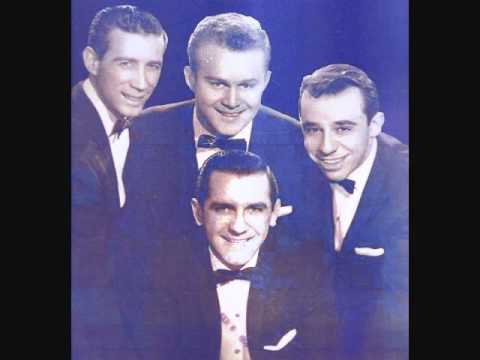 Given the content of this book, I thought it might be fun to pick a song that was popular in Canada in, say 1956.
I was pretty fascinated to learn from the Canadian Music Blog:
National charts did not begin in Canada until the launch of RPM Magazine in 1964. Below, from Oh Canada What a Feeling A Musical Odyssey by Martin Melhuish are lists of popular songs in Canada through the 1950s. We have also included big hits by Canadian artists that made the year-end charts of U.S. Billboard Magazine with their year-end positions on the chart.
Some popular artists back then were
Guy Lombardo & His Royal Canadians: Enjoy Yourself, The Third Man Theme, Dearie, Our Little Ranch House, All My Love, Harbour Lights, Tennessee Waltz. (all 1950) If, Because of You (1951) Crazy Heart, Blue Tango, Auf Wiederseh’n Sweetheart, Half as Much (1952) Hernando’s Hideaway (1954)
The Four Lads: Moments to Remember (#17) (1955) My Little Angel, A House with Love In It, The Bus Stop Song (A Paper of Pins) (1956) Who Needs You, I Just Don’t Know, Put a Light in the Window (1957) There’s Only One of You, Enchanted Island, The Mocking Bird (1958)
The Crew-Cuts: Earth Angel, Ko Ko Mo, Don’t Be Angry, Chop Chop Boom, A Story Untold, Gum Drop, Angels in the Sky (1955) Mostly Martha, Seven Days (1956)
Paul Anka Diana (#24) (1957) You Are My Destiny, Crazy Love, Let the Bells Keep Ringing, The Teen Commandments (1958) Lonely Boy (#5) Put Your Head On My Shoulder (#12) My Heart Sings, I Miss You So, It’s Time to Cry (1959)
My dad was really into big band music of this ilk and he had records from Guy Lombardo and The Four Lads. To me the switch from that kind of sound to the style of Paul Anka in 1957/1958 seems like a pretty big shift. I feel like my dad didn’t like the kind of crooner-y music that Paul Anka sang. It’s interesting that The Four Lads never rose above a chart position of 52 after 1958.
I chose this particular song because I know The Four Tops a little. But mostly because this song is very perplexing. I had no idea what a “paper of pins” could be. Turns out the lyrics are a traditional English children’s song. A “paper of pins” is a sheet of paper with different size pins for sewing. Why on earth would you give them as a sign of your love?
In the original, the song is a call and response, with the second verse being the rejection of the first verse.
I’ll give to you a paper of pins
And that’s the way our love begins
If you will marry me, me, me
If you will marry me[The original verse two is :
I don’t want your paper of pins,
If that’s the way that love begins,
For I won’t marry,
Marry, marry, marry
I won’t marry you.][The original next verse is not a feathery bed but:
I’ll give to you a silver spoon,
Feed the baby in the afternoon]I’ll give to you a feathery bed
With downy pillows for your head
If you will marry me, me, me
If you will marry me
After a few more verses, the Four Lads end:
But you don’t want my paper of pins
And you don’t want my feathery bed
You want my house and money instead
That is plain to seeWell, here they are take everything
My house, my money, my wedding ring
And in the bargain I’ll throw in me
If you will marry me
But in the original ends like this
If you give me the keys of the chest,
And all the money that you possess,
Then I will marry,
Marry, marry, marry,
I will marry you.Ah ha ha, now I see,
You love my money but you don’t love me,
So I won’t marry,
Marry, marry, marry,
I won’t marry you.
So The Four Lads made this song kind of sweet, but also kind of pathetic. Weird choices.
And why in the world is it called The Bus Stop Song?
[READ: November 17, 2019] The Canadians
This is a book of 79 photos taken from The Globe and Mail archives. The are not art, they are not beautiful. They are documentation. Documentation of a specific time and place–Canada in the late 1950s and early 60s.
These are pictures of regular folks working, doing chores, meeting politicians. There’s no posing, there’s no “beauty.” It’s just grim reality. I grabbed this book because Douglas Coupland wrote the introduction (I’m not sure who wrote the copy for the pictures–each picture has one line of information about it). The collection was edited by Roger Hargreaves, Jill Offenbeck and Stefanie Petrilli.
I love Coupland’s take on these picture because he looks at things from such a different vantage point than I’m used to. Like the way he opens the book. He says that the Canada depicted here pretty much didn’t exist anymore by the time he was born. He describes Canada then as “a country in which, it would seem, people were born, became teenagers, and then magically at the age of 21, turned into chain-smoking fifty year-olds with undiagnosed cancers.”
He observes that few people smiled and those that did had teeth riddled with nicotine stains. This is by and large true. The photos with politicians seem to have the biggest smiles although the young members of Chelecos and Lancers Motorcycle Club certainly mug for the camera. (more…)


 I Just Read About That...