Feeds:
Posts
Comments

Archive for the ‘Jerusalem in My Heart’ Category

jerusalemSOUNDTRACK: JERUSALEM IN MY HEART-If He Dies, If If If If If If [CST114] (2015).

ififif Since 2005, Jerusalem In My Heart has been Radwan Ghazi Moumneh (all music) and Charles-Andre Coderre (all visuals).  This is only their second album, however, because they were always more of a live band.

Obviously there’s no real visual component to the record.

Since I don’t know all that much about this band, I rely on the Constellation records website for my information.  Thus:

Moumneh expands his compositional palette on If He Dies, If If If If If If, exploring new deconstructions and juxtapositions of both traditional and popular Arab musical currents, with an album that oscillates between powerfully emotive vocal tunes and instrumental works that primarily make use of Radwan’s expressive acoustic playing on buzuk as a point of departure.

The album’s first song “Al Affaq, Lau Mat, Lau Lau Lau Lau Lau Lau (The Hypocrite, If He Dies, If If If If If If)” opens the disc with a short piece of processed vocals.  The Arabic traditional voice is mildly auto-tuned which sounds kind of cool.  [FROM CST: One of Moumneh’s finest melismatic a cappella vocal performances].

Track 2, “A Granular Buzuk” is a 7-minute instrumental piece of Moumneh on buzuk with pulsing electronic background music.  [CST: the buzuk is processed, re-sampled and otherwise disrupted through Radwan’s real-time custom signal patches]. As with a lot of this record, pretty instrumental passages are interrupted and taken over by noise—this time a kind of mechanical scratching.  It ends with some quietly ringing percussion as the electronics all slowly drift away.

“7ebr El 3oyoun (Ink From The Eyes)” is a vocal track with an electronic drone.  It sounds traditional and mournful, but about 3 minutes in, a drum and buzuk keeps time and the song grows a bit more upbeat.  [CST: languidly plaintive vocals set against a gradually accelerating riff underpinned by hand percussion].

“Qala Li Kafa Kafa Kafa Kafa Kafa Kafa (To Me He Said Enough Enough Enough Enough Enough Enough)” has incredibly loud static with a buzuk playing in the background.   After a minute and a half the static drops away and the background is filled with a quiet pulsing kind of static.  You can finally hear the instrument being played in all its glory.  [CST: a scabrous white noise intervention wherein the entire audio mix is fed through a contact mic placed in Radwan’s mouth].

“Lau Ridyou Bil Hijaz (What If The Hijaz Was Enough?)” is mostly synth–again an old sound with metronymic electronic percussion and quiet vocals. It’s all kind of muffled and very retro.  [CST: Moumneh continues to channel his love for Arabic pop and Casio/cassette culture with this silky lo-fi dance].

“Ta3mani; Ta3meitu (He Fed Me; I Fed Him)” is a faster piece.  Echoed vocals and drones rest behind a fast buzuk melody.  [CST: he pays homage to the until-recently-exiled Kurdish poet and singer Sivan Perwer on this traditional-minded, unadorned folk tune].

“Ah Ya Mal El Sham (Oh The Money of Syria)” opens with a loud vocal and a flute mirroring the voice.  It runs for seven-minutes and ends quietly.  [CST: a tour-de-force drone piece built from Bansuri flute (performed by guest player Dave Gossage)].

The disc ends with “2asmar Sa7ar (The Brown One Cast A Spell),” a fast buzuk solo played over the relaxing sounds of oceans waves.  It has a cool melody and runs quickly and then calmly for some five-minutes before the disc ends with more waves lapping against the shore.  [CST delicate acoustic number set against the sound of waves recorded on a beach in Lebanon].

As with the previous record, song titles employ the transliterative characters used in Arabic phone texting, which I think is pretty cool.

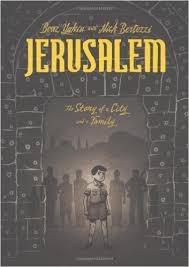
[READ: March 30, 2016] Jerusalem

With a title and subtitle like that you know this isn’t going to be a fun and lighthearted story.  And it is not.  The introduction explains how this is the story of a family, but it is more about the land and the strife that has been there for generations.

A lengthy history of Jerusalem is given, but for the purposes of this story the most recent action is the 1929 dispute over prayer rights which led to riots.  And then the British imposed the White Paper of 1939 which blocked Jewish immigration and was in place as the Nazis were riding to power. This led many Palestinian Jews to regard the British as hostile. And yet many Palestinian Jews joined the British army to fight the Nazis in Italy and the Middle East.  At the same time there were underground forces of Palestinian Jews who were attacking the British.

The action of this story takes place in 1945.

There is also a history of the Halaby family about whom this story is concerned.  Yakov Halaby was born after a series of girls were born in his family.  His father vowed that if they had another son they would move to Jerusalem.  After Izak was born they did so.  But Yakov was jealous from the start.  And he made Izak’s life miserable.  Eventually Izak left and married an Egyptian woman and they both moved back to Jerusalem. (more…)

Read Full Post »

harpjulySOUNDTRACK: JERUSALEM IN MY HEART-Mo7it Al-Mo7it [CST093] (2013)

mo7So just what is Jerusalem in My Heart?  According to the Constellation records website:

Jerusalem In My Heart (JIMH) has been a live audio-visual happening since 2005, with Montréal-based producer and musician Radwan Ghazi Moumneh at its core. Moumneh is a Lebanese national who has spent a large part of his adult life in Canada.  Moumneh is also active in the Beirut and Lebanese experimental music scenes, where he spends a few months every year.

but more specifically, what does it sound like?

Jerusalem In My Heart (JIMH) is a project of contemporary Arabic and electronic music interwoven with 16mm film projections and light-based (de)constructions of space, exploring a relationship between music, visuals, projections and audience.  …   [The album blends] melismatic singing in classic Arabic styles and electronic compositions with contemporary electronic production. …  Moumneh’s voice has become a powerfully authentic instrument, [along with Saturated synths and the overdriven signals of Moumneh’s acoustic buzuk and zurna].

And what’s up with the title of the record?

The numeral 7 is pronounced like an h; all titles on the album are rendered in contemporary colloquial “mobile” Arabic (the transliterative characters used in Arabic phone texting).

Alright, now that that’s out of the way, the album begins with “Koll lil-mali7ati fi al-khimar al-aswadi (Speak of the Woman in the Black Robe)” which opens with an echoed voice that reminds me of the way a dance track might start.  But it quickly becomes clear that the singer is sing in Arabic and in a somewhat traditional manner (but with an echoed effect on the voice).  I don’t really know how Arabic music might be sung, but this is what it sounds like to me.  By the end of the track, some keyboards are added, echoing to the end.

The second track, “3andalib al-furat (Nightingale of the Euphrates)” is a 9-minute instrumental.  It opened with acoustic stringed instruments Dina Cindric playing the Rast Virginal on the banks of Al-Furat.  It is a beautiful piece, recorded outdoors with the sounds of birds and other animals contributing.  It never grows louder than these instruments.

And then this acoustic and mellow piece jumps into the very electronic sounding third song, “Yudaghdegh al-ra3ey wala al-ghanam (He titillates the shepherd, but not the sheep…).”   The opening riff is very late 70s Tangerine Dream-sounding.  I expected a lengthy instrumental, so I was very surprised when the female vocalist (I assume Malena Szlam Salazar) began singing in tradition Arabic style.  It’s a great mix.  Especially at the end as her voice gets more processed.

Track four, “3anzah jarbanah (Sick, Diseased Goat)” is a mostly a capella vocal song with Moumneh singing in his mournful keening voice.  He sounds pained as his voice has a slight echo to it.  After about three minutes a distorted keyboard plays behind the voice.  It has a distinctly 1980s sci-fi vibe.

“Ya dam3et el-ein 3 (Oh Tear of the Eye 3)”  is 5 minute-instrumental which I believe is done mostly by Sarah Pagé playing the Bayat Harp on the banks of Dajla.  Again birds are heard throughout.  These instrumentals are just lovely.

“Ko7l el-ein, 3oumian el-ein (Eyeliner of the Eye, Blindness of the Eye)” has a kind of solo opening on what I assume is the buzuk.  It’s fast and a little wild by the end with an electronic sounding synth line running in the background that more or less takes over the song.  The final track is ” Amanem (Amanem)” which has Moumneh’s vocals and a keyboard drone behind it.  It’s a rather mournful and spooky  vocal style and sounds likes he as about to cry.

Since I don’t really know what the album is about, the ending seems like kind of a downer.  But since I am exposed to practically no contemporary Arabic music, I found this to be a really interesting listen, and I wonder if it is in any way representative of contemporary Arabic music.

[READ: August 22, 2016] “My Holy Land Vacation”

I read this more of Bissell, not because of the contents, as I like Bissell quite a bit.  But I found myself strangely engrossed by this story of traveling to Israel with a busload of Conservatives.

Bissell says that he enjoys listening to right-wing radio.  He names a few hosts who I don’t know and then ends with Dennis Prager.  I don’t know him either, but he is the impetus for this article so there ya go.  Bissell describes him as the “patriarch trying to keep the conversation moderately high-minded” which sounds pretty good.

Prager is Jewish and his audience is largely Christian.  And in the summer he organized a Stand with Israel tour.  For about $5,000 you could go on an all-inclusive guided tour across the world’ holiest and most contested land.

Bissell provides some context that the religious right hasn’t always been fans of Israel.  Indeed my recollection is that the Christian right was very antisemitic.  But by 2002 conservatives were vested in the cause because of some common beliefs like forbidding abortion and being suspicious of Muslims.

When Bissell first saw Prager in person he admits to the man’s charisma.  Bissell talks about what is known as the Israel Test which is summed up “if you ever find fault with Israel, you’re horrible.”  Prager believes that all American parents should send their children to Israel between high school and college to let their moral compass be righted again.

As for the trip itself–the food is plentiful everywhere–embarrassingly so.  He doesn’t like many of the people on the trip.  And he and his wife have to remember to not act like New York liberals.  But the one thing that Tom and his wife (and the people he has grown to like on the bus) can agree on is that their guide David is “the tour guide to have while Standing with Israel.”

Bissell is pleased to hear that the locals are pretty even-handed about a lot of things, always trying to explain up how most of the citizenry–both Israelis and Palestinians want peace.  But the travelers are appalled at this even handedness.  They want partisanship.  A woman yells that there no way that Israelis are teaching their children to hate.  A soldier–a man who lives here–responds to her that he knows Israeli families who do raise their children to hate Palestinians.  She responds, “Respectfully, no.  Respectfully, no.”

Later when they go to Nazareth, their tour guide explains that Nazareth has pretty much always been Arab territory–they didn’t take it from the Israelis, but no one appears satisfied with this answer.

Eventually they go to a settlement and meet self-described “Israeli rednecks.”  The man was born in Cleveland and moved to Israel in 1961.  He is a rabble-rouser and makes Bissell uncomfortable.  Bissell has to leave the room during the man’s excoriations.  When he steps outside, he meets Pastor Marty who is also appalled at the belligerence.  Marty blames talk radio in general and wonders when the last time “anyone was forced to have a civil discussion with someone who thought differently.”

But the real crisis is aboard Bus Five–Bissell’s bus–because their beloved tour guide has been fired because of complaints.  And a whole section talks about the bus’ reaction to this.  They even form factions who want to Stand Up for Dave, and the de facto leader begins trying to find out who is for or against Dave.  The section is pretty fun and strangely exciting.

But the final section grows much more serous.  They visit Yad Vashem, Jerusalem’s Holocaust Memorial.

Soon the rest of the bus and its occupants are forgotten and Bissell simply thinks about this memorial and the thousands of dead.  And then he thinks of his own family–he and his wife left their relatively new-born daughter home with grandparents.

I expected that this essay would be full of some crazy people spouting crazy things.  And to an extent it was, but what I like about Bissell’s writing is how empathetic he is and how he can really convey different perspectives while retaining his own individuality.  The essay also  contained a lot of interesting information and had a surprisingly emotional ending–one that is far removed from right-wing radio..

Read Full Post »