 SOUNDTRACK: MAGOS HERRERA AND BROOKLYN RIDER-Tiny Desk Concert #849 (May 15, 2019).
 Brooklyn Rider was on a Tiny Desk nearly a decade ago. My main take away was how poorly it was lit. I enjoyed them for their multicultural take on classical music. For this Tiny Desk, they team up with Mexican singer Magos Herrera (whom I’ve never heard of).
When the intrepid string quartet known as Brooklyn Rider first visited the Tiny Desk nine years ago, no one knew what the musicians might play. They’re as likely to trot out an Asian folk tune as they are a string quartet by Beethoven, or one of their own compositions.
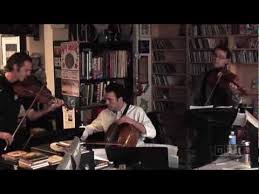
For this visit though, we knew exactly what was on tap. The band, fronted by the smoky-voiced Magos Herrera and backed by percussionist Mathias Kunzli, performed three songs from the album Dreamers, a collection steeped in Latin American traditions.
The versatile Mexican singer, who has never sounded more expressive, notes that these songs emerge from struggle.
She says, “Although there is a lot of light and usually I don’t sing that early, my heart is warm and expanding.”
The first song, Gilberto Gil’s bossa nova-inspired “Eu vim da Bahia” is “a tribute to his home state. He released it in 1965 as Brazil’s military dictatorship took charge.” I love that between the heart-felt words, there is a gorgeous instrumental passage from the quartet (Johnny Gandelsman and Colin Jacobsen: violins; Nicholas Cords: viola; Michael Nicolas: cello).
She says the songs transcend dark times with the values of their words. Gil wrote the tune a year before the dictatorship was installed in Brazil
The atmospheric, flamenco-tinged “La Aurora de Nueva York,” composed by Vicente Amigo, has lyrics from a poem written by Federico García Lorca, the Spanish poet who wrote it while he was in residence in New York in the 1920s. She says “A Poet in New York is my favorite book” and this poem is the most iconic poem from the book. Her voice is smoky and impassioned. There’s some wonderful pizzicato from the quartet. There’s some lovely solo moments from the violins and some spectacular percussion sounds from Mathias Kunzli.
García Lorca, who fell to assassins during the Spanish Civil War in 1936.
The final track “Balderrama,” by the Argentine folk legend Gustavo Leguizamón, ruminates on a café which served as a safe haven for artists to talk about their work.
One of the members of Brooklyn Rider says that when they talked about this project, they wondered which songs to do. Which would best represent beauty in the face of difficult circumstances–an antidote to cynicism. What is most precious and beautiful to a culture.
This song and all of them certainly do that.
[READ: May 16, 2019] “The Presentation on Egypt”
I have enjoyed everything I’ve read by Bordas. And I really enjoyed this one. A story would have to be good if the apparent main character has your name and–before committing suicide–has to pull the plug on a brain-dead man with your son’s name. [That was painful to read].
The story opens with Paul telling the wife of the brain-dead man that he is completely brain-dead. Unlike on TV, he wasn’t going to magically snap out of it. When the wife finally agreed to pull the plug and the main died, Paul went home, had a cigarette, and hanged himself.
Paul had a wife and a daughter (if either one had my wife or daughter’s name, I would have had to give Bordas a call). Paul hanged himself in the laundry room, perhaps knowing that his daughter would never go in there. (more…)




 I Just Read About That...