Feeds:
Posts
Comments

Archive for the ‘Black Sabbath’ Category

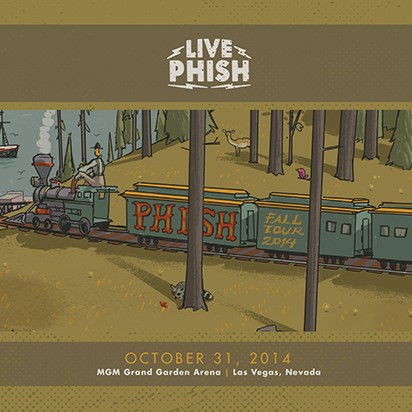
SOUNDTRACKPHISH-“The Birds” (MGM Grand Garden Arena, Friday 10, 31, 2014).

In honor of Halloween, these Ghost Box stories will be attached to a recent Phish Halloween show [with quoted material from various reviews]. 

Known for dawning musical costumes to celebrate [Halloween], Phish broke with tradition last year to offer a set of original music.  The Phish Bill read that Phish’s musical costume would be a 1964 Disney album of sound effects – Chilling, Thrilling Sounds Of The Haunted House.  But it wasn’t a cover set. Phish played original music set amongst an incredibly psychedelic, theatrical graveyard stage accentuated by zombie dancers and a ghoulish MC.  At the start of the set, the stage was cleared before a graveyard came to the foreground.  Smoke filled the air, zombie dancers appeared, and music filled the venue. A haunted house was brought to the front of the stage, which eventually exploded, and all four-band members appeared, dressed in white like zombies. 

“Some people keep birds as pets in their home.  Not you.”

This is a groovy song with some cool pauses with staccato drums and a heavy riff.  The song is littered with lots of samples of “They attack!” a sample that has been used regularly since in various shows.

Mike’s got a nasty fuzzy sounding bass while Page plays the organ rhythm.  At the end Trey and Mike play each other a solo off (complete with bombastic drums from Fish).

The set’s penultimate song, “The Birds,” showed off what Phish meant in the Playbill when they called Chilling, Thrilling Sounds of the Haunted House one of the heaviest albums of all-time. They feasted on a groove that recalled the best of Traffic, Black Sabbath and Abbey Road era Beatles. All the while, a spoken word sample of “They Attack!!” was worked into the sound. It was on “The Birds” that Mike Gordon shined most as he connected with McConnell and Fish on a dark and dirty progression that Trey shredded over. The song continued with Gordon and Anastasio facing off against each other and dueling it out for a few glorious moments as Page hit his keys for more “They Attack!!” samples. Eventually, [they] hooked up on an intense progression they worked over with Anastasio unleashing a wave of riffs that would’ve made Jimi Hendrix proud.

The ending is some pounding staccato chords with samples of “They Attack!”  It’s a very strong ending.

[READ: October 16, 2017] “The Treader of the Dust

Just in time for Halloween, from the people who brought me The Short Story Advent Calendar comes The Ghost Box.

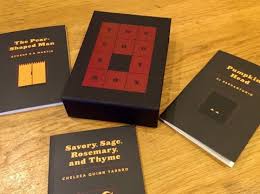
This is a nifty little box (with a magnetic opening) that contains 11 stories for Halloween.  It is lovingly described thusly:

A collection of chilly, spooky, hair-raising-y stories to get you in that Hallowe’en spirit, edited and introduced by comedian and horror aficionado Patton Oswalt.

There is no explicit “order” to these books; however, on the inside cover, one “window” of the 11 boxes is “folded.”  I am taking that as a suggested order.

This story opens with a quote from The Testaments of Carnamagos.

John Sebastian had had a debate and argument with himself.  He was typically a recluse but he was so upset, he had left his house for three days–an unheard of absence. (more…)

Read Full Post »

atwq3SOUNDTRACK: YES-Tales from Topographic Oceans (1974).

Tales_from_Topographic_Oceans_(Yes_album)After the huge success of Fragile and Close to the Edge (with its 18 minute suite), what could Yes do next?  Well first they would release a triple live album, which I’ll get to later.  And then?  Why they would release a double album with only 4 songs on it!  That’s right 4 songs each around 20 minutes long!  And it would be ponderous and pretentious and it would be reviled by everyone!

The album shipped gold (because their previous records were so popular) and then sales plummeted.  The album is much maligned and, frankly, deservedly so.  Now, I love me a good prog rock epic.  So, four 20 minutes songs is pretty heavenly for me.  But man, these songs just don’t really have any oomph.

My CD’s recording quality is a little poor, but I don’t know if the original is too.  The whole album feels warm and soft and a little muffled.  You can barely hear Anderson’s vocals (which I believe is a good thing as the lyrics are a bunch of mystical jiggery pokery).  But despite the hatred for the album, it’s not really bad.  It’s just kind of dull.

Overall, there is a Yes vibe…and Yes were good songwriters–it’s not like they suddenly weren’t anymore.  There are plenty of really interesting sections in the various songs.  It just sounds like they have soft gauze between them.  Or more accurately, it sounds like you get to hear some interesting song sections and then the song is overtaken by another song that is mostly just mellow ambient music.

Without suggesting in any way that this album influenced anyone, contemporary artists are no longer afraid to make songs that are super long (see jam bands) or songs that are just swells of keyboards (see ambient musicians).  Yes just happened to put them all in the same song–way before anyone else did.

The album is very warm and soft—rather unlike the last couple of Yes albums which were sharp and harsh.  There are washes of keyboards and guitars and Anderson’s echoing voice. But what you’ll notice is that I haven’t really mentioned Chris Squire.  He’s barely on the album at all, and when he is, it’s usually to provide very simple bass notes–bass notes that anyone could play–it’s such a waste!  And while Alan White is no Bill Bruford (who was off rocking with King Crimson then), he’s also barely there.  In fact, Rick Wakeman himself is barely there–the king of elaborate classical riffs is mostly playing single notes at a time.  According to Wikipedia,

Wakeman took a dislike to the album’s concept and structure from the beginning. He made only minimal musical contributions to the recording, and often spent time drinking at the studio bar and playing darts. [During the recording session] he played the piano and synthesiser on the Black Sabbath track “Sabbra Cadabra”.

Evidently Anderson wanted a pastoral feeling in the studio

According to Squire, Brian Lane, the band’s manager, proceeded to decorate the studio like a farmyard to make Anderson “happy”.  Wakeman described the studio, “There were white picket fences … All the keyboards and amplifiers were placed on stacks of hay.” At the time of recording, heavy metal group Black Sabbath were producing Sabbath Bloody Sabbath in the studio next door.  Ozzy Osbourne recalled that placed in the Yes studio was a model cow with electronic udders and a small barn to give the room an “earthy” feel. Anderson recalled that he expressed a wish to record the album in a forest at night, “When I suggested that, they all said, ‘Jon, get a life!'”

So we have an earthy pastoral album.  But what about the four sides?  Steve Howe describes it:

“Side one was the commercial or easy-listening side of Topographic Oceans, side two was a much lighter, folky side of Yes, side three was electronic mayhem turning into acoustic simplicity, and side four was us trying to drive the whole thing home on a biggie.”

Despite Wakeman’s complaints, he did have some nice thing to say about it.  he said that there are

“very nice musical moments in Topographic Oceans, but because of the […] format of how records used to be we had too much for a single album but not enough for a double […] so we padded it out and the padding is awful […] but there are some beautiful solos like “Nous sommes du soleil” […] one of the most beautiful melodies […] and deserved to be developed even more perhaps.”

And if Rick Wakeman says an album is padded, you can just imagine what the rest of the world thought!

The lyrics (and mood) are based on Jon Anderson’s vision of four classes of Hindu scripture, collectively named the shastras, based on a footnote in Autobiography of a Yogi by Paramahansa Yogananda.  So if I read this correctly–he wrote 80 minutes of music based ona  footnote!

The four songs are

“The Revealing Science of God (Dance of the Dawn)” [which Howe says is the commercial or easy-listening side] builds slowly and eventually adds vocals.  And then come the drums and a decent keyboard riff.  There’s some noodling on the keyboards.  The riff is catchy but not immediate (which might be the subtitle for the album).  At nearly 4 minutes a faster section kicks in and there’s a catchy vocal part, which seems like where Anderson might normally soar but he holds back.  The “must have waited all our lives for this moment moment moment” is catchy, but again I can’t help but feel it would have been much more dramatic sounding on an earlier record.  At 7 minutes there’s a nice jump to something more dramatic—good drums, but the bass is mixed very low (poor Squire).  There’s some good soloing and such but it is short lived and things mellow out again.  It resolves into a new riff at 9 minutes, but resumes that feeling of washes and noodling guitars.  At 11 minutes there’s an elaborate piano section and the song picks up some tempo and drama. Especially when the bass kicks in around 12 minutes.  The most exciting part happens around 17 minutes when the whole band comes to life and adds a full sound, including a good solo from Wakeman.  And while this doesn’t last, it recycles some previous sections which are nice to hear.

Track 2 “The Remembering (High the Memory)” [which Howe described as the much lighter, folky side of Yes] has a slow, pretty guitar opening with more harmony vocals.  The whole first opening section is like this—layers of voices and keys. Then come some keyboard swells and more vocals.  Some bass is added around 6 minutes. And then around 8 minutes the tone shifts and there is a lengthy slow keyboard solo that reminds me of the solo in Rush’ “Jacob’s Ladder” (released 6 years later).  At around 9 minutes there’s a more breezy upbeat section with a cool riff.  At 10:40 a new section comes in with some great bass lines and guitars and an interesting vocal part. It could easily have been the structure for a great Yes song (vocals are singing “relayer” which of course is their next album’s title). But this is all too brief (it thankfully returns again) and then it’s back to the gentle keyboards.  At 12 minutes there’s a new medieval type section with some great guitar work.  When the “relayer” part returns around 13 minutes there’s a whole section that is great fun.  And even though it doesn’t keep up, the song feels rejuvenated. By around 17 minutes there some interesting soloing going on and then the band resumes to bring it to the end (with a reprise of an early section). And the final section is quite lovely.

Track 3 “The Ancient (Giants Under the Sun)” [Howe: electronic mayhem turning into acoustic simplicity] is probably the most interesting.  It opens with some clashing cymbals and then a fairly complex percussion section and mildly dissonant guitar riff.  There’s even some staccato bass line. The vocals come in around 4:30 and the song shifts to a less aggressive sound, but the big bass continues throughout the beginning of the song until a fast riff emerges around 6 minutes. But more unusual Yes-type riffage resume briefly before segueing into the next part with lots of percussion.  While the staccato bass and drums continues, Howe solos away.  Then around 12 :30 the whole things shifts to a pretty, slow acoustic section with a classical guitar and vocals.  This entire end section sounds like it could easily have been its own song and it is quite lovely.  Howe’s acoustic work is great and there’s even a lengthy solo.

Track 4 “Ritual (Nous Sommes du Soleil)” [Howe: us trying to drive the whole thing home on a biggie] is also quite good.  It’s probably the most fully Yes track of the four, with many sections of “full band” material.  There’s a noodly guitar intro switching to an interesting dramatic minor key movement.  There’s a pretty, if simple, riff (done by guitar and voice) that is quite lovely.  Around 4:30 the guitar solo brings in a riff from a previous Yes song. By 7 minutes, the song settles into a fairly conventional sounding Yes song (with actual bass and drums and…sitar!).   Around 11 there’s a bit of Wakeman soloing (he did show up for some of the album after all) and then some wild guitar and bass work.   The crazy percussion resumes and there’s a wild keyboard solo on top of it. The end of the guitar solo even has a bit of “Born Free” in it.

I hadn’t listened to this record in probably 25 years.  And so I listened to it 4 times in the last few days.  And I have to say that I thought it was bloated and awful at first, but it slowly grew on me.  I found some really interesting sections and some very cool riffs.  If these pieces could have been truncated into individual songs they would be quite good.  The biggest problem for me is that so much of it is so slow and mellow–like it’s building up to a big climax which never arrives.  On previous albums, Yes had made quite a show of being insane musicians, and that just isn’t here.

So even though I have come around on these songs, they certainly aren’t my favorites.  But if you’re at all interested in Yes, there’s some gems hidden away in these monstrosities (just don’t think too much about what Anderson is talking about).

Since almost every Yes album had different personnel, I’m going to keep a running tally here.  The band stayed together after Close to the Edge, but this was too much for Wakeman who left after the recording:

Chris Squire-bass
John Anderson-vocals
Alan White (#2)-drums
Rick Wakeman (#2)-keyboards
Steve Howe (#2)-guitar

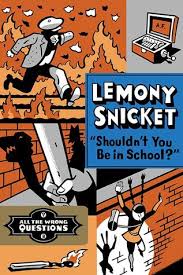
[READ: June 20, 2015] Shouldn’t You Be in School?

I am finding this series to be ever more and more confounding.  And I know that is its intent, but it is still a challenge.  Whenever anyone asks a question someone else replies that it is the wrong question.  But they never say what the right question should be (deliberately confusing!).  There are also so many threads and confusing characters, that if Snicket didn’t make the story funny and strangely compelling, it would be incredibly frustrating.

In this story, Hangfire, having been thwarted in his previous endeavor to capture children (for what end we do not know) is back with a new plan to capture children.  Also, the mysterious (and presumably wicked, but who can be sure) Ellington Feint has returned as well to help or hinder as she sees fit.

The other characters are back too, of course: Moxie is back taking notes, Jake Hix is cooking delicious foods at Hungry’s (in fact there are even some recipes that sound pretty yummy–Snicket himself makes a passable tandoori chicken).  S. Theodora is still his mentor (and the pictures by Seth of her are hilarious).  Late in the book Pip and Squeak show up.  And naturally the policemen and their bratty son Stewie are there too.  And we are still wondering what in the heck is going on with the bombinating beast.

There’s also some new characters, like Kellar Haines, a young boy who when we first meet him is typing up something in the offices of the Department of Education (with posters all over the walls that say Learn! Learning is Fun, etc).  And his mother is also becoming quite chummy with S. Theodora.

The danger in this book is fire.  Building after building is being burnt down.  The Stain’d Secondary School is engulfed.  Even the library is at risk!  And that’s when S. Theodora solves the crime!  She gets the library Dashiell Qwerty arrested for setting the fires.  And even though it is quickly determined that he did not do it (a building was burnt down while he was in custody), that doesn’t stop S. Theodora and her new friend Sharon Haines (in matching yellow nails) from partying.  It also doesn’t stop Qwerty from being taken to prison.

This story is a bit darker than the other ones (which were admittedly pretty dark).  Every kid is being drugged with laudanum which makes you sleepy.  We’re unclear exactly what they are being drugged for, but Snicket has a plan to stop it.  Snicket himself winds up getting beaten up–pretty badly–from Stew and others.

And for the first time, S. Theodora is kind to Snicket (more or less) and apologizes for her behavior (sort of).

By the end of the book a plan is hatched, a bunch of people join the V.F.D. (as seen in A Series of Unfortunate Events) and someone is taken to jail. There’s even a mysterious beast who is living in the fire pond.

As in previous books there is ample definition building–either from people saying they don’t know what a word means so that it can be defined or from Snicket himself simply defining a word.  As in “my brother and I played an inane game” “inane is a word which here means that my brother and I would pretend we couldn’t hear each other very well while we were talking.”  This game actually sounds fun:

What do you think of the weather this morning?
Feather? I’m not wearing a feather this morning.  This is just a hat.
Just a cat? Why would you wear a cat on your head?
A Bat in your bed etc etc.

The artwork by Seth is once again fantastic and noirish.

And the end of the book has a fragmentary plot “a great number of people working together, but they plotted together in such a way that nobody knew exactly what the other people were doing”  And finally we learn what the right question is, but it’s the unsatisfying: “Can we save this town?”  We’ll have to find out in the concluding book 4.

You can also check out the website for some fun.

Read Full Post »
jun9SOUNDTRACK: BUDGIE-“Breadfan” (1973).

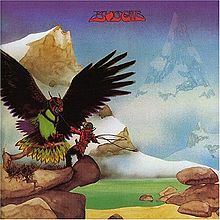
budgieI am pretty much wholly ignorant of Budgie. I know this song “Breadfan” because Metallica covered it back on one of their covers EPs. I really Metallica’s version, but since that was pre-internet, I was never able to explore Budgie more.  And then I forgot about them.

Well, just the other night, WXPN played “Breadfan” (as part of a 70s power trio segment) and I was shocked at how high-pitched Burke Shelley’s voice was (the comparisons to Rush are apt).  And I was also surprised at how heavy this song was.  While Black Sabbath had certainly been releasing heavy albums up until this time, this song introduced a much faster element.  And there were only three members in the band!

What’s also interesting is the prog rock leanings in some of their songs, like the middle of this one.  The fact that Roger Dean did this album cover and that they have a 10 minute song on this album seems to lean towards prog rock as well).

Time to dig deep in to the Welsh band’s catalog, I think.

[READ: June 17, 2014] “Beautiful Girl”

This year’s Summer Fiction issue of the New Yorker was subtitled Love Stories.  In addition to the two graphic stories, we have a series of five personal essays which fall under the heading of “My Old Flame.”  I like that all five writers have slight variations in how they deal with this topic.

Wolff surprises (me anyhow) by saying that when he was fifteen, he cut off the last joint of his left ring finger.  This piece of information just sort of lingers there until the end of the story.

Because he then talks about how he never really had a girlfriend.  In sixth grade he and his friend Terry would meet Terry’s cousin Patty and another girl in the movie theater and they would pair up and make out (clearly Terry did not make out with his cousin).   But they pairings were never seen in public and never went on a further date.

But later that winter his family moved to the Cascades, where the elementary school had all of four rooms.  There were ten kids in his class and nine were boys.  The one girl, Nevy, drove them all crazy. She favored one then the other but her real love was horses not boys. (more…)

Read Full Post »

june2SOUNDTRACK: THE BLACK ANGELS-Indigo Meadow (2013).

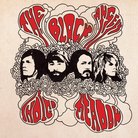
indigoThere’s another round of bands with Black in their name.  I had heard good things about this particular “black” band so I decided to get Indigo Meadow, their 4th album.  And while the album cover hints at the type of music (retro psychedelia), I was unprepared for the insane retro feel of this album.

The guitars are fuzzy, the keyboards are straight out of the 70s, there’s a middle eastern vibe and the vocals even sound of that era (a little tinny, a little fuzzy).  The music is a little heavier perhaps than the music of the era (well, except for Black Sabbath, of course)–louder, faster drums, newer guitar noises, things that make it sound new, not just like a lost relic

There’s something minor key and ecstatic about the way the title track builds and builds.  It’s an auspicious opening to the album.  It’s slightly off kilter but ever so catchy.

“Evil Things” has a big old heavy metal riff, but it throws in some different items–a slow soaring chorus and a big old Doors’ keyboard solo (over the top of that heavy metal riff) which creates an interesting mix of sounds.  “Don’t Play with Guns” has a slightly different sound, with a sixties pop chorus (under that psychedelic fuzz of their guitars).  The delicate keyboard opening of “Holland” quickly morphs in to a more retro keyboard sound with more echoed vocals.  It is one of the longer songs on the album at 4 minutes (So despite this album being psychedelic, the songs are all pretty short, emphasizing their pop roots).

Like “The Day” which is only 2 and a half minutes.  “Love Me Forever” has a very Byrds-ian feel, but with a far heavier chorus.  “Always Maybe” has an exotic sounding guitar riff and “Broken Soldier” has a really chorus (for a pretty dark song).

“Twisted Light” alternates between that retro keyboard and a buzzy guitar riff.  And the harmonies reinforce that era’s feel.  “You’re Mine” even sounds like it might be a cover (that chorus is a perfect example of psychedelic pop).  The final song plays with the set up somewhat by having the first two minutes build quietly before the big fuzzy guitars propel the song to the end.

So yes, the album is not original (although it is, since they take a style and aren’t afraid to tweak it) and it does not deviate from the style very much.  But it’s done so well.  And f you enjoy psychedelic pop (with a bit of heavy metal sprinkled on top), this i s an album that you will enjoy.  It’s 45 minutes of fuzzy pop fun.

[READ: August 17, 2014] “Ba Ba Baboon”

This is a story of deception, dishonesty and dogs.  It is told in third person and as we begin, we see that there are two people hiding in a pantry.  It turns out that the protagonist, Brooks, and his sister, Mary, are the ones hiding.  And they are hiding in someone else’s home.  We learn that whoever they are hiding from may have left.  But before we learn why they are in the closet, we learn a bit about Brooks.

He had an “accident” some time ago which did damage to his brain.  Someone smashed the left side of his head with a brick and took his car and wallet.  His memory isn’t what it used to be, but his “old self” likes to make jokes at his own expense (like singing “If I Only Had a Brain”).  And he is also rather different–he can’t tolerate smoke anymore even though he used to be a smoker, he can’t wear any dark clothes and he is intolerant of creases in his pants.  And, worst of all for Mary is that Brooks used to be the one who looked out for her–her big strong older brother, and now it is her turn to look after him.

So why has she gotten him trapped in a closet?  Mary says “we’ve been in here for an hour.  I don’t see the dogs.”  It turns out that on the other side of the flimsy door are two of the biggest dogs they have ever seen.  These are vicious guard dogs who can be turned of with a safe word, which Mary thinks is “Baba Beluga” or something like that. But that clearly isn’t it. The dogs and the house belong to Wynn, a “friend” of Mary’s.  (more…)

Read Full Post »

CV1_TNY_01_06_14Ware.inddSOUNDTRACK: BROWNOUT presents Brown Sabbath (2014).

brownout_cvrI was intrigued by the premise of this album: Brownout is a nine piece jazz band and they play a selection of Black Sabbath covers.  The NPR site (where you can stream the album this week) explains:

They played a residence at an Austin club where they devoted a week each to the repertoire of artists like Black Sabbath to break the monotony of a long club gig.  Audience response, not to mention the fun the band had on stage reworking Sabbath classics, led to a full-length album.

So, this band plays a number of Black Sabbath classics, with, oftentimes, the horns standing in for Tony Iommi’s guitars or Ozzy Osbourne’s voice. Although there are also times when the (various) singers in the band try out their inner Ozzy (and often succeed).  They get pretty heavy for the heavy parts (and there are guitars so the do have appropriate guitar sounds from time to time).   But they also play some of the groovier songs too (like “Planet Caravan.”)

Other songs include “The Wizard” (probably my favorite here), “Iron Man” (which is very different from the iconic song, and is only vaguely recognizable as the song, but is very good nonetheless).  They also do “N.I.B.” a bass heavy song which takes on a different style (perhaps a bit too much like Dread Zeppelin).  “Black Sabbath” has no vocals, just a guitar playing the lines–and the horns in the beginning add a suspenseful accent. “Hand of Doom” plays that slinky dark sound very well (I just like the original so much that this one can’t quite compare).  And “Into the Void” which also has no vocals, but sounds a little too marching band here (but the middle instrumental section is really trippy).

So I enjoyed this take on classic Sabbath.  Although I don’t need to listen to it more than once.

[READ: June 13, 2014] “First Husband”

Looking back, I see that I have enjoyed a lot of Antonya Nelson’s stories.  And I enjoyed this one too.  She seems to have a great eye for little details, or interesting aspects of family life that are fun to unravel.  The thing I really liked about this story was the simple construction of the character relationships.

Lovey is married to William.  It is both of their second marriages.  But Lovey’s first husband was married before he married Lovey–she was his second wife.  Lovey’s first husband had several daughters, including Bernadette.  So for a time, Lovey was Bernadette’s stepmother (even though she was close in age to the oldest daughter).  Then when Lovey and her first husband split up, she was no longer Bernadette’s step mother.  But because the marriage lasted for more than a few years, the girls grew close to her, especially Bernadette.  When they divorced, Bernadette actually chose Lovey over her father.  So now Lovey is her ex step mother.  And William is something to Bernadette that there’s not a word for.

I love that.  Even though it’s probably not that uncommon, it is such a linguistic mess that its clear no one was ever prepared for that.

I especially liked that that level of detail is included even though it is not the crux of the story.  It is relevant, but it is not the crux.  The crux is that Bernadette’s husband (whom no one likes) is out drinking.  Again.  Bernadette is nervous about him coming home drunk and the fight they will have so she wonders if she can bring the kids over to Lovey’s house.  It is 2AM.

Lovey doesn’t mind.  Lovey doesn’t have children of her own–she feels that her first husband (Bernadette’s dad) deliberately kept her from having children during her prime years and now she is stuck.  And even though these children are technically nothing to her, their ex- step-grandmother, she still cares them.  And Bernadette’s oldest boy, Caleb, is the reason she is named Lovey–it was something that he could say when he was little.  So when the children come crashing over, Lovey welcomes them without waking William (who needs to be up early for his doctor rounds). (more…)

Read Full Post »

 harper juneSOUNDTRACK: FUZZ-“Sleigh Ride” (2013).

fuzzHow can some 3 minute songs seem like they take a long time and others feel like they are about a minute long.  “Sleigh Rode” is one of those songs that is over before you know it.  With a big old fuzzy guitar riff opening the song it sounds straight out of classic rock.  Then the verses come in with faster riffing (like a less heavy Black Sabbath) and a sleazy kind of vocal.  It reminds me of a more garage band/sloppy Queens of the Stone Age.

This is (yet another) band from Ty Segall. Robin Hilton from NPR says that Segall had put out some 6 solo albums and is in a half a dozen bands as well (and he’s only 26).  he normally sings and plays guitar, but he plays drums in this band.

While I don’t actually know anything else by him, I really enjoy this piece of fuzzy distorted sleaze pop. and may need to see what he is other releases are like.

[READ: September 20, 2013] “Living Deluxe”

Diane Williams wrote Vicky Swanky is a Beauty which I did not really like.  It was experimental and flash fiction which I am growing to like less and less.  This short piece (which is actually longer than anything in Vicky Swanky, I believe), is from a collection in progress.  I’m not sure if that means that this is finished or not (it’s hard to tell with her).

This story deals with a woman who has taken money from her mother (and sister and brother) because her mother “knew I needed to be a person with flair” (I liked that line).

The thing about the rest of the story is that the narrator acts like a five year old telling a story.  The details that are added are not necessarily relevant to the story.  So we get two paragraphs on a man sneezing, a few paragraphs on her cat, and a couple of paragraphs about Leonard da Vinci.  These details might be relevant to the story.  But interspersed with these details are things that impact the taking-money storyline—that her sister took something that was hers (the Da Vinci bit is about a present she gave to her sister). (more…)

Read Full Post »

goliathSOUNDTRACK: UNKNOWN MORTAL ORCHESTRA-“No Need for a Leader” (live at the Rock and Roll Hotel in Washington, D.C, May 23, 2013) (2013).

umoI have been hearing about the Unknown Mortal Orchestra for a little while now  The name is intriguing and really could indicate so many different styles of music.  With the internet, it’s very easy to hear a sample of a band, but I like to happen upon them a bit more organically.  So, here was a track from a recent live show that NPR was sampling for us.

UMO is from New Zealand and they have a kind of psychedelic-meets-Black Sabbath feel.  The song isn’t really heavy so much as just riff-based and speedy.  The song has an appropriate Sabbathesque quick riff at the end of each verse and a boatload of flange and vibrato tossed on, too.

But I don’t really care for the vocalist, who seems kind of pinched and tight–almost exactly the opposite of what this expansive song is crying out for.

So this song is ultimately a mixed bag–I like the vibe of the band, but I don’t feel compelled to hear any more from them.

You can watch the video (and groove on the singer’s shirt) here.

[READ: July 5, 2013] Goliath

I enjoyed Gauld’s You’re All Just Jealous of My Jetpack enough to track down Goliath, his previous book.

Although Jetpack is a collection of strips, Goliath is a telling of the story of David and Goliath (which everyone knows is the great underdog story).  The big difference here is that we see the story from Goliath’s point of view (which I believe we do not ever see in the Bible–it’s been years since I’ve actually read it).

In this version, Goliath is a simple man.  Despite his size, he would rather do office work than fight.  Indeed, when given the opportunity, he jumps at the chance to do administrative paper work rather than practice with weapons.  But the Philistines are at war and everyone needs to help.

That’s when one of the soldiers gets an idea.  Goliath is to go into the valley and proclaim to all who can hear: “I am Goliath of Gath, Champion of the Philistines.  I Challenge you: Choose a Man.  Let him come to me that we may fight.  If he be able to kill me then we shall be your servants.  But if I kill him then you shall be our servants.” (more…)

Read Full Post »

5.20SOUNDTRACK: BLACK ANGELS-Evil Things (2013).

blackangelsThis song has a 70s era metal sound (with a heavy early Black Sabbath feel).  It opens with a big riff and surprisingly quiet vocals (the vocals are not really sung loudly, they’re almost whispered, and they are very clean–it’s a nice contrast to the big buzzy guitars).  But for al the buzzy guitars (and the wonderfully dated to 1967 keyboard sound), there are passages that are quiet and almost gentle.  Indeed, there’s a lot going on in this song.  It’s a nice marriage of heavy metal and psychedelia.

I love the way the end seems like it’s uncontained–like they couldn’t control the feedback.  It’s interesting that Bob and Robin on NPR relate this more to psychedelic bands of the late 60s and yet I hear more Black Sabbath–of course, Sabbath was a lot more psychedelia than we let on.

I’d like to hear more from these guys

[READ: May 16, 2013] “Cats Robo-Cradle”

The five brief pieces in this week’s New Yorker are labeled as “Imagined Inventions.”  And in each one, the author is tasked with inventing something.

Since Atwood wrote Cat’s Cradle, I wasn’t sure what to expect from this piece—the title of which was just kind of odd.  As with many magazine titles, I feel like perhaps she didn’t come up with the title because that’s not what she calls her invention–someone just tried to tie it into her famous novel.

Anyhow, she begins her piece by talking about the fascinating-sounding Museum of Failed Products in Ann Arbor, Michigan.  She says that there are so many interesting things there, some of which she feels must be better than her own invention, and must be better than Pop-Tarts.  She says she predicted the failure of Pop-Tarts because when her family first tried it, the jam exploded all over the toaster.  So she knows from good and bad ideas.

Her idea has to do with the death of so many birds and rodents from feral cats.  Recall that birds are predators of insects so their dwindling number is affecting forests and garden.  When cats kill the birds (and the rodents that larger birds eat), they are permanently impacting the climate.  Her idea is for a safe (to the cats) trap which she calls the Robo-Coyote. (more…)

Read Full Post »

[WATCHED October-November 2012] Metal Evolution

metal evolutionVH1 aired this series last year and I was intrigued by it but figured I had no time to watch an 11 hour series on the history of heavy metal.  Of course, this being VH1, they have since re-aired the series on an almost continual loop.  So, if you’re interested, you can always catch it.

This series was created by Sam Dunn, the documentary filmmaker who made the movie Metal: A Headbanger’s Journey.  I had heard good things about the movie, but never saw it.  After watching the series, I’m definitely interested in the movie.  Dunn is a keener–A Canadian heavy metal fan who is really into his subject.  He knows his stuff and he knows what he likes (heavy metal) and what he doesn’t like (glam metal, nu metal).

The sheer number of people he interviews is impressive (as are the number of locations he travels to).  Part of me says “wow, I can’t believe he was able to interview X,” and then I remember, “X is really old and is nowhere near the level of fame that he once had.”  Given that, the few hold-outs seem surprising–did they not want to have anything to do with VH1?  Are they embarrassed at how uncool they are now?  Just watch the show guys, you can’t be as low as some.

The only mild criticism I have is that the show relies a lot on the same talking heads over and over.  Scott Ian from Anthrax, whom I love, is in every episode.  Indeed, he may be a paid VH1 spokesman at this point.  There are a few other dudes who show up a little more than they warrant, but hey, you use what you got, right?

What is impressive is the volume of music he includes with the show.  I assume that he couldn’t  get the rights to any studio recordings because every clip is live.  This is good for fans in that we get to see some cool unfamiliar live footage, but some of it is current live footage which often doesn’t compare to the heyday.  Having said that, there’s a lot of live footage from the early 80s–of bands that I never saw live anywhere.  And that’s pretty awesome.

With an 11-part documentary there’s the possibility of exhaustion and overkill, but Dunn is an excellent craftsman  he jumps around from old to new, talks about how the history impacts the current and, because of his own interests, he makes it personal rather than just informative. (more…)

Read Full Post »

SOUNDTRACK: WOODEN SHJIPS-Live on KEXP, August 7, 2011 (2011).

while ago I reviewed an Earth concert and while I felt like I should have liked them, I didn’t like them as much as I anticipated.  Well, Wooden Shjips (no idea what’s up with that “j”) sounds like I would have liked Earth to sound–a bit faster and yet still ponderous   They play with really distorted guitars and heavy bass, but their songs aren’t terribly fast or anything.   The thing that sets them apart is the keyboard–loud droney keyboards that take a kind of lead role and add a weird sort of retro feel to the heavy proceedings.  Indeed, even the voice is fuzzed out and echoey, making the keyboard one of the few clean sounds in the show.

As befits droney metal bands, all of these songs are long.  The first two “Lazy Bones” and “Black Smoke Rise” are over four minutes while the final two “Home” and “Flight” are over 5 and nearly 7 minutes respectively.

Lazy Bones is dominated by a spacey keyboard riff and vocals that are echoed almost into oblivion, reminding me of a kind of mid 70s Black Sabbath (if Ozzy’s voice was deeper).  The riffs on “Home” and Flight” sounds like we’re in for some real classic rock, but again that droney keyboard (which also sounds retro but in a different way) mixes with the heavy distorted guitar in a new way.  I’m intrigued to hear more from them.

Rock out here.

[READ: November 15, 2012] “Batman and Robin Have an Altercation”

I’m always surprised to see a Stephen King story in say Harper’s or the New Yorker.  Not because he’s not good, but because he’s such a famous genre writer (and he certainly doesn’t need the exposure).   I don’t even think of him as a short story writer, really.  I wonder how he gets his stories in these magazines?  Does he get vetted?

Well, this story was really enjoyable and if I hadn’t known it was Stephen King, I never would have guessed.

The first 3/5 of the story are about Dougie Sanderson and his Pop.  Pop is in an old age home, suffering from Alzheimer’s. They have a routine, which is easy enough for Dougie  to do, even if to his father it’s new every time.  Dougie visits every week, they go Applebee’s, and they come home.  This depends, of course, on how good Pop is doing that day–as long as he’s fairly lucid and isn’t cursing out everyone in sight.

What I appreciated about this story was that Pop has moments of incredible lucidity that can be immediately followed by moments of utter confusion   Like when Pop calls him Reggie (Dougie’s brother who died forty-five years ago in a car accident .  But the moments of lucidity are nice for Dougie–although they’re not encouraging exactly, because most days he guiltily admits that he wishes things would end sooner rather than later.

The Batman and Robin of the title refer to a Halloween costume that Dougie ad Pop wore when Dougie was little.  Indeed, Pop remembers it very well, “Halloween, you dummy.  You were eight, so it was 1959.  You were born in ’51.”  Pop even adds a detail that Dougie didn’t remember: that Norma Forester looked at Dougie and said “trick or treat” and then looked at Pop and said “trick or drink” and offered him a bottle of Shiner’s.  Dougie is silent–amazed at the memory.  Then Pop says “she was the best lovin’ I ever had.”  Dougie doesn’t know whether to believe this or not thinking, “They hurt you….  They may not mean to, but they do….  There’s no governor on them, no way of separating the stuff that’s okay to talk about from the stuff that isn’t.” (more…)

Read Full Post »

« Newer Posts - Older Posts »