 SOUNDTRACK: DO MAKE SAY THINK-You, You’re a History in Rust [CST045] (2007).
 You, You’re a History in Rust feels very different from DMST’s previous album. That record felt kind of insular and tight. This one feels expansive and experimental. Like the first song which has multiple sections that feel completely unrelated and which are only connected by silence. Or the fact that there are lyrics in a song, or even a fairly conventional song.
“Bound to Be That Way” This song opens in a peculiar way. There’s a drum rhythm, that slowly builds and some piano chords are laid over the top. This goes on for about 45 seconds and then fades out. And then a new melody–completely different–with horns and guitar peeks its way out. And then it too fades. Then around 2 minutes a pretty guitar melody comes through followed by big crashing distorted drums. Eventually a new riff enters the song and it really starts grooving. It’s fantastic, but it too is just a portion of a song which ends at around 4:30. And then another new section comes in. Then acoustic guitar riff is counterpointed by some horns. The final melody is the catchiest one of the bunch and it ends this strange song on a high.
But if that was strange, “A with Living” offers the biggest shock to fans of the band. There are words in this song! And they are sung! Words were co-written and sung by Alex Lukashevsky and the Great Lake Swimmers’ Tony Dekker. Akron/Family also joins in doing “oohs” and “ahs.” It opens with rumbling drums and then the singing begins. The song has a conventional verse chorus verse structure with big horns. It’s catchy (the vocals are great). But it’s also a 9 minute song and at 4 and a half minutes the song moves way from the melody and enters a lengthy instrumental section with deep rumbling guitars. The chorus of voices returns briefly before the mellow guitars lead us to the end.
“The Universe!” is one of my favorite DMST songs. It rocks and rollicks. It has two notes and then five bashing chords. Repeated several times. It’s one of the most straightforward songs they’ve done. It has screaming guitar solos and a cool sliding bass. It’s also very raw sounding, with all kinds of noise floating around it. And just like that, it’s gone. Seguing into the quiet, “A Tender history in rust” which opens with processed guitars or keyboards, layered upon each other. There are voices fighting through (saying all kinds of sounds—including laughing), before it switches to a pretty acoustic guitar riff. It’s a delightfully conventional folk melody–another unusual addition for the band.
“Herstory of Glory” has another pretty acoustic guitar melody with some rattling drums (in the right ear). Then there’s a rumbling bass and distant voices before more and more instruments add to the beautiful song–pianos, trumpets, claps.
“You, You’re Awesome,” is the shortest song on the disc at under 4 minutes. It opens with slow electric guitars and a e-bowed solo. After a minute or so, the rest of the band comes in with a slide guitar and banjo making a kind of sloppy folky romp.
“Executioner Blues” is another favorite. Its 8 minutes long with some lovey guitar riffs and sounds. It opens with some big guitars and a repeating riff. A martial drums enters the song and keeps it moving until the next big section. Horns repeat a similar melody and then a romping bass guitar takes over. More instruments kick in making the song noisy and slightly distorted. There’s piano trills, glockenspiel, electric guitar, noises and more. and the instruments all go up the scale slowly for a few bars and then play a punch of staccato notes. It’s rather dramatic. After several permutations of this, they just keep going up and up the scale until the reach the top and then they gradually descend again. The last minute is a series of quiet bass notes, as if everyone has totally come down from that intensity.
“In Mind” is a quiet disc closer. A simple guitar melody, it is joined by banjo and trumpet. Then some bass lines come in followed by a very distorted chorus singing “When you die, you’ll have to leave them behind/You should keep that in mind/When you keep that in mind, you’ll find a love as big as the sky.” The disc ends with some quite banjo plucking.
This disc goes all over the place and really explores different avenues.
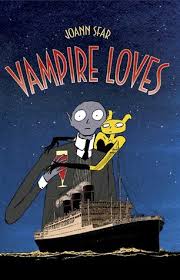
[READ: February 10, 2016] Vampire Loves
Joann Sfar created Little Vampire (and apparently about 100 other comics, some of which have been translated into English by Alexis Siegel and published by First Second). Of the things I’ve read by him, (and there have been a few) I enjoyed this the most. It seems like a lot of his books (like Little Vampire) are for kids, bu this one is absolutely for adults (there;’s curses in it and talk of sex and everything).
There are four stories in this book (I just learned that Sfar has written six in total, so maybe there will be more translated). After the third book in this collection, there’s a question as to whether or not Ferdinand, the vampire in this story is Little Vampire. There’s a little drawing of Little Vampire which says that Ferdinand is him. “But vampires don’t grow up! No, but they can grow little. Ferdinand was me before! You mean that before being little you were grownup? Yes.” So there’s that sorted.
“Could Cupid Care Less?” starts us off with Ferdinand the vampire’s woes. His girlfriend, Lana, (a kind of plant creature) has just come back. She cheated on him, but turns the conversation around to say that it is his fault–if he weren’t so jealous he never would have found out. He freaks about this and she storms off again. Furious, he sets off for his nightly feeding. Ferdinand is a nice vampire–he takes little sips and only with one fang so it looks like mosquito. While he is feeding on a woman, a red-haired vampire storms in and shows him how to do it right. She is a vixen with an ankh necklace and after feeding, she comes on to Ferdinand hard. She says she likes old, proper-looking vampires–not goth wannabes. She brings him back to her house but before they can do anything, her sister walks in. She’s also red-haired and has a shapely figure and actually has more in common with Ferdinand. And that’s when we learn that the first woman’s name was Aspirine and her sister’s name is Ritaline (ha!).
All of the stories cut back and forth to different sections. So we cut over the Lani who is staying with the Tree Man. He is trying to hit on her, but she’s having nothing to do with it.
We return to Ferdinand where he just can’t get rid of Aspirine, even when he wants some alone time. He can’t get a woman he wants and can’t get rid of the ones he doesn’t.
“Mortal Maidens on My Mind” opens with a Japanese woman meeting Ferdinand in Paris and falling for him. They do all kinds of things together and she even writes home about him. But Ferdinand had to return home and that was the end of that.
We cut back to the Tree Man who is still pining for Lani but is having no luck with her.
Back home, Ferdinand runs into the man who slept with Lani, Michael. He also argues that it was Ferdinand’s fault that things wound up as they did. He says that he was just looking for fun. He didn’t want to hurt anyone, so why did Ferdinand have to get involved? After a fight Ferdinand leaves to go to a bar where he tries to hook up with a woman but it all falls apart.
Then we cut to a man who has created a golem. He wanted the golem to do bad things, but the golem is so kind that he couldn’t possible have made the him do the evil things he planned.
The postscript of the story contains a few notes on the protagonists of this story which sort of retroactively tries to make sense of the seemingly disparate story lines and lets us know how these characters belong here.
“Lonely Hearts Crossing” shows Ferdinand on a cruise. But first we meet a woman named Alas, and her spiritual ghost-creature-friend named Sigh. Alas is looking to score with the captain of the ship (who is the invisible man).
Meanwhile Lani is going shopping with Tree Man. He has become her buddy and he can’t get out of it.
On the ship, Ferdinand runs into a werewolf who turns into a wolf when he sees a girl. He only transforms back if he can kiss a girl. But he is a such charming creature that he has no problems scoring–much to Ferdinand disgust and amazement.
The story turns very exciting as there are armed criminals on board and a shootout. And by the end of the story Ferdinand is making out with the spirit ghost creature (who teaches him how to go through walls which turns them both kind of ghostly for a time).
“Moonstruck Post Mortem” ends the book with Ferdinand trying to pick someone else up. His conscience is bothering him lately though so he manages to get rid of it. The woman is interested in him but already had two boyfriends so she kind of blows him off.
The scenes shifts to Ferdinand at the police station. He’s not n any trouble. in fact, the police would like him to help with their investigation of suspicious murders. Since he’s nocturnal they figure he can look at night. That’s how police work, right?
Ferdinand decides to go out drinking again. He meets a woman he likes, but she seems disinterested. So he quickly moves on and finds a creature who is into him. But he is quickly utterly disgusted by her. And the first woman just came back. Oh no!
Frustrated, he leaves and goes to see the dentist–because the dentist has some secret information about the investigation. But before he will give the information to Ferdinand, he needs to give him a compete check up. By the end, he tells Ferdinand not to get involved. And as the story progresses and the criminal is found… Ferdinand is shot and thrown into a hole! Can Ferdinand’s conscience come to the rescue?
The whole story concludes with Ferdinand going back to find Ritaline (but of course finding Aspirine instead). She offers to let him bite her–but when one vampire bites another it’s “catastrophe.”
It’s a totally nuts book but very funny. Another fun book in my #10yearsof01 February.
I think the reason I don’t enjoy the Sfar books as much as I might is because they are printed so small. I don’t know what the original size was, but the format makes everything feel really squished. This makes the dialogue hard to read and means you can’t see all of the details that well. I think if these books were bigger it would really help their appeal.
Read Full Post »
 SOUNDTRACK: DO MAKE SAY THINK-Other Truths [CST062] (2009).
 Other Truths is (so far) Do Make Say Think’s final album (they have been on hiatus since). I’ve mentioned this album before, but here it has context with the others.






 I Just Read About That...