This show was recorded July 7, 2009. It’s fascinating that it didn’t get posted until four months later.
As the Bowerbirds first started I didn’t think I would like them primarily because of the opening lyrics of “Hooves” “Back to when I was born on a full moon, I nearly split my mama in two.” It just seemed an offputting way to start especially when sung over very simple acoustic guitar. But after the first verse, the band joins in with some Ahhs, which flesh out the song very nicely. The accordion and violin fill in where necessary and make this a much more compelling-sounding song.
The second song, “Teeth” opens with a very full sound–I really like it–bowed double bass, violin, accordion and guitar and when the backing vocals complement the lead vocal, it’s really quite beautiful. “House of Diamonds” is a folkie song, but the final track “In Our talons” (which comes from their first album) is really dramatic, with a some great vocals, a cool section that slows down the tempo and rousing accordion-driven conclusion. (There’s something a bout an accordion that when played right can add incredible tension to a song).
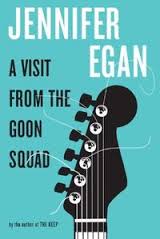
[READ: February 13, 2014] A Visit from the Good Squad
This book made many best of list at the end of 2010. I’ve wanted to read it for some time now, so when I saw it remaindered at Barnes & Noble, I grabbed it (yes, the library is cheaper, but I find that sometimes I will read things more quickly if I buy them).
I was expecting to be blown away by the book. But I wasn’t. At least not at first. And the real reason for that was because I read it over too long of a span of time. There are a lot of intricacies in this book that demand attention. It’s not a difficult book, but the structure of the book is not linear, and there are connections that are made and lost and resumed. And if you’re not paying attention, it’s easy to miss them. I enjoyed it quite a lot and I really liked the way the story filled in parts as it went along (you’ll see why that is significant shortly). And I loved the way the end tied everything together so nicely. But I found that I got even more out of it while writing this recap because it helped me to make connections I initially missed. So definitely read this, but either read it quickly or read it twice in a row.
So this book is set up that every chapter is narrated by or focuses on a different person at a different time in the story’s history. It’s a fascinating way to tell a story for the obvious reasons, but also because most of the characters are interrelated in some way (which was the clever part). And other characters arrive and disappear while still keeping continuity in the story.
There are thirteen chapters, which means 13 stories. Naturally there are more than 13 characters, so this makes for an interesting look at this world.
The first chapter and more or less the thread throughout the stories is Sasha. In the first chapter, (which is third person but in which Sasha is the protagonist), we see her planning to steal the wallet from a woman in the bathroom stall next to hers. She is on a date with a man named Alex, who is new to New York and is still kind of wide-eyed about it. He is amazed when later on he sees that Sasha has a bathtub in her kitchen (which she never uses). Sasha’s chapter is interspersed with her at the therapist’s office as she talks about her kleptomania and about her life as the assistant for Bennie Salazar–THE Bennie Salazar, record producer extraordinaire who discovered The Conduits. (more…)
SOUNDTRACK: RHEOSTATICS-Live at The Corel Center, Ottawa, ON, (November 28, 1996 & November 29, 1996).
There are two Rheostatics shows recorded at the Corel Centre (Nov 28, Nov 29). This was a gig opening for the Tragically Hip, which was probably the biggest crowd they ever played to. Gord Downie even mentions them on the live album that the Hip recorded from this tour (Live Between Us).
The Rheos usually play sets that are about two hours. These opening slots are 45 minutes, so with the two shows together you get nearly a normal Rheos show. And there’s only a little duplication among these two shows–their big hit “Claire,” their new hit “Bad Time to Be Poor” and, interestingly, “Motorino.”
Otherwise, between the two shows we get the other great songs: “Fat,” “California Dreamlime,” “Self-Serve Gas Station,” “Fan Letter To Michael Jackson,” “All The Same Eyes,” “Aliens,” “Dopefiends And Boozehounds,” “Feed Yourself,” “Horses,” and the little instrumentals (48 seconds) “Artenings Made of Gold” and (1:41) “Digital Beach.”
The sound quality isn’t spectacular–it’s clearly a fan recording. But the quality is certainly good enough to really enjoy. These come across as a kind of best of from 1996.
[READ: January 10, 2014] Bobcat
I don’t usually mention the book publisher when I post about books, but I’m quite taken with Madras Press. From their website:
Madras Press publishes limited-edition short stories and novella-length booklets and distributes the proceeds to a growing list of non-profit organizations chosen by our authors. The format of our books provides readers with the opportunity to experience stories on their own, with no advertisements or miscellaneous stuff surrounding them.
The format is a 5″ x 5″ square books that easily fit into a pocket. At present there are four series with four books in each series.
I really enjoyed this story a lot. It has many elements that seem disparate and yet they blend perfectly at the end.
The story is set at a dinner party. The hostess is planning a tureen, although she acknowledges that it probably won’t be very good. She is also picking a fight with her husband about the book he is writing. In the novel, there’s a woman he fantasizes about and she knows it is not her. She argues that it is really his editor, with whom he spends a lot of time (even though the character is nothing like her). He denies it outright–laughs it off in fact. (more…)
SOUNDTRACK: An open letter to the Rheostatics (2014).
To Dave, Martin, Tim and assorted drummers:
I’ve been a fan of the Rheostatics for a long time. I recall traveling to Toronto from New Jersey back in the 90s and tracking down Introducing Happiness at Sam the Record Man. And then later driving around the Niagara Falls region listening to the strange and wonderful album. I’ve enjoyed all of the subsequent albums.
You were a unique band with a unique sound. I was sad when you split up, even if that meant that now there were three solo projects to enjoy. Of course, there’s been a lot of bands that have broken up, it’s just part of being a fan. But the thing about the Rheostatics breakup is that you three (or four or five or six) have remained friendly. You’ve done a few reunion shows since the breakup, which I think that’s super cool. It’s especially cool because RheostaticsLive tends to post them after a while so that those of us who don’t make the shows can hear them.
I’ve never seen you guys live, and I imagine I never will. And I’m okay with that. What I’m mostly bummed about is that there will be no more new music from you. You put out approximately ten albums (there’s a few miscellaneous things that are hard to qualify). Those records include soundtracks and live albums and all manner of things, so there’s really seven proper albums (the others are great, don’t get me wrong). Anyhow, my gut feeling is that there needs to be some new Rheostatics music. I know you’ve all been doing solo stuff (and I have it), but sometimes the sum is greater, etc.
Clearly I’m getting at that it’s time for a new album from the Rheostatics. Before you scoff, I’m not talking reuniting for a grand tour, or even any tour, I’m not even talking a live show. Heck, I’m not even talking about you guys hanging out for more than a couple weeks. Just an album of new songs. A decade ago it would have been unthinkable that you would get together for the expense of an album without major label support. But now, the cost is so much lower and with your fan base expanding, I assume it would be easy to recoup the expenses.
So what do you say? Since it seems like everyone is still friendly and creative, maybe you can throw some ideas around in the email, see if there’s anything magical happening. Obviously, if there’s nothing there or you just can’t work together, then don’t continue. No one wants to hear a crappy Rheostatics album. But if there’s even a chance that you guys can throw some ideas together and pull out another “Horses,” or “Northern Wish” or “CCYPA,” or holy cow, “King of the Past,” or, hell, anything you’ve done, then it’s absolutely worth it.
I don’t imagine any of you will read this, but maybe if you google yourselves, Tim Vesely, Dave Bidini, Martin Tielli, you’ll see this and think that, yes, dammit, seven records of Rheostatics music is not enough.
Thanks for the music, Paul Debraski.
[READ: January 26, 2014] Worst. Person. Ever.
I told myself that I wanted to read this book before anyone requested it. And I did. In fact, I wanted to finish it before the weekend was up, which I did as well. It’s nice to meet a minor goal.
The last few Coupland books that I read (see last week) were very dark. Since those books, he has broadened his palette somewhat, including writing a children’s book and some more non-fiction. And then we get this. A vulgar, very funny sendup of modern culture. The introduction to the book says that it was based on a short story that he wrote for McSweeney’s #31 called “Survivior.” That story was written in the style known a biji which they described as
Biji is sort of a notebook, which contains legends, anecdotes, scientific notes and local wisdom. Accounts of everyday life mix with travel narratives as well as lists. It is meant to represent a picture of the culture at the time of writing.
I thought that this style was well suited to Coupland, because he includes all of that stuff anyway. And so he has taken that story and fleshed it out into this full novel.
The worst person ever is named Raymond Gunt. He thinks he’s Jason Bourne, but he’s really just a metaphorical extra in a Bourne movie (one who probably gets killed). Gunt is a cameraman working in England. He is divorced. His wife is a raging harpy (at least from his point of view, which is all we see). Since their divorce, she has become wildly successful in television production. He calls in on her at work and she tells him about a job working as a B cameraman on a show called Survival. He knows that the job must suck or she wouldn’t give it to him, but he needs to work. Of course, he is most upset at the thought of having to work with Americans (Americans are majorly abused in this story). Although by its very nature a B cameraman position is not as good as an A cameraman, Ray needs the work, so he agrees to fly to some godforsaken tropical island to watch beautiful people starve and try to have sex with each other.
On his way out of the building he sees a homeless guy. And since Ray is the worst person ever, he kicks him. But the homeless guy is no pushover and he chases after Ray. He catches Ray in an alley and pummels him, ultimately pushing his face into some garbage. The man is Neal and although he acts crazy, he’s actually quite sharp (why he is homeless is not addressed). After forcing Ray to sing the female verses of “Don’t You Want Me,” Neal gives him this sage advice:
“Stop being a cunt to the world and the world will stop being a cunt to you.”
Advice which Ray simply cannot follow.
When ray learns that he needs a personal assistant, um, slave, he immediately thinks of Neal. So he tracks him down, cleans him up and gives him a job. And off they jet to make some TV.
In the course of the book, a series of crazy things–the kind of things only Coupland thinks of–sidetrack them from Ray’s goal. (His real goal is to get laid, naturally). First, it turns out that Neal, despite being homeless, is a total babe magnet. And throughout the story, as he gets cleaner and fresher, he becomes irresistible This, of course, ruins Ray’s plans of bedding hot women. And as Neal gets cleaner, he becomes less and less Rays assistant and more and more Ray’s equal.
They jet to L.A., (he was supposed to be in first class, but was bumped and is super angry). He also gets in trouble with the airport bartender, Lacey, who comes back to haunt him in ways one could never predict. He gets first class seats on the way to Hawaii and he abuses the privilege. Then, because of unforeseen circumstances, they have to stay in Honolulu (with lots of Spam jokes). And because of those unforseen circumstances, they need to recast the show, which means Ray’s wife has to jet down and be around them. And Ray’s wife, Fiona, is delighted to make Ray’s life miserable. Eventually, they head to their intended island and prepare to set up for the show.
In the meantime, the U.S. has decided to destroy the Great Pacific Garbage Patch–in a very imaginative way. And ray is on hand to witness the destruction. This plan causes all manner of trouble with shipping and airplane traffic. Which has the effect of isolating everyone on the Survivor island–causing a literal survival situation.
Raymond Gunt may not be the worst person ever, but he is pretty darn close. He tries to sleep with anyone. He tries to screw over everyone else (but never seems to get anywhere). And he genuinely likes to torment others. And all the while he repeats his mantra, “I consider myself a reasonable enough citizen.” Despite Gunt’s personality, he (or at least the story) is funny enough that you want to keep reading (and maybe even to succeed in some of his designs). And that made this story a major page turner. And it was very funny as well.
Coupland really gets the feel for writing a British story. It doesn’t read like any of his other books and while it’s not full of crazy accents or overt Britishisms, his main character is defiantly not American. As I said, all Americans are fat, sweaty, stupid and prudish in Ray’s mind.
This is also the worst person that Coupland has ever written. He is such an abominable person with an incredibly filthy mouth. The above quote is just one of just many curses in the book. In fact there’s a whole subplot about how prudish Americans are about people saying “fuck” despite their cavalier acceptance of violence and other things (we say friggin, when everyone knows we mean fucking).
I have to assume Coupland had a ton of fun writing this. And it really comes through. I’m also going to guess that a lot of people’ won’t like this book because Gunt is so reprehensible. But if you can get past that, the story is funny, and makes some pointedly humorous observations about a lot of contemporary life. Like “Survival [sic] is a popular reality TV show… You’re either into this show or you’re not. It’s binary.” or “‘Come on Eileen’ was a single in 1982…What’s weird about this song is that it was so huge at the time and now you listen to it and wonder, what the hell was everyone thinking? Well, that’s pop culture for you.” It even has what seem like Wikipedia entries of things throughout in the book (and a YouTube link which is bizarre to see in print).
I really enjoyed this, and I’m thrilled that Coupland has unleashed his inner black humorist.
Watch him talk about the book with Jian Ghomeshi, a great interviewer
SOUNDTRACK: TALLEST MAN ON EARTH-Tiny Desk Concert #26 (September 14, 2009).
I was not aware of The Tallest Man on Earth before hearing him on All Songs Considered. And then WXPN started playing one of his songs, so he became somewhat familiar to me. I have since listened to some of his concerts and this Tiny Desk Concert and I really like him a lot.
So the Tallest Man on Earth is Kristian Matsson, a Swedish folksinger with a great guitar picking style and a deep powerful gritty voice. He plays three songs in this set. “I Won’t Be Found” has wonderful fast guitar picking that contrasts wonderfully with his simple singing melody. It’s a great song. As is “The Gardener” which sounds very different. This one is largely strummed–a bouncy, jaunty strum. It seems to contain the origin of his unusual stage name (or perhaps it just a fun allusion to it).
“Pistol Dreams” has more great finger picking (and reminds me a little of Richard Thompson). It’s a sweet song, and his gruff voice once again provides excellent contrast.
I hope to hear more from The Tallest Man on Earth. Check it out.
[READ: January 30, 2014] “Find the Bad Guy”
This story was surprisingly dark (I don’t think of Eugenides as quite so dark). It starts out with the narrator talking about the house that he and his wife have owned for 12 years. And yet they still haven’t gotten the smell of the previous owners completely out of it. (There’s a nice payoff to this idea later in the story).
But that’s not the point. The point is that he has recently been kicked out of his house—given a restraining order, in fact. But since he knows the plans of his house he knows that he can stand right where he is—just inside the front fence—and know that he’s not too close.
The story has trappings of being current—he plays Words with Friends with his daughter (her name is mrsbieber), which I found to be just slightly out of touch. But that’s irrelevant.
The narrator is Charlie Daniels (not that one—he goes by Charlie D to avoid confusion, especially since he works in music). He met his wife at a radio station. She worked at a country station, although she didn’t like country music. Johanna was from Germany (her name was Lübeck, but everyone pronounced it Lubbock). But the thing about her was that she was very tall (not that tall in Germany, she said). And Charlie D was suave, so he asked her clever things like how the weather was up there and if she ever played basketball. She didn’t fall for this, of course, but then one day she asked if they could get married so she could get a green card. He said sure. (more…)
SOUNDTRACK: DARK MEAT-Tiny Desk Concert #25 (August 31, 2009).
For those keeping track, I wrote about Tiny Desk Concert #24 (The Swell Season) quite some time ago.
Dark Meat is a ramshackle band which I had not heard of before this Tiny Desk Concert. The blurb says that they have had as many as 20 people in their band and often play loud rambunctious music. In this Tiny Desk Concert, there are only 8 of them (they have reduced for this tour), but they’re still a huge band for a Tiny Desk.
This concert is an acoustic jam –mandolin, guitars, trombone and piccolo—and is apparently quite different from their usual show. As such, I can’t really imagine what they typically sound like, because they sound like a pretty solid folk band.
Initially I wasn’t all that impressed, but after a couple listens I found myself getting into their sloppy fun folk rock. I enjoyed their first song, “The Faint Smell of Moss” a little more than the others because of the great backing vocals, and the possibly slightly off sounding trombone. The second song, “Dead Man” is long, but it has a fun middle second in which the singer invites the office to sing along (and howl like dogs). “When the Shelter Came’ is a rambling track which I think actually suffers from the trombone at the end.
I don’t know anything else about the band, but I imagine them playing folk festivals. I’ll be they’re fun to see live, although I can admit that i didn’t find their songs all that memorable.
[READ: January 22, 2014] “Benji”
“Benji” is the story of wealth and idleness. As the story opens, we learn that Benji, now 40 years old, is the last remaining male in the family. His mother, Mrs Anyaogu is telling her guest that Benji must choose someone to marry because anyone who remains unmarried, even a man, is suspect at that age.
Then we meet the guest who Benji’s mother is speaking to—a woman named Alare. Alare also got married pretty late—in her thirties–to a man who was about 40. Her husband was not wealthy—he was a gardener. And this was something of a sore subject in their marriage, Of course, he must have also felt the embarrassment of his employment, but that was his lot in life.
Alare and Mrs Anyaogu became friends when Alare’s congregation had disintegrated because of a scandal with the pastor and she joined Mrs Anyaogu’s Deep Life church.
Alare was aware of the wealth that the Anyaogus possessed, but she hadn’t witnessed it until today. While the house was beautiful, she felt that the furnishing were tacky—not entirely, but enough. Nevertheless, the lunch was nice and the food was delicious. The groundskeeper, Godwin, kept the garden beautiful and Benji complimented the man on his loyalty and hard work. (more…)
SOUNDTRACK: SARAH SISKIND-Tiny Desk Concert #23 (July 27, 2009).
I don’t know much about Sarah Siskind. She is a country-ish singer who seems to have gained some fame once Bon Iver started covering her song “Lovin’s for Fools.” She tells a pretty interesting story about how he came to learn her song (by looping it–thereby missing out on the words to the second chorus. And yes she did wonder why he didn’t play that chorus).
She plays three songs in this Concert. I like her guitar work, especially on the first song, “Falling Stars.” But there’s something about either her voice or her delivery that I just don’t really like. I’ve listened a few times ow and I have grown to appreciate her style, but it’s just a matter of personal taste that I don’t really care for her.
[READ: January 17, 2014] “The Bear Came Over the Mountain”
One thing that I like so much about Alice Munro is that her stories are so timeless. This story was originally published in 1999 (wonder why they didn’t re-publish that first story which I wrote about yesterday), but there are no real indicators of when it was written. (There are some clues to the time frame of the story, but it was clearly not set in the late 90s).
This is a straightforward but fairly complex story, with a lot of emotional heft. A married couple, Grant and Fiona, have been together for a long time. Fiona had always written notes to herself, but Grant sensed recently that the notes were becoming somewhat alarming. Instead of books to read or appointments to keep, she was writing “cutlery” on the kitchen drawers. Then she started forgetting normal things–like how to drive home or that something which she thought had happened last year had actually happened 12 years ago. Not major problems, but causes for concern.
And so, Fiona was sent, at first temporarily, to Meadowlake. And Grant was not to show up for the first month–they found that patients settled in better if they were not reminded of their house and old life. After a month of wondering about her and thinking about her, Grant goes to Meadowlake, excited to see Fiona. But when he arrives she is not in her room–the touching reuniting scene will not be enacted as he pictured. And the nurse seems rather impatient with him when he asks where she is. (more…)
SOUNDTRACK: MARIA TAYLOR-Tiny Desk Concert #19 (June 29, 2009).
I’d never heard of Maria Taylor before this Tiny Desk Concert. She was part of the duo Azure Ray (who I also don’t know). Then she went solo and as of this recording has released three albums.
Taylor has a pleasant voice (she reminds me of a number of different Lilith Fair singers, although I can’t pinpoint who specifically), but it’s not especially remarkable. The first song “Ladyluck” I found to be nice. The second song “Time Lapse Lifeline” fared better–the guitar melody was a little stronger, and the harmonies really helped.
The final track, “Clean Getaway” is another pretty gentle ballad (the two guitars really help add texture to all of these songs). Although even the end seemed to just stop without actually ending.
I didn’t find Maria Taylor to be terribly memorable. However, the Tiny Desk setting seems to be the best way to hear Taylor as her voice is well suited for an intimate location.
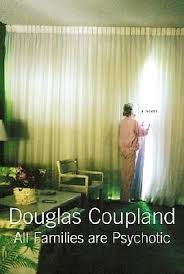
[READ: January 17, 2014] All Families Are Psychotic
I saw recently that Douglas Coupland had a new book coming out in 2014. And I also knew that I had three of his older novels to re-read, so I decided to make this the Winter of Douglas Coupland and read all three of those books before his new one came out. Then I got to work and saw his new book on top of a pile of newly delivered titles. Sigh.
Well, there was still no reason I couldn’t read the other three in a row, possibly even before anyone wanted his new book. So, off I went. And indeed, I finished this book on our little vacation. And even though I’m fairly certain I’ve read it before (it came out just before or after 9/11/01, gasp) I didn’t remember a thing about it.
This book has a title that I’m mixed about. It’s a great sentence, but I’m not sure it’s a great title. And although someone speaks the title in the book, it doesn’t really explain the book very well.
In fact it’s pretty hard to explain the book quickly. (more…)
SOUNDTRACK: GRIPE-“Man vs Cop” CHULO-“Hombre vs Tombo” Split Single (2012).
I downloaded the Gripe album yesterday and then saw this split single. It has two songs which total 59 seconds.
Gripe has like a typical grindcore sound–pummeling and tinny. All 32 seconds of “Man vs Cop” contain a pummeling riff, screamed vocals and even a ride cymbal at some point.
I was more intrigued by Chulo because I was surprised at how different a band could sound within the same limited soundscape of grindcore. The big difference for me was the real presence of a bass guitar. As “Hombre vs Tombo” opens, there’s a few seconds of pummeling sound (although their snare drum sounds more like a bongo) and then the sound drops out and there’s a cool heavy bass sound (for two notes). Then the pummeling resumes, although again, much more bass heavy. The other big difference is that they sing in Spanish. I’m curious to know if that slightly different sound is a Latin American sound for grindcore or if it is just their own.
If you have a minute you can listen (or download for free) the single here.
[READ: January 7, 2014] “Weight Watchers”
This story began in a very weird way. In it, an adult’s father has been kicked out of his house because his wife is mad that he now weighs more than 250 pounds. Something that she has done on multiple occasions. I find this reason/excuse so incomprehensible that it really impacted the rest of my reading this story. This “problem” did put things in motion but was more or less ignored through the story and it seems that there were other more pressing issues that they needed to worry about.
When we meet the father, he has come to stay with his son. He believed that anything “done for pleasure was escapism.” So we learn he has no tolerance for pleasure, except “when it came to seducing his secretaries and most of my mother’s friends.” Then we learn that his mother got pregnant as soon as she could when his father got back from the war because she figured that would get him to settle down. his father basically resented him for his whole life. So I guess the whole family is screwed up.
Especially when we find out that the son has witnessed all manner of “disturbances,” meaning his parents’ infidelities, in their house. One of them was a very weird scene of food and eroticism. Ew. (more…)
With the new year, I was excited to see what albums NPR would be streaming. Imagine my surprise when the prominent album was by a grindcore band called Gripe. I’d never heard of Gripe before. But Lars, the guy who posted the album, said that they’ve released two albums and two singles (most of which you can download for free at Grindcore Karaoke).
I downloaded their album Pig Servant and their split single with Chulo (all 15 songs fit in under 13 minutes). And now I’m giving this one a listen.
So grindcore is a fair name for the sound of the music–take hardcore but make it sound like it is grinding against something. On Pig Servant, the longest song was 1:47, and that included a lengthy sample. I have to assume it took longer to draw the elaborate cover than to record the album. It sounds fast and noisy and chaotic and like it was recorded on a boombox. I was surprised that there was a liner note with the download because I didn’t believe that the noise he was making was actually lyrics, but if you follow along you can kind of tell that he’s screaming actual words.
In his Image is a more sophisticated sound. The drums don’t sound like tin plates, there’s an actual bass sound and one of the songs is over 3 minutes long. You still can’t understand any words. But song titles like “7 Billion Reasons Not to Reproduce,” “Assisted Genocide” “Stuff Your Wretched Face” and “Nothing Left But Hate” give you some idea of what you’re in for. I was surprised by how articulate the words from Pig Servant were–not poetry mind you, but articulate at least. There’s no lyrics sheet for this so I have no idea what to make of the words here.
This album is 23 minutes, which is a bit long for grindcore (and may be longer than all of their existent recorded output). I just like the idea that you can listen to this on NPR. If you dare, check it out.
By the way, this recording has literally nothing t do with this story. Nothing.
[READ: January 8, 2014] “Katania”
Wow, I really liked this story a lot. It is fairly simple and the end may be a bit obvious and/or gimmicky, but Vapnyar earned it.
It opens with the narrator, Katya, reflecting back to when she was a little girl living in Russia. She did not have a lot but compared to some, her family was comfortable (they had a three room apartment). But the thing that held her interest and love was her doll family. They lived in a shoebox. It was painted to look like a house. It also had furniture and even some animals–a cow, a pig and a very large chicken.
As for the doll people there were only girls. One became a mother, one became the daughter (or herself) and a hedgehog head on a human body was the grandma. But there was no father.
Katya suggests that this was not uncommon for the time and location–there seemed to be no fathers around. Her own father had died, but many other fathers had simply run off. Like the neighbor’s father who shouted “I’m sick of all of you” and then left.
Then her uncle brought her a father doll. He was perfect–he fit in with the family and had a beautiful smile. He did have a disjointed leg, but the narrator didn’t mind. Until Tania made fun of it. (more…)
Woven Hand is yet another band that I hadn’t heard of until this Tiny Desk concert (and I thought I knew a lot of bands). They are a band, but for this Tiny Desk Concert David Eugene Edwards plays solo. He has a cool baritone voice that has a nice ponderous quality. This suits his chosen instrument–a mandolin-banjo hybrid made in 1887 by the Pullman Train Company (!)–perfectly. Turns out that Edwards was the voice behind 16 Horsepower, so that explains some of the sound he’s going for.
The opener “Whistling Girl” and the closer “Kingdom of Ice” (which is practically a mini-epic) are beautiful slices of Americana made slightly more esoteric by the instrumentation and his voice. I like them a lot. The middle song he plays is a Bob Dylan song “As I Went Out One Morning.” I know that I’m not a big Dylan fan, but I just can’t get over how many songs he has written that people cover. I’d never heard this one, which with this instrumentation takes on a kind of fairy tale quality (which I assume the original doesn’t).
This makes me want to bust out my 16 Horsepower CD and to check out more from Woven Hand. I enjoyed his solo performance so much I can’t imagine what a full band version would sound like.
[READ: January 7, 2014] “The Breeze”
I have really enjoyed Joshua Ferris’ work, so I was excited to read this. But I was ultimately disappointed by this story.
The construction is interesting, so of. It looks at multiple possible outcomes of a situation. But I felt like even that was done a little too vaguely to be really effective.
It also features one of my most hated scenarios in real life and one which I guess I have no patience for in fiction. It concerns a person who is bored, existentially bored. So when she wants to do something, she proceeds to ask her partner what he wants to do. Thus, Sarah asks her husband to come home from work early. She is sitting on the balcony of their apartment enjoying a perfect spring breeze. When he gets home, she is excited to have a wonderful excursion with him. So she asks him “What do you want to do?” And naturally he hasn’t thought of this at all, so he has no opinion. But this makes her mad. She asks if he doesn’t want to do anything. He says he does. And then she asks him what. I don’t know if this is a gender-specific scenario, but I have been in it many times in many different relationships and I know my parents went through it as well—my mother always complained about my father’s lack of wanting to do things and he would always say all she had to do was say what she wanted to do and he would do it. So, I guess Ferris has tapped into something, but I hated reading about it. (more…)
 SOUNDTRACK:BOWERBIRDS-Tiny Desk Concert #35 (November 16, 2009).
 This show was recorded July 7, 2009. It’s fascinating that it didn’t get posted until four months later.




















 I Just Read About That...