Feeds:
Posts
Comments

Archive for the ‘Marriage Trouble’ Category

[LISTENED TO: August 2016] Neil Armstrong Is My Uncle & Other Lies Muscle Man McGinty Told Me

neilThe title of this book sounded weird and fun. So I grabbed it from the audio book collection at the library and we listened to it on the way home from vacation.

Set in Long Island (narrator Emily Bauer does some great Long Island accents for the adults (and a few kids) in the story), this is the story of a young girl, Tamara Ann Simpson (Tammy) growing up on Ramble Street in 1969 just a few weeks from the Moon Landing!

But that’s miles away.  Because it is summertime and all she can think about is kickball.  Well kickball and her friend Kebsie who took off all of a sudden one day without even saying goodbye.

Kebsie was Tammy’s best friend.  She lived in a foster home on Ramble Street.  They did everything together and even had a secret “arooo” signal.  They were BFs and even bought necklaces to prove it.  Kebsie was a straight shooter and took no crap from anyone.  And then one day, she was gone.  As we understand it, her mother returned and took Kebsie away to secret place because there was some kind of abuse in he family and they needed to be removed from everyone they knew. (more…)

Read Full Post »

tny 5.26.08 cvr.inddSOUNDTRACK: PACIFICA QUARTET-Tiny Desk Concert #383 (August 18, 2014).

pacificaIn this Tiny Desk Concert, the Pacifica Quartet explore the world of a single composer, Dmitri Shostakovich.  They will play three movements from different Shostakovich quartets

The quartet consists of Simin Ganatra and Sibbi Bernhardsson on violins, Masumi Per Rostad on viola and Brandon Vamos on cello.

I’m going to quote a ton from the NPR blurb because they know from what they speak.  But I’m going to chime in that these pieces are really cool.  I like Shostakovich, but haven’t really devoted a lot of time to him. His music seems at times playful and at other times very dark.

In the first piece I love how that three note motif recurs in different places and then the piece turns into a delicate pizzicato section.

The second piece is so light-hearted as it starts–pastoral and lovely.  But there hangs a slightly menacing version of that pastoral riff.  I especially enjoyed watching the cellist bow aggressively.  It goes a little crazy towards the end but somehow remains upbeat.

The final piece plays off of the notes of Shostakovich’s initials (they explain all about this in the intro and what the S and H are in terms of musical notes).  It’s amazing to think that these different parts play with those four notes in a different way.  It’s an intense piece and reminds me a bit of Psycho.

From the blurb [with my comments in brackets]:

With the arguable exception of Béla Bartók’s six string quartets, it’s generally accepted that the 15 by Dmitri Shostakovich are the strongest body of quartets since Beethoven….  The Shostakovich quartets are intense, like page-turning thrillers, as they pull you into his world. They are dark and introspective, witty and sarcastic, and stained with the Soviet-era violence and hardship the composer lived through.

Quartet No. 7 in F-sharp minor, Op. 108 (1960) Allegretto
Eerie pizzicato and piercing stabs in the violins help color the twitchy, even sinister, opening movement of the Seventh Quartet. Stalin might have been dead since 1953, but hard-line Soviet politics (including the violent suppression of the 1956 Hungarian uprising) were still in place. The music’s lightness and transparency create a crepuscular feel.

Quartet No. 3 in F major, Op. 73 (1946) Allegretto
The Third Quartet’s first movement looks back to a slightly more pleasant time before World War II. At one point Shostakovich considered a subtitle: “Calm unawareness of the future cataclysm.” The jaunty opening theme, like Haydn after a few beers [now that is a hilarious line], is among the most lighthearted in the 15 quartets. But the mood sobers with an intense double fugue before returning to the opening music and a flashy final page.

Quartet No. 8 in C minor, Op. 110 (1960) Allegro molto
The Eighth Quartet is Shostakovich’s most popular — and one of his most hair-raising. He dedicated it to victims of fascism and war while at the same time creating his own epitaph. The entire quartet is built on a foundation of four notes that spell out his first initial and the first three letters of his last name [watch in the beginning of the piece as they demonstrate these notes]. The second movement juxtaposes violent energy with a tweaked version of a Jewish folk theme from an earlier work.

[READ: February 27, 2016] “The Full Glass”

I never understand how the New Yorker selects what it will publish each week.  Sometimes authors can go for years without a piece and sometimes they can go just a couple of months.  Such is the case with 2008 where there have been many duplicate authors in the span of a few months.  Updike’s last story in the magazine was in January of 2008–that’s barely five months.

Anyway, this story is written from the point of view of a man turning eighty.

He talks about retiring from his job as a wood floor re finisher in Connecticut.  He’s admitting he is his age and is taking a ton of pills every day and what not.

And he reflects on a many things in his life.  Like the bliss of a cold glass of water.  He hates the thought of drinking 8 glasses a day, but a cold glass at night is wonderful [I concur]. (more…)

Read Full Post »

2008_05_12SOUNDTRACK: QUETZAL-Tiny Desk Concert #378 (August 2, 2014).

tzalQuetzal are a band from Southern California who have been performing in the Chicano scene for about 20 years.

Guitarist Quetzal Flores plays the Mexican jarana for both rhythm and melody, violinist Rocio Marron adds blues licks into Mexican folk runs and bassist Juan Perez provides a nimble and melodic bottom end.  And then there’s lead singer Martha Gonzalez who has a great voice and is quite the activist.

The first song, “Palomo Vagabundo” is pretty and sad.  The song means vagabond Pigeon and is a story about a beaten up pigeon who still tries to find love.  Quetzal says the whole album is about life of urban animals and how we relate to them.

They introduce the second song “Tragafuegor” which is about a fire breather they saw in Mexico.  He was putting himself in harm’s way to make some change but also shining light on reality.  This is a faster, livelier song with Gonzalez dancing on a box–like Saintseneca.  The dancing rhythms, the great violin and the cool robust bass really make this song stand out.  About the stomp box, this is a tarica from Veracruz, Mexico.  Quetzal explains that Martha is a percussionist by trade as well as a professor as Scripps College in Pomona.

The final song, “Todo Lo Que Tengo” is a beautiful ballad.  Again Martha’s voice soars above the music.

It’s always fascinating to “discover” a band who has been around for 20 years.

[READ: February 23, 2016] “A Man Like Him”

This is in unusual story in that the main character is a man who is obsessed with a story in a magazine.  Teacher Fei is an older man, unmarried and now living with his elderly mother.  She needs his care and he doesn’t mind giving it to her.

The story that he has become fixated on is about a nineteen year old girl who is set out to publicly humiliate her father.  The girl’s mother and father divorced three years ago.  And once the girl turned eighteen she sued her father, suspecting that another woman had seduced hm away from her mother.  She said that he should be punished for abandoning his family and for the immoral act of taking a mistress.

She had also created a website to humiliate the man.  She wanted him to lose his job, his freedom and his mistress. And this angered Teacher Fei (who didn’t know any of them) to distraction. (more…)

Read Full Post »

2008_04_21-400SOUNDTRACK: HIGHASAKITE-Tiny Desk Concert #376 (July 25, 2014).

 highkiteFor some reason, some bands play a Tiny Desk Concert that is very short.  It’s especially disappointing when the band is unusual and interesting like Highasakite.

They play only two songs (for a total of 8 minutes), but they cram a lot of interesting sounds into these songs, including a flugabone.  Kristoffer Lo plays that mournful horn and Ingrid Helene Håvik compliments the yearning with words that are mysterious and somewhat dark.

For “The Man on the Ferry” the song opens with the horn playing mournful notes while the percussionist plays a tiny steel drum and Håvik plays a kind of autoharp.  There’s the fascinating lyric: “It made the Indian in me cry.”  (It’s especially interesting since the band is from Norway).

Håvik has an inflection something like Björk’s (although her singing style is very different) and there are some delightful harmonies.

The melody of the second song “Since Last Wednesday” is familiar to me.  Or the combination of steel drum and horn is just really compelling. It’s fascinating to watch the guitarist wield his horn in one hand while holding the guitar with the other and singing harmonies.  The song is also kind of mysterious (that horn again) with the lyrics:

He would never do graffiti or vandalize that house. And he would never be caught spray painting on those people’s walls. But no one has seen or heard from him since last Wednesday.

As the song progresses some really dark lyrics crop up, all under that beguiling melody.

The blurb lists some of their other titles: “Leaving No Traces,” “I, The Hand Grenade,” “The Man on the Ferry,” “Science & Blood Tests” which really says quite a lot about this interesting band.  I definitely want to hear more than eight minutes from them.

[READ: February 20, 2016] “The Repatriates”

I was fascinated by this story because I hadn’t really heard of the phenomenon of Russian emigres returning to Russia because they felt the conditions were better there than in America

The story starts by telling us that Grisha and Lera’s marriage has dissolved.  In 1994 Grisha’s visa had been processed and he was brought to America by Hewlett-Packard.  He found it demeaning and like servitude ans as soon as it was up her quit and got a new job with Morgan Stanley–building market models for mortgage traders (for those of us who doesn’t know what that is, it’s not rally that important).

But Grisha felt empty.  He said there as no spirituality in America (even though he himself was not spiritual)

Eventually Grisha started travelling back to Moscow (they had not been able to sell their apartment there, so he had a place to stay). He would visit old friends and make news ones.  He started going more frequently.  And then one of his trips lasted for two months. (more…)

Read Full Post »

TNY 4.14.08 cvr.indd SOUNDTRACK: HAMILTON LEITHAUSER-Tiny Desk Concert #375 (July 21, 2014).

hamleitHamilton Leithause was the lead singer of The Walkmen.  When they went on hiatus, the guys in the band made solo records.  For this set, Leithauser is accompanied by The Walkmen’s Paul Maroon on guitar and Hugh McIntosh, who played drums in Leithauser’s old band The Recoys.

Leithauser has a big voice and these songs allow him to really wail (in a restrained and tasteful way).  “11 O’Clock Friday Night” has a very folkie feel to it with a big chorus of “you and me and everybody else.”

“Alexandra” is a bit more uptempo and rocking with a cool rumbling bass line provided by the electric guitar (he really gets to belt out the chorus and the bridge in this song).

“5AM” is a moody ballad which shows he can play mellow as well as big.

Incidentally perhaps it was back in 2014, but Leithauser was doing some kind of concert in Philly and they must have advertised it ten times a day for months.  I was rather tired of hearing his name (I didn’t know who he was at the time). I had to look him up and he was fine.  About the same as I felt during this show.

[READ: February 18, 2016] “The Lie”

I have really been enjoying Boyle’s stories.  He has a way of making his protagonists unlikable and yet somehow sympathetic.  But this time, I felt like his protagonist was just too much of an asshole.  He went too far.

Lonnie is a new dad.  He’s a young guy who has married a woman whose nighttime sleepwear is a Cramps shirt and nothing else.  Her name is Clover, but she hates that her hippie parents named her that and wants to change it to Cloris.  He says that Cloris sounds like a detergent and she hates him for that.

Anyway, he wakes up and doesn’t feel like going to his editing job (I may have been more sympathetic if the job were harder).  He is tired of hearing the same people recite the same dialogue every day.  He says he’s not rally an editor, he’s a logger. (more…)

Read Full Post »

2008_03_03-400SOUNDTRACK: FOREIGN EXCHANGE-Tiny Desk Concert #370 (July 5, 2014).

FeIt’s amusing how “religious” lead singer Phonte Coleman comes across in this set given how profane his language is.  He begins the set by telling us what a “church clap” is: a church clap is when you clap for someone when they sing in church but they suck.  It’s a slow clap that says keep trying, baby.

Foreign Exchange is Phonte on vocals, guitarist Nicolay, keyboardist Zo! and percussionist Boogie.  Their music (in this setting anyhow) is a kind of mellow stripped down soul pop.

“On A Day Like Today” is a kind of acoustic r&b with acoustic guitar and gentle keyboards. Phonte is an engaging and fun performer enticing people to clap and singing that he’s gonna wipe the sweat off his face as he does so.

He says he’s “sweating like a preacher here.”  After the first song he hits the gong ans says “when you hear this sound, that means turn the motherfuckin’ page.”   he describes the second song, “Listen to the Rain” as when you need to wind down and things ain’t going right.  It is a delicate ballad full of nice percussion.

Before the final song he says, “You never get a second chance to make a first impression so I hope this is a good motherfuckin impression.”  Then as he is ramping up the song, he tells everyone to turn to your neighbor and say “‘Neighbor, put home in your heart,’ goddamn right.” “Call It Home” is a pretty, smooth rocker.  Phonte has a good solid voice and these songs are all pretty enjoyable.

Phonte is a great front man having fun right up to the end as he jokes about how he “felt it” and was overcome during the final song.

[READ: January 29, 2016] “Leaving for Kenosha”

Richard Ford is a famous writer whom I have never read.  I think of him as writing very large books, so I’m surprised to see this short story here.

I have this image of what Ford writes, but I was rather surprised that this was set in New Orleans soon after the flood.  Interestingly, the main character is not the one leaving for Kenosha.

Walter Hobbes (which is the name of the dad in Elf, by the way) is a lawyer.  He is picking up his daughter from school before taking her to the dentist.  His daughter, Louise, is thirteen and trying to be independent.

I really enjoyed the way the Ford set up the family dysfunction–Louise needs a sleep guard to keep her from grinding her teeth–which she has only started doing since her parents got divorced.  There’s some back story about Walter’s wife leaving him and the fact that she still lives in town.  (more…)

Read Full Post »

lilychen SOUNDTRACK: BARRY DOUGLAS-Tiny Desk Concert #537 (June 3, 2016).

barryBarry Douglas is a “classical” pianist from Ireland.  I’ve put classical in quotes because although what he plays is classical in sound, the music actually comes from Celtic tradition rather than the classical canon.

“The Coolin” (An Chúileann) translates to “The Fair-Haired Girl” and dates to around 1641.  His arrangement has a very baroque feel (he is actually a classical pianist, too), which gives the traditional song a more regal air.

He follows that lovely delicate song with “Planxty Dylan.”  Planxty is an Irish dance.  He says that harpists would travel around Ireland and people would look after them.  The harpist would then thank the homeowner by writing a song named after the home where they stayed.  This romp of a dance (at only about 1 minute long) was dedicated to the house of Dylan.

From playing a planxty to the band Planxty.  Douglas has arranged the Planxty song “Raggle Taggle Gypsy” for solo piano.  It has been around since the 18th century.  Planxty made it more famous as a vocal song (which I know) but Douglas’ piano version has a lot of fun with the melody as well.  The melody is also known as “Black Jack Davy.”

“My Lagan Love” is about the River Lagan in Donegal (there are actually four Lagan Rivers in Ireland).  The melody and poem were written by unknown persons.  Douglas arranged this without words in an attempt to make it more timeless.  I know the original and this is a really lovely in this instrumental version.

I can say that I was pleasantly surprised to hear this was the kind of solo music that Douglas was going to play.

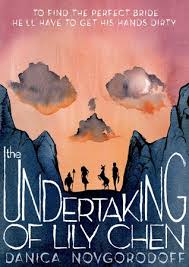
[READ: April 2, 2016] The Undertaking of Lily Chen

The whole premise behind this story is disturbing and apparently true.

Novgorodoff includes a section of an article from 2007 which says that parts of rural China have seen the rise of “ghost marriages.” In this situation, when an unmarried an dies, his parents procure the body of a woman, hold a wedding and then bury them together.  This has led to a black market in corpse brides.  EW!

This story explores that revolting concept. (more…)

Read Full Post »

march 21 SOUNDTRACK: PWR BTTM-Tiny Desk Concert #519 (April 4, 2016).

pwrbttmPWR BTTM are the most fun Tiny Desk concert to come along in a long time.  They are a two person—drums and guitar only–queercore band.  The two guys are Ben Hopkins and Liv Bruce.  They are punky and brash and a lot of fun.

Ben plays guitar for the first three songs and they switch off lead vocals.

“Ugly Cherries” opens with an excellent, complex guitar riff played on a very distorted acoustic guitar.  I love that that complicated riff runs through the song and ends with an awesome harmonic’d note.  It’s two minutes of pop punk fun.  And the opening lyrics sets the tone for the song (and the band):  “My girl gets scared, can’t take him anywhere.”

Between songs Ben and Liv are full of jokes and chatter.  Liv says “This is my favorite show that we’ve ever done…its cool to be someone’s lunch break.”

For “Dairy Queen,” Ben switches guitars.  He has an electric guitar this time and Liv sings lead.  Interestingly, this guitar is less distorted than the acoustic.  This is a funny song with the refrain of “right now I’m in the shower.”  There are lots of ideas about things they could do if he wasn’t in the shower like “We can go to Disneyworld and fuck shit up,” At the end of the song Liv moans that he had planned to change Disneyworld to NPR because it is the same syllables, but he forgot.

“Nu 1” returns Ben to lead vocals.  It is a slower song with a simpler guitar riff.  Although once the chorus comes in it’s loud and brash with backing vocals from Liv.  The opening line “God damn everyone’s dumb” is pretty great.  The end of the song has a guitar riff that is similar to the first song, but played in a very different style.

For the final song “C U Around” they switch places with Liv moving to guitar and lead vocals.  As Ben heads to the drums Bob comments on his nail polish and Ben looks over and says “Bob… up here” pointing to his eyes.  While everyone is laughing and Liv is tuning, Ben says

When I was 15 and didn’t think a queer person could ever be in a band….  I  never thought I’d get to throw shade at Bob Boilen.  This is my biggest dream come true.

Then Ben asks how is Liv doing up there and Liv shouts “Guitars are hard!” His guitar playing is very different–more strumming than Ben’s manic style.  The song is slow with a plucked guitar riff and I like the way near the end he starts strumming really hard and gets a cool fuzzed out bass guitar tone while retaining the regular sound of the guitar’s high end.

As you can see from the photo, PWR BTTM dress outlandishly.  Ben is in a bright red dress with sparkly nail polish and really garish facial makeup (with his beard showing through) and swim goggles on his forehead.  Liv is a bit more subdued although when he steps to the front mic you can see that his lipstick is really quite striking.  A few months back Bob said they put on his favorite live show.  If I loved the fifteen minutes of this one I can only imagine how great a 90 minute extravaganza of PWR BTTM would be like.

[READ: March 25, 2016] “A Resolute Man”

Since I’ve read a few pieces by Proulx recently I felt like I knew her M.O.: bad things happen to people who seem innocent, but might not be–usually by strangely named people.  And all set a long time ago.

This one is not far from that description, although it does change things somewhat.  And I enjoyed it a lot more.

I found the beginning to be a little slow going (but that may be because I was anticipating a long slog).  We learn about Captain James Duke.  And this time I marveled at Proulx’s descriptive sentences; “Duke, at fifty, was complicated, dark-haired, and somewhat handsome”.  That’s a lot of things in a few words.  We learn about Duke’s history and then we learn that he has inherited a parcel of land in Boston (he currently lives in England). (more…)

Read Full Post »

314SOUNDTRACK: ANE BRUN-Tiny Desk Concert #518 (April 1, 2016).

aneAne Brun is a Norwegian singer who is currently based in Sweden.  She plays piano and guitar and has a pretty voice which reaches high notes but maintains a kind of rough rasp.  She says she had a terrible cold and this is her first day of singing.  She doesn’t trust her voice yet and she thanks everyone for being so quiet.

The three songs she sings are slow (a little too slow for my tastes).  The blurb says that these are the three slower songs on the album, so maybe I’d like them a bit more amid the other songs  This is not to say the songs are bad, just a little too mellow.

Having said that, the melody and vocal lines of “Still Waters’ are beautiful.  This is the one song she plays on the piano and it does sound rather different from the other two.

For “All We Want is Love” (which she describes as the ultimate love song, kind of), she plays a pretty, picked melody on the acoustic guitar.  But its clear that her voice is the main instrument here–and she hits some lovely notes in the repeated refrain of “All we want is love.”

“Signing Off” is the last track on the album.  It is a slow guitar song. The melody isn’t as immediate as the previous song, but her voice really does carry the tune nicely.  I wonder if her voice normally sounds like this or if the cold impacted her singing.

[READ: March 14, 2016] “For the Best”

I wasn’t that inspired by the previous story of Beattie’s that I read.  And I didn’t really love this one either.  I found it very slow going.

The story is about a man named Gerald, an older divorced man, who gets invited to a party.  His ex-wife, whom he has not seen in some thirty years will also be invited.

But the way this was revealed was kind of circuitous, I thought.

the Clavells weren’t the sort to play pranks, so the printed invitation to their annual Christmas party arrived after what Gerald and Charlotte’s son, Timothy, would call a “heads-up,” sent by e-mail, letting them know that both were invited to the event, at the Clavells’ apartment, on West Fifty-sixth Street. Gerald hadn’t seen Charlotte since their divorce, thirty-one years before, and this was the first time he’d seen her e-mail address. Whether she was on any social media he wouldn’t know, as he was not.

I enjoyed some of the oddly phrased ways the story was revealed (like that last sentence), but it took me a few tries to puzzle out if Gerald was the recipient or the sender oft he invite.  It’s a long first sentence, I guess.

I also enjoyed this follow-up sentence: “It was a rather jaunty message from the Clavells, who were not jaunty people.”  But I think that reading so much of the story like this is exhausting. (more…)

Read Full Post »

henrySOUNDTRACK: THEE SILVER MT. ZION MEMORIAL ORCHESTRA-Fuck Off Get Free We Pour Light on Everything [CST099] (2014).

99Aside from the dance remix single of “Hang on to Each Other,” this is the latest Silver Mt. Zion record to be released.  For those keeping score, GYBE has released an album more recently than SMtZ.  This album is full of punk piss and vinegar (as if the title didn’t give it away).  It’s mostly represented by a heavily fuzzed out guitar that runs underneath nearly all of the songs.

The album begins with a child saying, “We live on the island of Montreal … and we make a lot of noise … because we love each other.”

This first song is called “Fuck Off Get Free (For the Island of Montreal)” and the music starts with scratching noisy guitars and everyone else playing a simple ascending and descending riff.  The vocals kick in right away and it feels like the whole group is singing along too–everyone is involved in this noisy song.  It works great.  Even when the song shifts to a more singable part it retains the intensity of the pacing.  Around 4 minutes we get a return to the chanted vocals that lead into a kind of hurricane of a solo section.  And when they come out of that the chorus sings the chanted title.  The biggest change comes at 6 and a half minutes when the whole song shifts and a slower, heavier and deeper guitar chord (unlike any they have played before–it feels unearthly) drives the remainder of the song.  As I’ve noted in other songs, I love when the choir sings by itself (the female singers in this case singing “pull me under”), and they all sound much more “professional” than the kind of loose choir they were a few albums ago.  This choir sings to the end of the song as the instruments all drop off leaving only voices.  It’s pretty fantastic.

“Austerity Blues” is 14 minutes long and opens with a flat sounding scratched acoustic guitar and sing along vocals.  While the scratching  guitar is going on a cool bass line begins.  Things quiet down which leads to a noisy one-note distorted guitar that adds a layer of noise to the melody line.  The song shifts to a louder section with scratchy violins and big pounding drums (David Payant has really added a lot to these songs with his powerful drumming).  Around 6 minutes in, a distorted echoing guitar plays a kind of Middle Eastern-sounding guitar solo.  When the solo settles down a new faster section begins–lots of drums and group singing.  By ten minutes, the song feels like it’s fading out as the music gets quieter.  But a new set of vocals resume more quietly this time, and they sing their melodies quietly until the end.

“Take Away These Early Grave Blues” opens with a girl with a very thick British accent wondering why “people think like that” as a noisy violin kicks in with a see-saw riff and shouted vocals.  This song sounds like a pretty standard SMtZ song with the big exception being the really noisy drums that dominate the track (Payant again).  At around 2 minutes, the music drops away leaving just a buzzy bass introducing a noisy drum and guitar solo.  When the vocals resume the music becomes a fast pounding drum fill and more distorted violins and guitars.  The song is intense and while only about 7 minutes long, it really packs a lot in.  It ends with a fast riff (that’s almost an Irish jig) followed by crashing drums and chanting lyrics: “Love each other that’s all.”

“Little Ones Run” is only two and half minutes long.  That’s unusual in itself for the band.  But even more unusual is that the song is like a lullaby.  It’s a quiet piano melody and lyrics sung by the female members of the band.  It hearkens back to their first albums which were all piano, but this is a much updated version of that early sound.

“What We Loved Was Not Enough” opens with quiet violins and deep bass notes.  The relative quiet is shattered by Efrim singing (this is the first instance on this album where his polarizing voice stands out–on the rest of the album it’s pretty well mixed in with everything else.  But I think he’s won us over by this time and we can accept it, especially since the musical melody is so pretty.  There’s also a lovely violin solo that runs through the middle of the song.  In fact, the whole song would be really quite pretty except for the distortion that permeates it–a noisy guitar underpins the whole thing.  But at 6 minutes, everything drops out except for the pretty violin and the vocals,  “And the day has come when we no longer feel.”  That refrain is picked up by the beautiful choir voices (they really sound great).  As they repeat this section, Efrim sings a harsh lead vocal (he sounds a bit like Larry Kirwan from Black 47).  There’s an instrumental section that scorches with noisy guitars for about a minute and then at 9 minutes the song returns to that beautiful chorus (with male voices added) and that delicate violin.  It goes on like this until the end.  It’s really lovely.

The final song “Rains Thru the Roof at Thee Grande Ballroom (For Capital Steez)” is also rather different for the band.  It is “introduced” by an interview (in English and translated into French) from an unnamed musician who is talking about how being in a band is more than a part time gig … it’s what you devote your life to.  When the music comes in it’s floor toms and an unsettling distorted and scratchy strings or keyboards or sampled voices and keyboard which slowly growing louder.  There’s stabs of piano and vocals which are far back in the mix.  The melody is nice but mournful and it continues for all of the four minutes.  [Capital Steez was a rapper from Brooklyn who committed suicide in 2012.  I honestly can’t tell what this song has to do with him].

I’m not sure which band we can expect to hear from next, but both GYBE and SMtZ have released really strong records in the last few years.

For this album, the lineup stays the same as on the previous album (and the band name has remained the same, too).

Thierry Amar: Upright bass, electric bass, plucked piano, vocals
Efrim Menuck: Electric guitar, acoustic guitar, mellotron, vocals
Jessica Moss: Violin, plucked piano, vocals
Sophie Trudeau: Violin, plucked piano, vocals
and David Payant has taken over for Eric Craven on drums, organ, piano and vocals

[READ: March 15, 2016] “Confessions of a Humorist”

I only found out about this story from reading The Fate of the Artist.  I have always vaguely liked O. Henry, but can’t say that I’ve read much by him.  I found this story to be simple and fairly obvious, although perhaps it was obvious because he introduced this style of storytelling to the world one hundred years ago.

The narrator is a bookkeeper in a hardware firm.  We learn a bit more about him and his family.  This line delighted me for some reason, “Naturally, we lived in a vine-covered cottage.”

On the occasion of the senior partner’s 50th birthday, he was selected to give a speech.  And it was a hit.  People laughed and suddenly his reputation as humorist was established. (more…)

Read Full Post »

« Newer Posts - Older Posts »