Feeds:
Posts
Comments

Archive for the ‘Marriage Trouble’ Category

jan2017SOUNDTRACK: DECLAN McKENNA-Tiny Desk Concert #589 (January 3, 2017).

declanI only know Declan McKenna from NPR’s coverage of SXSW last year.  He played a SOUTH X Lullaby of the third song in this set.

And although he looks a little different, his singing style hasn’t changed.  He has an interesting delivery–with notes that sound like they crack as he sings.  But he is in total control.

The blurb notes:

It’d be easy to look and listen to this young English singer and think he’s just another sensitive songwriter with a guitar, singing about his troubles. But Declan McKenna writes about a much bigger world than you or I might expect from a singer who only recently turned 18. He came to NPR this past summer, a bit nervous but passionate. He stripped down three of his songs to their musical essence, and the power of their words eclipsed the hooks for which they’re equally known. “Bethlehem” tackles religion:

Because I’m in Bethlehem
I’ve got a seat in heaven
And though I’m heaven sent
I can do as I want and you don’t have the right to choose

McKenna’s most famous tune, “Brazil,” is a song about football, money and poverty that also touches on religion.

But even without the blurb, his music pretty well speaks for itself.  “Bethlehem” begins slowly, with him singing in a deeper voice but when he gets to the chorus his voice starts to break in his trademark way.  And as the song moves on he shows off a strong falsetto as well.  He opens “Brazil” with a little guitar flub which makes him laugh before he starts again.  The song sounds very much like other versions I’ve heard—his vocal style is all deliberate.  The chorus is so catchy (whatever it’s about):

I heard he lives down a river somewhere
With 6 cars and a grizzly bear
He got eyes, but he can’t see
Well, he talks like an angel
but he looks like me.

And I love how after all of this catchy stuff, he throws in a third section that is even catchier than the rest:

I wanna play the beautiful game while I’m in Brazil
Cause everybody plays the beautiful game while in Brazil
It’s all you’ve ever wanted, and it’s all that you want still
Don’t you wanna play the beautiful game out in Brazil?.

It’s practically a different song.  But so good.

This is the first I’ve heard “Isombard” (which I looked up afterward and is much more synthy).  He says he’s never done this acoustic before. He describes the song as being “somewhere between baroque pop and riff rock so it doesn’t translate easily.”  It’s got a very pretty melody and his slower singing style.  The song is also catchy and I’m surprised he hasn’t caught on a bit more yet.

[READ: January 17, 2017] “A Window to the World”

The narrator tells us that there were two writes at the Yiddish Writers’ Club in Warsaw.  Each of these men had talent and earned a reputation but then seem to have been silenced forever.

The two men were Menahem Roshbom (who had written three novels before he was 30) and the other was Zimel Hesheles (who had written one long poem at the ages of 23).  Since then, nothing–Roshbom was now in his 50s and Hesheles in his late 40s.  The two played chess and although Roshbom was a better player, he would always lose patience near the end which would cost him the match.

Roshbom had taken to journalism.  He was a chain-smoker and he carried on with women, mostly from the Yiddish theater.  He had divorced three times and was currently with another man’s wife.  By contrast Hesheles was small, reserved and silent.  He was poor but came to the club every day at noon and left at 2 when others came for lunch. (more…)

Read Full Post »

nySOUNDTRACK: TAKEN BY TREES-Tiny Desk Concert #253   (November 29, 2012).

treesTaken By Trees plays only 2 songs, and it’s one of the shortest Tiny Desk Concerts I can think of (it’s not even 7 minutes long).  I clearly have gotten Taken By Trees confused with a number of bands with similarly constructed names (band with By and The in the title), for I had no idea what this band sounded like.

They are a four-piece with a lead singer, Victoria Bergsman, who sings in such an understated way that it’s almost melodic speaking.

“I Want You” has a reggae feel to it—the quick guitar chords and slow bouncy bass, but with Bergsman’s delivery the song couldn’t sound less reggae.

“Only You” is a bit more uptempo.  It was in this song that I noticed Bergsman’s accent (she and the band are from Sweden).  The set up of this song is similar to the previous one–a deep bass running through under high guitar chords.  It doesn’t sound reggae this time, but it sounds very delicate.

This was a gentle concert, which I enjoyed, although I don’t know that I’d ever want to see them live.

[READ: July 14, 2016] ”La Vita Nuova”

I enjoyed the fragmentary way that this story was constructed.  The story begins on the day that Amanda’s fiance left her.

Her parents were upset and angry.  Her friends said that he was no good.

She walked home, took out her wedding dress and brought it to work where she had all of the children at her school “decorate it.”  The school didn’t appreciate this gesture: “your personal life is not an appropriate art project for first grade.”

Then she lost her job at the school and later that year her ex-fiance married someone else (as her friend said he would). (more…)

Read Full Post »

2014_11_10SOUNDTRACK: LORD HURON-Tiny Desk Concert #247 (October 25, 2012).

lordhironLord Huron is one of those bands that I hear of a lot, but whom I don’t really know much about. I also think they are someone I like, but listening to this Tiny Desk Concert, it’s clear they are not any of the bands I think they are.

As far as this Tiny Desk Concert goes, Lord Huron proves t be a five piece folk outfit.  They have lovely harmonies

“She Lit A Fire” is a pretty standard folk song.  Although I like the way the song shifts gears to a faster guitar style.  I really like the way the one guy’s guitar sounds like mandolin, too.  “Time To Run” is a bit faster and catchier.  In fact, when the oh oh oh oh part comes in, it’s hard not to want to sing along.  And the middle part where it’s just guitar and bongos is pretty hard not to enjoy.

“Lonesome Dreams” opens with some echoed bass notes. It’s got some really catchy parts although I don’t really love the yodeling voice that he puts on.  The band does four songs (practically unheard of).  “Ends of the Earth” opens with that same yodeling voice, but once the harmonies kick in it sounds great.

I didn’t realize that Lord Huron had only released their first album in 2012.  They have really made a name for themselves.

[READ: July 20, 2016] “Primum Non Nocere”

I enjoyed this whole story except for the very end which seemed to turn the story into something else.  In retrospect that something else is also pretty interesting and it throws a whole new light on the story, but I enjoyed the story so much as it was that the twist really impacted the way I enjoyed the rest of the story.

The title translates as “first, do no harm” and the story is about a youngish girl and her mother–who is a psychotherapist. 

I loved the way the story began.  Jewel is totally embarrassed that her mother asks her patients if they are “Cell phoning.”  She says it all the time.  How lame.  Until she realizes that her mom is actually asking if they are “self-harming.”

Her mother was brutally honest about a lot of things and was, of course, right about everything.  One thing that her mother always said was “that no one ever gets beyond high school. It’s all high school for the rest of your life.” Not true, Jewel knew, yet also true.

Her patients loved her for that unconventional understanding. She stood up for them; she visited their homes and talked to their problematic relatives, went to the store with them, walked them along the river, allowed them to bring their pets to their therapy sessions. She came to her children’s defense, too, with teachers or friends or the parents of those friends. She was brutally honest, blunt.

(more…)

Read Full Post »

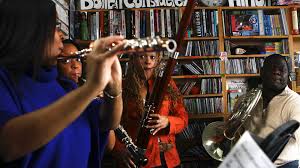
dressSOUNDTRACK: IMANI WINDS-Tiny Desk Concert #277 (May 29, 2013).

windsFor some reason this video and audio has been removed from the NPR site (no explanation is given).  But I found it elsewhere and was able to really enjoy it.

But they have left up the blurb:

When Igor Stravinsky began composing The Rite of Spring, his ballet for vast symphonic forces, he could hear the music in his head but couldn’t quite figure out how to write it down. It was just too complicated.

Today, 100 years after The Rite‘s premiere, the fearless musicians of Imani Winds make it all sound remarkably easy, given that they’ve condensed Stravinsky’s massive walls of sound down to just five instruments: bassoon, clarinet, flute (doubling on piccolo), oboe and French horn.

Make no mistake: Many of the jagged rhythms and crunching chords remain viscerally intact, albeit on a more intimate scale. As the group huddled behind Bob Boilen’s desk, bassoonist Monica Ellis noted the opposing ratios, saying, “It’s apropos in some strange way that we are playing one of the most massive pieces in some of the smallest instrumentation in one of the smallest settings that it could possibly be played in.”

The setting might be small, but in this clever arrangement by Jonathan Russell, we learn that a wind quintet, when called upon, can make a mighty and sonorous wail. Just listen to how the Imanis cap off “Dances of the Young Girls” with the entire quintet in full cry (at about 4:30 into the video). The bassoon repeats a fat bass line while the clarinet runs its snaky scales. The piccolo, in piercing chirps, serves as a foil to a frenzied oboe and snarling “whoops” from the French horn.

But not everything in The Rite is all pound and grind. Stravinsky’s transparent introduction, almost impressionistic, is a fluttering aviary of winds — even in the original — with individual colorings for each instrument. It’s all rendered beautifully here by Imani Winds, musicians brave enough to play David to Igor Stravinsky’s imposing Goliath.

This concert is fascinating to watch (and listen to) because even though this piece is familiar (to me) in theory, it’s apparent that I don’t really know it.  And I can see why this piece was so controversial when it came out–it is weird and chaotic and almost random at times.  I imagine that seeing it as a ballet might make it more cohesive, but it’s still pretty out there.

I love that the bassoon seems to be the primary instrument–one that doesn’t typically take center stage.

The group breaks up their selections into three primary chunks.

Selections from The Rite of Spring:

For “Introduction” the bassoon is the primary instrument playing the initial melody.  Then the clarinet and oboe give the whole thing an unsuaul sound–to say the least.  The French horn actually works as the the bass for this part.  It’s also neat watching the flautist switching between flute and piccolo.  I’m not sure when the second part “Augurs of Spring” begins, but I assume it’s when the bassoon repeats that initial melody and then the French horn plays a staccato bass note. The music sounds kind of threatening but whimsical at the same time.

Somewhere in here “Dances of the Young Girls”  begins.  I assume once the piccolo starts chirping and swooping.   And then the band grows very loud before abruptly stopping.

The second segment she describes as incredibly picturesque. “Ritual of Abduction” begins nosily with almost total chaos from all the instruments–the piccolo stands out as sharp and piercing.  As with the other segments, I’m not sure when “Spring Rounds” begins, but I have to wonder if this is when the music seems to go circular and then slow down. There are low notes from the French horn while someone is playing accent notes that sound, not off, but dissonant–providing stark contrast with the rest of the slow movement.  There are some blares of music from the French horn as well.

I’m guessing that “Dancing Out of the Earth”  begins with the fast bassoon melody: up down up down up down up down with trills and swirls from the flutes and clarinet.  It rises and rises very dramatically and then stops.

They tell us that it’s not possible to play the entire ballet so they have taken the “greatest hits” and for this show it’s the greatest hits of the greatest hits.  Consider it a deconstruction with five instruments. But it still evokes the spirit of this sacrificial dance.

She talks about how controversial this was in 1913, “when ballet was meant to be about… I was going to say flamingos…. fairies swans, the other water animals.”   This is the final moment the virgin who sacrifices herself dances herself to death.  And they are going to exemplify trombones and timpani and all that loud stuff (the French horn player laughs and says “Grr I am trombone”).

“Sacrificial Dance: The Chosen One” begins with a three note melody–again it is somewhat threatening.  There’s lots of little fast runs by the French horn with accents from everyone else.  It stops dramatically at one point and then resumes with so many different melodies.  And then comes the surprise ending with a rising flute line and then a low end from the horn.

Without taking away anything from Imani Winds, I ‘m sure this performance doesn’t do the whole thing any justice.  But it is amazing to imagine how much more there is to it.  And it is amazing that these five instruments can evoke so much.  It’s an uncomfortable and somewhat shocking first listen.  It’s amazing that is over 100 years old, although it sounds so contemporary.

I don’t know why it’s not on NPR any more. I found it on YouKu (whatever that is).  I have been able to watch it twice but on two other times I was unable to watch it.  So keep trying, it’s worth the effort.

[READ: May 5, 2016] The Boy in the Dress

David Walliams is best known (if he is known at all) as the tall one on the sitcom Little Britain.

I had no idea he wrote books (he has done over half a dozen children’s books), and I was happy to start with this, his first one.

This book is illustrated by Quentin Blake, who is best known (if he is known at all) as the illustrator for the Roald Dahl books.  So his simple, somewhat sloppy, style might look familiar.

The story is, as the title suggests, about a boy who wears a dress.  And the story is very funny–not because it makes fun of him for wearing a dress, oh no.  In fact, I love the story for going out of its way to show that it is normal that a boy might want to wear a dress. (more…)

Read Full Post »

CV1_TNY_03_18_13Kalman.indd SOUNDTRACK: THE MILK CARTON KIDS-Tiny Desk Concert #232 (July 16, 2012).

milk-cartonI was unfamiliar with the Milk Carton Kids before seeing them on NPR.  I had always assumed they were a punk band with a name like that. Well, nothing could be further from the truth.  The Milk Carton kids are a delightful folk duo.  And they give the origin of their band name a little later in the Concert.

Joey Ryan sings lead and plays rhythm acoustic guitar.  Kenneth Pattengale plays lead guitar and sings beautiful harmonies.  It’s his guitar work that is so disarming because he plays leads throughout the songs, so rather than having the two guitars doing the same thing, his guitar is all over the place–playing beautiful trills and lines while Ryan is singing.

The first song they play is “Michigan.”  I love how in the middle of the song between the melodies and the harmonies it sounds like about three different bands—there’s a kind of Simon & Garfunkel vibe, a Jayhawks vibe, and maybe even a CS&N vibe–and yet it retains their original sound.  There’s some beautiful melodies in the vocals and the lyrics are really good (but sad).

After the song, Bob asks about the neckerchief on Kenneth’s guitar.  he says, “well it looks good.”

Then he explains that in a technical way, “This guitar is a bit crummy.”  When they play higher chords the strings buzz, so the neckerchief keeps that from happening: “It’s practical and it’s alluring—this is what got Stephen to stop at our concert to listen.”

Kenneth then says that Joey usually talks more than this “I don’t know why he’s so demure today.”  Joey deadpans, “I don’t know what demure means, but I’m, sorry if that’s how I’m behaving.”

Before the next song, Joey deadpans, “This is something we’ve been looking forward to for a long time.  Hence our palpable excitement.”

They’re very happy to be behind this desk so “We’ll play you a love song to the desk.  This song is called ‘To the Desk.'”  The song is actually called “Stealing Romance.”  They sing a duet with Ken taking the high notes.   It’s a slow ballad.  During the song you can hear all kinds of sirens going past the offices.  When it ends, Ken says, “I think Joe Biden drove down the street during that one.”  Joey reacts: “Who’s that?”

Then Joey explains the origins of their band name Milk Carton Kids.  The name comes from one of their songs “Milk Carton Kid.”  The song itself is named after a lyric in the song.  He says it’s an attempt to answer the question that’s one everyone’s mind with a completely unsatisfactory answer.  Then he says they’re not going to play that song.

Rather, they play “their happy song” “I Still Want A Little More”which proves to be really fast and uptempo—a real surprise after the other two songs.  Ken is wailing away on his guitar while they sing in great harmony.  There’s some rollicking guitars and singing.  This is my favorite song of the three.

I don’t love their slower songs. Although as far as slow songs go, their setup is great–the harmonies, the interesting guitar.  But I really like the two of them.  They are great performers and excellent storytellers.

[READ: July 20, 2016] “Checking Out”

This story is bookended with a man planning on marrying woman.

Obinze is African, and he is in London on a work visa.  He is arranging a sham marriage to be able to stay in the country.  The arrangement has been set up by some Angolans. They claim that he is a friend of a friend and they’re doing him a favor, but they are keeping lot of the money that is meant to go to his bride.

When he met Cleotilde, he was surprised to see that she was young and pretty.  And it seemed that she was pleased with him when she saw him as well-0ff.  I guess expectations are pretty low in this situation.  He was kind to her from the start, making sure that she was okay doing this. And she said she was–she really needs the money for her family.

Obinzne and Cleo meet up a few times to get their details straight, and he finds that he is really falling for her–although he knows he can’t really act on it until after the marriage. (more…)

Read Full Post »

2011-07-11-18-ulriksen-birdsSOUNDTRACK: THE WALKMEN-Tiny Desk Concert #234 (July 29, 2012).

The Walkmen perform a Tiny Desk Concert at NPR headquarters in Washington, DC on Tuesday, June 26, 2012.

I know Hamilton Leithauser, the singer of The Walkmen, more than the band itself.  He has gone solo since 2012 and released some songs that have gotten a lot of attention.  Leithauser has a very powerful voice.  Form the blurb I gather that The Walkmen used to be a bit louder/punkier.  But for this set, Leithauser plays an acoustic guitar so this band isn’t getting too abrasive, that’s for sure.

The first song “Heaven” has a swirling guitar and bass motif that reminds me instantly of some 1990s songs.   The song is really catchy and Leithauser never lets up with his powerful singing.  The blurb comments on his voice, that it gives the songs “grit and grace, not to mention hair-raising intensity that feels a little jarring coming from a bunch of guys in crisp button-up shirts.”

“We Can’t Be Beat” begins as a slow verse with just acoustic guitar and singing.  Then the electric guitar plays some ringing notes as the drums play delicate percussion along with it.   About half way through the song, he holds a really long note (“so looooong” and then the whole band picks up the song with a loping sound that propels the song very nicely.

“Love Is Luck” has a nice beat and some great guitar sounds. It’s another catchy song from the band.

I enjoyed this set quite a bit, although I found that after listening a few times I got a little tired of Leithauser “woah oh ing” so much.

[READ: July 21, 2016] “Aphrodisiac”

The aphrodisiac at the heart of this story is interesting and subtle–it doesn’t even exactly seem like a part of the story until the end.

But I found the bulk of the story a little too long and unrelated to the aphrodisiac to be really enjoyable.

The story is about Kishen, a university graduate who had big plans to write a novel about India–to be really sunk into the Indian experience.  He had gone to school in Cambridge, but was now living back home in New Delhi with his mother and older brother Shiv.  Shiv had recently gotten married and Kishen was meeting the bride for the first time.  Her name was Naina.

Kishen found her to be kind of stupid.  However because of his own hang ups, she was the only person he felt comfortable talking to.  She seemed to accept him and even made him part of her circle of girlfriends–they all seemed to be amused by him. (more…)

Read Full Post »

nydec SOUNDTRACK: BLIND PILOT-Tiny Desk Concert #573 (October 21, 2016).

blind-piot

I really only know Blind Pilot because of NPR–they are favorites of a few of the hosts of All Songs Considered.

I don’t know their music well, but I remember enjoying what I’ve heard.  But I was still surprised by this Tiny Desk Concert because in addition to guitar and drums, there’s an upright bass (bowed and plucked), a ukulele, the ubiquitous Tiny Desk harmonium and a set of vibes!

Evidently since 2008 the band has expanded from a duo to a sextet.

The band plays four songs.  They are lovely folk song.  The vibes add a cool touch to some otherwise simple melodies.  “Umpqua Rushing” is a pretty song with a very catchy bridge.

Introducing “Packed Powder,” Israel Nebeker explains that it stems from when he was a teenager and they used to modify legal fireworks to make them more interesting.  This is my favorite of the four songs primarily because of the wonderful backing vocals during the chorus–when everybody sings “I want to see how the POWDER BURNS!”  It’s a great moment (or three) in the song.

“Don’t Doubt” is a mellow song, quite pretty, with some more lovely harmonies.

They planned to play three songs, but when Israel asks how many they should play, someone on the staff says “…four.”  So someone in the band then says, should we play, “Hot for Teacher” or “Jingle Bells.”  They decide to play “Joik #3.”  Israel explains that it was his first  attempt to write a song called “Joik.”  “I could tell you what that is, but you have Google…and an amazing team of researchers here.”

He says that before the album came out, Ari Shapiro aired it on NPR.  It’s a pretty song and Israel’s voice sounds especially powerful on it.  And, again, when the band sings the loud harmonies, it sounds terrific.

[READ: March 15, 2016] “In Other Rooms, Other Wonders”

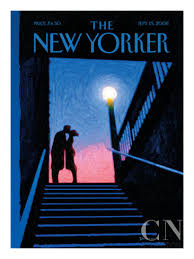
Many authors seemed to get two stories in the New Yorker in 2008, but this has to be the closest gap between stories–Sept 15 to Dec 1.

Like the previous Mueenuddin story, the actual story part is pretty simple to recap.  And the sizable length of the story is mostly taken up with details and interior feelings.

And like the previous story, this one is set in Pakistan and looks at someone who might be able to move up a level of class, but who knows that it is a hard road.

The story begins simply enough. Husna needed a job. (more…)

Read Full Post »

2008_10_13SOUNDTRACK: HALEY BONAR-Tiny Desk Concert #570 (October 11, 2016).

Haley Bonar was born in Canada but raised in the U.S.  She haleyis a folksinger with a country leaning (but without the twang).   For this Tiny Desk, Haley plays acoustic guitar and sings lead.  She had a keyboardist who sings great harmonies.  And behind them there’s a guy playing electric guitar (with great echoed effect), a bassist and a drummer.

“Hometown” has a great catchy chorus (well, and verse too).  It’s upbeat but melancholy at the same time.  There’s a very cool echoed slide guitar solo in the middle of the song.

Bonar doesn’t speak much, expect to joke about the appropriateness of the second song.  “Jealous Girls” is slower and moodier.  (“Jealous girls don’t have no fun unless they’re sure they’re the only one).  The middle section of this song is really cool, the way it changes the mood.  She doesn’t play guitar on this one, but there’s some great lyrics at the end of the song:

And you turn up your guitar
In another shitty bar in another shitty town
And you wonder when you’ll wake up
Yeah you wonder when you’ll wake up
From this long distance daydream of
Playing while girls scream
Alone in a hotel
Like piss in your ice cream

I love that the way this end part is sung and played it seems like it’s going to transition to another part.  But that’s just the end.

“Called You Queen” is a fast folkie song.  I really like her delivery on the verses. The chords for the chorus are fairly obvious but are really catchy anyway.  It’s a really good song.  The abrupt ending (with a hint of echo on the guitar) is spectacular

I didn’t know Bonar before this set, but i really liked it.

[READ: March 9, 2016] “Gold Boy Emerald Girl”

Yiyun Lee had a story in a 2008 May issue of the New Yorker as well.  I have enjoyed pretty much all of her stories. This one was quite different from the others in that the whole story has a feeling of inevitability to it.  And yet it was a kind of gentle inevitability that almost didn’t seem to be there.  Or something.

The story is about two adults, Siyu, 38 and Hanfeng 44.  The opening paragraph tells us that she was raised by her father and he was raised by his mother.

Siyu knew Hanfeng’s mother because she was a Professor and Siyu worked for her a while ago.  But the Professor is now retired and Hanfeng has moved back home after a stint in America to live with her.

And we see now that the Professor has set the two up on a date.

The story is told in a very gentle, unhurried way, as befits the story of these two who have taken their time with thee lives. (more…)

Read Full Post »

nySOUNDTRACK: THE SECRET SISTERS-Tiny Desk Concert #564 (September 12, 2016).

secretsisThe Secret Sisters are, in fact, Lydia and Laura Rogers, two sisters from Alabama.  They sing pretty folk/country or even traditional songs and have wonderful harmonies.

“Tennessee River Runs Low” is from the point of view of the river (and is really quite delightful).  It comes complete with an “oh de oh de oh de oh” section.  The music is pretty simple (just a little strummed guitar) and their wonderful voices.

After the first song she says that she has seen lots of Tiny Desk Concerts and they’re thrilled to be there.  It’s more spacious than you might think.  They could square dance there–except they can’t square dance.  She says that it feels kind of like being a zoo animal.

The second song is “a super duper sad song.”  Since their previous record came out they have both gotten married–to different men, she clarifies.  (Well, they are from Alabama, they joke).  They don’t know what to write about anymore–who wants to hear happy songs?

“You’ve Got It Wrong” is indeed a sad ballad–a very pretty, very traditional sounding country song.  Their voices really sell it.

Before the final song, she says that “if you want to be happy and in a good mood don’t ever come to one of our shows.”  They only play downer music. She explains that  they grew up singing gospel in a church that had no musical instruments.  It was only their voices and no solos or choirs.   She didn’t realize they were learning how to sing at church–that’s where their harmonies come from.

So they are doing an old gospel number, “Flee as a Bird.”  The melody of the verses its wonderful–the kind I’ve never heard in a church song before.

I would never see these guys in concert, but fora Tiny Desk, their songs were quite lovely.

[READ: March 7, 2016] “A Spoiled Man”

This was a lengthy story that seemed to speak to the futility of life.

There were a lot of details which made the story really interesting, but as I think about summarizing it, I realize that the story is bombastically a man lives, succeeds, fails and dies.

Fortunately Mueenuddin tells a lovely winding story that shows just how much a man’s life can change.

The story is set in Islamabad and the main character is Rezak, “a small, bowlegged man with a lopsided, battered face.”  He is outside of the mansion of a local man who has recently married an American woman.   The woman proves to be a nice person who genuinely seems to enjoy her new life.  In Pakistan.  And people liked her as well.

Rezak tried to make himself useful around the mansion. Despite his appearance, he is a strong man and he does wind up helping the workers.  At the end of the day they invite him for dinner, but his pride makes him refuse. (more…)

Read Full Post »

6916SOUNDTRACK: GIRL IN A COMA-Tiny Desk Concert #190 (January 30, 2012).

girlcoma I was planning on writing only about recent Tiny Desk Concerts for a while, but Nina Diaz’s (Aug 2016) Concert informed me that she was the singer of the band Girl in a Coma who are presently on a hiatus while Nina tours some solo material.

So I went back and watched this Tiny Desk to see the origins of Diaz’s music.

Girl in a Coma is a three-piece with Nina Diaz on guitar and vocals, her sister Phanie Diaz on drums and Jenn Alva on bass.  The blurb suggests that the band plays punk–typically loud crunchy guitars (although I listened to the recorded version of “Smart” and it doesn’t really sound very different from this version).  So I didn’t get that.

At any rate, the trio sounds great in this setting.  The percussion is simply tambourine and a shaker.  And Alva’s bass is really melodic and lovely playing more than just the same notes as the guitar.

“Smart” is really catchy (although Diaz does some weird things with her voice late in the song).  “Knocking At Your Door” has a fast, almost metal sounding guitar (albeit acoustic here).  But it’s the bass (which is not doing anything crazy) that takes center stage with the melodies she plays.

Before the final song Nina says it feels like show and tell or something.  And while she’s saying this, the other two switch places, with the drummer coming up front and the bass sitting in the back.

“So” has a pretty traditional folk song structure.  The reason for the switch of seats comes in the second verse when Phanie plays the melodica.  It’s a pretty song and Diaz’s voice is really nice.

I really can’t imagine them being a punk band at all, frankly.

I’m also going to point out what Diaz looks like here for contrast of what she looks like in her solo show four and a half years later.  In 2012, she’s wearing dark jeans and a v neck sweater (stripes in the purple family).  Her hair has bangs and a long braid on the side.  And she has no obvious makeup on.  Keep that in mind for the next post

[READ: November 1, 2008] “Tits-Up in a Ditch”

I read this story back in November 2008 and just couldn’t get into it.  I tried several times and could not penetrate the barrier that I felt Proulx was creating.  Well, here it is 8 years later and I tried it again, and not only did I finish it, I sort of enjoyed it.  Even though it, like everything else I seem to have read from Proulx was incredibly depressing.

The story is about Dakotah.  Dakotah’s mother abandoned her when she was a baby and left her own parents to take care of her.  They resented their daughter and Dakotah from the start.  They were harsh and uncaring towards her (although it could be prairie love, I suppose).  The grandparents are named Verl and Bonita Lister (Proulx has fun with names in her stories).

Verl and Bonita are hardscrabble, religious folks who don’t have a lot of joy.  Well, Verl had moments of happiness but probably no joy–he rode hard and then injured himself.  But he was stuck because during the 1980s in Wyoming oil companies came in and took away all the workers.

Verl gives us the title of the story when he says “Had me some luck today.  Goddam cow got herself tits-up in the ditch couple days ago.  Dead, time I found her.”  See, charming people. (more…)

Read Full Post »

« Newer Posts - Older Posts »