Feeds:
Posts
Comments

Archive for the ‘Marriage Trouble’ Category

SOUNDTRACK: REIGNWOLF-“In the Dark” (Field Recordings, June 29, 2012).

This is another Field Recording set at Sasquatch! Music Festival [Reignwolf: A One-Man Rock Show].

I’d never heard of Reignwolf and I’m still not sure if Reignwold is typically a solo project–like here or a band.  “In the Dark” is a simple blues rock song–like Led Zep via the White Stripes.

Jordan Cook plays a noisy, distorted guitar with a metal slide so that there’s pretty much always something coming out of the amp.  After some pretty simple verses he plays a wild, sloppy (broken stringed) solo.

The way he was tearing it up during an impromptu set at the Sasquatch Music Festival, you’d barely notice that Jordan Cook, a.k.a. Reignwolf, broke a string midway through his fiery rendition of “In the Dark” — that is, until you saw the mangled remnants of his guitar, smoldering on the ground after he’d wrenched every wailing chord from its guts.

The song works best when he plays the kick drum.  It adds just enough oomph to make it not seem like a guy playing a guitar.

The Saskatoon native and recent Seattle transplant never misses a beat — literally. When he’s not with a band, he accompanies himself on kick drum and makes enough noise to match a dozen metalheads. In this video, recorded at the artist campground between sets at the festival, Reignwolf causes a ruckus beside his RV and rousts a crowd of sleepy campers into dancing and cheering.

The soloing goes on for a while and the people around him seem to like it.  Although the soloing behind his head is a bit much, but hey, if you can do it, then go ahead!

[READ: February 1, 2017] “The Sightseers”

I really liked a main aspect of this story, and so many of the details.

The story begins with an overprivileged New York family.  They have a maid/cook/gofer named Kiki from Tibet and the husband marvels at Kiki and “their calm, those people.”

The father, Robert, is happy that they no longer go to North East Pennsylvania for Thanksgiving–the round nephews and the piles and piles of food.  For their Thanksgiving they would be having salmon as Robert was training five times a week with a Navy Seal.

When the salmon turns out to be halibut, the son says that wasn’t on the menu (the menus were designed ahead of time to limit daily stress by preparing the children for their dinners ahead of time–there would be no surprises.  The son asks if the next time they have halibut it will be salmon.  The father thinks that’s an excellent suggestion. (more…)

Read Full Post »

SOUNDTRACK: STEVE COLEMAN-“Ritual” (Field Recordings, April 27, 2012).

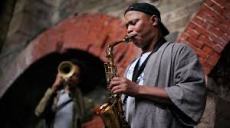
This Field Recording was filmed at the Newport Jazz Festival [Steve Coleman And The Invention Of New Languages] is one of the few where the artist speaks over the music.

Coleman talks about the tradition of making vocal sounds with music.  He says that Jen Shyu was a classical singer before she started singing with them.  She is Taiwanese-American and after working with them making sounds (not necessarily words), sometimes she sings snippets of any of the languages she speaks, and sometimes not.

The Asian-American singer Jen Shyu speaks several languages, among them English, Spanish, Portuguese and various East Asian tongues from China, Taiwan and East Timor. But then she started performing with saxophonist Steve Coleman. None of her native tongues would serve for his knotty tunes; “doo-bop-a-da” scat singing wasn’t going to cut it, either. So she had to devise her own sound and fury — perhaps signifying nothing formally, but full of intense personal feeling.

This short piece is trumpet and sax and Jen’s voice and they all seem to be doing their own thing, but it all melds nicely.

Steve Coleman has long been known as an inventor of language — a composer who draws equally from rigorous examination of music theory, esoteric natural science and myth, and Charlie Parker. But you don’t have to speak his language to be entranced by it. There’s flow, and pulse, and delightful chord changes. And, yes, it’s a little disorienting, which seems like part of the point.

Coleman’s vision was on display when his band Five Elements played the Newport Jazz Festival last year. But we wanted to know more. So we brought him, Shyu and trumpeter Jonathan Finlayson into the ruins of Fort Adams for a more intimate, stripped-down look at his music. We also asked him for a translation into the English language: “If anything, that’s what this music is…  It’s a lot of different influences, coming from different places — plus, whatever’s coming from inside you, which is the main thing.”

It’s pretty cool to hear what you know is nonsense but still feel it embued with meaning.

[READ: April 10, 2016] “Alone”

I have read a lot of stories by Yiyun Li and I have consistently enjoyed them all.  What I especially like about them is that while none of them are ever “exciting,” (since they are all about small human dramas), none off them are ever boring and none are ever quite the same)..

Most of the stories are an encounter between one to four people and they have something in common (or not) which brings them together.  It’s the commonalities that vary so greatly in each story–and those commonalities are virtually never the “interesting” or “dramatic” part of the story.

This story begins with Suchen, a young woman, sitting in a cafe.  The waitress has just asked her how she is dealing with the smoke.  There is no smoke so she just nods.  The man sitting next to her leans over and fills in that there have been wildfires in the north.

There is an older couple sitting at the table next to her as well.  She imagines what it would be like to be with someone you trusted until you were that age.  For the time being anyhow, that won’t be her as she and her husband Lei have recently separated–on pretty much mutual terms although Lei is the one who started the proceedings. (more…)

Read Full Post »

SOUNDTRACK: LEE FIELDS-“Still Hanging On” (Field Recordings, April 18, 2012).

This was another Field Recording from SXSW filmed on the patio of Joe’s Crab Shack [Lee Fields: Early Morning Soul].

Lee Fields is soul singer who I don’t know.  Evidently he toured in the 1970 sand resurfaced in the ’90s.  He’s got a great powerful voice, but you can tell he’s a bit wiped out.

It was Friday morning during South by Southwest, and Lee Fields was gassed. The veteran soul singer told us he’d given his all in a concert the night before, and you could tell that our early appointment at Joe’s Crab Shack in Austin, Texas, had left his voice gravelly and raw.

He has steadily put out funk-tinged blues and gospel records, crooning love songs and belting world-weary anthems with an expressive voice full of swagger and regret.

So on that March morning, Lee Fields reached deep, fought off the morning fog and gave a passionate, stripped-down performance of “Still Hanging On” with the help of guitarist Vince John. It was a rare peek at a legendary, impossibly gracious singer who proved that, after all these years and even with little sleep, he’s still got it.

Somehow the rawness and weariness of his voice makes it all the more poignant and impressive.

[READ: January 8, 2017] “The Weir”

This was a fascinating story that went in a few different directions.

It begins with a fifty-something year old man throwing tennis balls to his dogs.  He is on a large swath of land that abuts a river.  He is using this time with his dogs to think about his family.  His wife left him six weeks ago and he feels he is coping well (the dogs help).

But his son was the real problem.  He was gone missing.  For years.  His wife had even said that it would be better if he were dead.

While in his thoughts, he sees a young woman hugging the cliffs on the edge of the river.  As he watches her he realizes that she is going to jump in (the river is extremely fast and dangerous).  He rushes to try to stop her, but she can’t hear anything with the noise of the river.

Without even realizing he did it, his jacket and shoes were off and he was jumping in.  The river is crazy and violent and he is tossed around.  Finally he catches up to her, but she is attacking him–whether on purpose or not he doesn’t know.  Eventually he is able to drag her to the shore.  The water was really cold.  The air is cold.  She is cold and he is cold.  She is breathing but not responsive.

He hauls her back to the car and wraps the dogs’ rug around her. The only thing she says is “not the hospital.”  So he brings her to his house.

It’s all really exciting. (more…)

Read Full Post »

SOUNDTRACK: GIL SHAHAM-“Partitat No. 2 “Gavotte en Rondeau” by J.S. Bach” (Field Recordings, January 12, 2012).

This was the very first Field Recording posted on the NPR site back in 2012 [Gil Shaham: A Violinist’s Day At The Museum].

Shaham plays Bach in the Hirshiorn Museum.

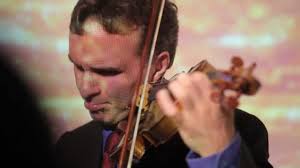
As Gil Shaham wandered through the back offices of the Hirshhorn Museum and Sculpture Garden in Washington, D.C., he said he felt “like Ben Stiller in Night at the Museum.” For this impromptu Bach mini-recital, the violin superstar momentarily became part of the art, bathed in the modish lighting and projections of a multimedia installation during the performance.

He is introduced with the rather amusing:  “A world famous, world renowned violinist who, by the way, starts every morning with a bowlful of Cap’n Crunch.  He told me that.”

I love that this first Field Recording was, like many of NPR’s best things, a spontaneous idea:

A crowd packed the exhibit room to watch as Shaham launched into Bach’s third partita. After the performance, the violinist greeted fans in the museum, many of whom were headed to his concert at the Kennedy Center that night. He seemed surprised and delighted that the guerrilla concert, announced only on local classical station WETA and Twitter that day, drew so many people willing to hear Bach in the afternoon.

[READ: January 22, 2017] “Are We Not Men”

Boyle’s stories aren’t usually as fanciful as this.  But I loved it just as much as many of his other more down to earth stories.  I particularly enjoyed that it was set in the future, although there was no real statement of that until late in the story.  There were hints, which seem obvious in retrospect, but which at first just seemed like hyperbolic or metaphorical.

Like “the dog was the color of a maraschino cherry” or that the lawn incorporated “a gene from a species of algae that allowed it to glow under the porch light at night.”

The story opens with the cherry-colored dog killing an animal in the narrator  Roy’s front yard (on that grass).  He wanted to chase the dog away because it might ruin his grass.  Then he noticed that what the dog had killed was his neighbor Alison’s pig.  She loved that pig and anthropomorphized it.  To try to salvage the pig, he ran up to the dog waving his arms.  It immediately latched onto his forearm instead.

As Roy fights with the dog, the dog’s owner, well, the daughter of the owner, came running across the street.  She looked like a teenager but was actually 11 or 12.  When the girl says, “You hit my dog,” he replies that she bit him.  The girl says Ruby would never do that–she’s just playing.

Amid this horrorshow of blood and violence and death, and a sprinkling of genetic splicing, Boyle throws in a very funny experiment gone wrong.  Crowparrots were a modified bird which blended crows with the invasive parrot population.  It believed that the experiment would turn the parrots into carrion eaters.  But instead it made their calls loud and more frequent.  And they mimicked, so they “were everywhere, cursing fluidly, (“Bad bird! Fuck, fuck, fuck!“).” (more…)

Read Full Post »

SOUNDTRACK: CORY HENRY AND THE FUNK APOSTLES-Tiny Desk Concert #792 (October 5, 2018).

Cory Henry & The Funk Apostles blew me away with the first song of this Concert.  “Love Will Find A Way” opens with a deep bass sound as the funk starts.  And then Henry adds the great sound of the Hammond.

There’s so much joy in the sound of the Hammond organ, especially for those of us of a certain age. Hearing it can transport you to the early ’70s, when every rock band seemed to have one in its arsenal: The Allman Brothers, Santana, Deep Purple. In the hands of true masters — like the late Billy Preston and the very-much-alive Booker T. Jones — the organ can be a melodic, funky rhythm machine.

Cory Henry’s name belongs in the same breath as the Hammond organ masters of the past. The instrument creates the central sound of his dynamic, neo-soul- and funk-infused musical identity, and he opens his turn behind the Tiny Desk with what feels like an encore: the full-on soul assault of “Love Will Find a Way.” The song twists and turns, then winds up as a full-on celebration — and it’s only the first song in his set.

The song does have several part including a lengthy middle solo section.  Over the heavy organ chords there’s a wailing guitar solo and a keyboard solo from the synth player.

By the end of its six minutes it absolutely feels like an encore–a show ender.  It’s awesome.

“Trade It All” is a bit more soul, less funk, which means I don’t like it as much.  B

Henry’s keyboard skills are on full display during a synth solo in “Trade It All,” which also spotlights his entire band. To my mind, they’d have sounded right at home on Stax Records in the ’70s — no small accomplishment.

The middle shows a softer, quieter side of the Hammond–one that sounds a bit cheesier to my ear.  And yet there’s no denying Henry’s deft finger work (there’ a hint of Stevie Wonder in there for sure).

The final song, the ten-minute “Send Me a Sign” has a lengthy, almost preacher-like quality and is clearly gopsel-inspired.

It showcases some of the roots of Henry’s songwriting; it’s inspired by church sermons that bloom into group sing-alongs. Just another way Cory Henry digs way back to give us something new and exciting.

[READ: October 11, 2017] “One Saturday Morning”

I have never been disappointed with a story from Tessa Hadley.  She might be one of my favorite writers whom I’ve never read outside of magazines.

This story is wonderful because the we learn so much about so many people through the eyes of one woman.

Valerie is Gil’s second wife.  Gil is in his fifties and Valerie is twenty-four.  Gil is a successful professor and she was (as someone described her with disdain) a typist.

But as the story opens, Valerie is trying to cope with Gil’s daughter.  Robyn is nine years old, can’t button her own dress and is utterly unprepared for several days at another house.  This was the first time Valerie had met her…stepdaughter?  And Robyn was plain and kind of dull.  She was polite but had no toys (she played cleverly with scraps of fabric, but would not engage when asked about them).

She was certainly a dullard when it came to food–toast was all she could think of. (more…)

Read Full Post »

SOUNDTRACK: ST. VINCENT-Masseduction (2018).

St. Vincent’s latest album seemed like a radical departure for Annie Clark.  It seemed to be all synth–a transgression from her guitar prowess.  But in fact it was a continuation of the sound that Clark generates with her guitar.

Her albums have always used synths.  And her albums have always used effects on her guitars to create different sounds.  They have just moved further along on this album.

“Hang on Me” opens the disc with drums and sound effects.  The guitar comes in but it sounds like synths (like most of the album).  Her voice is up front  (It would have been very cool if it sounded like she was whispering in your ears).  The song builds with more and more sounds.  The processed guitar still sounds nothing like a guitar but you can tell from the way it is played that it is a guitar–which is pretty cool.

“Pills” is almost all dance–lots of drums and synth sounds (which may be guitar, who can tell).  It’s the chorus, (the repeated pills pills pills) that really grabs you.  The guitars that come through have a very Prince-like feel (and the sexual connection–pills to fuck) even when the roaring fuzzed out guitar solo comes blasting through it’s not unlike something Prince would have done.  When the second part of the song comes in–absolutely quiet compared to the chaos that came before (S. assumed it was a different song) it has a beautiful melody and really showcases Annie’s voice nicely.  The two parts are so very different and yet both are really catchy in their own way.

“Masseduction” is the most poppy song on the record (and probably of her career).  It starts again with drums and Annie’s whispered vocal (again mixing her right in your ears would have been very intense).  Then comes there’s the big chorus of echoed vocals singing “mass seduction” with roaring guitars underscoring everything (even though this album feels very un-guitar there are noisy guitars galore on it, they’re just buried underneath everything).

Chanted vocals and programmed synth open up the fast-moving “Sugarboy.”  I love that the riff from “Los Ageless” is presented her in much faster and more staccato and mechanical way.  This song has a great, catchy chorus.

“Los Ageless” was the second single off the album and the dancey beat and synth sounds were quite a shock when the song came out.  For this one, her voice is mixed right in the middle of your head, which is very cool.  But it’s the “how can anybody have you” part that is so incredibly catchy and wonderful.  There’s not a lot of guitar on this song until the third verse in which all the synths drop out and you get a nasty guitar playing behind the verse–once again so inorganic but so interesting.

“Happy Birthday Johnny” is a beautiful piano ballad that showcases a great melody and lovely vocal from Annie.

“Savior” features a slinky guitar line with bits of wah-wah on it (slighty porn-y to be sure, especially given the topic of the song).  The bridge picks things up and with each subsequent verse more and more is added (backing vocals, big drums and sound effects).  It’s when the song gets to the third part, the ‘pleeeease” that it totally soars.

“New York” is another piano song, this one with more dance beats in it and the rather graphic “you’re the only motherfucker in the city who can stand me” for a chorus (odd choice for first single).  The bridge “I have lost a hero” just soars out of the piano section in a very cool way–the juxtaposition is outstanding.

After the quite ending of New York the noise and electronica of “Fear the Future” comes as quite a shock.  It’s practically a wall of noise before and abrupt ending

“Young Lover” is quieter and sounds a lot more like early St. Vincent songs.  The music is spare–thumping drums and washes of music.  But that first chorus grows very loud–crashing electronic drums and soaring vocals.  The amazing part comes toward the end as Annie hits some incredibly high notes and then caps it off with a high note that gives me chills every time I hear it.  The fact that she duplicated it live was just staggering.

“Dancing with a Ghost” is 46 seconds of waves of synths (or guitars) that I never quite realized was its own song.  It almost segues into “Slow Disco” which is a quiet song with strings and Annie singing.  When the harmony vocals come in it builds the song nicely.   Then someone (Annie?) sings a recurring motif of “don’t it beat a slow dance to death.”  It’s my least favorite song on the album and the one she has now made two (slower) remixes of.

That feels like it should end the album, but there is one more song, the dramatic “Smoking Section.”  With a husky voice Annie sings of getting stomped out and screaming “let it happen, let it happen, let it happen.”  The strings build dramatically until a loud three note riff introduces the second part of the song.

This album is pretty polarizing, even though it is St. Vincent through and through.

[READ: October 3, 2018] “The Rise and Rise of Annie Clark”

The previous story that I read by John L’Heureux was also about the Catholic church.  That one was the story of Jesuit Priesthood, circa 1954, and a man trying to join.

This one is also based around the Catholic church circa 1950.  The subject is very different, but with the same questioning attitude.

Annie Clark is a middle-aged woman in the 1950’s .  I’m unclear where this is set.  At first I thought France, but that is unlikely. so somewhere in the States, but I have no idea where.

Since the end of WWII, Annie knows that women were the real winners–women are taking charge of their lives.

But Annie is Catholic and must proceed slowly. (more…)

Read Full Post »

SOUNDTRACK: SEVYN STREETER-“It Won’t Stop” (Field Recordings, August 6, 2014).

The blurb for this song totally cracks me up (especially 4 years removed) because not only did this song not seep into my collective consciousness, I’ve never heard of it. Nor have I heard of Sevyn Streeter.

Although it is funny that just last week my wife and I were utterly mocking people who name their child a number–what else did George Costanza tell them to do? And how misspelling it like this is even worse.

Anyhow, here’s the blurb:

In the spring of 2013, songwriter and R&B singer Sevyn Streeter released a song called “It Won’t Stop,” which she’s called her “baby.” Over the year and change that’s followed, the song has sunk into our collective consciousness through commercial radio play and a music video viewed more than 35 million times, and on the recommendation of a growing group of critics and fans. The lyrics are vernacular, warm, unpretentious, while the performance demanded by the music is not for the meek. Away from a studio — and air conditioning — in a New Orleans boxing gym, Streeter executed with muscle and grace.

Having mocked the blurb, the song itself is pretty.  I’ve no idea what the original sounds like, but this version is done with just two acoustic guitars–one of whom seems to be playing some bass melodies from time to time.  Streeter sings and warbles all over the song and does those R&B quivering notes that I hate, but she does have a nice voice.

But damn is this song long.  Why is a pop song five minutes long?

It’s neat that they filmed this Field Recording [Sevyn Streeter Knocks Us Out] in a boxing gym–how on earth were they able to eliminate all of the ambient noise?  It almost seems like it’s not live.

[READ: February 8, 2018] “Microstories”

This is a collection of flash fiction pieces which may or may not be connected.

Rain
Never ending rain seemed to be the truth until the day he was born.  While everyone was delighted for him that he never had to experience it, he lived with regret that he would never have the chance.

Divorce
He is dressing for his grown up daughter  What a strange thing to have to do–how infrequently he sees her, how should he look.  No idea what happened at the end of it though?  An earthquake? (more…)

Read Full Post »

SOUNDTRACK: PHOEBE BRIDGERS-Live at Newport Folk Festival (July 28, 2018).

I saw Phoebe Bridgers three days after this set at Newport Folk Festival (I had no idea).  She plays five more songs at my show than here (yay, me).

The size of the crowd does’t seem to intimate her in any way and she sounds just as great (and intimate) as she did in the small club where I saw her.

A few songs into her sun-drenched Saturday Newport Folk set, Phoebe Bridgers paused and proclaimed, “I am a puddle of sweat.” It was a one-liner that primed those huddled at the Harbor Stage for the 2018 Slingshot artist’s catalog: details delivered with specificity and a subtle sense of humor.

I will say the one thing about this recording is that I don;t think you can hear all of the percussion as clearly as I could at Asbury Lanes.

The show started much the same as mine did with a beautiful languid version of “Smoke Signals” and a try-to-hold-back-the-tears reading of “Funeral.”

For the next song, “Georgia,” she brought out songwriter Christian Lee Hutson who is “going to help me sing harmonies.”  Whether it was the song itself of Hutson’s addition, but Bridgers’ voice really soars on this song.

Even Bridgers’ stage banter reflected her striking style, mixing straightforward address and astute observation. “This song is about how every time I smoke weed, I remember why I don’t smoke weed,” she said of the plainspoken plea “Demi Moore.”

She continued: “I face plant and my brain is erased for many hours and I think I’m thinking too loud.”

There’s some gorgeous harmonies on the darkly sweet song, “Killer.”  Then she played “Steamroller” solo on the acoustic guitar.

Later, she called “Steamroller,” a devastatingly candid cut from her 2015 EP, Killer, “another dark love song, thanks.”

Introducing Gillian Welch’s song “Everything Is Free” she said. “This is my friend Marshall.  We’re going to sing my favorite song about music streaming ever written.”  I loved hearing this live and it sounds just as solid here.

Up next was a song she did not play at my show.  She welcomed Christian Lee Hutson (playing guitar with Jenny Lewis) and Sharon Silva (from The Wild Reeds) played bass with me for exactly one week and I waited for a really bassist…Emily.  Chris wrote this song for me.”  The chorus goes “”lets get the old band back together again, and there’s even a line, “with Emily on bass, it doesn’t feel the same.”

The crowd reacts strongly, as they should to her awesome song “Motion Sickness.”

Despite its venom, it’s a song that unspools with a sonic ease that feel refreshing, even for an overheated festival audience.

The songs sounds great live and she holds a 17-second note just for kicks.  The sets ends (as did ours) with “Scott Street.”  She says “This is about L.A. where we live;  where it’s hot all the time.”  It’s a quiet song, sounds and represents her music pretty perfectly–quiet, sad, with clever lyrics.

At our show, we got two encores after this, so again, yay for us.  But this is a great example of her live show.

[READ: April 22, 2016] “Playing with Dynamite”

Back in February of 2017, I posted about an essay by George Saunders from 2009 in which he remembers John Updike “Remembering Updike“.  He says that back in 1992:

 It was going to be in Tina Brown’s first issue and they marked this occasion by running two stories contrasting the new writers (Saunders) with the established.  Of course the establishment writer was going to be Updike.  Saunders said he was chagrined because he knew the contrast would go something like this:

Wonderful, established, powerful representative of the Old Guard kicks the butt of the flaky, superficial, crass poseurish New Guy.  Saunders’ story was “Offloading for Mrs. Schwartz.”

I can see why they paired the George Saunders story with this particular Updike story.  Both stories deal with grief and memory loss, although Updike’s does so in a very different way.  On the other hand, their writing styles are so very different that it’s nearly impossible to compare the two stories.

The story begins with an interesting image from childhood: “one aspect of childhood Fanshawe had not expected to return in old age was the mutability of things–the willingness of a chair, say, to become a leggy animal in the corner of his vision.”  But living now “in death’s immediate neighborhood” he allowed that things like that might happen and it wouldn’t be the end of the world.

There is then an episode in Fanshawe’s day when his wife, who was younger and more spry than he, passed him going down the stairs.  She caught her heel on her dress and fell down the stairs.  It was only after all the guests had left that she said to him, “Wasn’t I good, not to tell everybody how you pushed me me?” (more…)

Read Full Post »

SOUNDTRACK: SABA-Tiny Desk Concert #791 (October 1, 2018).

I have been thinking about why I have never heard of many of these new artists. Since I don;t pay active attention to the pop charts, it makes sense that I wouldn’t know many of these artists.  I just assume that anyone riding high on the pop chart will worm his or her way into my consciousness.

So maybe it makes sense that I haven’t heard of Saba as his fame seems to be forthcoming:

Every Tiny Desk is special, but sometimes the stars align and we’re treated to an artist just as he’s coming into his own. Six months after releasing Care For Me — a sophomore studio LP on which Saba transforms his survivor’s guilt into something equal parts traumatic and transcendent — the Chicago native paid a visit to Tiny Desk. His performance at NPR’s Washington, D.C. headquarters came just two days after he announced his first tour of Australia, New Zealand, Japan and Korea, scheduled to begin in November. It’s an incredible achievement for an independent artist who released one of 2018’s best hip-hop albums without the benefit, or creative constraints, that come with major-label backing.

The live band does a great job with this music (although it is a little too lite/lite jazz sounding for me).  But the choice of two keyboards, bass and trumpet is interesting if not inspired.

To help translate Care For Me live, Saba brought along a band consisting of the same musicians who helped bring his album to life in the studio — including Daoud Anthony [keys, with the dreads] and daedaePivot [keys, with the shaved head], who produced the entire LP with him; instrumentalists Cheflee [bass] and Brandon Farmer [drums]; theMIND and Kaina [Castillo], who contributed vocals on the record; and another featured vocalist and special guest that Saba took extra pride in introducing.  [And Tahj Chandler on trumpet].

“You’re not gonna believe me when I say it,” he prepped the crowd, turning to the tall man wearing the Saba tee and Panama hat. “This is Chandlar, my father.” Fans of the album may be familiar with Saba’s references to his dad on the songs “Life” and “Prom / King” — the epic seven-and-a-half minute eulogy to Saba’s cousin and Pivot Gang rap collective founding member, John Walt, whose 2017 murder serves as the impetus for Care For Me. But Chandlar is also an accomplished soul singer, songwriter and producer in his own right, as well as one of Saba’s earliest musical influences.

Saba himself is a really nice guy (it seems).  He’s funny and self depricating and his rap skills are impressive.

I didn’t like “Busy/Sirens” as it started because Saba’s delivery is oddly affected (he has that Chicago-style of rapping which I’m mixed on).  The chorus is very mellow and with that trumpet sounds very smooth jazz.  But there’s something fascinating about his delivery.  And the lyrics are really good–tons of words covering all kinds of personal topics with great rhymes.  theMIND sings a verse and he has a nice voice.  It switches to “Sirens” which is an interesting shift.  I hate the repeating keyboard sound, but again the lyrics are great. I wonder if the album version is different.

Hands behind your head
And they won’t let up out they lead
But if I move thats disrespect
But if they shoot then that’s just that?
And if I run then that look bad?
Drawing they gun right off their hip
I’m probably deservin’
‘Cause I know they serve and protect
But they think I’m servin’
Or they think my cellphone’s a weapon
Heard that the robber wore a black mask
I fit the description, a.k.a. “nigga”
What is the difference? It’s an enigma

After a lengthy and thoughtful introduction of everyone, he says, “I very rarely have to introduce this many people… So I feel like I did okay so make some noise for me for doing it.”

For “Logout” he shifts his delivery a little bot and I really like it.  The first verse has a great rhythm and the second verse has amazing speed.  I love how with the chorus (chorus?) it ends with four beat where every gently sings a different staggered word each time.  It’s very cool, especially that it ends so dramatically as well.

In a live set that proved to be as resonant as Care, Saba and his band showcased the album’s emotional depth and range with stark juxtaposition, like the sound of the bright hook on album closer, “Heaven All Around Me,” set against a particularly haunting version of “Life.” It’s a Tiny Desk testament from an artist whose future feels as promising as his pen.

“Heaven All Around Me,” has a cool middle section breakdown with a trumpet fill that switches into the much darker “Life.”

After some more terrific powerful verses, we get the direct chorus

Life don’t mean shit to a nigga who ain’t never had shit.

I wish him and his father a great trip to Europe and beyond.


[READ: January 2, 2017] “To the Moon and Back”

About the last Keret story I wrote:

Sometimes a very short, very well written story can really make your day.  I read this story this morning (because it was so short–a page and a quarter) and I was immediately hooked.

I feel like all of his stories are very short and compact.  This one wasn’t quite as enjoyable as the previous one, primarily because it was much darker and full of aggressive language (like his other stories, this one was translated from Hebrew by Sondra Silverston).

This is the story of a man who has been divorced from his wife.  He opens the story by telling us that he can only celebrate his son’s birthday n the day before or the day after his actual birth day because of the restraining order. “The botch.”  He asks if he can just come by and give Lidor a kiss on his birthday she says she’ll make his life hell if he does.

So he has to make up by buying expensive presents, like the $89 multi-copter drone he picked up in duty free.  However, he forgot to buy batteries for the thing.  And rather than disappointing his son, he lies and says they are going to the mall first to buy some candy. (more…)

Read Full Post »

SOUNDTRACK: ALYSON GREENFIELD-“Mama Said Knock You Out” (2011).

I found this song about 4 years ago and meant to post about it but never did.  I just saw it in my notes and decided to check it out again.

Alyson Greenfield is a pianist.  She sings (and plays) a bit like earlier Tori Amos.  And, like Tori, she takes an unlikley song to make an interesting cover.

The basis of this song is a wonderfully busy and complicated piano.  She doesn’t rap the verses exactly, but she does recite them quite quickly.

She is verbally dexterous, all while she’s playing a complex and beautiful arrangement on the piano.

The second chorus quiets down completely with a gentle piano melody and her singing softly but not un-menacingly.

It’s a fairly radical reinterpretation of the song.  There is no music in the original–just a sample of a simple musical motif), so everything that she plays is rather interesting and inspired.

I honestly don’t remember how I found this song.  But I have just looked her up and I see that it comes from an EP of covers of this ilk. The other songs include “Bad Boys” (a song I never had to hear again, even in her version).  “All That She Wants” which aside from being on piano instead of dance doesn’t sound all that different.  “Milkshake,” which I ‘d never heard of and “Gangsta’s Paradise” played on glockenspiel.

None of these covers is especially interesting because they lack the awesome musicality of “Mama.”

Since putting out that EP she released a one-off goof song called ‘Michael Cera C​*​ckblocked Me at SXSW,” and a song called “Uncharted Places,” which is kind of interesting–dancey but with toy instruments.  Her voice certainly sounds good in a poppy way.

But that was four years ago.  I’ve no idea what she’s up to.

[READ: January 5, 2018] “Blueprint for St. Louis”

I printed out this story from the web.  But apparently I missed the first page.  I was delighted that the story started with no introduction. I thought it was really cool that the first line was just:

What consumed them both right now was the situation in St. Louis.

What a wild opening.

It was said that in St. Louis there were thirty dead souls, but everyone knew that that number was low.  By a couple of decimal points. There had been a bombing and it was big.  It emerged that the explosives had been buried in the foundation of the building when it was being built two years earlier.

Terrorism wasn’t really the term anymore.  “Tax” seemed more like it.  This time it was levied on St Louis.  It was New Orleans the previous year.  Tuscon three years ago.  A tax on comfort and safety.  You learned not to be surprised.

It was Roy and Ida’s job to honor the site, honor the dead.  They designed large public graves where people could gather and maybe cool food trucks would park. (more…)

Read Full Post »

« Newer Posts - Older Posts »