 SOUNDTRACK: COLIN STETSON-Live at All Tomorrow’s Parties, October 4, 2011 (2011).
 In addition to playing SXSW, Colin Stetson also played All Tomorrow’s Parties, and NPR was there. Unlike with SXSW, this set appears to be full length (about 50 minutes–which is a pretty amazing amount of time for him to blow that horn). Like SXSW (and the album) Stetston starts with “Awake on Foreign Shores” and “Judges.” What I love about this recording is that after Stetson finishes “Judges” a guy in the audience shouts (in a voice of total amazement) “That shit was off the hook!” And he is right. It’s not even worth me going into how amazing Steston is once again (check previous posts for that), but man, just look at the size of that horn he’s playing (seriously, click on the link to see it bigger).
Stetson plays a few more songs from New History Warfare, Vol. 2: Judges like “The Righteous Wrath of an Honorable Man” (which is outstanding) and “A Dream of Water” (which works without Laurie Anderson, although he does say he’s sorry she’s not there). He also introduces two news songs “Hunted 1” and “Hunted 2” which show new levels and new styles that Stetson employs.
This is a remarkable set, and Steston is clearly in his element (and the crowd is rapt). The only problem I have is the recording level. It must be very difficult to maintain recording levels for Stetson’s brand of noise–his louds are really loud–but you can’t hear him talk at all. And most of the time, the introductions to his songs are worth hearing. I’m sure if they tried to get the speaking level a little louder the music would have sacrificed though, so I think they made the right choice–I only wish there was a transcript available.
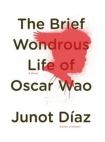
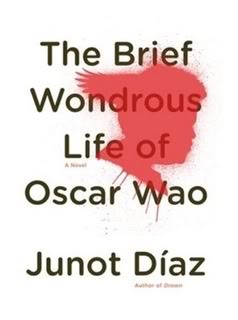
[READ: October 31, 2011] The Brief Wondrous Life of Oscar Wao
Apparently it’s pronounced, “Wow”, by the way.
Because of my new job, I don’t have a full hour of lunch-time reading like I used to. And so this book took considerably longer than I intended. However, once I set aside some time to read it, I flew through the book.
I’m going to get this part out of the way because I was thinking about it throughout the book and I want to mention it without having it bog down the post. This story reminded me a lot of Roberto Bolaño. On the surface, sure this is because they are both writers from “Central America” (Diaz is originally from the Dominican Republic but moved to the US, while Bolaño is originally from Chile but moved to Mexico and then Spain). But I’m not really talking about their origins so much as the style of storytelling.
Without going into a lot of Bolaño here, I’ll just say that Bolaño tends to write very detailed character studies–stories that follow one person throughout his whole life on something of a fruitless quest. And the details of that person’s life include information about family members and distant relatives. Further, Bolaño has written about the brutalities of both Chile and Mexico and how a person can survive in such a place. Similarly, Díaz follows the life of Oscar and his extended family and he talks about the brutalities of the Dominican Republic.
This is in no way to suggest that there is any connection between the two writers. I mean, The Savage Detectives came out in the States in 2007 (same years as Oscar Wao) and while he certainly could have read it in Spanish, I have no evidence that he did (and as I recently found out, the first draft of the Oscar story was written in 2000). Again, the parallels are only from my reading and have nothing to do with Díaz himself.
Okay, now that that’s out of my system…
This is the story of Oscar de Leon. But more than that, this is the story of a fukú–a curse that befalls the de Leon family and follows them through several generations. Oscar is the youngest member of the family and the person whom the narrator knows best. So we see this fukú as it impacts Oscar. And although the book is ostensibly about Oscar, it is about much more.
Oscar was born in Paterson, NJ (the town next to where I grew up!) and went to Don Bosco Tech High School (where many of my friends went). Oscar is Dominican (his mother is from the DR, but he and his sister were born in NJ), but unlike every other Dominican male, Oscar is totally uncool, into geeky sci-fi and D&D and is clearly destined to be a virgin because he is fat with terrible hair and no social skills.
And, (no spoiler), as the title states, his life will be short. (more…)
Read Full Post »
 SOUNDTRACK: CHI’S SWEET HOME (new) end credits (2010).
 I have yet to watch the anime of Chi’s Sweet Home, so I don’t know how new this is (r frankly even if it is new–of course why would this poster lie). My kids will love it but it’s only available subtitled so I’m not sure how much they would enjoy that.



 SOUNDTRACK: SONG OF THE SILENT LAND (2004).
 This is a compilation from Constellation Records. It features mostly unreleased tracks and turns out to be a great sampler for both the fan of the label and the novice.
 I Just Read About That...